
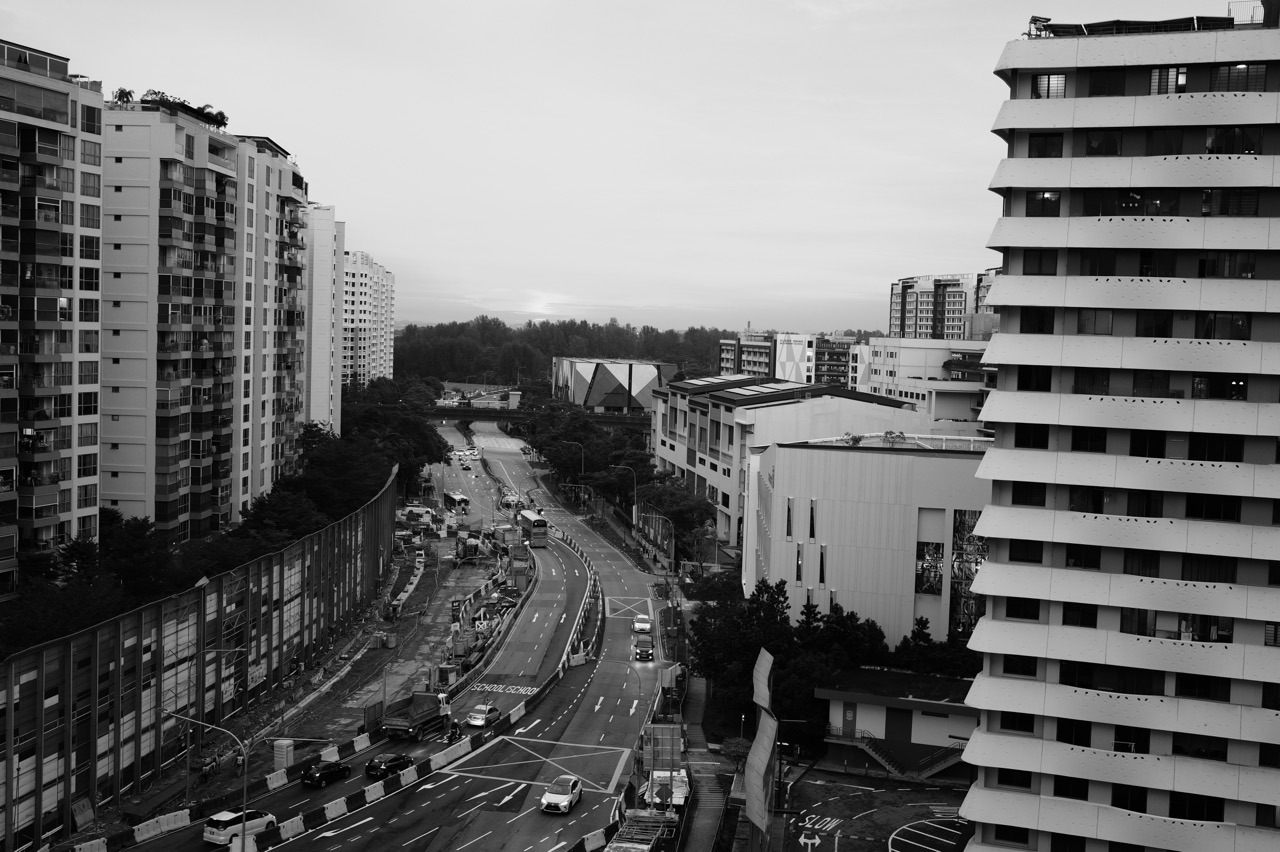
Why does the future Riviera MRT station in Punggol need a tunnel-boring machine almost as wide as a bus is long? A new railway might seem like a matter of digging a trench, laying tracks and covering it up. But Punggol is already a developed town, with homes, roads, utilities, an operating LRT line and everyday journeys that cannot simply be put on hold while engineers excavate for years.
The Cross Island Line–Punggol Extension is being constructed underground. At the future Riviera interchange, LTA has specified an unusually large Earth Pressure Balance (EPB) tunnel-boring machine, roughly 12 metres in diameter, to create a single 4.3-kilometre tunnel containing two tracks. The official contract description places the tunnel at an approximate depth of 25 metres below ground and identifies safety measures such as ground improvement and staged traffic diversions.
Those dimensions are not just dramatic construction trivia. They explain why the work requires careful control of underground pressure, soil movement, tunnel lining, monitoring and the interface between a future underground station and an already operating elevated LRT stop. People see hoardings and road changes at street level, but much of the technically difficult work occurs far below them.
This article explains why the Riviera Cross Island Line project uses a large tunnel-boring machine, how its components work, why the excavated soil may help hold the tunnel face stable, why ground monitoring matters and how to distinguish ongoing construction from a line that is open to passengers. It is an engineering explanation, not a prediction of exact construction noise, settlement or completion status at a particular Punggol address.
The answer in 50 seconds
LTA awarded the design-and-construction contract for the future Riviera MRT station on 30 September 2022. The station is near Punggol East and Punggol Central and will link with the existing Riviera LRT (PE4) on the Punggol East Loop.
The tunnel design uses a roughly 12-metre-diameter Earth Pressure Balance TBM to excavate one large 4.3-kilometre bored tunnel containing two MRT tracks, at approximately 25 metres underground. The EPB method keeps excavated earth under controlled pressure at the tunnel face while a rotating cutterhead advances. Material is removed through suitable machinery, and the tunnel is supported with engineered lining segments.
LTA says the four-station, 7.3-kilometre Punggol Extension—Punggol, Riviera, Elias and Pasir Ris—is targeted for passenger service in 2032. That is still a future project as of 31 October 2026.
The central lesson is: constructing an underground railway means controlling the surrounding ground while creating space for trains, not merely digging a hole and hoping the buildings above remain unaffected.
Why the town cannot simply be cut open from end to end
One way to create underground infrastructure is to excavate from the surface. A large open trench can be useful for some projects, depending on depth, land use and the structure being built.
But a long new railway through an occupied urban area would face existing buildings, roads and buried utilities. Continuous surface excavation could create extensive disruption and require different land arrangements.
A tunnel-boring machine can excavate a route below much of the surface, using controlled methods and designed access points. That does not eliminate disruption; stations, shafts, utility works and supporting construction still require surface activity.
The project therefore combines underground construction with specific surface works rather than either leaving the ground untouched or opening the entire railway alignment as one trench.
Why a tunnel is different from a station box
The tunnel carries trains between stations. The station contains platforms, entrances, circulation, services and spaces where passengers board and alight.
They have different geometries. A train tunnel can be a relatively consistent cross-section, while a station needs a much larger internal arrangement for passengers and equipment.
At Riviera, LTA describes station excavation requiring ground-improvement and earth-retaining measures, alongside the bored-tunnel programme.
This helps explain why residents might see substantial surface work around the station even though a TBM constructs the connecting tunnel underground. The station and tunnel are related components built through different operations.
What ‘tunnel boring machine’ means
A tunnel-boring machine, or TBM, is specialised equipment designed to excavate a tunnel while providing controlled support to the surrounding ground.
A large rotating cutterhead breaks or cuts material at the front. The excavated material is managed and transported away. Hydraulic systems push the machine forward and help control its alignment. Precast concrete lining segments can be erected behind the machine to form a supported tunnel.
LTA has published an educational explanation of these components, including the cutterhead, excavation chamber, screw conveyor, segment erector and control room.
The machine is therefore not just a giant drill bit. It is a moving construction system that excavates, removes material, installs support and monitors its own progress.
Why the diameter is important
LTA’s Riviera contract identifies a TBM measuring about 12 metres in diameter. That is considerably larger than many conventional single-track railway tunnel bores.
The size matters because the project uses one bored tunnel that contains two tracks. The cross-section must accommodate the track arrangement and other required infrastructure under the final engineering design.
A larger diameter also affects the volume of excavated material, machine capacity, lining segments and construction logistics.
It would be misleading to say that a large machine is always better than two smaller ones. Engineers compare site conditions, geometry, risk, cost, maintenance and operational requirements before choosing a particular arrangement.
Why one large bore can hold two tracks
A single-bore double-track tunnel contains two railway tracks within one broad excavated enclosure. By contrast, some underground railways use two separate smaller bores with a track in each.
LTA explicitly selected the single large-bore approach for the Riviera contract section described in its 2022 release.
The arrangement changes the construction geometry and the way the internal tunnel space is organised. One excavation drive can create a large envelope for both tracks, subject to the design.
But the choice also creates engineering trade-offs. Excavating one wide tunnel is not identical to excavating two narrow ones, and a complete comparison would require actual design and ground-condition information.
Why two smaller tunnels are not always automatically simpler
Smaller tunnels may have different excavation volumes, lining arrangements, track separation and construction sequences. Two tunnels can require two bores and related connections or support measures.
A single larger tunnel may reduce the number of separate drives in a particular project but demands a much larger machine and cross-section.
There is no universal answer independent of the route and intended railway. The Riviera contract records the selected engineering solution; it does not establish that every MRT corridor should use the same design.
For students, this is a useful design lesson: different geometries create different costs, constraints and risks, so selecting one method requires more than counting holes.
Why a simple area calculation is revealing
Treat the cutting face as an ideal circle of diameter 12 metres. Its radius is 6 metres, giving a cross-sectional area of roughly 113 square metres using the formula \(A=\pi r^2\).
That is an illustrative area based on the published approximate diameter, not an exact engineering measurement of excavated or usable interior space.
Now imagine a one-metre advance. A simplified cylinder would have a volume around 113 cubic metres. The actual amount of excavated material and the process of handling it depend on conditions and construction details.
The calculation shows why a large bore involves significant material movement even though the progress underground is hidden from residents.
Why excavation volume changes logistics
A machine cannot simply make soil disappear. As its cutterhead advances, the excavated material needs to be managed and transported out of the construction system.
LTA’s TBM explainer describes a screw conveyor and other conveying equipment moving material from the excavation chamber towards appropriate transport and handling arrangements.
That creates supporting needs for equipment, site space, vehicles or other material-handling methods, plus environmental controls.
The excavation work may be underground, but the management of spoil can still affect activity at surface construction locations. A complete plan therefore includes both the tunnel drive and the removal and disposal or reuse of material.
Why Riviera uses an Earth Pressure Balance machine
An Earth Pressure Balance (EPB) TBM is a type of shield machine designed to control conditions at the face of an excavation by using the excavated earth as part of a pressurised supporting medium.
LTA’s educational guidance explains that the excavated material helps support the tunnel face. The International Tunnelling and Underground Space Association similarly describes EPB systems as maintaining the correct pressure in the excavation chamber while the machine advances.
This is important in ground where excavation could otherwise lead to movement or inflow under the relevant conditions.
The actual geotechnical reasons for every aspect of Riviera’s machine selection involve engineering data that should not be guessed from a general website. The documented facts are the chosen EPB method and its general stabilisation mechanism.
What the tunnel face is
The tunnel face is the surface of ground immediately ahead of the machine where excavation is taking place.
If ground at that face is not adequately supported, material could move into the excavation in an uncontrolled way, depending on conditions. Groundwater can introduce additional pressure and complications.
An EPB machine manages the excavation face through its pressurised chamber and controlled material removal.
The key idea is that a tunnelling project must keep the surrounding ground in a sufficiently stable condition as space is created. Safety depends on design, pressure control and monitoring rather than the strength of a drill alone.
Why the excavated soil can help support the face
In an EPB TBM, the material dug out by the cutterhead enters a chamber where its pressure can be managed. Under suitable conditions, that material helps counter the ground pressure at the excavation face.
The machine cannot simply remove soil as fast as possible without regard to stability. Excavation and material discharge have to be coordinated.
The engineering uses controls, equipment and monitoring to maintain conditions within designed ranges.
For a student, the surprising insight is that the soil being removed can temporarily play a useful stabilising role before it is carried away. That is more sophisticated than the image of a drill cutting an unsupported hole.
Why the chamber is pressurised
The excavation chamber allows the machine to manage the pressure supporting the tunnel face. Pressure that is too low or otherwise inappropriate can create stability concerns, while unsuitable pressure can create other problems.
Professional tunnelling teams monitor and adjust operation according to the ground and technical plan.
It would be dangerous and inaccurate to publish an invented pressure setting for Riviera or suggest that every EPB machine uses the same value.
The educational principle is balance under controlled conditions, not maximum pressure at all times.
Why the screw conveyor matters
LTA describes the screw conveyor as a rotating screw mechanism that helps move excavated material out of the machine’s chamber.
In an EPB process, controlling the rate of material removal is important to the pressure balance and excavation sequence. The conveyor is therefore part of the tunnelling control system, not merely a device for cleaning out a hole.
The material may then be transferred to additional transport equipment for removal from the site.
Students can compare the idea with a screw feeder in a controlled manufacturing process, while recognising that a TBM works under much more demanding conditions.
Why the cutterhead is not the whole machine
The cutterhead contains tools that break up ground as the machine advances. It is the most easily imagined component, but its work creates a need for several other systems.
The excavated material must be controlled and transported. The machine must keep its intended alignment. The tunnel behind it must receive adequate support. Workers need safe operating conditions.
LTA’s explainer identifies the segment erector, hydraulic systems, conveyors, control room and ventilation as parts of the complete TBM.
This is a classic lesson in engineering: the visible cutting tool is only one part of an integrated process.
Why the machine needs a control room
A large TBM is operated and supervised by trained specialists using information about excavation, steering, pressure and equipment conditions.
LTA’s educational TBM description identifies the control room as the place where operators monitor and manage key parameters.
That means the machine is not simply moving along a route under its own intelligence without human oversight. Skilled teams make or supervise operational decisions within the construction plan.
For children, the control room introduces the concept that machines require measurement and accountable operation, especially when they work beneath buildings and roads.
Why the tunnel needs a lining
After excavation, the surrounding ground must be supported by a durable structural system designed for the tunnel conditions.
LTA explains that TBMs can use a segment erector to position precast concrete lining segments behind the machine. Together they form rings that support the tunnel.
The lining is not merely decoration. It is part of the engineered structure, providing the geometry and support required for the tunnel over its operating life.
A student should understand that digging a space and building a stable underground structure are two different tasks carried out in a coordinated sequence.
Why precast segments can help
Precast concrete segments are manufactured before being brought into the tunnel construction process. They can be placed in defined arrangements to form the lining.
Using designed components can support consistency and a controlled assembly process, subject to quality checks.
But a precast segment is not automatically correct just because it fits. Engineering design, positioning, seals, connections and inspection remain important.
The educational lesson is that modular construction can be useful when components meet precise requirements and are assembled properly.
Why the tunnel lining is built as the machine advances
The ground behind a moving TBM cannot simply remain unsupported for the full length of the route.
The lining installation process follows excavation so the completed tunnel gains appropriate structural support.
That allows excavation and construction to progress as a linked sequence, rather than drilling the entire route and only afterward thinking about how to stabilise it.
This is an example of build and support in stages. The procedure controls risk as the construction work moves forward.
Why a tunnel must follow the correct alignment
The future railway needs to connect the right stations and meet the designed geometry for trains and infrastructure.
A tunnel-boring machine must therefore be steered and monitored along the required path. Small deviations matter over a long route.
The construction teams use survey and control systems to follow the engineered alignment, making suitable adjustments as the machine advances.
The exact precision requirements and survey methods belong to the technical project documents, but the general principle is easy to understand: a tunnel is not successful if it emerges in the wrong place.
Why engineers study the ground before tunnelling
The materials below a city can vary. Soil, rock, groundwater and buried features may affect excavation and support needs.
LTA explains that engineers evaluate ground conditions before choosing the appropriate TBM. Different machine types, including EPB and slurry-shield designs, suit different conditions.
For Riviera, LTA describes ground-improvement works before certain station excavation activities. That confirms the need to manage underground conditions, but it does not justify guessing the exact soil composition beneath a particular Punggol block.
A good technical article identifies the principle and the verified project measure without inventing site-specific borehole results.
Why ground improvement can be necessary
Ground improvement describes engineering interventions intended to make the ground more suitable for construction under defined conditions.
Depending on site requirements, methods may be used to modify ground strength, permeability or other characteristics. The chosen solution depends on geotechnical assessment.
LTA identifies ground improvement as part of the safety measures ahead of Riviera’s earth-retaining and excavation works.
That statement supports the conclusion that the project includes deliberate management of ground conditions. It does not tell us exactly which method was used at every point or what numerical properties resulted.
Why earth-retaining structures matter at the station
A station excavation may require a large temporary or permanent underground space. The surrounding earth must be restrained appropriately as construction proceeds.
Earth-retaining structures are designed to manage ground movement and support excavation under relevant conditions.
LTA says Riviera’s works would include these structures before and during the underground station construction programme.
The important difference from the tunnel drive is scale and shape: a station requires a more extensive passenger space, while the tunnel carries trains between stations. The different geometries create different construction methods and controls.
Why 25 metres underground is not an exact depth everywhere
LTA’s contract description identifies the tunnel at approximately 25 metres below ground. The word *approximately* matters.
The actual vertical alignment may vary, and a project’s depth can be defined in different ways. A public explanatory figure should not be converted into an exact distance beneath every nearby road or flat.
A reader should not conclude that the TBM is always exactly 25 metres directly below the nearest footpath at any particular date.
The figure explains the general scale of the underground project, while detailed measurements belong to approved engineering plans.
Why surface construction is still visible
A bored tunnel reduces the need to excavate the entire route from above, but the project still needs station sites, access arrangements, utility work and ground preparation.
That is why residents may encounter hoardings, construction vehicles or temporary changes near Punggol East and Punggol Central.
These surface works do not mean the project is not using a TBM. They are supporting activities for the larger underground railway.
The lesson is that a hidden tunnel can depend on very visible work at selected locations.
Why traffic diversions are introduced in stages
Roads near an underground station may be affected by construction structures, utility relocation, site access and excavation works.
LTA’s Riviera contract announcement explicitly says traffic diversions would be implemented in phases to reduce inconvenience.
A phased approach allows construction activities and traffic movements to be coordinated over time rather than necessarily closing every route at once.
But a historical announcement is not a current traffic notice. Residents travelling today must follow the latest LTA signs and road advisories.
Why a traffic diversion is not proof of a road’s permanent closure
During construction, temporary lanes, crossings or junction layouts may be introduced. They can change again as the work advances.
A route blocked during one project stage may reopen later, while another section becomes affected.
This is why an online route guide needs a date. A photograph of a 2024 diversion does not necessarily describe conditions in October 2026.
The practical approach is to use current on-site directions and official transport information rather than rely on speculative shortcuts through active works.
Why pedestrians also need protection during construction
A traffic plan is not only for drivers. Pedestrians may need to reach homes, shops, LRT stops and other destinations near the worksite.
Temporary pedestrian paths should be safely arranged and clearly signed under the applicable construction management measures.
Families with strollers or mobility needs should consider whether a temporary route is accessible and allow additional time when conditions are unfamiliar.
The goal is to maintain appropriate public circulation while specialised work takes place, not assume the construction site’s convenience overrides all other users.
Why underground work can still generate noise
Tunnel excavation, station works, construction vehicles and supporting machinery may produce noise. Some activities occur below ground while others are on the surface.
LTA’s Punggol Extension groundbreaking release described the use of measures such as electric excavators and battery-supported equipment in some work areas to reduce noise and pollution impacts.
Those measures can be useful but do not guarantee that no resident hears construction activity. Actual exposure depends on distance, activity, timing and local conditions.
A responsible report describes specific observations without assigning an exact source to every sound by guesswork.
Why vibration monitoring matters
Underground excavation can alter stresses and movements in the surrounding ground. Engineers monitor relevant conditions to evaluate whether work remains within the project’s designed controls.
LTA says it and the contractors will closely monitor Riviera’s works for safety and to minimise the impact on nearby stakeholders.
Monitoring does not mean every ground movement indicates a dangerous problem, and it does not guarantee that no movement occurs. It is part of managing uncertainty and verifying conditions during the project.
Residents should report concerning observations through the proper channels rather than use an informal smartphone measurement as proof of a structural defect.
Why settlement is a technical concern
Ground settlement refers to downward movement of the ground surface or underlying material under particular conditions.
Excavation, groundwater changes and other processes can influence settlement, depending on the site and construction method.
Tunnelling engineers design support, pressure controls and monitoring to manage such risks. A pressurised EPB system is one tool for maintaining appropriate conditions at the face.
But this article cannot diagnose a specific Punggol building from an unrelated crack or a photograph. Professional assessment is required before attributing any defect to railway works.
Why controlled excavation is not the same as zero risk
A well-planned construction method can reduce and manage risks, but no major underground project should be described as having literally zero uncertainty.
Ground conditions may vary, equipment can require maintenance and unexpected findings may call for adjustments.
The responsible public message is that the project uses appropriate engineering measures, monitoring and qualified teams rather than relying on wishful thinking.
Residents should distinguish evidence-based concern from exaggerated rumours that a large machine beneath a town must inevitably damage every building.
Why an LRT station can remain open while an MRT station is built nearby
Riviera LRT (PE4) is an existing operating station on the Punggol East Loop. The future Riviera Cross Island Line station is a separate underground component intended to connect with it.
Construction near an existing transport facility requires coordination, but the future MRT has not yet opened for passenger service.
A commuter can use the current LRT while the underground interchange works progress, subject to any actual temporary service or access notices.
This distinction is especially important on a rail map. A future interchange symbol may indicate the planned connection even when the new line is years from opening.
Why an interchange has more than one platform
A rail interchange allows passengers to transfer between separate rail services or lines.
At Riviera, the project will connect the future underground Cross Island Line station with the existing elevated Punggol LRT station. That involves vertical movement, suitable circulation, ticketing or fare-control arrangements and accessibility considerations under the completed design.
The two services have different networks, train types and destinations. Building a connection between them makes journeys possible that would otherwise require different transfers or modes.
This article focuses on the underground construction required to create that future access, not a claim about the finished interchange’s exact walking time.
Why the 2032 opening is still a target
LTA’s March 2026 rail-development factsheet said the Cross Island Line–Punggol Extension was progressing, with station construction underway and completion slated for 2032.
That is the relevant official programme horizon. The date is not evidence that Riviera’s new MRT platforms are operating in October 2026.
Major projects may move through stages of tunnelling, station construction, system installation, testing and commissioning before passenger service begins.
A responsible local guide keeps the target clearly labelled as a future milestone until official evidence confirms opening.
Why construction milestones can be misleading
The arrival of a TBM, the completion of a tunnel drive and the opening of a station are different events.
Even after the physical tunnel is finished, the railway needs tracks, power, signalling, communications, ventilation, safety equipment and operational testing.
Residents may see progress photographs without being able to infer the final opening date or the readiness of the full route.
The proper question is which component has reached which stage, not simply whether a major construction machine has stopped moving.
Why the Punggol Extension is 7.3 kilometres but the tunnel contract is 4.3
LTA describes the overall Cross Island Line–Punggol Extension as 7.3 kilometres, linking Punggol, Riviera, Elias and Pasir Ris.
The Riviera contract’s single-bore double-track tunnel is described as 4.3 kilometres. These are different project scopes.
A student should not conclude that the remaining distance was forgotten or that one tunnel contract covers every station and track component.
Large infrastructure projects are divided into civil contracts and different construction sections. A contract length and the whole line’s length answer different questions.
Why the four stations matter to the construction story
The planned extension includes Punggol, Riviera, Elias and Pasir Ris. Punggol will connect with the North East Line, Riviera with the Punggol LRT, and Pasir Ris with the East-West Line.
These transfer points shape the usefulness of the railway once operational. They also create engineering interfaces with existing stations and infrastructure.
The future network aims to provide a more direct rail link between the north-east and the east of Singapore.
However, those passenger benefits are distinct from the tunnelling process. Engineers must complete the safe physical railway before the projected journey improvements can be realised.
Why future travel-time savings are estimates
LTA’s Punggol Extension materials give examples of expected travel-time savings after the line opens, including a projected Punggol to Pasir Ris journey of around 15 minutes, compared with longer existing bus journeys.
Those examples are planning estimates and depend on the defined origin, destination and route assumptions. They are not journey times available today.
A future interchange might improve a household’s regular commute, but a specific door-to-door trip will include walking, waiting and transfers.
Residents should not base an October 2026 travel plan on a train line targeted for 2032.
Why a new tunnel needs its own rail systems
After civil construction, an underground MRT line needs trackwork, electrical power, signalling, communications, ventilation and other operational systems.
These are separate from the concrete tunnel lining itself. A structurally complete tunnel is not automatically ready to carry passengers.
LTA awards and manages rail-systems contracts as well as the civil structures. Testing and commissioning verify that the components work together safely.
This is another example of systems engineering: a finished container does not equal a finished service.
Why ventilation and emergency access matter
An underground railway must provide suitable ventilation, emergency procedures and access for operating and maintenance teams.
The relevant arrangements depend on the tunnel’s final design and regulatory requirements. A single-bore two-track tunnel has its own engineered safety provisions.
A casual diagram of a circular hole is not sufficient to explain the complete railway. Passengers, staff and equipment need managed routes under normal and abnormal conditions.
Students should recognise that safety infrastructure occupies real space within an underground project even when it is not visible in the public rendering.
Why water matters underground
Groundwater can interact with excavation and support requirements. The amount and pressure depend on local geology and hydrogeology.
An EPB system controls conditions at the excavation face, but other design measures may be needed for groundwater and structural performance throughout construction.
It would be inaccurate to say all of Riviera’s ground consists of one specific soil type or that no groundwater is present without project-specific investigations.
The useful first-principles lesson is that tunnelling involves both the soil or rock and the water within it, making pressure control a key engineering concern.
Why the machine cannot travel at an arbitrary speed
Excavation progress depends on ground conditions, cutterhead performance, material removal, lining installation, maintenance and operational constraints.
LTA’s TBM educational information gives examples of how different ground types can support very different rates of advance.
Those examples should not be used to predict the exact number of metres Riviera’s machine excavates on a particular day.
The lesson is that engineering progress is constrained by safe operation and real conditions rather than a promise of constant speed.
Why a large TBM needs maintenance during the drive
The cutter tools, conveyors, motors, hydraulic systems and other components work under demanding conditions.
Specialists may need to inspect or service equipment as the project progresses. Maintenance access and the sequence of work form part of the construction plan.
A slower week is not automatically evidence of project failure; it may reflect necessary checks or changing ground conditions.
Conversely, a promotional claim that a TBM never needs attention would be technically unrealistic.
Why a construction programme is not only a digging programme
Before excavation, engineers investigate the ground and prepare work sites. During excavation, they monitor conditions, remove material and construct lining. After tunnelling, more work is required on stations and rail systems.
The programme also includes coordination with roads, utilities, nearby buildings and the public.
This is why a projected opening date may lie years after construction begins. The tunnel drive is important but not the only task.
For families, understanding the sequence makes long construction timelines easier to interpret without pretending the work is simple.
Why the contractor’s experience matters
LTA awarded the Riviera design-and-build contract to a joint venture of Taisei Corporation and China State Construction Engineering Corporation’s Singapore branch, according to its September 2022 announcement.
A design-and-build contract involves responsibilities for developing and constructing the specified infrastructure under the applicable requirements.
Large underground works require specialist engineering, equipment and management capabilities.
The contractor’s past experience is relevant background, but it does not guarantee a perfect outcome or replace the need for site-specific monitoring and oversight.
Why the cost figure must be attached to its scope
News reporting on the Riviera contract described an award value of roughly S$1.1 billion. That refers to the relevant design-and-construction contract, not the total cost of the entire Cross Island Line.
A figure without its scope can mislead residents into thinking it pays only for one platform or, conversely, for every tunnel and station across Singapore.
A good article identifies which contract or project stage a cost represents.
The deeper lesson is that infrastructure spending must be evaluated alongside its scope, complexity, safety requirements and long-term public use.
Why an underground station still needs surface access
Passengers do not begin their trips 25 metres below ground. They approach from homes, shops, buses, paths and the existing LRT.
The future station therefore needs suitable entrances, circulation and connection arrangements between street level and the platforms.
Construction also requires temporary access and work areas. These create interfaces with the surrounding neighbourhood.
A well-designed underground railway must connect both ends of the trip: trains moving through tunnels and people moving from public space into the station.
Why accessibility must be considered at the interchange
A person with a stroller, wheelchair or heavy baggage may need a suitable step-free route between the LRT and future MRT platforms.
The completed interchange’s lifts and access facilities must follow the approved design and current operating arrangements once the station opens.
An artist’s impression may suggest how the place will look, but it is not proof of the exact future walking route or lift availability.
The responsible planning approach considers the complete journey rather than only the diagrammatic point where two lines meet.
Why a tunnel can help protect surface connections
A bored underground route can allow many surface uses to continue above it rather than permanently replace them with railway tracks.
But building underground still has consequences. Station sites, traffic diversions and utility works can create temporary disruption.
The trade-off is therefore not surface impact versus no impact. It is how different construction and route alternatives manage land, access, safety and long-term operations.
This is why a sophisticated rail project needs both transport planning and construction engineering.
Why public updates need absolute dates
The Riviera contract was awarded in September 2022. Construction of the broader Punggol Extension was formally marked in October 2023. LTA’s March 2026 update said works were progressing towards 2032.
An article from 2022 predicting construction would start in early 2023 may have been correct for its publication date. It should not be republished in 2026 as if that start date remains a future event.
A reliable local library uses dated milestones and distinguishes early plans from later updates.
This is especially important for road diversions, because the current situation can differ from both the original rendering and an older notice.
Why the ‘one large tunnel’ detail should not be copied to every CRL section
LTA has selected different machine types and tunnel arrangements for different parts of the wider Cross Island Line.
The Riviera contract uses a large EPB machine and one two-track bore. Other sections may use slurry-shield machines or other construction solutions depending on geometry and ground conditions.
The lesson is that large infrastructure programmes are not technically uniform from end to end.
A claim verified for Riviera should not be transferred automatically to another station or contract.
A fictional excavation-volume exercise
Imagine a cylindrical tunnel with a circular diameter of 12 metres. Using a radius of 6 metres, the idealised cross-sectional area is about 113 square metres.
Over ten metres of advance, the simplified excavated cylinder would be around 1,130 cubic metres. The real engineering quantity would require the actual diameter, geometry and material conditions.
The calculation helps students see why excavated material handling is a major project function.
It does not allow them to derive a precise number of truck trips without additional information about bulk density, vehicle capacity and construction methods.
A fictional pressure-balance exercise
Draw a chamber against a tunnel face. On one side, soil and groundwater exert forces under relevant conditions. On the other, the EPB machine maintains a suitable supporting pressure through controlled excavation material.
Ask what might happen if the process removed material without managing the support conditions. The learner should identify a potential risk of ground movement rather than assume the ground can support itself under all circumstances.
Explain that real pressure calculations require professional geotechnical data.
The objective is understanding the mechanism, not calculating an operating setting for a live machine.
A fictional construction-sequence exercise
Give students five cards: investigate ground, prepare station worksite, excavate with TBM, install tunnel lining and install railway systems.
Ask which operations depend on earlier ones and which may overlap under a real programme.
The student should learn that the sequence is more complex than “dig, place train, open station”.
This method of thinking transfers to many engineering and educational projects.
A fictional neighbourhood-access problem
A temporary worksite affects a familiar pedestrian route near a fictional station. The family wants to reach a clinic on the other side.
The students should choose the currently designated safe diversion rather than walk through the worksite or climb over barriers.
They should also consider a person using a mobility aid, who may need a different suitable route.
The lesson is that safe access remains essential during construction, even when the long-term project promises better connectivity.
A fictional source-evaluation problem
One webpage claims the Riviera MRT is already open in October 2026. Another cites LTA’s March 2026 target of 2032.
The student checks the authoritative source and concludes that the Cross Island Line–Punggol Extension remains a future passenger service.
They distinguish the existing Riviera LRT from the future Riviera MRT, explaining how the station names can create confusion.
The lesson is to verify both the mode and date before making a transport claim.
Why the project matters to local schools
A school near the worksite may be affected by temporary road arrangements, dust or noise under particular conditions. The correct details depend on the actual site and current construction stage.
Teachers can use the project for Geography and Science learning without encouraging students to enter construction areas.
Topics include underground land use, pressure, soil, material transport, data monitoring and the effects of public projects on neighbourhoods.
The local setting makes difficult engineering ideas more concrete, while safety and evidence remain paramount.
Why transport improvements require patience and scrutiny
Long-term rail projects involve real disruption and cost before the public sees the completed benefit.
Residents can reasonably ask for clear road notices, safe pedestrian routes and proper management of impacts. They can also distinguish legitimate construction progress from misleading rumours.
A sound public response avoids treating every inconvenience as proof the entire project is a failure or dismissing genuine problems simply because future travel will improve.
Good planning requires both long-term infrastructure goals and accountability for present-day neighbourhood conditions.
Why the 2032 benefits depend on a complete network
A large tunnel is only one link. The Punggol Extension needs its four stations, completed tracks, operational systems and the connections with existing rail lines before passengers can benefit.
LTA has projected better access between Punggol, Sengkang, Pasir Ris and eastern areas after the extension opens.
Those are genuine planning goals, but they are not services available today. For current journeys, residents must use the existing operating rail and bus network.
This is the final systems lesson: civil engineering, rail technology and passenger operations must all reach readiness before a planned route becomes a real commute.
Common misunderstandings
One mistake is saying a 12-metre TBM is being used only because the station platform needs to be wide. The machine constructs a large two-track tunnel section, while station excavation has additional requirements.
Another is assuming that building a bored tunnel causes no disturbance at the surface. Station works, spoil handling and road diversions remain important.
A third is claiming that EPB means groundwater and soil can never move. It is a controlled method, not a guarantee of zero risk.
A fourth is confusing 4.3 kilometres of tunnel under one contract with the entire 7.3-kilometre extension. Another is treating the existing Riviera LRT as if the new Cross Island Line platform were already open.
Finally, do not copy exact depths, construction dates or machine settings from another project without verification.
Frequently asked questions
What is being built at Riviera?
A future underground Cross Island Line station connecting with existing Riviera LRT (PE4), as part of the Punggol Extension.
Why is the machine so large?
LTA’s Riviera tunnel design uses a single large bore containing two tracks, requiring a much wider excavation than some single-track tunnels.
How wide is the Riviera TBM?
LTA’s official contract description says about 12 metres in diameter.
What is an EPB machine?
An Earth Pressure Balance TBM uses controlled excavated material under pressure to help support the tunnel face during excavation.
How long is the tunnel under the Riviera contract?
LTA describes a 4.3-kilometre single-bore double-track tunnel.
How deep is it?
The contract description gives an approximate depth of 25 metres, not a precise depth under every point of the route.
Is the Riviera MRT station open in October 2026?
No. The existing Riviera LRT operates, but the future Cross Island Line MRT interchange is targeted for 2032.
Why are traffic diversions needed?
Surface station construction, utilities and worksite arrangements require carefully phased changes near roads and pedestrian routes.
Does the TBM work without engineers?
No. Trained teams monitor pressure, steering, equipment and safety conditions throughout excavation.
What is the expected Punggol Extension opening year?
LTA’s current programme targets 2032, subject to the project’s later official updates.
A practical Punggol resident checklist
- Distinguish existing Riviera LRT from future Riviera MRT.
- Use current LTA road and pedestrian notices near construction sites.
- Do not enter work zones or attempt to inspect underground infrastructure.
- Treat published TBM dimensions as approximate project figures.
- Remember that construction milestones are different from passenger opening.
- Report genuine safety concerns with a precise location rather than an invented cause.
- Avoid making building-damage allegations without professional evidence.
- Check that transport articles use the latest official date and project scope.
- Do not treat a 2032 rail benefit as a journey option available today.
- Recognise that ground support, material handling, lining and monitoring all matter.
Teaching Guide: build an underground railway safely
Learning goal. Students explain why a large tunnel-boring machine is used beneath a developed town and identify the separate roles of excavation, pressure control, lining, monitoring and eventual rail operations.
Stage one: draw the town. Put homes, roads, buried utilities and the existing Riviera LRT above a proposed underground line. Ask why continuous open excavation through the surface would create difficulties.
Stage two: draw a tunnel face. Add a rotating cutterhead, an excavation chamber and surrounding soil. Explain why the ground must be appropriately supported as the space is created.
Stage three: add material removal. Draw a screw conveyor and a route for excavated material. Ask why the soil cannot simply disappear inside the tunnel.
Stage four: install lining. Place fictional precast segments behind the machine. Ask why excavation and structural support must be coordinated.
Stage five: calculate geometry. Find the area of a hypothetical 12-metre-diameter circle and estimate an illustrative cylindrical volume for ten metres of advance.
Stage six: compare two bores. Draw one large circular tunnel containing two tracks and two smaller tunnels with one track each. Discuss possible trade-offs without claiming one is always superior.
Stage seven: add monitoring. Imagine a sensor reporting an unusual ground movement. Ask why qualified engineers must assess it rather than jump to an unsupported conclusion.
Stage eight: add construction stages. Label station excavation, completed tunnel, railway-system installation, testing and passenger opening as separate milestones.
Stage nine: test current information. Compare a 2022 contract announcement with LTA’s March 2026 programme update. Ask what is already built or underway and what remains a 2032 target.
Transfer test. Apply the same ground-stability reasoning to a different underground infrastructure project, explaining why the actual machine choice still depends on local soil, water and geometry.
Parent checkpoint. A good explanation is: “The giant machine digs a tunnel wide enough for two tracks while controlling the ground at the front and building a lining behind it. The station and railway systems still have to be completed before trains can carry passengers.”
Where this explanation fits in eduKatePunggol
The existing Future of Punggol | Riviera Cross Island Line Interchange and East Loop Journeys focuses on the planned passenger network. Cross Island Line Punggol Extension | Stations and Opening Date explains the route and benefits. What to Expect for Punggol 2027 | Riviera Works, LRT and Riverside Access covers local access and construction planning.
This article answers a different question: why does the Riviera section require a giant pressurised boring machine, and what engineering work turns ground beneath an occupied town into a safe future railway tunnel? It explains construction mechanics rather than another forecast of stations, route times or property effects.
Official sources and further reading
- LTA: Riviera Civil Contract and 12-Metre EPB TBM, 30 September 2022
- LTA: How Tunnel Boring Machines Work
- LTA: A Closer Look at the Tunnel Boring Machine
- LTA: Punggol Extension Groundbreaking, October 2023
- LTA: Next Phase of Rail Development, March 2026
- eduKatePunggol: Riviera Interchange and East Loop Guide
The one idea to remember
Riviera’s future MRT tunnel is not just a hole beneath Punggol. It is a carefully controlled underground construction process using a large EPB tunnel-boring machine, engineered pressure balance, material removal and structural lining. The purpose is to create a safe two-track route beneath a town that must continue functioning while the railway is built. The promised new interchange becomes useful only after the whole system is completed and tested.


