
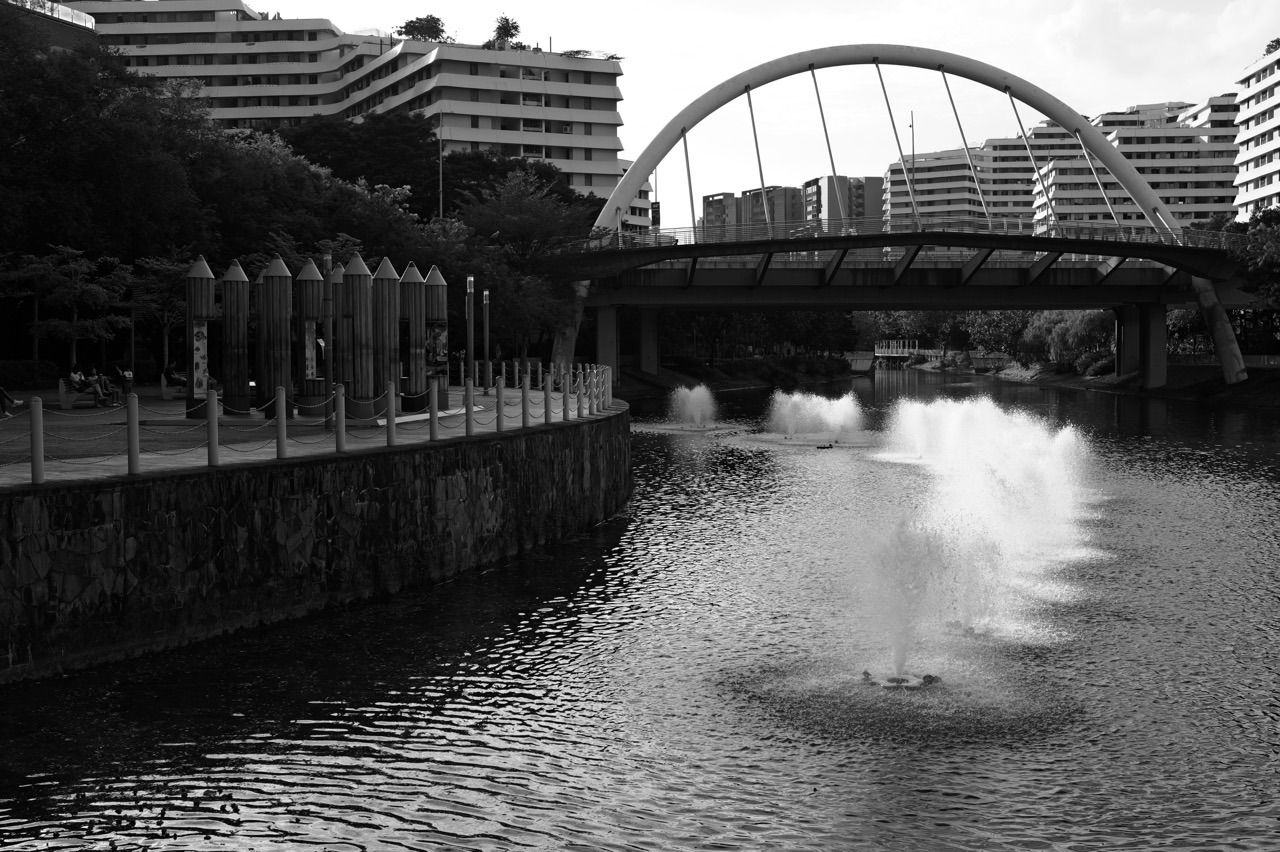
Why would Singapore place an island of living plants on the surface of a reservoir instead of planting everything on the banks? At first sight, a floating wetland can look like an unusual garden. It has greenery, may attract birds and appears to sit on the water rather than on ordinary soil. Yet its purpose is not simply to provide decoration. It is a deliberately engineered combination of floating support material, plant roots, microorganisms and habitat.
An example is the Sengkang Floating Wetland in Punggol Reservoir. The name can confuse Punggol residents: the wetland is at the Sengkang side of Punggol Reservoir, near Sengkang Riverside Park, and is not the same as a garden beside Waterway Point in central Punggol. PUB, Singapore’s national water agency, describes it as a constructed wetland that helps improve reservoir water quality while creating habitat for birds and fishes. Boardwalks provide designated public access to enjoy the view and learn about the system.
A wetland normally grows from waterlogged ground. A floating wetland takes a different approach by holding suitable plants on buoyant mats so their roots extend into the water below. That arrangement offers contact between living roots and the reservoir without needing a traditional planted shoreline at every point.
This guide explains why Punggol Reservoir contains a floating wetland, how the structure stays afloat, what plants and microorganisms can contribute, why wildlife may use it and why it should not be confused with either a swimming facility or the leachate-treatment system at Lorong Halus. It provides a local Science and Geography lesson rather than another nature-walk itinerary.
The answer in 50 seconds
PUB describes the Sengkang Floating Wetland as a constructed feature in Punggol Reservoir that helps improve water quality and provides habitat for birds and fishes. It was developed through Singapore’s Active, Beautiful, Clean Waters (ABC Waters) Programme, which integrates water management, attractive public spaces and environmental learning.
PUB’s educational materials describe plants growing in a buoyant floating mat, with roots extending into the water. Roots can take up nutrients, while microorganisms growing on root surfaces can help break down certain pollutants. The floating structure gives aquatic organisms and birds places to shelter or feed.
Older PUB training resources describe the floating wetland as 2,400 square metres and use a historical educational count of plants and species. Those are records of the constructed feature at the time of publication, not a claim that every plant remains unchanged in October 2026.
The central lesson is: a floating wetland uses biological processes to support water quality and habitat, but the reservoir still requires professional management and raw water is not automatically safe to drink.
Why a reservoir needs more than water storage
A reservoir’s primary role within Singapore’s water-supply system is to collect and store raw water for eventual treatment. But a reservoir is also a living environment. Water conditions influence plants, fish, invertebrates and birds.
The surrounding land and water are connected. Nutrients and other substances can enter the water through natural processes and human activity, while organisms interact through food webs and habitats.
A management approach can therefore consider the reservoir as more than a storage container. Suitable ecological features may help support water quality and habitat diversity alongside the central water-supply purpose.
PUB’s description of Sengkang Floating Wetland specifically identifies these two benefits: cleaner water and habitat for wildlife. The site gives residents an opportunity to understand why water management and ecology can be linked.
Why Sengkang is part of the Punggol Reservoir story
The names might suggest that Sengkang Floating Wetland and Punggol Reservoir are in different water systems. They are not. PUB expressly locates the wetland within Punggol Reservoir.
A reservoir’s name, nearby parks and administrative town boundaries do not necessarily match. A resident standing in Sengkang can be beside a waterbody called Punggol Reservoir.
The distinction matters for accurate mapping and travel directions. Someone seeking the wetland should look towards the Anchorvale Community Club, Sengkang Sports Complex and Sengkang Riverside Park area, rather than simply travelling to Punggol MRT and expecting the feature beside Waterway Point.
This is a useful geographical lesson: water systems can cross the everyday boundaries people use for addresses and town names.
Why a floating wetland is not an ordinary island
An ordinary island consists of land rising above the surrounding water. A floating wetland is an engineered structure supported by buoyant material on which suitable plants grow.
The plants’ roots extend into water beneath the mat. The structure may resemble vegetation growing on a natural island from a distance, but the underlying support and growing conditions are different.
PUB’s primary-school learning trail describes planting media made with coconut fibre, a floating support layer and roots that penetrate into the water. The specific construction materials of a current installation should be verified against updated maintenance records, not assumed from every historical educational illustration.
The essential point is that the support floats while the roots interact with the surrounding water. It is a living treatment and habitat feature rather than a mound of earth deposited in the reservoir.
How a buoyant mat can support plants
Buoyancy allows suitable objects to float when the upward force from displaced water balances their weight. An engineered floating mat uses materials and structure selected to support the planted vegetation.
PUB’s teaching material illustrates the mat as a buoyant support, with spaces that allow roots to grow into the water. Planting media anchors the plants while they establish themselves.
For a Primary Science learner, the concept is easy to recognise from objects that float. But an operating wetland is far more complex than a toy raft. It must support biological growth, withstand environmental conditions and be maintained safely.
A child should never attempt to approach or climb onto the actual mats. Their apparent stability from a distance is not permission for public access.
Why the roots are below the surface
In an ordinary garden, roots spread through soil. In a floating wetland, roots can extend into the reservoir water beneath the plant-support system.
That position matters because it places plant surfaces in contact with the water. Roots can take up some dissolved nutrients as part of the plants’ growth and provide surfaces for microorganisms.
The plants are not simply standing above the water like flowers in a vase. Their roots are part of the biological interface between the floating garden and the reservoir.
This makes the invisible underwater portion of the wetland particularly important. A photograph of the leaves alone cannot explain the full mechanism.
Why nutrients are useful to plants but can still create problems in water
Plants require nutrients for growth. Compounds containing nitrogen and phosphorus, for example, have important biological roles.
But waterbodies can experience problems when nutrient levels are excessive under particular environmental conditions. Nutrient enrichment may contribute to unwanted algal growth and changes in water quality.
A planted wetland can take up some nutrients as plants grow. However, the effectiveness depends on species, conditions, flow and maintenance. It cannot be assumed to remove every nutrient molecule or maintain perfect quality across an entire reservoir.
The valuable lesson is that a substance can be a useful plant nutrient while requiring management in the wider aquatic environment.
Why microbes are important even when nobody sees them
Microorganisms can live on and around plant roots. Some are able to break down certain organic materials or transform substances under appropriate conditions.
PUB’s floating-wetland educational material specifically identifies root-associated microorganisms as contributors to pollutant breakdown.
This is a natural biological process used within an engineered design. It does not mean that all bacteria are harmless, that every contaminant can be removed by microbes or that somebody can make unsafe water potable merely by placing plants in it.
The scientifically accurate explanation distinguishes the microbial mechanism from the full set of water-quality requirements that a public reservoir must meet.
Why the plants were selected carefully
A floating wetland needs plants capable of growing under the particular water and support conditions. They should contribute to the intended habitat and water-management objectives while remaining suitable for maintenance.
PUB’s training resources explain that plants are selected for cleansing properties and aesthetic contributions. Their roots and vegetation can support ecological processes and provide food or shelter for some organisms.
This does not mean any ornamental houseplant can be substituted. Species differ in tolerance, root structure, nutrient uptake and ecological effects.
A resident should never add potted plants or floating material to a reservoir. Planting and maintenance are controlled environmental-management activities.
What ’emergent plants’ means
PUB’s ABC Waters guidance describes floating wetlands using emergent wetland plants. These are plants adapted to grow in wet conditions with parts such as stems and leaves rising above the water.
Their roots are associated with the water or wetland substrate. Their above-water growth can create structure, shade and vegetation used by certain organisms.
For young learners, this contrasts with plants that remain entirely submerged or float freely without an engineered mat.
Understanding the different growth forms helps children see why a wetland is not simply a collection of normal garden plants placed beside a pond.
Why the floating mat does not have to be made of natural soil
A constructed wetland can use engineered materials for support, planting and buoyancy. PUB’s school materials describe a floating layer made from recycled polyester fibres and bound using suitable foam, with coconut-fibre media for planting.
Different wetlands and later maintenance work may use other material specifications. The public teaching point is the function of each layer: hold the vegetation, support its weight, allow root growth and keep the system afloat.
The engineering and living parts perform different jobs. The synthetic or processed support does not itself replace the biological processes that take place around the roots.
This is a useful example of technology and ecology cooperating rather than existing as opposites.
Why the wetland is not a chemical-free waterworks
PUB’s ABC Waters design guidance describes how floating wetlands can help remove some pollutants using biological processes without adding treatment chemicals in the wetland feature itself.
But this does not mean the reservoir water becomes safe to drink without further treatment. Singapore’s waterworks use a separate, professionally managed series of processes to produce safe tap water.
A child may mistake “natural cleansing” for “potable water”. The distinction must be made explicit: improving certain water-quality characteristics is not the same as meeting every drinking-water standard.
Nobody should taste reservoir water or collect it for an unsupervised home experiment.
Why water quality involves more than the appearance of water
A reservoir may appear blue or green depending on reflections, suspended material, algae and light. Its visual appearance does not establish the concentrations of dissolved substances or microorganisms.
PUB’s water-management responsibilities involve appropriate monitoring and treatment across the water system. The floating wetland is one environmental feature, not an informal visual test that replaces measurements.
A student who sees healthy-looking plants cannot conclude that every water-quality parameter is within a particular limit.
The correct scientific habit is to distinguish what was observed from what would need measuring to establish a stronger claim.
Why a root system can provide habitat
Plant roots extending into water create surfaces and structures that some small aquatic organisms may use. The vegetation above water may provide opportunities for birds and insects, depending on the species and conditions.
PUB describes habitat for birds and fishes as one of the Sengkang Floating Wetland’s purposes.
It is important not to turn that statement into a guarantee that a particular bird or fish will appear during a short visit. Animals move, habitats change and disturbances influence behaviour.
The practical value is creating ecological opportunities, not manufacturing a wildlife show on demand.
Why a wetland can attract birds without being a bird sanctuary
Birds may use plants and nearby water for resting, shelter or foraging, depending on their species and behaviour.
A floating wetland with vegetation may offer resources within a reservoir, but that does not mean every planted surface is suitable for nesting or that all bird activity can be predicted.
A responsible visitor observes from the boardwalk or designated paths. Feeding, chasing or approaching wildlife can interfere with natural behaviour.
The lesson is that habitat design can support biodiversity while visitors still need to avoid turning the habitat into an interactive attraction.
Why fishes may benefit from underwater structure
Some fish and other aquatic organisms use plants and structural shelter within the water environment. Roots can create additional surfaces and spaces beneath the floating vegetation.
PUB notes that the Sengkang feature provides natural habitat for fishes. The exact species and abundance require ecological monitoring, not assumptions from a general description.
This is a useful reminder that an aquatic habitat is three-dimensional. The visible leaves above water may be only a small part of the structure important to living organisms below.
A student should avoid throwing food into the water to attract fish for a photograph. Feeding can create environmental and behavioural problems.
Why the wetland can be described as multifunctional
Sengkang Floating Wetland combines several intended roles: water-quality improvement, habitat creation, public appreciation and environmental education.
That is different from a feature performing one narrow task. A public bridge primarily connects routes; a decorative planter adds visual interest. The wetland integrates biological and educational functions into a managed reservoir setting.
But multifunctional does not mean unlimited. It cannot serve every form of recreation, and not all water-quality problems are solved by the same plants.
The useful design principle is to combine compatible functions without pretending a single piece of infrastructure can do everything.
Why PUB created boardwalks
PUB describes boardwalks near the Sengkang Floating Wetland that bring visitors closer to the view and allow them to learn about the wetland ecosystem.
A boardwalk helps organise public access while keeping people on designated routes instead of entering vegetation or water. It can provide opportunities for observation without turning the floating mats into walking surfaces.
The exact route and access conditions should be checked before visiting, especially for people with mobility needs or during maintenance or bad weather.
The underlying principle is access without unnecessary disturbance. Public enjoyment is possible when visitor movement is carefully separated from the living treatment feature.
Why the site connects several Sengkang destinations
PUB’s visitor page notes the floating wetland’s connection with Anchorvale Community Club, Sengkang Sports Complex and Sengkang Riverside Park.
Those links help explain why the facility can be encountered by people who are not specifically visiting to study water engineering. It sits within an ordinary recreational and community network.
The location may be near Punggol Reservoir, but the approach is from the Sengkang side. A reader should not assume that the Sengkang Floating Wetland is reached through the same entrance as Punggol Waterway Park.
This is another example of how a waterbody and the paths around it can cross familiar naming boundaries.
Why the National Water Story belongs on the trail
PUB’s self-guided learning materials use the floating wetland to introduce Singapore’s water supply and Four National Taps.
Those taps are local catchment water, imported water, NEWater and desalinated water. Punggol Reservoir contributes to the local catchment system, while the floating wetland demonstrates one environmental-design feature associated with the water landscape.
This helps children see that water management combines source diversification, catchment protection and public education.
The floating wetland itself is not a fifth National Tap. It has a specific role within one reservoir environment.
Why the ABC Waters Programme matters
PUB’s Active, Beautiful, Clean Waters Programme aims to transform selected reservoirs, canals and waterways into attractive, clean and vibrant environments for the community.
The Sengkang Floating Wetland is one example of this broader approach. It makes environmental management more visible and creates opportunities for the public to learn.
The letters ABC stand for Active, Beautiful, Clean. That phrase describes several public objectives rather than a single water-treatment device.
A good educational article should explain the mechanism behind each actual feature instead of using the programme name as a substitute for technical understanding.
Why the wetland is different from a rain garden
A rain garden is a planted landscape feature designed to receive and manage suitable surface runoff. Water may pass through growing media or be temporarily detained, depending on the design.
A floating wetland instead places suitable plants on a buoyant structure in an existing waterbody, with roots in contact with the water beneath.
The two may use plant and microbial processes, but their physical construction, water flow and management arrangements differ.
For students, this is a useful lesson in categorisation: similar natural-looking solutions can solve different engineering problems through different layouts.
Why the wetland is also different from Lorong Halus
Lorong Halus Wetland has a distinct purpose associated with water passing through a former landfill before reaching Serangoon Reservoir. PUB describes a constructed wetland and leachate treatment arrangement there.
Sengkang Floating Wetland is in Punggol Reservoir, using buoyant planted mats to support water quality and habitat.
The two demonstrate how wetland-related techniques can be applied to different environmental settings. They should not be merged into one place or one treatment process.
A correct Geography lesson identifies the waterbody, source of water and intended control at each site.
Why the term ‘constructed’ matters
The floating wetland looks natural because living plants are central to it, but the structure is deliberately engineered.
Humans selected materials, plant species and a site and created a system intended to support ecological processes. Over time, living organisms grow and interact within that designed environment.
This corrects a false choice between “natural” and “artificial”. A constructed wetland can use real biological processes while still requiring human planning and maintenance.
The question is not whether it contains technology. It is whether the technology is appropriately designed and achieves its intended purposes.
Why a floating wetland may need maintenance
Plants grow, age and sometimes die. Floating support materials can be affected by weather, loading and wear. Litter or debris can accumulate and may need appropriate removal.
PUB’s ABC Waters design guidelines discuss maintenance needs for wetland features, including plant care, cleaning, flow management and removal of unwanted material.
A wetland therefore does not remain effective simply because it looked healthy at its opening. Continuing professional management matters.
Residents should not attempt to weed, harvest or repair floating structures themselves. Such work requires appropriate skills and authorisation.
Why maintenance does not mean the wetland has failed
A visitor may see work near planted areas and assume the system was poorly designed. But many engineered facilities require planned inspection and renewal even when functioning as intended.
A wetland includes living plants and an outdoor floating structure, both subject to changing environmental conditions. Maintenance is therefore an expected part of responsible operation.
The correct question is whether suitable care and monitoring support the facility’s long-term purpose, not whether somebody ever has to replace a plant.
For children, this teaches a general truth about infrastructure: living systems need continued care, just as machines need servicing.
Why plant selection can influence water-quality results
Different wetland plants have different root systems, growth rates and nutrient requirements. They may therefore contribute differently to a treatment or habitat objective.
PUB’s learning materials emphasise that suitable plants were selected for their cleansing and aesthetic properties. That makes plant choice part of the engineering design.
But the claim should remain specific. A plant that grows well in one wetland may not survive in another. Some species may also be inappropriate for environmental or biosecurity reasons.
A child should not interpret a list of plants as permission to introduce seeds or cuttings into a reservoir.
Why the old plant counts must be dated
PUB’s historical student and training resources describe the wetland’s planted area and plant diversity at the time those materials were prepared.
Those figures can help students understand the scale of the original installation, but they do not establish that the exact same number of plants and species remains in October 2026.
Outdoor living systems change through growth, maintenance and environmental conditions. A correct article should label older inventory data as historical rather than present an unverified current census.
This is an important evidence lesson: a reliable source can still be outdated for a question about today’s exact conditions.
Why a wetland is not guaranteed to improve every water parameter
Water-quality assessment involves many possible measurements. A plant-based feature may influence nutrients or certain organic substances under appropriate conditions without addressing every contaminant.
For example, the presence of roots does not mean that pathogenic microorganisms are eliminated to drinking-water standards. It also does not establish how much improvement occurred in a particular month.
A responsible scientific explanation states the intended mechanism and the need for monitoring.
The strongest claim supported by PUB’s visitor page is that the wetland helps improve water quality. A precise numerical treatment efficiency requires suitable measurements and a defined comparison.
Why slow processes still have practical value
Plant uptake and microbial processes operate on biological timescales. They are not equivalent to flipping an electrical switch.
A wetland’s contribution may be gradual and continuous, depending on environmental conditions. That can still be useful within a larger managed waterbody.
The time dimension helps students understand why a system might be designed to provide ongoing ecological benefits rather than produce an immediate spectacular change.
The correct evaluation asks what happens over a suitable period and under relevant conditions, not whether the reservoir visibly changes colour during a five-minute visit.
Why temperature and sunlight can influence the system
Plants need suitable environmental conditions for growth. Sunlight, temperature, water chemistry and weather may affect their activity and health.
Microorganisms also respond to environmental conditions. Their processes are not identical under all temperatures or water-quality conditions.
Singapore’s tropical climate influences how constructed wetlands are designed and managed. PUB’s ABC Waters guidelines explicitly discuss the relevance of biological activity in warmer conditions.
Students should avoid assuming a wetland performs at one constant rate regardless of season, weather or maintenance.
Why a floating system can use water surface differently from shoreline planting
A reservoir has a limited shoreline area that may also contain paths, structures and environmental habitats. Floating wetland features can occupy suitable water-surface space while maintaining plant roots in the water.
That creates a different physical arrangement from planting all vegetation along the bank. The exact choice depends on engineering, safety, ecology and other reservoir requirements.
This is not an argument that every reservoir should be filled with floating mats. Other uses, water operations and ecological needs must be considered.
The planning lesson is that placement matters. A technology may be chosen because it works with the conditions and constraints of a particular site.
Why the wetland is not a picnic island
The word *island* may suggest a place where visitors can step ashore. A floating wetland is not intended to be entered or used as an ordinary recreation platform.
It contains engineered mats and living plants, and access may disturb the system or create serious safety risks.
Use designated boardwalks and public routes. Do not climb onto the mats, throw objects into them or approach the reservoir edge for a closer photograph.
This is a basic public-safety distinction: a feature designed to support plants is not automatically designed to support people.
Why litter can undermine the experience
Rubbish floating in reservoir water can create environmental problems and require maintenance. Litter can become trapped around vegetation or structures and reduce the site’s quality for wildlife and visitors.
A good community response is to prevent litter at source, use bins and follow responsible waste-disposal practices. Volunteers should not enter the water or the floating structures without authorisation to retrieve objects.
Residents may report environmental concerns through official channels with an accurate location, rather than attempting unsafe collection.
The lesson is that a well-engineered habitat still depends partly on responsible public behaviour.
Why feeding fish and birds is not a good learning method
Children often want wildlife to come closer so they can observe or photograph it. Feeding can change animal behaviour and may add unwanted material to the water.
The more responsible method is observation from a suitable distance without offering food or chasing animals.
PUB’s wetland is a place for learning about ecosystems, not an informal petting or feeding attraction.
A learner can understand a bird’s habitat by observing its surroundings and consulting reliable identification resources, even if the bird never comes close enough for a dramatic photograph.
Why seeing fish does not prove the water is safe to drink
A visitor may notice aquatic life near the wetland and conclude that the water must be clean enough for human consumption.
That inference is unsound. Species differ in tolerance, and their presence does not establish the absence of dissolved substances or microorganisms that matter to public health.
PUB’s water-supply system includes professional treatment and monitoring. A reservoir is a raw-water source, not a drinking-water tap.
The educational lesson is to separate ecological observation from potable-water certification.
Why boardwalk safety still matters
A boardwalk provides a managed way to approach a wetland environment. It does not remove all risks associated with nearby water, weather or public movement.
Families should keep children supervised, avoid leaning dangerously over railings and follow current signs. Strong winds, heavy rain and lightning can make an otherwise pleasant outing unsuitable.
People with mobility needs should check the actual route and access conditions. A boardwalk’s existence does not automatically certify every connecting path.
Good nature learning begins with a route that is appropriate for the people visiting.
Why a local field trip can be short
PUB provides self-guided learning resources for primary and secondary learners. These can help a family or school focus on specific questions rather than try to complete every possible observation.
A short trip may be enough to identify the floating vegetation, understand its position in the reservoir and discuss how roots interact with the water.
The learning can continue at home with diagrams, official videos or a reading activity. There is no need to collect water, plants or animals for an unsupervised experiment.
The value lies in the quality of observation and explanation, not the length of the walk.
Why water-quality testing requires appropriate arrangements
PUB’s learning-trail material includes educational water-quality testing concepts. Such activities need suitable equipment, supervision and approved procedures.
An ordinary family visit does not grant permission to enter treatment features or collect unknown reservoir water for home chemistry. Water can contain hazards that are not visible.
Teachers should use PUB’s official learning resources and any current programme requirements rather than invent their own field sampling rules.
Students can understand water quality through hypothetical data or approved demonstrations without handling raw water.
A Primary Science explanation
Begin with the idea that plants need water and nutrients. At Sengkang Floating Wetland, suitable plants are supported by a floating structure while roots extend into the reservoir.
The roots can take up certain nutrients, and microorganisms living around them may contribute to breaking down some substances. The plants also create habitat opportunities for animals.
Explain clearly that this helps the water environment but does not make reservoir water safe to drink.
A child who can describe those three roles—support, nutrient uptake and habitat—has understood the essential mechanism.
A Secondary Science explanation
Older students can examine nutrient cycles, microbial activity, ecological niches, buoyancy and water-quality parameters.
They should distinguish an environmental mechanism from a measured outcome. For example, plant uptake is a mechanism; a quantified reduction in a nutrient concentration over a defined period is a possible measured outcome.
A good investigation would need suitable sampling, controls and consideration of other influences. A field photograph alone cannot establish treatment efficiency.
This connects Biology, Chemistry and Physics within one local engineered system.
Why buoyancy and ecology belong together
A floating mat remains at the water surface because of physical support and buoyancy. That allows the living plants to occupy an unusual position relative to an ordinary soil-based garden.
Once established, roots and microorganisms interact with the water. Birds and fish may then use the resulting habitat.
The physical design makes the biological interactions possible. This is a useful example of engineering enabling ecological processes.
A student should not separate the mat and plants into unrelated features; their relationship is the core of the design.
A fictional nutrient example
Imagine a laboratory model with a water tank containing a measurable concentration of a nutrient. Suitable plants can take up some of that nutrient under the right conditions.
Suppose the concentration changes from an invented 10 units per litre to 8 units per litre after a period. That is a 20% decrease in the simple numerical example.
But we cannot conclude from those two numbers alone that plant uptake caused all of the change. Water flow, sampling error, microorganisms and other processes may also matter.
The lesson is that scientific conclusions need controls and context, not just arithmetic.
A fictional floating-mat example
Imagine a model raft designed to support a safe lightweight load. As more mass is added, the raft must displace enough water to support it, within its stability and structural limits.
That is a simplified way of introducing buoyancy. It does not reproduce the design requirements of a full-scale floating wetland with living plants and environmental loading.
A class can explore the idea with safe classroom materials under supervision, without visiting or touching the real wetland structure.
The lesson is that an engineered support system can make an unusual planting arrangement physically possible.
A fictional habitat comparison
Draw an ordinary empty reservoir surface in one picture and a planted floating structure in another. Ask what additional shelter, surfaces or plant resources might become available for some organisms.
A strong answer proposes possibilities while recognising that the actual species and benefits require observation and ecological assessment.
The student should not claim that every bird or fish will automatically increase. Habitat creation and biodiversity outcomes are related but not identical.
The lesson is to think about an organism’s needs rather than use the vague idea that “more greenery always brings everything.”
Why the site is a good Geography case study
The wetland illustrates how a reservoir can serve water management, recreation and environmental education in a dense urban region.
It also demonstrates why geographical naming can be tricky: a wetland called Sengkang is located in Punggol Reservoir, close to several Sengkang public facilities.
Students can place the site on a map and distinguish the name of the waterbody from the adjacent town, park and community facilities.
This is a stronger exercise than simply memorising one address. It teaches how different geographical systems overlap.
Why the Sengkang connection should be described honestly
Punggol residents may be interested in the wetland because it lies in Punggol Reservoir, but the visitor approach and surrounding amenities are in the Sengkang Riverside Park / Anchorvale area.
This article should not claim the feature is beside Punggol Waterway Point or suggest that the ordinary town-centre park entrance leads directly to it.
The distinction matters for families arranging a visit, school teachers planning a route and readers trying to compare local water infrastructure.
An accurate place guide uses both the reservoir name and the correct visitor geography.
Why water systems link several towns
Rivers, reservoirs and catchments do not always follow administrative borders. Water may move through or be stored near areas with different town names.
The Sengkang Floating Wetland and Punggol Reservoir demonstrate how one named waterbody can be relevant to communities on different sides.
This is also true for infrastructure generally. A railway depot in Sengkang can support Punggol trains. A reservoir near Sengkang can form part of a water system named Punggol.
A child learns that public systems often operate across the lines used for neighbourhood identity.
Why the historical 2,400-square-metre figure matters
PUB’s earlier teaching material describes the wetland as 2,400 square metres, also presenting it as a major constructed floating wetland in Singapore.
That figure helps students visualise its scale. For comparison, a square 50 metres on each side would have an area of 2,500 square metres, close to the historical wetland figure.
But this is a mathematical illustration, not a claim that the wetland is square or that its precise present-day footprint has not changed.
The lesson is to label the source and date of an infrastructure dimension instead of silently treating an old measurement as live status.
Why a wetland is not simply a fish farm
Both may involve water and living organisms, but their purposes are different. A floating wetland is designed for ecological and water-management functions; a fish farm is an aquaculture facility with production and husbandry aims.
The presence of fish beneath a planted structure does not mean the wetland is authorised for fishing, harvesting or releasing animals.
A responsible visitor follows PUB and other applicable rules rather than transferring assumptions from a recreational fishing pond.
The educational skill is recognising that similar-looking environments can have different ownership, goals and permitted activities.
Why this is different from Coney Island
Coney Island Park is a naturalistic public park with coastal forest, mangroves and other habitats. Its management places considerable importance on protecting existing and restored ecological areas.
Sengkang Floating Wetland is an engineered planting structure within a freshwater reservoir, using buoyancy and root-based processes for defined environmental purposes.
Both can support wildlife and education, but their physical mechanisms and visitor rules differ.
A learner who can explain those differences is moving beyond the generic statement that all green places work the same way.
Why the wetland should not be seen as the reservoir’s only water-quality measure
A large managed reservoir requires a wider programme of catchment protection, monitoring and operational care. A floating wetland is one local feature within that system.
It is incorrect to imagine that the whole reservoir would automatically fail without one island of plants or that the feature alone solves every pollution concern.
The responsible explanation is that wetland design can contribute to water-quality objectives alongside other measures.
This distinction reflects how real environmental management works: multiple safeguards address different risks.
Why public design should make science visible
Many parts of the water system are hidden in pipes, treatment plants or monitoring records. A floating wetland offers a visually understandable starting point.
A child can see the plants and ask why they are placed on water. The official learning trail then connects that observation to roots, microbes, habitat and the national water story.
The value is not that every process becomes visible. It is that an accessible public feature creates a reason to investigate processes that remain partly hidden.
This is a useful model for scientific education within urban planning.
Common misunderstandings
One mistake is saying that Sengkang Floating Wetland is beside Punggol MRT or Waterway Point. Its visitor setting is on the Sengkang side of Punggol Reservoir.
Another is treating the mats as ordinary islands suitable for walking or picnicking. A third is saying the plants alone turn reservoir water into safe tap water.
A fourth is confusing the floating wetland with the different Lorong Halus leachate-treatment system. A fifth is claiming every bird and fish species is guaranteed to appear.
Another error is presenting plant counts from old educational guides as a live 2026 census. Finally, do not treat a water-quality learning activity as permission for unsupervised sampling.
The correct explanation keeps location, engineering, ecology and public access separate but connected.
Frequently asked questions
Where is Sengkang Floating Wetland?
It is in Punggol Reservoir near Sengkang Riverside Park and Anchorvale community facilities, according to PUB.
Is it part of central Punggol Waterway Park?
No. It is a different feature on the Sengkang side of Punggol Reservoir.
Why does it float?
An engineered buoyant mat supports suitable wetland plants while their roots extend into the water.
Does the wetland improve water quality?
PUB says it helps improve water quality. Plant nutrient uptake and root-associated microbial processes can contribute under suitable conditions.
Can the reservoir water be drunk directly?
No. Raw reservoir water requires professional treatment and monitoring before distribution as safe tap water.
Does it support wildlife?
PUB describes habitat benefits for birds and fishes. Individual sightings are not guaranteed.
Is the floating area open for walking?
No. Visitors should use designated boardwalks and public paths, not climb onto floating vegetation.
How large is it?
Historical PUB educational material describes about 2,400 square metres. Current exact dimensions should be verified if required.
Is it the same as Lorong Halus Wetland?
No. They are distinct constructed wetlands with different locations and primary engineering contexts.
Can schools use it for learning?
PUB provides self-guided primary and secondary learning resources. Any hands-on sampling must follow appropriate current arrangements and supervision.
A practical visitor checklist
- Identify the Sengkang Floating Wetland in Punggol Reservoir, not Punggol Waterway Park.
- Plan the route via current Sengkang-side maps and permitted entrances.
- Use designated public boardwalks and paths.
- Keep children away from water edges and floating mats.
- Do not pick plants, feed wildlife or release animals.
- Do not collect raw reservoir water for unsupervised experiments.
- Check weather and avoid exposed routes during lightning.
- Respect the needs of other boardwalk users.
- Record visible observations separately from scientific conclusions.
- Use PUB’s official learning-trail materials for accurate explanations.
- Treat published historical plant counts as dated records.
- Remember that water-quality improvement is not the same as potable-water treatment.
Teaching Guide: build a floating ecosystem on paper
Learning goal. Students explain how an engineered mat, plants, roots and microorganisms can form a floating wetland that supports water-quality and habitat purposes.
Activity one: identify the place. Locate Punggol Reservoir on a map and identify Sengkang Floating Wetland on its Sengkang side. Explain why the reservoir and wetland names differ.
Activity two: label the structure. Draw a water surface with a floating mat and planting media. Add stems above water and roots extending below.
Activity three: add biology. Explain nutrient uptake by plants and root-associated microorganisms. Ask which parts of the process are visible to a person standing on a boardwalk.
Activity four: add habitat. Draw a bird above the plants and small aquatic organisms near the roots. Ask what resources or shelter might be provided, while recognising that actual species require evidence.
Activity five: challenge a claim. A fictional visitor says the reservoir is safe to drink from because the wetland looks healthy. Ask why that claim does not follow.
Activity six: compare designs. Draw a floating wetland, rain garden and subsurface-flow constructed wetland. Ask how their physical structures and water-management purposes differ.
Activity seven: calculate area. Use an invented 40-metre by 60-metre rectangle. Calculate 2,400 square metres and compare it with the historical PUB wetland figure, without claiming that is the real shape.
Activity eight: introduce maintenance. Ask why plants and floating structures still need inspection and care. A system that uses natural processes is not maintenance-free.
Transfer test. Imagine another city planning planted floating mats on an urban lake. Ask what information engineers would need about water conditions, species, access and maintenance before deciding whether the idea is suitable.
Parent checkpoint. A strong explanation is: “The mat keeps the plants afloat, their roots extend into the reservoir, and the roots and microorganisms can help with certain water-quality processes. The plants also create habitat, but the reservoir still needs proper management.”
Where this article fits in eduKatePunggol
The existing Sengkang Floating Wetland | Nature Walk Near Punggol explains the visitor location. Science Tuition in Punggol | Floating Wetland Science introduces the learning connections. Why Punggol | The Reservoirs Keep Rain for Singapore’s Water Supply explains the larger raw-water system. Why Punggol | Lorong Halus Wetland Treats Water From the Former Landfill covers a different treatment mechanism.
This article answers the narrower question: why would engineers place living wetland plants on floating support mats within Punggol Reservoir, and how can that help water quality and habitats? It explains the mechanism without duplicating a nature-walk itinerary or confusing the Sengkang and Lorong Halus sites.
Official sources and further reading
- PUB: Sengkang Floating Wetland Visitor and Learning Information
- PUB: ABC Waters Design Guidelines
- PUB: Sengkang Floating Wetland Primary Learning Trail
- PUB: Reservoirs and Waterways
- eduKatePunggol: Sengkang Floating Wetland Nature Walk
- eduKatePunggol: Why Lorong Halus Wetland Treats Former Landfill Water
The one idea to remember
The floating wetland in Punggol Reservoir shows how engineering can provide a place for real biological processes. A buoyant support mat allows plants to grow with their roots in water, where nutrient uptake and microorganisms may contribute to water quality, while the vegetation offers habitat. Its usefulness depends on appropriate design, maintenance and public care—not on the illusion that a floating garden solves every water problem.


