
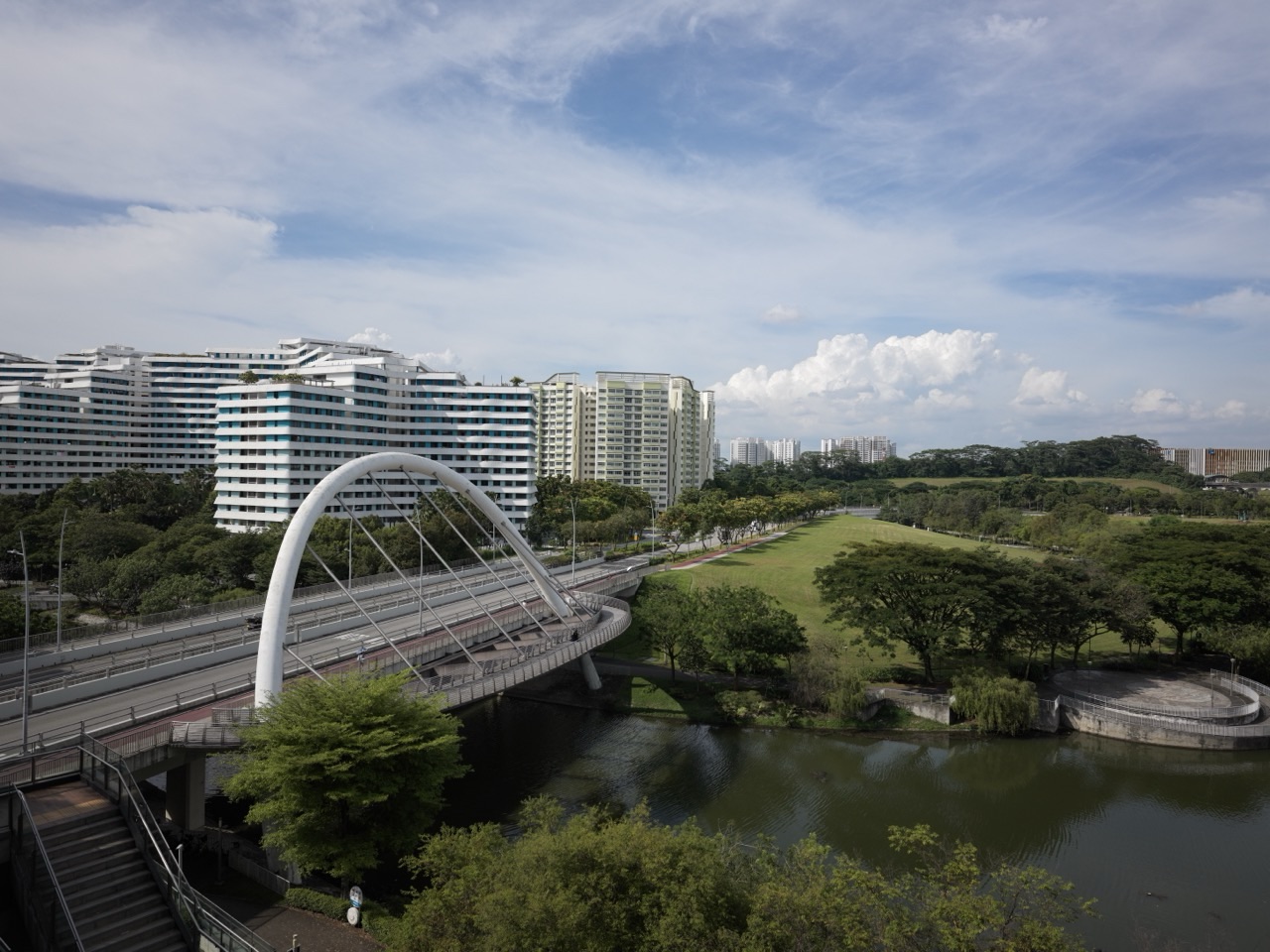
Why would Singapore build dams across the mouths of rivers in the north-east, turning stretches of water once influenced by the sea into managed freshwater reservoirs? To someone walking beside Punggol Waterway, the result may appear mainly scenic: calm water, park connectors and a waterfront identity. But the most important reason is not a view. It is the value of rainfall.
Punggol and Serangoon Reservoirs are part of Singapore’s local catchment water supply. PUB explains that the Punggol–Serangoon Reservoir Scheme began in 2006 and was completed in 2011. By closing off the river mouths and expanding the area from which rain could be collected, the scheme helped Singapore make greater use of stormwater from its growing north-eastern urban districts.
The mechanism is easy to miss. Rain falls on homes, roads, green spaces and other surfaces. A managed network of drains, canals and waterways conveys appropriate runoff into reservoirs. The stored raw water can then be sent through a separate drinking-water treatment process before reaching people’s taps.
This article explains why retaining rainwater matters, why a reservoir is not simply a large drain, why urban catchments need careful pollution prevention and why the water beside Punggol should never be assumed safe to drink directly. It is not another guide to reservoir fishing rules or a live account of tidal-gate operations.
The answer in 50 seconds
PUB describes water from local catchments as Singapore’s First National Tap. Rain falling on about two-thirds of Singapore’s land area is collected through a network of drains, canals and rivers and channelled towards the country’s 17 reservoirs.
Punggol and Serangoon Reservoirs were developed to capture more rainfall runoff from north-eastern Singapore. Along with Marina Reservoir, their completion helped increase the national water-catchment area from about half to two-thirds of the island.
The reservoirs store raw water, not finished tap water. PUB conveys water to waterworks for treatment, filtration and disinfection, followed by quality monitoring and distribution. The waterbody visible from the park is therefore part of a larger system, not an open-air container of ready-to-drink water.
The central idea: rain that would otherwise flow away can be stored and treated as part of Singapore’s water supply.
Why rain is a resource instead of just a weather event
When rain begins, people often think about umbrellas, flooded paths and inconvenient travel. Rainwater may appear to be a problem that should be removed from roads as quickly as possible. But for a water-scarce city, rainfall is also a valuable resource.
Singapore does not have unlimited natural freshwater storage. Land is limited, and reservoirs must compete for space with housing, transport, industry and parks. Capturing suitable runoff lets the country make use of rain that falls within its own territory.
That does not mean every drop can be stored or that a drainage system should simply block all outflow. Reservoirs and drains need safe management of water levels, extreme rain and discharge. The objective is to collect appropriate water while also protecting people and property.
This is why water policy is more than supplying taps. It also involves catchment management, drainage, quality, storage and long-term resilience.
What a catchment means
A *catchment* is an area from which rainfall drains towards a common water system. A student can picture a large landscape with roofs, hills, paths and drains. Water does not stay exactly where it falls. Depending on the terrain and engineered routes, it may infiltrate, evaporate or flow into connected channels.
The water eventually reaching a reservoir may have fallen some distance away. That is why a reservoir’s effective water-supply area is not limited to its visible surface.
PUB explains that Singapore’s local catchment system collects rain through drains, canals and rivers across roughly two-thirds of the land area. Urban spaces are therefore involved in water collection, not only forests or rural areas.
For Punggol families, the most useful question is not simply “Where is the nearest reservoir?” It is “How does water travel from the surrounding catchment into the managed water system?” That question connects the park landscape with the rest of the town.
Why the city cannot rely only on natural lakes
Singapore’s land area is relatively small, and naturally occurring freshwater bodies cannot meet all its water needs. Reservoir development is one way to create and manage storage within the available geography.
Damming suitable river mouths can form reservoirs and make more surface runoff available for water supply. The approach requires engineering, water-quality management and consideration of the environment, not simply building a wall and waiting for a lake to appear.
The Punggol–Serangoon scheme is one example. PUB describes the river-mouth works and the gradual transformation of the impounded water from brackish to freshwater as the system developed.
This demonstrates a powerful planning principle: the physical landscape can be adapted to perform a water-resource function. But the adaptation has trade-offs, and it must be managed carefully over time.
What ‘brackish’ means and why it matters
Brackish water contains more dissolved salts than ordinary freshwater, often because fresh river water mixes with seawater. Before the damming works, the lower parts of coastal rivers could be influenced by the sea.
Closing off river mouths changes the way seawater and freshwater interact, allowing incoming rainfall and runoff to contribute to a managed freshwater reservoir. That transition is a process rather than an instant change the moment a dam is completed.
PUB’s historical educational material notes that the damming works were completed in 2009 and the impounded water was gradually transformed from brackish water towards freshwater. The broader Punggol–Serangoon scheme was completed in 2011.
A student should distinguish the construction milestone from the water-quality transformation. The completion of a structure and the achievement of an operating water condition are related but different events.
Why the two reservoirs matter together
Punggol Reservoir and Serangoon Reservoir are distinct reservoirs in the north-eastern water landscape. They are not merely two names for one continuous lake. Punggol Waterway connects parts of that landscape and contributes to the waterfront-town setting.
PUB’s Punggol–Serangoon Reservoir Scheme was developed to expand local catchment harvesting in the north-east. Punggol Reservoir became Singapore’s sixteenth reservoir, and the broader system contributed to the country’s present network of 17 reservoirs.
The two reservoirs should be viewed as part of a managed collection network, not as independent pools with no relationship to the land around them. Their function depends on catchment conditions, water quality, infrastructure and PUB’s wider operations.
For residents, this explains why a waterfront view can coexist with a national water-supply purpose. The scenery is real, but it is not the only reason the water is there.
Why the waterfront town was planned around water
HDB’s Punggol waterfront vision placed water and greenery at the heart of town design. The Waterway, park connectors and reservoirs have therefore shaped the character of surrounding housing and public spaces.
Yet the freshwater infrastructure is not simply a landscape decoration. It belongs to PUB’s broader water system, while the housing and public-space design involves HDB, NParks and other organisations with different responsibilities.
The roles complement one another. A managed waterway may provide attractive public surroundings, and nearby parks can encourage residents to understand the water landscape. But public access has to respect the reservoir’s operational, safety and water-quality needs.
This is an example of integrated planning: one place can deliver several forms of public value when the functions are coordinated carefully.
Why the rainwater is not directly drinkable
A reservoir collects raw water from its catchment. That water may contain soil particles, organic matter, microorganisms and dissolved substances. A surface that appears clear does not establish potability.
PUB explains that raw water is conveyed by pipelines to waterworks, where it is treated through appropriate processes including coagulation, filtration and disinfection. The treatment and monitoring system is what makes water suitable for consumption.
Children sometimes ask whether a clear reservoir could supply a bottle directly. The correct answer is no. A waterbody intended for water supply is not the same as treated tap water at the end of the distribution process.
Never taste or collect reservoir water on the assumption that it is safe because the surrounding park is clean. Water safety depends on regulated treatment, testing and control rather than visual appearance.
How raw water becomes drinking water
PUB describes a multi-barrier treatment approach. Depending on the waterworks, processes can include screening, coagulation and flocculation, sedimentation, sand or membrane filtration, disinfection and further treatment.
Coagulation helps tiny suspended particles gather into larger clumps that can be separated more effectively. Filtration removes remaining particles. Disinfection addresses harmful microorganisms. Additional treatment stages manage water chemistry and other quality requirements.
The details differ among waterworks and should not be reduced to a single homemade filter demonstration. Actual drinking-water production is a regulated, professional process with monitoring at multiple stages.
The valuable school-level explanation is the sequence: collect raw water, treat it appropriately, test it and distribute the treated product. Omitting the treatment stage gives a dangerously incomplete account.
Why one treatment stage is not enough
Water quality has several dimensions. A filter designed to remove particles does not necessarily remove every dissolved substance or microorganism. A disinfection step has a different purpose from sedimentation.
That is why PUB uses multiple barriers and extensive monitoring rather than relying on one visible process. Each barrier addresses part of the risk profile, and the combination helps provide a reliable supply.
A child can understand this with a simplified analogy. A sieve can separate large objects from water, but it cannot make unknown water safe to drink. More advanced processes and testing are necessary.
The important warning is not to attempt a home “purification” exercise using actual canal or reservoir water. A classroom demonstration can illustrate a physical principle without producing potable water.
Why testing is essential
PUB reports continuous water-quality monitoring and close to 500,000 tests annually across relevant parameters and points in the supply system. The purpose is to verify quality from source to tap.
The word *monitoring* matters because a water treatment plant’s design is not proof that it always functions perfectly under every condition. Changes in source water, equipment and operations must be detected and managed.
Tests address different questions: suspended material, chemical characteristics, microbiological quality and other regulated factors. A single value does not establish every aspect of water safety.
For students, this is a powerful scientific lesson. A claim about water quality needs appropriate measurements, reference standards and context. “It looks clean” and “someone swam near it” are not substitutes for evidence.
Why Singapore uses four National Taps
Local catchment water is only one part of Singapore’s water strategy. PUB describes four National Taps: water from local catchments, imported water, NEWater and desalinated water.
Each source has different capabilities and constraints. Rainfall-based catchments depend on weather and available land. Imported water involves agreements and external sources. NEWater uses advanced treatment of used water. Desalination treats seawater through energy-intensive technologies.
The purpose of diversification is to avoid relying entirely on one source. When water needs grow or conditions change, having several sources can strengthen resilience.
This does not mean each tap supplies exactly one-quarter of demand. Their contributions vary, and the mix can change. The central point is strategic diversity rather than a fixed mathematical split.
Why reservoirs and NEWater are not the same process
A reservoir captures runoff from a catchment and stores raw water. NEWater is high-grade reclaimed water produced using advanced treatment of used water, including membrane and disinfection processes.
PUB explains that NEWater is used mainly for industrial purposes and may also be added to reservoirs during dry periods, where it mixes with raw water before the combined supply is treated at waterworks.
This distinction matters because the same reservoir can be part of the wider national water loop, but its physical function remains different from a NEWater production plant.
A student who says “Punggol Reservoir is a NEWater factory” would be confusing storage and catchment with reclamation technology. The correct description identifies each process separately.
Why rainwater drains and sewage pipes must be separate
PUB states that Singapore uses separate systems for rainwater and used water. Rainwater travels through the stormwater system towards reservoirs. Used water from homes and businesses enters sewers that lead to water reclamation plants.
Why keep them apart? Because the systems have different purposes and water-quality conditions. Mixing used water indiscriminately into stormwater drains would create pollution and undermine local catchment protection.
This is a particularly relevant concept in Punggol, where urban runoff contributes to water supply. A drain is not a general waste-disposal pipe. Residents should never pour chemicals, grease or household waste into storm drains.
The child-friendly rule is simple: rain drains are part of the environment and water catchment, not a rubbish chute. Used water and stormwater must follow their proper systems.
Why a reservoir does not replace flood management
A reservoir stores water, so it may seem logical that it can simply hold all extra rainfall during a storm. In reality, its operational levels, capacity and surrounding drainage requirements must be managed.
PUB’s Source–Pathway–Receptor approach addresses urban flood resilience through controls where rainfall lands, drainage pathways and protection of vulnerable areas. Reservoir and coastal-gate operations are separate technical matters within the broader system.
An infrastructure plan must consider extreme events. A storage area cannot be assumed to have infinite room. Keeping raw water for supply and managing unusually intense runoff require careful decisions rather than a simplistic “hold everything” policy.
For residents, the practical conclusion is to continue following flood and weather advisories even when living near a large reservoir. No waterbody is a universal guarantee against all floods.
Why gates and dams do different jobs
A dam is a structure that retains or separates water. Gates and related infrastructure may allow controlled management of levels and flow under the operating design. Their specific use depends on the reservoir, tidal conditions, rainfall and safety requirements.
The Punggol and Serangoon river mouths were dammed as part of the reservoir scheme. That provides the physical separation needed for the freshwater system, but it does not mean water never moves out of the catchment.
Do not infer operational settings or opening times from a photograph of a gate. Such matters are controlled by PUB and require technical evidence.
The distinction between creating storage and managing its operation is important: a reservoir needs both infrastructure and continuing management.
Why catchment protection starts far from the reservoir
A resident may never walk beside Punggol Reservoir, yet their behaviour in the surrounding town can affect urban cleanliness. Litter in open drains, improper dumping and unsuitable discharges can create problems that move through the environment.
Not every dropped item necessarily reaches a particular reservoir. The route depends on the actual drainage network. But the broader principle is established: urban catchments include spaces used by ordinary households and businesses.
Protecting water is therefore a distributed responsibility. Agencies manage infrastructure and enforcement; residents and businesses can prevent litter and pollution at source.
A child should understand that waste belongs in the correct disposal system. The nearest storm drain is not a convenient substitute for a rubbish bin.
Why an attractive lake can hide a complex system
When people see calm water, they may assume it has always been present in the same form. The reservoir’s current appearance can conceal the engineering that created it and the earlier brackish river conditions.
The story involves geography, water scarcity, dam construction, runoff capture, treatment, ecological change and recreation. It is a system with history rather than a static natural postcard.
This is a recurring lesson in urban design: visible beauty and invisible infrastructure can share the same location. An attractive public space may also perform a function essential to the city.
Punggol is especially useful for teaching this because the water is part of many residents’ everyday visual environment.
Why a floating wetland is not a drinking-water treatment plant
Singapore has used floating and planted wetland features in reservoir environments. They may provide habitat and contribute to ecological or water-quality objectives under suitable designs.
However, a floating wetland is not the same thing as a waterworks producing finished drinking water. Its presence does not establish that people may drink from the surrounding reservoir.
The Sengkang Floating Wetland, associated with the Punggol Reservoir setting, can therefore be an educational feature without replacing professional treatment. Different parts of a system do different jobs.
Families should avoid treating any planted water feature as permission to enter the water, collect specimens or release organisms.
Why the Waterway also matters to biodiversity
Waterways and their landscaped surroundings can provide ecological resources and public green spaces. Birds, aquatic organisms and vegetation respond to specific habitats, water conditions and human disturbance.
This ecological role complements the water-resource function, but it does not automatically prove that every species thrives or that the entire catchment has identical water quality.
A responsible nature observer keeps to designated paths and does not feed or disturb wildlife. Monitoring and management remain the responsibilities of appropriate agencies and specialists.
The educational benefit is seeing that water bodies can carry several forms of value at once while still needing clear priorities and rules.
Why land scarcity shapes the reservoir decision
Singapore’s limited land area makes water storage a planning challenge. Land used for reservoir catchments, homes, roads and industry must be managed carefully.
By harvesting urban rainwater at scale, the local catchment strategy makes parts of the developed city contribute to the water supply. PUB identifies Singapore as one of the relatively few countries harvesting urban stormwater on a large scale for potable consumption.
That achievement does not eliminate trade-offs. Water quality must be protected in areas where people live and work. Infrastructure must fit within dense surroundings. Recreational access has to respect the needs of water management.
The lesson is not that every parcel of land should become water storage, but that one land-use system can sometimes serve multiple carefully coordinated purposes.
Why water security matters to schools and businesses
Water is needed for drinking, sanitation, food preparation, cleaning and many economic activities. A city cannot plan homes, healthcare, industry or education without reliable water.
The local catchment system contributes to that reliability as one of four National Taps. It reduces the extent to which Singapore must rely on any single source.
This is particularly relevant to a developing district such as Punggol, with homes, universities and workplaces. The underlying water service supports all of them, even if most people rarely think about the reservoirs while using a tap.
A student studying national infrastructure can therefore connect a familiar local waterway with the larger question of resilience.
Why rainfall varies and storage helps
Rain does not arrive at a constant rate. Some periods are wetter than others, and individual storms can be intense or short. Water demand, meanwhile, continues every day.
Storage helps bridge some of the timing difference between rainfall and use. It does not make rainfall predictable or remove the need for alternative sources during dry periods.
A simple analogy is collecting appropriate rainwater in a tank: the tank fills when water arrives and can supply a controlled amount later. A national reservoir is much more complex, with quality, capacity and operational constraints, but the timing principle is similar.
Students should not confuse storage volume with a guarantee of how many days of supply a particular reservoir provides. Such claims require actual capacity, inflow and demand data.
Why quantity and quality must be managed together
Collecting more water is not useful if its quality becomes unsuitable for the intended treatment and supply requirements. PUB must therefore manage both the amount of water captured and the quality of the catchment.
The two objectives can interact. Land development changes runoff patterns, and pollution incidents can affect water-quality management. Rainfall intensity creates drainage challenges even as it supplies catchment water.
This is why the wider network of agencies and public responsibilities matters. Housing development, waste management, drainage and water treatment cannot be treated as entirely separate concerns.
A strong civic explanation follows both questions: how much water can be collected, and what needs to be done to keep it safe for subsequent treatment?
Why clear water may still contain dissolved substances
A visitor might conclude that reservoir water is clean because it looks transparent. But some dissolved substances and microorganisms are invisible without appropriate analytical methods.
Turbidity is only one possible characteristic of water quality. Even if suspended particles are low, that does not automatically answer questions about microbiological or chemical safety.
PUB’s treatment and monitoring programmes address multiple parameters. That is why a clear appearance does not allow someone to bypass the waterworks.
This teaches a general scientific principle: what is visible is only a subset of what can be measured. A claim about safety needs evidence suited to the actual hazard.
Three worked family examples
Example one: the rain that falls on a housing block
A child watches rain falling on a Punggol block from a safe sheltered place. The adult asks where the water goes after reaching the roof and ground. They explain that some runoff may enter the stormwater network, depending on the actual site.
At home, the child draws an illustrative route from roof to drain to canal to reservoir and then to waterworks. The diagram is explicitly conceptual, not a verified pipe map for that block.
The lesson is that local rainfall can become part of a much larger water-resource system.
Example two: a student mistakes a reservoir for a tap
A learner sees the clean-looking surface of Punggol Reservoir and says the water could be bottled for drinking. The adult asks what safety evidence is missing.
The learner learns about waterworks, filtration, disinfection and testing. They revise the answer to say that raw reservoir water must be treated appropriately before distribution as safe drinking water.
The lesson is the distinction between a water source and finished water.
Example three: a town has a dry period
Imagine a fictional town where rain falls heavily one month but little in the next. Residents still need water during both periods. A reservoir can store some water from wetter periods for later use, subject to capacity and management.
The child then learns why a diversified water supply offers additional resilience. The conclusion is not that one reservoir solves every drought, but that storage and alternative sources work together.
The lesson is about managing variability rather than assuming constant rainfall.
A Mathematics exercise: rainfall, area and volume
Suppose a fictional catchment is 100,000 square metres and receives 20 millimetres of rain. Since 20 millimetres equals 0.02 metres, the total rainfall volume landing on that area is 100,000 × 0.02 = 2,000 cubic metres, before accounting for infiltration, evaporation, storage and other losses.
That is a volume of rain falling on the surface, not a verified quantity reaching a reservoir. Some water will not become usable runoff, and the timing matters.
Now suppose a second hypothetical storm produces 10 millimetres. The same calculation gives 1,000 cubic metres falling on the catchment. A student can compare the quantities but should not conclude the reservoir receives exactly half as much without considering the actual hydrology.
This exercise connects units, area, volume and careful assumptions.
How to explain this to a Primary Science learner
Begin with three ideas: rain falls; water can move; some of it can be stored. Use a simple drawing, then explain that Singapore needs to treat collected raw water before people drink it.
Avoid overwhelming a child with every chemical treatment stage. They need to understand the purpose first. Water does not become safe merely because it has entered a reservoir.
Introduce the idea of clean drains and responsible disposal, but do not ask children to inspect or enter drainage structures. Observation from safe public places is enough.
A strong young learner can complete the sentence: “The reservoir stores rainwater from the catchment, and the waterworks makes suitable raw water safe for our taps.”
How to explain this to a Secondary Geography learner
At Secondary level, introduce catchment boundaries, urban runoff, land use, reservoir creation and the trade-offs of water management.
Students can compare storage with drainage: one emphasises retaining water for later use; the other manages conveyance and flood risk. Both depend on the catchment’s changing inputs.
Ask learners to distinguish Punggol Reservoir from the neighbouring Serangoon Reservoir and from Punggol Waterway. A map should be used to identify the actual features rather than placing all water under one label.
Finally, link the local example to Singapore’s Four National Taps and explain why diversified water sources are important for long-term resilience.
What not to assume about reservoir recreation
Reservoirs may support designated activities, but water-supply functions impose safety and environmental considerations. A scenic path does not mean swimming, fishing or boating is allowed everywhere.
Use current PUB and relevant managing-agency guidance for specific activities and permitted locations. Do not enter restricted operating areas or attempt to cross barriers for photographs.
Visitors should also follow weather and lightning safety guidance. The presence of attractive water does not override ordinary hazards.
The best family outing is one that respects the place’s environmental and operational purpose.
Why PUB’s historical dates matter
The Punggol–Serangoon scheme began in 2006. The damming works were completed around 2009, and the wider scheme was completed in 2011. These milestones are related but should not be treated as the same event.
A historical photograph from before the works may show a different water environment. A current image shows the managed reservoir landscape. The change is substantial, but its timing should be described accurately.
This is a useful source-reading habit. Construction, commissioning and official completion may occur at different times. Do not choose one date arbitrarily and claim everything happened overnight.
Historical precision strengthens the explanation of how Punggol became a waterfront town.
Why public water information should not be used as a live gauge
PUB’s general website explains how catchments and treatment operate. It does not necessarily provide live measurements for a particular dam, reservoir level or gate at the time someone reads this article.
A parent planning a visit or concerned about heavy rain should use current official weather and flood advisories, not infer operational conditions from the general explanation.
Similarly, a classroom diagram should not be passed off as the exact present-day pipe network. Diagrams teach mechanisms, while current operational data answers immediate questions.
This distinction between general knowledge and live information is important for any public infrastructure topic.
Common misunderstandings
One mistake is assuming the reservoir exists mainly for scenery. Another is thinking every drop of rain falling anywhere in Punggol reaches the same reservoir. Actual catchment boundaries matter.
A third is treating stormwater drains as general waste-disposal channels. A fourth is believing that a dam turns brackish water into drinking water instantly. A fifth is assuming raw reservoir water is safe because it looks clear.
Another mistake is confusing local catchment water with NEWater production or desalination. These are different National Taps. A final mistake is assuming a large reservoir removes all flooding or water-shortage risk.
The correct explanation follows the full system: catchment, collection, storage, treatment, monitoring and distribution.
Frequently asked questions
Why were Punggol and Serangoon Reservoirs created?
To expand Singapore’s ability to collect and store rainwater runoff from the north-eastern catchment, contributing to local water supply.
When was the scheme completed?
PUB records completion of the overall Punggol–Serangoon Reservoir Scheme in 2011, following works that began in 2006.
Does water from the reservoir eventually become tap water?
Local catchment water is a national supply source, but raw reservoir water undergoes treatment and testing before distribution. Do not assume a one-to-one pipe connection from a named reservoir to a particular flat.
Can I drink straight from Punggol Reservoir?
No. Reservoir water is raw water; Singapore’s treated tap water is produced through waterworks and quality control.
What is Singapore’s First National Tap?
Water from local catchments, collected through drains, rivers and reservoirs and subsequently treated.
How many reservoirs does Singapore have?
PUB describes 17 reservoirs in its current local catchment information.
What share of Singapore is water catchment?
PUB says rain falling on about two-thirds of the land area is channelled towards the reservoir network.
Is Punggol Waterway the same as Punggol Reservoir?
No. The Waterway is a distinct connecting and landscape feature within the wider north-eastern water system.
Does the reservoir contain NEWater?
PUB explains that NEWater may be used to top up reservoirs during dry periods within the national water loop. That is different from the reservoirs themselves producing NEWater.
Why must storm drains be kept clean?
Urban rainwater contributes to catchment systems. Litter and inappropriate discharges can create environmental and water-management problems.
A Punggol family checklist
- Identify whether you are looking at Punggol Reservoir, Serangoon Reservoir or the Waterway.
- Remember that catchment runoff comes from a wider area than the visible waterbody.
- Distinguish raw reservoir water from treated tap water.
- Keep litter and unsuitable substances out of stormwater drains.
- Use official information for water quality and current operating conditions.
- Respect signs and designated reservoir activity areas.
- Never collect or drink reservoir water without appropriate treatment.
- Teach children with maps and safe diagrams rather than drainage exploration.
- Understand the role of the First National Tap alongside Singapore’s other sources.
- Recheck time-sensitive information before planning a water-based outing.
Teaching Guide: follow rain from sky to tap
Learning goal. Students should explain why Singapore stores rain in reservoirs, identify the difference between raw and treated water, and understand the value of diversified supply.
Stage one: draw a catchment. Draw a fictional landscape containing a roof, road, garden, drain and reservoir. Show possible movement of rainfall without claiming that the diagram is an exact Punggol drainage map.
Stage two: add storage. Ask what happens if rain falls today but people need water throughout the week. Explain that reservoirs can help store water for later treatment and supply, subject to their capacity.
Stage three: add waterworks. Draw a separate treatment building between the reservoir and households. Ask why raw water should not be drunk directly.
Stage four: introduce the Four National Taps. Name local catchment, imported water, NEWater and desalinated water. Discuss why a country may want more than one source.
Stage five: calculate rainfall. Give a hypothetical area of 2,000 square metres and 10 millimetres of rain. Convert 10 millimetres to 0.01 metres and obtain 20 cubic metres falling on the area. Explain why this is not equal to usable reservoir inflow.
Stage six: introduce pollution. Ask what may happen if someone pours unsuitable waste into a storm drain. The student should understand why catchments require protection.
Transfer test. Present another city with a reservoir and changing rainfall. Ask how collection, storage, treatment and source diversity would help.
Parent checkpoint. A strong answer is: “Punggol’s reservoirs help Singapore keep rainwater instead of simply letting it flow away. That water is only a raw source; it must be treated and checked before it becomes drinking water.”
Where this article fits in the Punggol library
The existing Understanding Punggol | Waterway, Reservoirs, Rainwater, Floods and Water Safety gives a broader local overview. Tidal Gates, Reservoir Water Levels and Coastal Tides examines gate and level concepts. Why Stormwater Must Slow Before Reaching Drains focuses on peak flow and detention.
This article owns a distinct question: why capture and retain rainwater in Punggol’s reservoirs as part of Singapore’s water supply? It follows water from catchment to treatment rather than retelling a reservoir recreation guide.
Official sources and further reading
- PUB: Water from Local Catchment, the First National Tap
- PUB: Singapore Water Story and Four National Taps
- PUB: Water Treatment
- PUB: Drinking Water Quality and Monitoring
- PUB: Stormwater Management
- eduKatePunggol: Understanding the Waterway and Reservoirs
The one idea to remember
The water around Punggol is not merely an attractive blue space. Punggol and Serangoon Reservoirs help Singapore capture rain that can be treated and used as part of the national water supply. The system succeeds because collection, storage, pollution prevention, treatment and monitoring work together—and because raw water is never confused with finished drinking water.


