
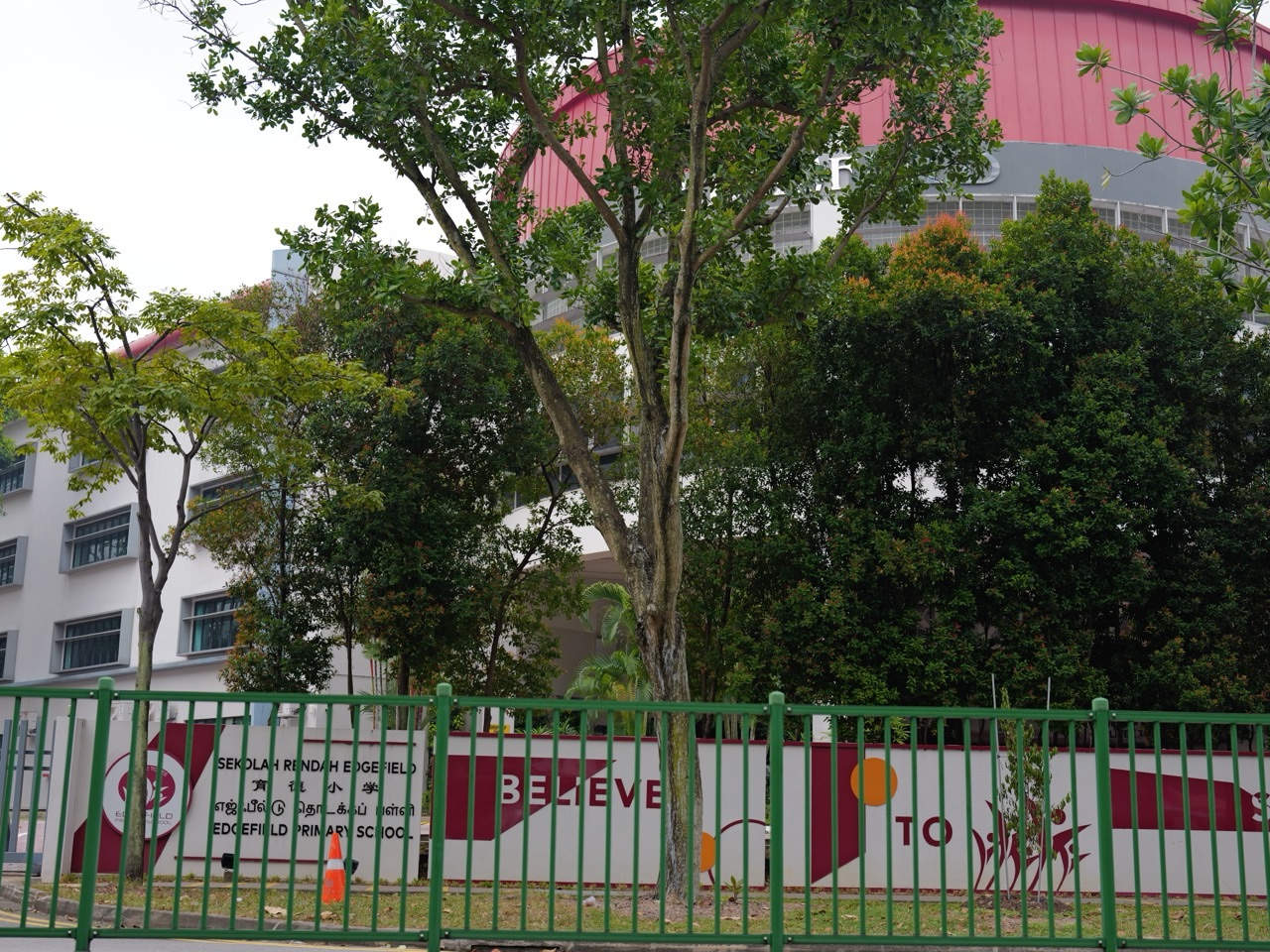
What should Punggol families expect from Edgefield Primary School in 2027? The school already operates at 41 Edgefield Plains. Its latest E.D.G.E. Signature Programme describes 22 structured learning modules across seven domains, including STEM, Language Arts, Digital Literacy, Performing Arts, sports and character. The school also offers a STEM Innovator Applied Learning Programme focusing on food sustainability and energy conservation.
The meaningful 2027 changes are how children experience the current E.D.G.E. curriculum, progress in school and prepare for new levels—not the opening of a new campus. A particularly important fact-check is that newer school material describes seven programme domains, while an older principal’s message refers to six.

Edgefield Primary 2027: verified facts
| What to expect | 2026 official school information |
|---|---|
| Existing campus | 41 Edgefield Plains, Singapore 828869; general school office 7am–5pm weekdays. |
| Signature programme | E.D.G.E. = Experience, Develop, Grow and Empower; 22 modules across seven domains. |
| Universal school experience | P1–P6 structured signature modules, with level-based progress and reflections. |
| Applied Learning Programme | STEM Innovator: P4 food sustainability and P5 energy conservation. |
| Performing Arts LLP | Rhythm and dance, ethnic dance, dancesport, hip-hop and other staged learning opportunities. |
| Digital literacy | P1–2 ScratchJr; P3–4 Docs/Slides; P5 mBlock coding and introductory AI. |
| Character | LiLo: Live Life, Love Life, grounded in Integrity, Graciousness, Responsibility, Unity and Excellence. |
| Not guaranteed | P1 admission, a selective innovation invitation, a fixed public performance date or an identical 2027 timetable. |
Official programme details checked 29 October 2026 against the school’s August and October 2026 pages. The seven-domain version is prioritised over an older description with a different count.
The 2027 story is Edgefield Primary’s new signature curriculum, not a new building
Did you know that Edgefield Primary School, one of modern Punggol’s early primary schools, now describes a whole-school E.D.G.E. Signature Programme involving 22 modules across seven learning domains? Its latest August 2026 overview makes this a more meaningful development to understand than a vague prediction that the neighbourhood needs a future school.
The established school is at 41 Edgefield Plains, Singapore 828869, with general office hours from 7am to 5pm on weekdays and a phone number of 6312 6091. The campus exists and serves current pupils; families thinking about 2027 must distinguish continuing school programmes from admission, class timetables and selected activities that have their own rules.
E.D.G.E. means Experience, Develop, Grow and Empower. The school’s vision is that pupils should discover talents, develop capabilities and become responsible contributors. That educational idea is not the same as guaranteeing that every participant will win a competition or complete an identical external course.
The current school website names seven domains, not six
The latest overview identifies Global Awareness, STEM, Language Arts, Performing Arts, Live Life, Love Life, Digital Literacy and Sports. It presents this structure as a programme accessible through Primary 1 to Primary 6, with twenty-two modules across the learning journey.
An older principal’s message refers to six domains and 22 modules, while the newer 2026 E.D.G.E. overview refers to seven. This is a good example of why dated official pages should be read carefully rather than combined into a contradictory claim. For 2027 planning, the later seven-domain overview is the better guide to the programme’s current structure.
Across the curriculum pupils experience some modules at different stages, rather than attending all seven domains every week. The schedule is a progression from exploration and foundational skills to more demanding projects, with presentations and reflection along the way.
Parents should not conclude that an extra domain means extra exam subjects or compulsory private tuition. E.D.G.E. is integrated with the school’s holistic educational experiences and should be interpreted through its own published purpose.
E.D.G.E. is a structured experience for all pupils, not a selective CCA
The school’s programme overview states that the signature modules are structured experiences woven into the school timetable from Primary 1 to Primary 6, with no separate sign-up necessary for the broad programme. It is different from a conventional CCA that may require a child to choose and receive a place in a particular activity.
The curriculum describes ipsative assessment: children are encouraged to compare their current development against their own earlier performance. A pupil who learns to speak confidently after initially avoiding public discussion may have made meaningful progress even if another child is already comfortable speaking on stage.
Individual reflections, recognition and portfolios are meant to make learning visible. A portfolio is useful if it shows the problem a child faced, what they tried, evidence of progress and what they could do differently—not simply a stack of attractive images.
The school also describes regular showcases where pupils share their work. The programme’s existence does not guarantee a public 2027 event on a particular date. Families should use the actual school calendar and consent instructions for individual performances.
Language Arts begins with the child finding a voice
The 2026 Language Arts page gives a four-year progression. Primary 1 pupils use choral reading, Primary 2 storytelling, Primary 3 readers’ theatre and Primary 4 a musical. Each stage connects English language skills with expression, confidence and cooperation.
Choral reading encourages rhythm and listening. Storytelling brings structure and emotions into a sequence. Readers’ theatre asks pupils to interpret dialogue and coordinate with peers, while a musical integrates language, movement and sound. The complexity increases gradually rather than asking a new P1 child to perform a full theatrical production.
Parents can support the underlying learning at home by asking a child to retell a story in their own words, name what a character wanted and explain how a listener might feel. Doing this thoughtfully is more useful than memorising a large number of dramatic adjectives with no context.
A child who is shy may need time and a suitable amount of encouragement. The purpose of performance is to build communication through experience, not to treat stage confidence as a single measure of a child’s value.
Performing Arts builds from rhythm to different art forms
Edgefield Primary’s Performing Arts strand is its Learning for Life Programme. The current description includes Primary 1 rhythm and dance, Primary 2 ethnic dance, Primary 3 dancesport, Primary 4 hip-hop dance and experiences with musical instruments in later years.
By learning movement, music and performance, children practise timing, respectful interaction, collaboration and listening. Ethnic dance can also encourage them to appreciate Singapore’s diverse cultural traditions without reducing a culture to a costume.
Not every activity will become a public concert, and the school may adjust what a cohort performs depending on opportunities and readiness. A school programme is not a guarantee that every pupil becomes part of a selected performing-arts CCA.
The strongest family support often includes allowing a child to enjoy making something with peers. A ten-minute household rhythm game can reinforce coordination without turning leisure into another assessment.
Digital literacy starts before children use complicated AI tools
The school’s 2026 Digital Literacy programme identifies a progression through ScratchJr, Google Workspace and mBlock. Primary 1 and 2 use ScratchJr to learn sequences, loops and debugging; Primary 3 and 4 organise information and create documents or presentations through Docs and Slides; Primary 5 explores mBlock coding and elementary AI ideas.
The progression is important because children need a foundation before making sense of powerful digital tools. A Primary 1 pupil can learn that a computer follows instructions. An older child can learn why a source is unreliable, how to collaborate ethically on a document and what a model can or cannot infer.
The current school page describes age-appropriate ‘vibe-coding’ activities for older pupils. That wording should not be treated as permission to use unsupervised AI tools, upload personal data or copy generated answers without checking. The school’s digital values include empathy, integrity, ethical online behaviour and safeguarding information.
A 2027 parent can ask how learning is supervised, how children’s work is assessed and what devices or platforms are approved. A promotional photo of a tablet is not a school device-purchase requirement.
Primary 4 learns how to investigate food waste rather than just talk about it
Edgefield Primary’s STEM Innovator Programme is its Applied Learning Programme. For Primary 4, the 2026 plan uses Food Sustainability: pupils examine food waste in their school community, empathise with people involved, conduct an audit and propose and prototype practical improvements.
This is a real example of Design Thinking. A child can first identify what is being wasted, when and why, then propose alternatives and test whether people would find them workable. The purpose is not to judge someone who eats differently or to assume every discarded item has the same cause.
Food-waste audits require hygiene and safety boundaries. Children should follow teacher instructions and should not handle hazardous discarded materials or photograph other pupils during meals without consent.
Parents can practise the principle by measuring ordinary household food waste carefully for a short period and considering one reasonable change. If the change does not work, that is evidence for adjusting the idea, not proof that sustainability education has failed.
Primary 5 extends the approach to energy conservation
For Primary 5, the school introduces Energy Conservation and Innovation. Pupils investigate energy use in school or at home, identify opportunities and present proposed solutions using sketches and storyboards. The work is related to Singapore’s environmental aims while remaining an age-appropriate educational exercise.
The central distinction is between an estimate and a measurement. A class may propose reducing unnecessary lighting, but a claimed reduction in kilowatt-hours requires data and a clear comparison. A poster alone cannot prove it saved a particular amount of electricity.
A small advanced innovation track exists for selected pupils with aptitude in inventive and adaptive thinking. It offers further mentoring and project opportunities; the school says selected learners can work with industry mentors and share ideas at a Young Innovators’ Fair.
Parents should not treat the selective extension as a universal guarantee or compare every child solely on whether they enter that track. The broad STEM programme offers opportunities for all children to practise practical reasoning.
Design Thinking is a cycle rather than a perfect first answer
The 2026 STEM page presents the stages of empathising with a user, defining the problem, generating possible ideas, prototyping and testing with feedback. It includes brainstorming techniques such as Crazy 8s and SCAMPER as ways to consider more than one idea.
This process teaches children that a useful invention must serve an actual need. A complicated mechanism might impress a judge but still be the wrong solution if it is expensive, difficult to maintain or inconvenient for the person using it.
At home, a parent can ask a child to improve the organisation of a study corner. What gets lost? Is a box, label or new routine the most practical response? Test the plan and ask if it helped. This exercise teaches problem solving without proprietary equipment or extra paid lessons.
Better reasoning involves asking what evidence would show success, recognising trade-offs and remaining willing to revise. The school programme creates opportunities for those habits to develop across different subjects.
LiLo is the character-development thread across ages
Live Life, Love Life, or LiLo, focuses on social-emotional competencies, positive habits, empathy and resilience. The school describes Primary 1 work on basic positive routines, Primary 2 on gracious communities and Primary 6 on reflecting on strengths, preparing for transitions and future readiness.
Edgefield’s stated iGRUE values are Integrity, Graciousness, Responsibility, Unity and Excellence. These can be meaningful in simple daily actions: returning an item, offering fair help in a group and admitting when a task was not completed.
For a Primary 6 pupil preparing for secondary school, resilience should not mean suppressing worry or ignoring fatigue. It can mean using reliable routines, asking for help and adapting a plan when circumstances change.
A parent can connect these themes to life in Punggol’s shared estates. Children encounter other residents in lifts, corridors, parks and public transport; learning to respect shared spaces is part of citizenship.
Sports develops movement, judgement and cooperation
The 2026 E.D.G.E. Sports page describes structured movement and play, beginning with activities such as athletics, rope skipping and outdoor learning in Primary 2. It also mentions Swimsafer exposure for Primary 3 and a wider choice of physical activities in the upper years.
Physical education should encourage competence and healthy habits rather than make every child feel obliged to excel at the same sport. A pupil developing coordination, self-management and the ability to work fairly with a teammate is learning valuable skills.
A specific water activity or sport experience can require assessment, permission, equipment and teacher supervision. The school programme list should not be interpreted as a guarantee of identical venues and activities in the 2027 school calendar.
Parents can support the child through regular safe movement, adequate sleep and a realistic weekly routine. Excessively filling the calendar may undermine the enjoyment and recovery that sport can provide.
The official contact page and Punggol journey
The school’s 29 June 2026 contact listing gives 41 Edgefield Plains and general office hours of 7am–5pm on weekdays. It gives the main phone number as 6312 6091. These are useful for verification before a first visit.
An exact school address matters because Edgefield Primary and Edgefield Secondary are separate campuses with different programmes. A resident sending a courier or meeting a teacher should confirm the correct site instead of treating the word ‘Edgefield’ as a single school location.
Transport planning should start from the family’s actual block and the school-designated arrival gate, using current crossings and school security notices. The nearby East Loop and town-centre buses create possible options, but they need to be checked for the chosen travel direction and date.
School hours and administrative counter access are not the same as an individual pupil’s dismissal and CCA times. A safe pickup plan requires the child’s actual class and current instructions.
How to prepare for Primary 1 and later transitions
MOE Primary 1 Registration for the 2027 intake takes place under the relevant 2026 exercise, with phase-based priorities, vacancies and possible balloting. Nearby housing is not proof of entitlement to a place at Edgefield Primary.
Once a place is confirmed, families can practise basic independence, respectful communication, organising belongings and recognising who to approach when something goes wrong. Those habits connect well with LiLo and the E.D.G.E. learning themes.
Parents of upper-primary children should check dated assessment schedules. The school currently publishes 2026 learning outcomes for Primary 1 and 2 and assessment plans for Primary 3–6. These are reference material, not an automatic 2027 examination timetable.
Families should ask teachers about the child’s progress from their own starting point, rather than rely on competition results or a school’s publicity alone.
What Edgefield residents should expect in 2027
The school will continue to run its existing broad curriculum subject to term arrangements. Real updates may include specific level projects, staff information, parent briefings, CCAs, assessment calendars or approved community partnerships. Each such update needs its own school date.
Families can use local libraries, parks and carefully chosen community activities to reinforce curiosity without pretending to recreate controlled school experiments. A walk through Punggol Waterway can support observational language or environmental questions, while the school remains responsible for its own education programmes.
Crucially, the broad E.D.G.E. curriculum differs from a selective innovation opportunity and from normal CCA enrolment. Keeping those three levels separate helps parents make realistic decisions.
The most valuable preparation for 2027 is supporting a child who can learn independently, communicate responsibly, recover from mistakes and participate kindly in a growing neighbourhood.
Family preparation checklist for 2027
- Confirm the correct Edgefield Primary campus and its current arrival gate.
- Check 2027 Primary 1 placement through MOE rather than assuming home proximity means admission.
- Understand E.D.G.E. as a structured learning journey distinct from selective ALP extensions and CCAs.
- Ask what STEM work teaches about evidence, users, sustainability and prototyping.
- Support language confidence through reading, retelling and respectful discussion.
- Practise safe digital behaviour and teach children to verify AI-assisted outputs.
- Check actual level assessments and school notices instead of reusing a 2026 timetable.
- Make time for rest, movement and a realistic home–school route.
Frequently asked questions
Where is Edgefield Primary School?
41 Edgefield Plains, Singapore 828869.
Is Edgefield Primary a new 2027 school opening?
No. It is an established primary school with current pupils and ongoing programmes.
What does E.D.G.E. stand for?
Experience, Develop, Grow and Empower.
How many EDGE modules and domains does the current page describe?
Twenty-two modules across seven domains in the latest August 2026 overview.
Why do some older school pages mention six domains?
Older principal messaging used a different grouping; the newer official programme overview lists seven domains.
Must a pupil sign up separately for the entire signature programme?
The current school overview says it is a structured part of learning for P1–P6, not a selective CCA.
What is the current Applied Learning Programme?
STEM Innovator, with P4 food sustainability and P5 energy-conservation projects.
What does digital learning look like at lower primary?
P1–P2 begin with ScratchJr block coding, progressing to digital productivity and AI concepts in later years.
What is the Learning for Life Programme?
Performing Arts, supporting communication, confidence, empathy and collaboration through music and dance.
What does LiLo mean?
Live Life, Love Life, the school’s character and resilience programme.
Does every child receive advanced innovation mentoring?
No. The specialised Tier 2 track is for selected pupils.
Does living in Punggol guarantee a Primary 1 place?
No. MOE eligibility, phase, distance and vacancy rules apply.
Official school and MOE resources
- Edgefield Primary address, phone and office hours
- Edgefield Primary 2026 E.D.G.E. overview, seven domains and twenty-two modules
- Edgefield STEM Innovator ALP, P4 food and P5 energy
- Edgefield Digital Literacy with ScratchJr, Workspace and mBlock
- Edgefield Language Arts P1–4 development
- Edgefield Performing Arts LLP
- Edgefield Live Life, Love Life character programme
- Edgefield Sports curriculum
- Edgefield 2026 assessments and P1/P2 learning outcomes
- MOE Primary 1 Registration
Related Punggol articles
- Edgefield Primary campus photos and E.D.G.E. programme context
- What to Expect for Punggol 2027: Edgefield Primary and Secondary neighbourhood
- History of Punggol: Edgefield Primary and the 2002 school cohort
- Greendale Primary 2027 Design Thinking and Outdoor Education
- Oasis Primary 2027 Language Artisans and leadership
Editorial note: 29 October 2026. This article uses the current school programme description, distinguishes the full signature curriculum from selective extensions, and does not guarantee future admissions, course placements or identical 2027 activities.


