
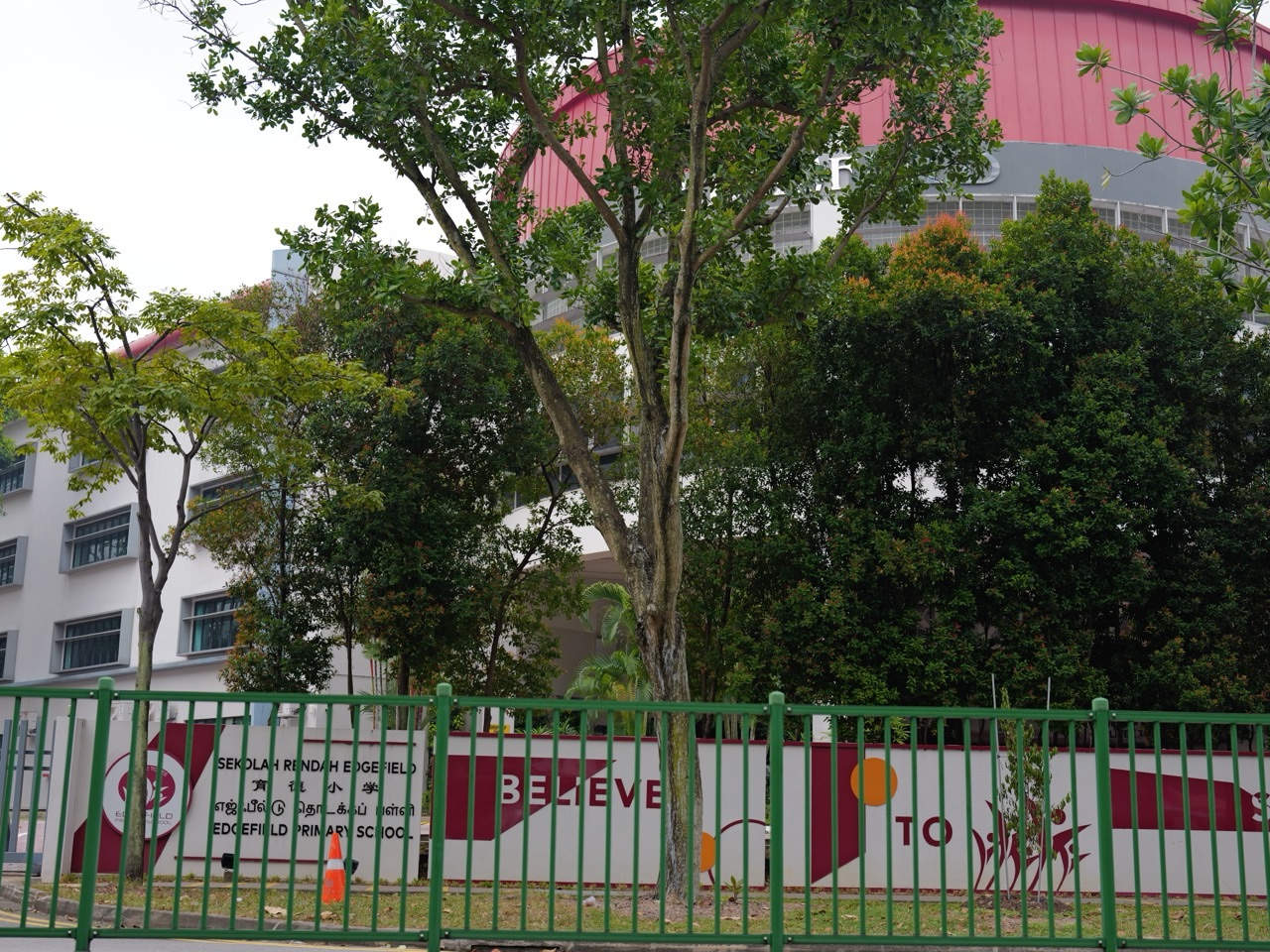
Edgefield Primary School is at 41 Edgefield Plains, Singapore 828869. Its June 2026 school rules say children should be in the classroom or hall for morning assembly by 7.25am, and pupils arriving after 7.30am are considered late. The school also has a distinctive 2026 development: its new E.D.G.E. Signature Programme brings 22 hands-on modules across seven learning domains into Primary 1 to Primary 6. Our original October 2026 eduKatePunggol photos show the campus exterior, helping local families recognise the school without making unsupported claims about gate operations or individual pupils.
For parents, the useful questions are both practical and educational. How is 41 Edgefield Plains different from Oasis Primary’s 71 Edgefield Plains? What does a 7.25am assembly target mean for an ordinary morning commute? What do the school’s device rules mean for pickup communication? And how can an exterior building image lead to an informed conversation about the actual 2026 E.D.G.E. programme without pretending the photographer entered classrooms? This guide answers those questions using the school’s own current public pages.

Edgefield Primary: fast facts for parents
- Address: 41 Edgefield Plains, Singapore 828869.
- School phone and email: +65 6312 6091; edgefield_ps@moe.edu.sg.
- General Office: Monday–Friday 7am–5pm, from its contact page updated June 2026.
- Morning assembly: children should be in class or hall by 7.25am; arrival after 7.30am is recorded as late.
- Ordinary dismissal: follow the child’s current timetable and school notice; do not apply old Primary 1 orientation slide timings to every 2026 pupil.
- Personal phones: the June 2026 rules require switched-off phones to be deposited in school phone lockers and retrieved after the last period or after-school programme, whichever is later.
- 2026 development: E.D.G.E. = Experience, Develop, Grow and Empower.
- Programme scope: school describes 22 modules across seven domains for all Primary 1–6 pupils.
- Seven areas: Global Awareness, STEM, Language Arts, Performing Arts, Live Life Love Life, Digital Literacy and Sports.
- School vision: Lives Empowered, Lives Touched; new motto in 2026 centres on becoming the best version of oneself.
- Student Care: the school lists NASCANS as its current provider, subject to enrolment and actual collection rules.
- Photos: three original exterior views dated October 2026; live visitor and school operations must come from the school.
Primary references are Edgefield Primary Contact Us, 2026 School Rules, E.D.G.E. Signature Programme, 2026 Principal’s Message, Mission and Values, Student Care and 2026 Assessment Plans.
Why the school’s full name and number matter
Edgefield Primary at 41 Edgefield Plains is a different location from Oasis Primary at 71 Edgefield Plains and Punggol Secondary at 51 Edgefield Plains. Greendale Secondary also appears in searches, but its official street is Edgedale Plains, a different spelling altogether.
A family may have relatives helping with pickup from more than one school. Give the complete name and postal code in any private travel instruction. A recognisable photo can reinforce the information, but an incorrect block number can still send somebody to the wrong place.
What the new photographs document
The media library includes Edgefield Primary School exterior views showing the public-facing building. They help a newcomer see what the campus looks like from outside and provide an October 2026 record of the neighbourhood.
A photograph cannot say which internal room a class occupies, whether a specific gate is open, or where one pupil must meet an adult. Current school rules and a class notice are the authoritative sources for such operational questions.
School architecture isn’t the education programme
A school can look modern and well maintained in a photograph, but the image says little about what pupils learn. Edgefield’s official 2026 website provides much richer information about its learning approach, including the new E.D.G.E. programme.
To evaluate fit, ask what children actually do, how the school supports their development and how the family can partner with teachers. Avoid drawing conclusions about exam results from colour, facade design or a distant view of a playing field.
The 7.25am assembly requirement
The June 2026 School Rules page specifies that pupils should be in the class or hall by 7.25am. This is more precise than an informal statement that school starts somewhere around half past seven. Parents can use it to plan a sensible arrival margin.
The right departure time depends on the route from home. A family should account for transit, public crossings and a child’s walking pace. Don’t make the student run through traffic because the alarm was set too late.
When a student is officially late
The same rules say students arriving after 7.30am are considered late. The distinction between reaching assembly by 7.25am and the later official late threshold shouldn’t be treated as an invitation to aim for 7.29am every day.
The school expects punctual participation, not a daily race. Plan for a calm reporting routine and use the actual school procedure when an unavoidable delay occurs.
Why an official school contact page matters
The school lists 41 Edgefield Plains, phone 6312 6091 and a Monday–Friday General Office window of 7am–5pm. These are useful verified facts for an appointment or administrative enquiry.
Office hours are not necessarily every child’s curriculum hours, and a phone line being open doesn’t grant an adult permission to enter through any gate. Contact the school for current visitor and pupil instructions when the purpose is specific.
Finding a lawful approach from public transport
Current journey directories identify Cove LRT (PE1) among nearby transport options around the school. But the best walking route depends on the origin, correct crossing and actual path conditions, rather than simply the distance measured between two map pins.
Use current LTA maps and ground signs, especially if travelling with a young child or mobility aid. The external photos provide recognition only, not a complete pedestrian route survey.
Morning bag preparation
A younger child may forget a worksheet or water bottle while the adult is thinking about bus timings. A brief evening routine can prepare the schoolbag, uniform and any activity items based on the next day’s actual timetable.
Keep responsibility age-appropriate. A Primary 1 pupil can help check one or two items, while an older pupil can review a fuller list. The purpose is to reduce avoidable rushing, not create stress over every small mistake.
Phone lockers and the school day
Edgefield’s June 2026 rules require pupils to switch off handphones and deposit them in the school-provided lockers on arrival. They are retrieved after the last lesson or after-school activity, whichever comes later, and may only be used after leaving school premises.
A family should not depend on receiving real-time messages from a child’s phone during lessons or CCA. Use the school’s established communication channel for timetable changes and authorised pickup.
How the phone rule affects parents
A parent who sends repeated text messages during the day may not receive a response, and that can be normal under the school’s policy. It is better to plan the correct schedule and establish an official contingency beforehand.
If an urgent concern arises, contact the General Office instead of asking the pupil to break rules. Parents can support responsible digital habits by respecting the limits the school has set.
What the 2026 principal’s message announces
Edgefield’s principal says the school has new mission, values and motto in 2026, alongside the E.D.G.E. Signature Programme. The emphasis is on students learning from mistakes and developing as whole people, not only chasing scores.
An important point for parents is that the programme is not restricted to pupils who are already strong in a particular skill. The school’s published overview describes participation across Primary 1 to Primary 6.
E.D.G.E. means Experience, Develop, Grow and Empower
The programme name describes a learning sequence: pupils encounter experiences, develop skills, grow in character and become empowered to apply what they have learned. The exact activities differ by year level.
This language becomes meaningful when linked to a project. A child can try a new performance, reflect on what was difficult, practise and improve, then share the result. The point is growth over time rather than a perfect first attempt.
Twenty-two modules across seven domains
The official overview says the E.D.G.E. programme contains 22 hands-on modules across seven areas. That is a programme design figure, not a promise that every child completes all 22 in a single school year.
Pupils progress across Primary 1 to 6, with development organised by level. Ask which modules apply to the child this year. An overview number needs the actual schedule to become a meaningful family plan.
Domain one: Global Awareness
The Global Awareness domain encourages pupils to understand cultures, global issues and their responsibilities as citizens. The school’s programme table places particular Global Awareness work at upper-primary levels.
An external school photo doesn’t show this learning in action. Parents might ask the child to explain a current project in their own words and how it connects to the neighbourhood or wider world, rather than assume the subject is simply memorising facts.
Domain two: STEM
The STEM area emphasises problem-solving and design thinking. The school’s published examples include environmental sustainability for Primary 4 and energy conservation for Primary 5.
A family can support curiosity by asking how the pupil tested an idea, what did not work and what evidence led to a change. The point is reasoning, not producing an impressive-looking prototype at any cost.
Domain three: Language Arts
The school’s Language Arts sequence includes experiences such as choral reading, storytelling and presentations. Its English key programmes page also describes a development from Show and Tell to Pick and Tell, public speaking, persuasion and debate.
A parent can help by listening patiently and asking a question about the child’s idea. Confidence comes through practice and feedback, not merely copying a script from the internet.
Domain four: Performing Arts
The E.D.G.E. tables include rhythm and dance, ethnic dance, musicals, hip-hop dance and other arts experiences across different year levels. These offer creative ways for pupils to express themselves and collaborate.
Not every pupil will become a performer, and participation need not be judged only by a final show. The learning may involve remembering a sequence, managing nerves or making room for other pupils’ contributions.
Domain five: Live Life, Love Life
Edgefield’s Live Life, Love Life domain emphasises positive relationships, habits, resilience and personal wellbeing. Its published progression includes foundations for positive habits and later themes of future readiness.
Parents can reinforce those ideas through ordinary routines: keeping agreements, handling disappointment and showing consideration for classmates. This doesn’t replace a teacher’s support for an individual pupil, but it connects the school theme to family life.
Domain six: Digital Literacy
The programme describes digital literacy work including computational thinking, block coding, cybersecurity awareness, productivity tools and basic AI concepts. The exact level and module must be read from the school’s current plan.
A child learning digital skills also needs safe habits with passwords, privacy and credible information. The school’s phone locker rules show that responsible technology use includes knowing when devices should not be used.
Domain seven: Sports
The Sports domain uses movement, skill learning and teamwork, with published examples including SwimSafer in Primary 3 and later opportunities to learn sports. That is an educational pathway, not a guarantee of a particular public swimming booking.
Families should follow the school for programme details, appropriate equipment and any medical or safety instructions. An exterior photo is not evidence of the availability of a swimming pool inside the campus.
How the modules progress through the years
The E.D.G.E. programme is tiered from exploration in lower primary toward more involved skills in upper primary. A Primary 1 pupil might start with group storytelling or movement; an older student may tackle energy conservation or a more demanding public presentation.
This progression means parents shouldn’t compare the output of a seven-year-old with a Primary 6 performance and conclude that one is behind. The programmes are designed for different developmental stages.
Why an individual learning portfolio matters
Edgefield’s official overview describes portfolios through which students document experiences, contributions and growth. It also names ipsative assessment, comparing pupils with their own earlier progress rather than only classmates.
A parent can ask what changed between two attempts and what the child would do differently next time. This often reveals deeper learning than asking only for a numerical grade.
The E.D.G.E. Showcase
The school describes term showcases where pupils share projects and performances with peers, teachers and parents. A showcase can help children practise presenting, celebrating effort and giving constructive feedback.
Actual event timing and visitor permissions come from the school’s current announcement. Don’t assume an outsider can visit a showcase simply because the programme description appears publicly online.
P1 Language Arts and computational thinking
The current table places choral reading and introductory computational thinking among Primary 1 experiences. These can help children connect spoken language, patterns, sequencing and collaboration in developmentally appropriate ways.
At home, a parent can enjoy reading aloud or a simple step-by-step game, without turning every activity into an assessment. If the child struggles with a particular skill, talk to the teacher about the specific need.
P2 block coding and storytelling
Primary 2 pupils encounter storytelling and block coding in the published sequence. Both involve arranging components into a meaningful order, even though one uses language and the other uses computational ideas.
A thoughtful question is ‘What did you change and why?’ rather than only ‘Did you get the right answer?’ The child can practise explaining choices, which strengthens transferable reasoning.
P3 relationships and SwimSafer
The official programme overview lists building positive relationships, digital wellness/productivity work and SwimSafer at Primary 3. Each has different practical arrangements, from discussions to movement activities.
Parents should check actual kit, permission and safety information before a specific swimming programme. The broad overview is not a timetable for an individual pupil and not permission to enter a swimming facility on an unbooked day.
P4 environmental sustainability
At Primary 4, the school’s STEM domain includes environmental sustainability, while other areas cover a musical, performance and information skills. A pupil may explore how everyday choices affect the environment and how ideas are communicated.
Families in Punggol can discuss recycling or waterway care as ordinary examples without claiming the school ran a particular field trip. The pupil’s real project should be the source of any specific assertion.
P5 energy conservation
The Primary 5 STEM sequence includes energy conservation. This is a practical theme in a residential town of schools, shops and transport, but an exterior school photograph cannot tell us its actual electricity use.
An age-appropriate home activity is to identify devices switched off when not needed and explain the reason. Don’t present invented savings or building performance statistics as facts about Edgefield Primary.
P6 resilience and future readiness
The published final-year modules include themes of resilience, future readiness and sports. These can help pupils prepare for a new school system after PSLE without reducing the year to examination drills alone.
Parents may support reflection about what the child has learned over six years and which habits they want to carry forward. Secondary school transition involves identity, friendships and travel as well as subject outcomes.
A photo can show place, not programme outcomes
The three October exterior images document the campus in the Punggol neighbourhood. They cannot verify any one pupil’s project, grade, personal growth or feeling about school.
Descriptions of E.D.G.E. come from the school’s official programme pages, not from inventing scenes inside unphotographed classrooms. That distinction keeps the article accurate and respectful.
Morning assembly at 7.25am versus late at 7.30am
A caregiver might wonder why two different times appear in the rules. One is the expected assembly arrival; the other is the late threshold. The five-minute interval isn’t a suggested daily buffer to use up.
For a predictable routine, aim to be ready early enough to reach the appropriate classroom or hall at the expected time. The family should plan for the entire route, including crossing and settling.
A worked morning calculation
Suppose, in a hypothetical journey, a child needs ten minutes on an LRT, seven minutes walking and eight minutes for variable waiting. That’s twenty-five minutes. Adding a ten-minute margin gives thirty-five minutes before the desired arrival.
These are invented numbers for learning, not measured travel times to 41 Edgefield Plains. Ask the student to replace them with actual supervised observations and consider what happens if transport is delayed.
What to do if a child is unwell
The school’s rules direct parents to notify the school about absences and provide medical certificates or letters in relevant circumstances. For school examinations, the rules specify formal medical certificates.
If a pupil feels unwell at school, follow the school’s actual reporting and collection process. Don’t ask a child to unlock their phone against policy and leave independently.
Student Care and NASCANS
Edgefield Primary’s June 2026 Student Care page describes NASCANS as the school-based provider. That may be relevant to families needing supervision after ordinary lessons, but actual fees, availability, hours and collection are provider-specific.
Contact the provider or school through the appropriate channel before depending on a schedule. A parent’s workday and a pupil’s schoolday can be coordinated only when the real arrangement is confirmed.
A student whose CCA ends later
The phone policy says pupils collect personal devices after their final lesson or after-school programme, whichever is later. This is a clue that different children can remain at school for different activities, not a publication of one universal dismissal time.
Parents should use the child’s actual timetable and approved pickup instructions. Do not infer that a pupil is free at the normal class end when an authorised CCA is still running.
How the school promotes respectful conduct
The values page lists Integrity, Gratitude, Resilience, Unity and Empathy. The motto is ‘Believe to See’. These offer language for discussing good choices, such as admitting an error, thanking a worker or helping a peer.
A parent can ask for one real example rather than making the child recite all five values. The school emphasises growth and meaningful contribution, which can be practised in simple daily habits.
Parent Support Group opportunities
Edgefield’s official Parent Support Group page describes activities including Buddy Reading, school events and support for the school community. Parents interested in joining should follow its current registration instructions rather than assume any parent can enter a classroom at will.
Volunteering is a meaningful partnership when it is organised safely and respects the school. A photo-led article should not use public images to imply that a reader is already registered or authorised to participate.
A school’s anti-bullying statement
Edgefield’s School Rules page addresses bullying, describing repeated harm and power imbalance, and says the school takes a firm stance. This subject involves the safety and privacy of individual children.
If a family has a concern, contact school staff through the appropriate confidential channel. Avoid naming other pupils or making public accusations based on overheard conversations at the gate.
Learning platforms and phone restrictions are compatible
The school lists Student Learning Space and Student iCON resources for study, but its campus rules restrict personal phone use. The two are not contradictory: digital learning can occur through approved resources without pupils using personal devices at any moment they choose.
Parents can help with legitimate home access and password security, while respecting school boundaries. Do not share pupils’ private MIMS credentials in chats or online assignments.
School assessments vary by level
Edgefield’s 2026 assessment page provides learning outcomes for Primary 1 and 2 and assessment schedules for Primary 3–6. This reflects age-appropriate differences in how schools monitor development.
A pupil’s success should be discussed through real feedback, not inferred from a single ranking or school photo. Parents can ask teachers what a particular learning outcome means and how to support practice at home.
The difference between Edgefield and Oasis Primary
Both official addresses contain Edgefield Plains, but Edgefield Primary is at number 41 and Oasis Primary at number 71. Their school-day details also differ, so families should not copy Oasis’s published Wednesday dismissal as Edgefield’s.
Our Oasis Primary Wednesday timetable guide covers that separate school. Match each child to the correct institutional notice.
The difference between Edgefield and Greendale
Greendale Secondary School’s street is Edgedale Plains rather than Edgefield Plains. Similar words and a shared Punggol district are not enough to identify a destination.
A family attending a school event should check the full institution name and postal code. The Greendale Open House article explains its independent address.
The proper role of an exterior photo
The three photographs are suitable for broad local architecture and place recognition. They should not be used to identify private pupil routines, map restricted security positions or claim that every entrance shown is open.
Respect school photography rules and avoid posting recognisable children’s faces with their daily travel times. The campus is where pupils learn, not a public photo stage.
A simple English writing exercise
Ask a child to write a factual sentence describing the school exterior and a second explaining how to verify its address. The first uses visible details such as building shape; the second uses the official contact page.
Then invite a fictional paragraph about an invented character attending a first-day assembly, clearly marked as imaginative. This helps pupils separate observational writing from storytelling.
Mathematics about five-minute differences
Morning assembly is 7.25am and the late threshold is after 7.30am, a five-minute interval. Ask the pupil how many minutes a hypothetical departure must shift earlier to increase the buffer from five to fifteen minutes.
The arithmetic is straightforward, but the application depends on a realistic route. A good family plan builds extra time rather than treating the five minutes as a daily race.
A Primary 4 design-thinking example
A student might think about how a school walkway could be easier for people carrying heavy bags. Begin by identifying a genuine user need, ask what constraints exist and sketch a simple improvement without modifying school property.
The E.D.G.E. programme describes design and sustainability themes, but this is a hypothetical home discussion rather than a claim about an actual school assignment. Labelling the example matters.
A P6 reflection on growth
At the end of primary school, a pupil can review experiences from learning to read aloud to presenting projects or understanding digital safety. Ask which skill took practice and which habit helped them persist.
The best reflection is the child’s genuine answer, not a generic claim that every pupil achieves identical outcomes. The school frames progress as personal growth, and a family can honour that without comparison pressure.
A final parent checklist
Confirm Edgefield Primary at 41 Edgefield Plains, the pupil’s actual reporting and dismissal instructions, public travel route, school device policy and authorised caregiver. Build a calm morning that reaches assembly without rushing across roads.
For learning, follow the current E.D.G.E. programme, class communications and assessment information. Use the photographs to recognise the building—not to decide admissions, security rules or how a particular child should be collected.


Frequently asked questions about Edgefield Primary School
Where is Edgefield Primary?
41 Edgefield Plains, Singapore 828869.
What is its telephone number?
6312 6091.
What time should students reach assembly?
By 7.25am, according to the June 2026 School Rules.
When are they officially considered late?
If they arrive after 7.30am.
Does the school publish one universal dismissal here?
The current pupil timetable and school notice govern actual dismissal; old orientation slides should not be applied to every 2026 class.
How are personal phones handled?
They are switched off and placed in school phone lockers until the last class or activity ends.
Can pupils use phones during recess?
Follow the current school rules; phones are not to be used inside school.
What is E.D.G.E.?
Experience, Develop, Grow and Empower, the 2026 school signature programme.
How many modules are described?
22 modules across seven learning domains over Primary 1–6.
What are the seven domains?
Global Awareness, STEM, Language Arts, Performing Arts, Live Life Love Life, Digital Literacy and Sports.
Does every child participate?
The official school overview describes participation for all Primary 1–6 pupils.
Does every pupil take all 22 modules in one year?
No such claim is made; the school describes a progression across levels.
What does ipsative assessment mean?
It means evaluating a student’s progress against their own earlier work rather than only against peers.
What is the school’s vision?
Lives Empowered, Lives Touched.
What is the school’s motto?
Believe to See, with 2026 emphasis on becoming the best version of oneself.
Who provides Student Care?
The school lists NASCANS, subject to enrolment and provider arrangements.
Is the school on the same street as Oasis Primary?
Yes, both official addresses say Edgefield Plains, but Oasis is number 71 and Edgefield Primary is 41.
Is Greendale Secondary on Edgefield Plains?
No. Greendale’s official street is Edgedale Plains.
Where can I find 2026 assessments?
The school publishes P1/P2 learning outcomes and P3–P6 assessment schedules on its official site.
Can photographs identify the correct student pickup gate?
No. They are dated exterior views and don’t provide current individual collection instructions.
What is a suitable source for current school programmes?
Use the E.D.G.E. programme and curriculum pages maintained by the school.
Can parents volunteer?
The official Parent Support Group page describes ways to enquire and participate.
Is this a tuition advertisement?
No. This is a factual local school information and photo orientation guide.
Where are the wider school facts?
Use the established Edgefield Primary School profile linked below.
Official sources and onward Punggol guides
- Edgefield Primary — Address and School Contact.
- Edgefield Primary — 2026 Assembly, Punctuality and Phone Rules.
- Edgefield Primary — Principal’s 2026 Message.
- Edgefield Primary — E.D.G.E. Signature Programme.
- Edgefield Primary — English Oracy Programme.
- Edgefield Primary — 2026 Assessment Schedule and Learning Outcomes.
- Edgefield Primary — NASCANS Student Care.
- Edgefield Primary — Parent Support Group.
- Edgefield Primary School Profile.
- Oasis Primary: Separate 71 Edgefield Plains School.
- Complete Punggol Guide
Editorial reviewed 23 October 2026. Three external Edgefield Primary School photos were uploaded to eduKatePunggol in October 2026. The 2026 assembly, device and educational programme facts are drawn from current official school pages, not inferred from images. No individual pupil is named or tracked, and no live gate/visitor procedure is guessed. Follow newer school communications.


