
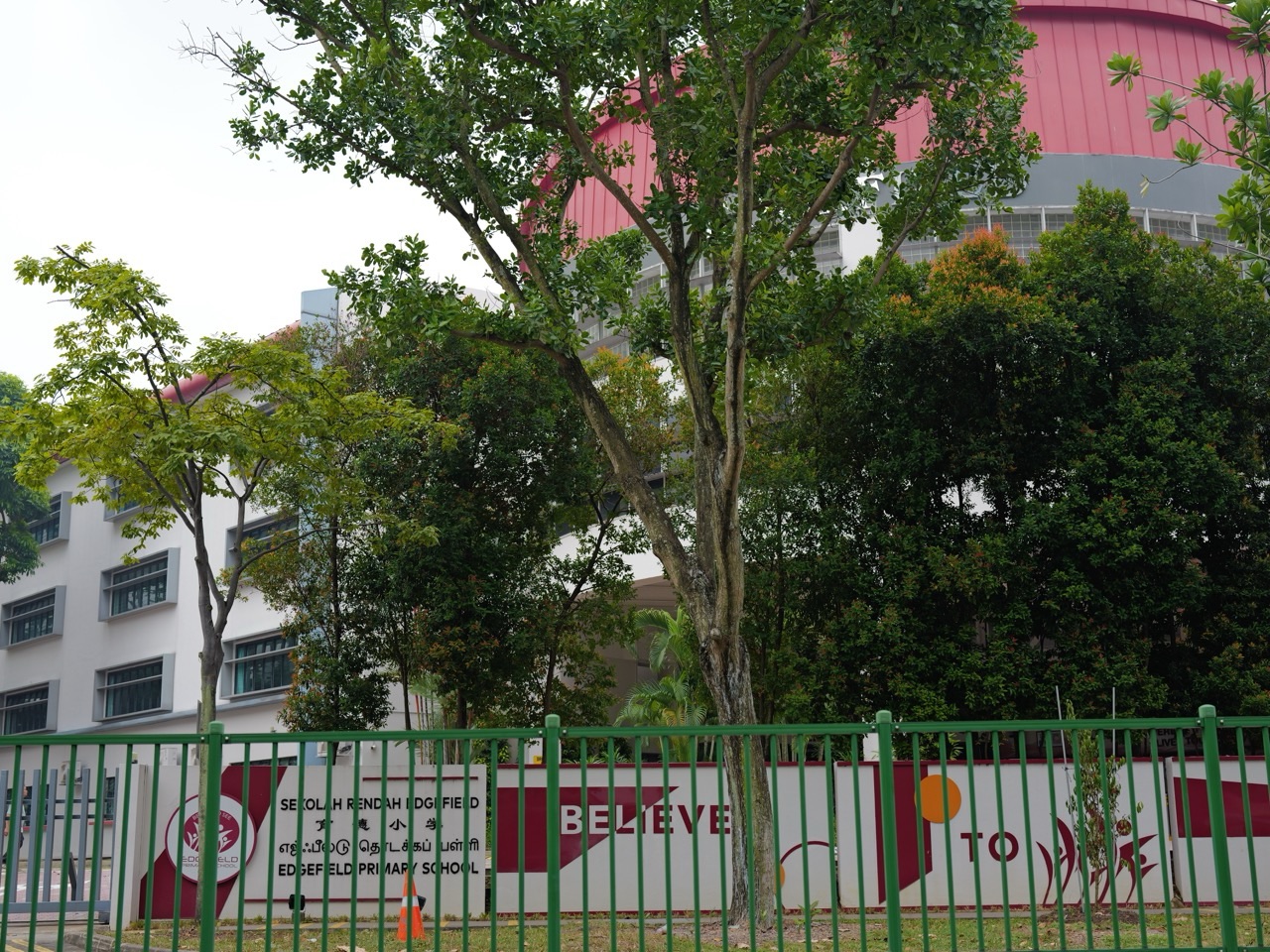
Edgefield Primary School belongs to a completely different chapter of Punggol education from the village schools. It began operating in 2002 and identifies itself as the first primary school in the Punggol 21 estate. That makes its earliest pupils part of the first generation of children growing up inside Singapore’s new waterfront-town experiment.
For readers searching Edgefield Primary School history, first primary school in Punggol, Punggol 21 schools or what education looked like when the new town was still young, the precise answer matters: Edgefield was the first primary school in the Punggol 21 estate. That claim does not erase earlier schools associated with historical Ponggol, such as Sekolah Melayu Ponggol or CHIJ Ponggol. It marks a new-town beginning.
Did you know? Edgefield began operating in 2002 under founding principal Sabrina James, while its official opening took place on 2 July 2004 by then Acting Minister for Education Tharman Shanmugaratnam. Starting lessons and holding an official opening were separate milestones—just as Punggol itself was already functioning while still incomplete.
The Crazy-Rich Idea: A Town Becomes Real When Children Begin Building Memories Inside It
A masterplan is abstract.
A school day is not.
Children walk from home.
Parents learn the route.
Teachers establish routines.
Friendships form.
A neighbourhood stops being “new” once people begin repeating ordinary life inside it.
That is why Edgefield matters to Punggol history.
It marks the moment the new town began producing childhood memory.
2002: The School Begins While Punggol 21 Is Still Becoming Real
Punggol 21 had been unveiled in 1996.
By 2002, families were already living in the new estate, but the town was still far from the mature Punggol residents know today.
There was no Waterway Point.
No Punggol Coast MRT.
No Punggol Digital District.
The Waterway had not yet become the town’s dominant public-space identity.
Edgefield’s first pupils therefore attended school inside a town that was still under construction as an idea.
The First Primary School Is More Than a Date
A new housing estate needs schools quickly because children cannot wait for the town to be “finished”.
Primary education is time-sensitive infrastructure.
If housing arrives without nearby schools, families inherit long daily journeys.
So Edgefield’s founding represents one of the first signs that Punggol 21 was becoming capable of holding an ordinary family day.
A New School Has to Build Culture From Zero
An old school inherits traditions.
A new school has to invent them.
The founding principal and early staff have to decide:
- what routines matter;
- what values become visible;
- how assemblies feel;
- what pupils are encouraged to become;
- what school identity means before alumni even exist.
This is institution-building at its most exposed.
There is no inherited culture to hide behind.
The Founding Pupils Became Part of the School’s Heritage
Later pupils enter a school with established songs, awards, routines and stories.
Founding pupils experience something different.
They are part of the period those later stories will refer back to.
Their first days are not just personal memories.
They become institutional memory.
School History Is Also New-Town History
Urban history often focuses on roads, blocks and transport.
Schools reveal whether the town can support everyday family continuity.
A school tells us:
- families have arrived;
- children need local services;
- daily routines are becoming established;
- the estate is shifting from construction site to community.
That makes Edgefield a social milestone inside the wider Punggol 21 timeline.
For the town-level chronology, continue with Crazy Rich Punggol | Punggol 21, Punggol 21 Plus and the Luxury of a Town That Got a Second Draft.
2004: Official Opening Confirms a School Already in Motion
Edgefield’s Virtual Heritage Gallery records the official opening on 2 July 2004.
This is a useful chronology lesson.
- 2002: school begins operating;
- 2004: official opening ceremony.
Those dates are not contradictory.
One marks function.
One marks public recognition.
Why “First in Punggol 21” Is the Right Phrase
Historical Punggol already had education before 2002.
There was Sekolah Melayu Ponggol.
There was CHIJ Ponggol.
There were institutions tied to the wider old Punggol–Upper Serangoon landscape.
So the precise claim is not:
Edgefield was the first school ever in Punggol.
It is:
Edgefield was the first primary school in the Punggol 21 estate.
One qualifier preserves an entire layer of earlier history.
The School Gives Punggol a Generational Clock
A town can be dated by buildings.
It can also be dated by cohorts.
The first Edgefield pupils entered in 2002.
Those children are now adults.
Some may have younger siblings who experienced a much more mature Punggol.
Eventually, some may raise children in the same town.
That is when a new town starts becoming an intergenerational town.
A Geography Lesson: Schools Reveal Residential Density
A primary school needs a local catchment of children.
That means school openings can be read as indirect evidence of population growth.
As more families move into an estate, demand for school places increases.
The school network therefore grows with the residential geography.
Education infrastructure becomes a map of demographic maturation.
A Mathematics Lesson: Cohorts Turn Town Growth Into Numbers
Students can model a growing school through:
- number of classes;
- average class size;
- intake per year;
- total enrolment;
- number of teachers required;
- classroom capacity.
Then connect those numbers to housing growth nearby.
The school becomes a population model.
An Economics Lesson: Schools Lower the Household Cost of Living in a New Town
A nearby school reduces more than transport expense.
It can reduce:
- parent travel time;
- school-bus dependence;
- child commuting fatigue;
- coordination complexity before and after school.
That makes education infrastructure part of household economics.
A town becomes easier to live in when essential routines require less friction.
An English Lesson: “First” Is One of the Most Dangerous Words in History
“First” sounds precise.
It is only precise when the category is defined.
- First school where?
- First school of what level?
- First in which planning boundary?
- First under which name?
- First to operate or first officially opened?
Edgefield’s history is a perfect lesson in qualification.
The accurate phrase is stronger because it is narrower.
From Village School to New-Town School
Put Sekolah Melayu Ponggol beside Edgefield Primary and the scale of change becomes visible.
The village school served a rural community.
Edgefield served the first generation of a masterplanned HDB town.
The educational function remained:
children need a place where knowledge, routine and community can continue into the next generation.
The system around that function became dramatically larger.
The Current Parent Guide Owns Today’s School-Choice Question
This page owns heritage and the Punggol 21 beginning.
For current programmes, school information and parent considerations, use the separate Edgefield Primary School parent guide.
That separation keeps a 2002 history article from pretending to answer a 2026 school-choice question.
Evidence Anchors
- Edgefield Primary School — official school history
- Edgefield Primary School — Virtual Heritage Gallery
The crazy-rich Punggol lesson is that town-building becomes real when the first cohort of children can grow up without leaving the town for every essential part of life. Edgefield was not only a school opening. It was proof that Punggol 21 was becoming capable of raising a generation.
Edgefield Primary School began operating in 2002 and identifies itself as the first primary school in the Punggol 21 estate. Its early history captures a different stage from Punggol’s older village schools: the creation of a school community in a developing new town.
Founding principal Sabrina James led its early development. The school’s official opening took place in 2004. Starting lessons and holding an official opening were separate events, so both dates have a place in the timeline.
For readers asking which was the first primary school in Punggol 21, Edgefield is the documented answer. The qualification ‘in the Punggol 21 estate’ matters: it does not erase the earlier schools associated with the wider historical Punggol area.
Choose your reading route
The beginning in 2002 · Why ‘first in Punggol 21’ is the precise claim · The official opening in 2004
CHAPTER 1 OF 5
1. The beginning in 2002
Edgefield Primary’s official school history provides the founding account. It describes an emphasis on academic learning alongside social, moral and leadership development.
A new school needs more than its completed classrooms. Teachers and pupils must establish routines, relationships and a shared sense of belonging. This is the human part of a new town’s development: a place becomes familiar through repeated daily activities.
The founding cohort provides a useful scale for understanding that beginning. A reader can picture a smaller community forming the habits that later pupils would inherit, without assuming that every feature of today’s school already existed.
CHAPTER 2 OF 5
2. Why ‘first in Punggol 21’ is the precise claim
History uses boundaries as well as dates. ‘First school in a new estate’ is a different claim from ‘first school ever associated with a place name’. The first concerns a particular development; the second concerns a much broader historical landscape.
Earlier educational stories include Sekolah Melayu Ponggol and Hai Sing’s Upper Serangoon origins. They belong to other settings and institutional journeys.
Keeping the qualification makes a timeline more accurate and more interesting. It allows the reader to see a new-town beginning alongside older educational traditions, rather than replacing one with the other.
Previous chapter · Contents · Next chapter
CHAPTER 3 OF 5
3. The official opening in 2004
The school’s Virtual Heritage Gallery records its official opening on 2 July 2004 by then Acting Minister for Education Tharman Shanmugaratnam.
An opening ceremony marks public recognition of an institution. It is not necessarily the first day its pupils enter classrooms. When preparing a project, label these events rather than treating the two years as competing answers.
A simple timeline can therefore have one entry for the start of operations and another for the formal opening. That small distinction prevents a common error in school and community-building histories.
Previous chapter · Contents · Next chapter
CHAPTER 4 OF 5
4. School history as new-town history
An estate is experienced through recurring journeys: leaving home, reaching school, meeting friends and returning. Studying the earliest school community offers a way to understand the development of everyday life rather than only the development of buildings.
For an interview with a founding pupil or parent, ask what they remember about the route to school, the surrounding streets and their first friendships. These are questions to investigate, not details that should be supplied from imagination.
The Punggol 21 development timeline gives the town-level setting. A school recollection can add the household and child-level experience within it.
Previous chapter · Contents · Next chapter
CHAPTER 5 OF 5
5. Heritage and present school choice
The existing Edgefield Primary parent guide addresses programmes and practical family questions. Historical priority is an interesting fact; present suitability depends on current information and the child’s needs.
A student researching the school can start with its documented beginning, distinguish the formal opening, and explain what a school contributes to a growing neighbourhood. This gives the dates a purpose within the account.
Use the Punggol history directory to compare Edgefield’s new-town story with institutions that moved into Punggol or carried an older Punggol name into another neighbourhood.


