
Did you know? In the first Singapore-Cambridge Secondary Education Certificate (SEC) in 2027, a candidate taking G3 English Language K300 must write a 250–350-word situational response and a 350–500-word continuous-writing composition in Paper 1. Yet a beautifully written essay can still lose marks if it fails to answer the exact question or misuses the information in the visual stimulus. This is why useful English tuition begins with purpose and evidence, not with more elaborate adjectives.
The other easily missed rule concerns Listening. The 2027 K300 paper contains a short information note-taking task whose recording is heard only once, while recordings for the earlier listening section are heard twice. Practising all recordings with unlimited replay is helpful when first learning a skill, but it is not a realistic final exam simulation.
This guide is for Punggol Secondary 4 students registered for G3 English K300, not G2 K200 or G1 K100. It interprets the actual syllabus, shows original worked examples and helps parents understand what a genuine three-student tutorial should improve. Every practice passage below is fictional and is not a claim about the actual 2027 question.
Which 2027 English syllabus is correct?
SEAB’s 2027 G3 school-candidate register identifies English Language K300, formerly English Language 1184. The official K300 syllabus PDF is the source for the durations, mark allocations and assessment criteria described here.
Under Full Subject-Based Banding, English is offered at different subject levels. An individual’s registered level, not a generic “Secondary 4 English” tuition label, determines which paper structure applies. Parents should verify the school registration before selecting question banks and asking tutors to set mock examinations.
The 2027 SEC introduces a common examination certificate, but that does not make G1, G2 and G3 English syllabuses interchangeable. The purpose and language skills may overlap, while specific written lengths, question sections and expectations differ.
The official four-paper K300 structure
The published K300 syllabus prescribes four compulsory papers, with 180 raw marks distributed across the following components:
- Paper 1, Writing: 1 hour 50 minutes, 70 marks, 35% of the final subject weighting. Editing 10, Situational Writing 30, Continuous Writing 30.
- Paper 2, Comprehension: 1 hour 50 minutes, 50 marks, 35%. Section A two short texts including a visual text, 5 marks; Section B narrative/recount, 20; Section C non-narrative passage including a summary, 25.
- Paper 3, Listening: approximately 45 minutes, 30 marks, 10%. Section A 22 marks; one-play Section B note-taking 8 marks.
- Paper 4, Oral Communication: approximately 20 minutes including 10 minutes of preparation, 30 marks, 20%. Planned Response 15; Spoken Interaction 15.
The raw marks should not simply be added to estimate a final percentage without applying the paper weightings. For instance, Paper 1 and Paper 2 both carry 35% despite having different raw mark totals.
A strong study plan allocates attention according to weighting and individual needs, not weighting alone. A pupil with a serious listening weakness may need frequent short listening sessions even though Listening carries 10%, while another needs concentrated work on sustained reading and writing.
Paper 1 Section A: understand the grammar correction
Editing involves identifying grammatical errors in prose. The K300 syllabus says that spelling and punctuation errors are not tested in that particular Editing section. This does not remove the importance of spelling and punctuation in other written responses.
Original practice: “Each of the pupils have received the instructions.” A student should change have to has because the head of the subject is each, which is singular.
Change the subject: “All of the pupils have received the instructions.” Now the plural verb is correct. Without understanding the grammatical relationship, a learner may memorise the previous answer and incorrectly change every occurrence of “have”.
A useful lesson asks why a correction is appropriate, then requires the child to detect the same principle in a different sentence. Error correction without explanation often produces a temporary improvement that disappears when the wording changes.
Paper 1 Section B: purpose, audience and context
Situational Writing is worth 30 marks and asks for 250–350 words on a situation accompanied by a visual text. The text form might be an email, report, speech or letter, as specified in the question.
Original fictional task: You are part of your school’s student committee. Write to the teacher coordinating a school learning fair to propose a quiet reading corner and explain how it would operate.
A weak opening might be: “Reading is amazing. Books are exciting. Everyone should read because reading is good.” The general sentiment is clear, but the recipient still has no concrete proposal or required information.
A stronger opening could be: “I am writing on behalf of the student committee to propose a quiet reading corner during the learning fair. We suggest using the spare discussion room from 11 a.m. to 1 p.m., subject to teacher approval, with a small selection of books and a volunteer sign-up sheet.”
This identifies the writer, recipient, intended action and practical arrangements. The figures are invented for the teaching scenario and not an actual school schedule.
The complete answer would need to develop all compulsory task points, incorporate the given visual information accurately and choose a suitable tone. A fluent composition on a different topic is not a successful situational response.
Worked example: a visual detail changes what must be written
Imagine an invented poster for the fair states that volunteers must register by Monday, but the fair itself takes place on Friday. A pupil writing “The event will happen on Monday” has confused the registration deadline with the event date.
The problem is not advanced vocabulary; it is reading the relationship between information and purpose. A tutor can ask the learner to label every date, place and person on the visual text before writing.
A complete situational-writing response should also consider its audience. A speech to classmates may use a different greeting and tone from a report to a coordinator, even if both concern the same event.
The final check should be: Have I answered what the reader needs to know, or merely written something that sounds sophisticated?
Paper 1 Section C: an argument must develop distinct reasons
Continuous Writing is also worth 30 marks. Candidates select one of four topics and write 350–500 words, choosing a mode appropriate to the actual prompt, such as narrative or argument.
Original argumentative topic: “Should students be encouraged to take part in neighbourhood activities?”
A weak plan repeats “It is good” in three paragraphs. A stronger plan examines community understanding, skills built through meaningful participation and conditions under which participation remains fair and manageable.
An original possible thesis is: “Schools should encourage meaningful neighbourhood participation because it helps students understand different needs and practise responsibility, but activities should allow choice, adequate supervision and time for rest.”
The opening establishes a position and an important qualification. The rest of the essay should support the claim with plausible examples, consider limitations without false balance and finish by directly addressing the question.
For narrative topics, the pupil needs a coherent series of events: setup, complication, decision, action and consequence. Plot memorisation without relevance is as weak as an argument that never develops its central idea.
The hidden reading problem: inference versus invention
Original fictional reading passage: “Amir returned to the rehearsal room after everyone had left. He read the feedback sheet twice, circled one suggestion, and asked his teacher whether he could attempt the presentation again.”
A literal question might ask what he circled. He circled one suggestion on the feedback sheet.
An inference question might ask what his actions suggest about his attitude. A defensible response is that he takes feedback seriously and wants to improve. His repeated reading, circling and request to try again are the evidence.
An unsupported answer would claim his parents punished him for poor performance. Nothing in the passage establishes punishment or an examination grade.
A useful three-step method is claim → clue → explanation, followed by a limit: does the evidence genuinely support the strength of the claim? Better reading answers are often more precise, not longer.
Language for effect is not a device-label competition
Consider two original sentences: “The corridor was silent” and “The corridor swallowed the echo of her shoes.” The second gives the corridor a figurative action, suggesting that sound seems to disappear into the stillness.
A student who only writes “personification” has named a technique but not explained its effect. A stronger answer explains how the image shapes the reader’s impression of quiet, perhaps unsettling or peaceful depending on the surrounding context.
A tutor should ask what the specific words make the reader imagine, why they are more effective than a neutral description and which nearby details support the interpretation.
There is no rule that every instance of personification automatically creates suspense. A literary interpretation must remain accountable to the passage.
Paper 2 Section A: two texts, one visual
The Comprehension paper begins with short texts, one involving visual information. Students may need to read headings, captions, dates or other visual features alongside prose.
For an original exercise, consider a poster showing “Registration closes Wednesday” and a paragraph stating “The programme begins on Saturday”. An answer claiming the programme begins Wednesday reflects a misread label, not a vocabulary deficit.
The student should identify what the text actually says about who, when, where, why and for whom. If visual evidence conflicts with the written passage, the pupil must not silently ignore the contradiction; they should read the task instructions closely and recognise the intended source.
These are useful skills beyond exams because modern communication combines images, text and numbers.
Paper 2 Section C: summary without distortion
The non-narrative passage includes a summary writing task of about 80 words, excluding the introductory words supplied by the paper. Good summarising is a process of selecting and organising ideas, not finding the longest possible synonyms.
Original source paragraph: “The school opened a student-led study corner to give pupils a quiet place to revise. More people began using it, so the organisers introduced separate spaces for individual reading and group discussion. Volunteers also prepared a simple booking sheet to prevent confusion.”
A concise summary could say: “The school created a quiet student-led study area. As usage increased, organisers separated individual reading from group discussion and introduced a booking sheet to manage access more clearly.”
This preserves the cause and measures. It does not claim that every pupil supported the change or that the scheme succeeded permanently; those details were never established.
A frequent error is paraphrasing “some” as “all”, or “may” as “will”. That changes certainty and therefore meaning. Ask students to compare each summary sentence with the source before polishing the language.
Paper 3: listening for final decisions
The 2027 K300 Listening paper has 22 marks of tasks involving twice-heard recordings in Section A and 8 marks of information note-taking on a once-heard recording in Section B.
Original fictional announcement: “The science fair was initially planned for 2:15 p.m. in the hall. Because the hall is needed elsewhere, the event will begin at 3 p.m. in Room 3. Participants should bring their school tablets; printed handouts will be provided.”
The final start time is 3 p.m., the final venue Room 3, and the required item a school tablet. A pupil who records the earlier hall or time has missed the revision signal.
A useful note-taking grid includes time, place, action, reason and required items. Initial teaching may use replay for explanation, but final practice for the eight-mark task should respect the one-play condition.
The purpose is selective comprehension, not a speed contest in copying every spoken word.
Paper 4: Planned Response and Spoken Interaction
The 2027 Oral Communication paper lasts about 20 minutes including 10 minutes of preparation. The candidate plans and delivers a response of up to two minutes to an on-screen video and prompt, then discusses a broadly related topic with examiners. The official syllabus says candidates are not tested on recalling what people said in the video.
Original video-practice scenario: Residents are trying to organise a shared community reading event.
A Planned Response might explain how community reading can benefit families, with a specific example of older and younger readers learning from one another. A Spoken Interaction follow-up could ask whether activities should always be free to join.
A stronger response recognises access and cost constraints, offers a position and explains its reasoning. It should not rely on a memorised full speech about “community service” that ignores the examiner’s actual question.
A useful pattern is viewpoint → reason → illustration → qualification, applied naturally rather than repeated as four compulsory sentence openings.
Vocabulary precision: the difference between a stronger argument and a louder one
Terms such as suggests, indicates, demonstrates and proves carry different degrees of certainty. A pupil who claims a small survey “proves” that every student wants the same thing may be making a logical and language error at once.
Likewise, reluctant and cautious are not identical. The former suggests unwillingness or hesitation; the latter can mean thoughtful attention to risk. Context determines which description is fair.
A vocabulary plan should group related words, explain their distinctions and ask for independent use across reading, conversation and writing. Spaced retrieval helps: revisit words after days and interleave them with earlier material.
The purpose of richer vocabulary is more precise thought, not decorative complexity.
An error log that changes the next lesson
- Task fulfilment: a situational-writing response fails to address a required point.
- Audience: the tone is inappropriate for the recipient.
- Grammar: the student selects a verb based on a nearby noun instead of the real subject.
- Reading evidence: a plausible inference is unsupported by the passage.
- Language effect: a device is named but its impact is never explained.
- Summary: a paraphrase exaggerates or omits an important relationship.
- Listening: the first detail is treated as final after an announced correction.
- Oral: a memorised answer does not respond to the follow-up.
- Timing: too much time is spent polishing one opening while a compulsory section remains incomplete.
Record the first incorrect decision, its cause and a fresh changed exercise. A student who can solve a different question unaided has shown more progress than one who merely copies a model correction.
A practical SEC 2027 English calendar
Term 1: find the first weak link
Confirm K300 registration and gather recent marked work. Check situational task completion, argument structure, comprehension inference, summary accuracy, once-heard listening and spontaneous oral development separately. Choose the two highest-impact gaps.
Term 2: develop clarity and transfer
Use original texts and unfamiliar visuals. Practise audience-aware writing, reading evidence, word choice and the 80-word summary. Review corrections after a delay without announcing the same topic in advance.
Term 3: integrate the actual paper structure
Once the fundamentals are stable, practise Writing and Comprehension at 1 hour 50 minutes each, Listening at about 45 minutes, and the video-based oral format. Review both marks and the specific causes of lost performance.
Final SEC period: protect reliable performance
Use the school’s confirmed timetable and the SEAB SEC information portal. Consolidate recurring mistakes, keep routines consistent and avoid unverified predicted essays or late-night drilling that undermines concentration.
What a three-student tutorial should actually do
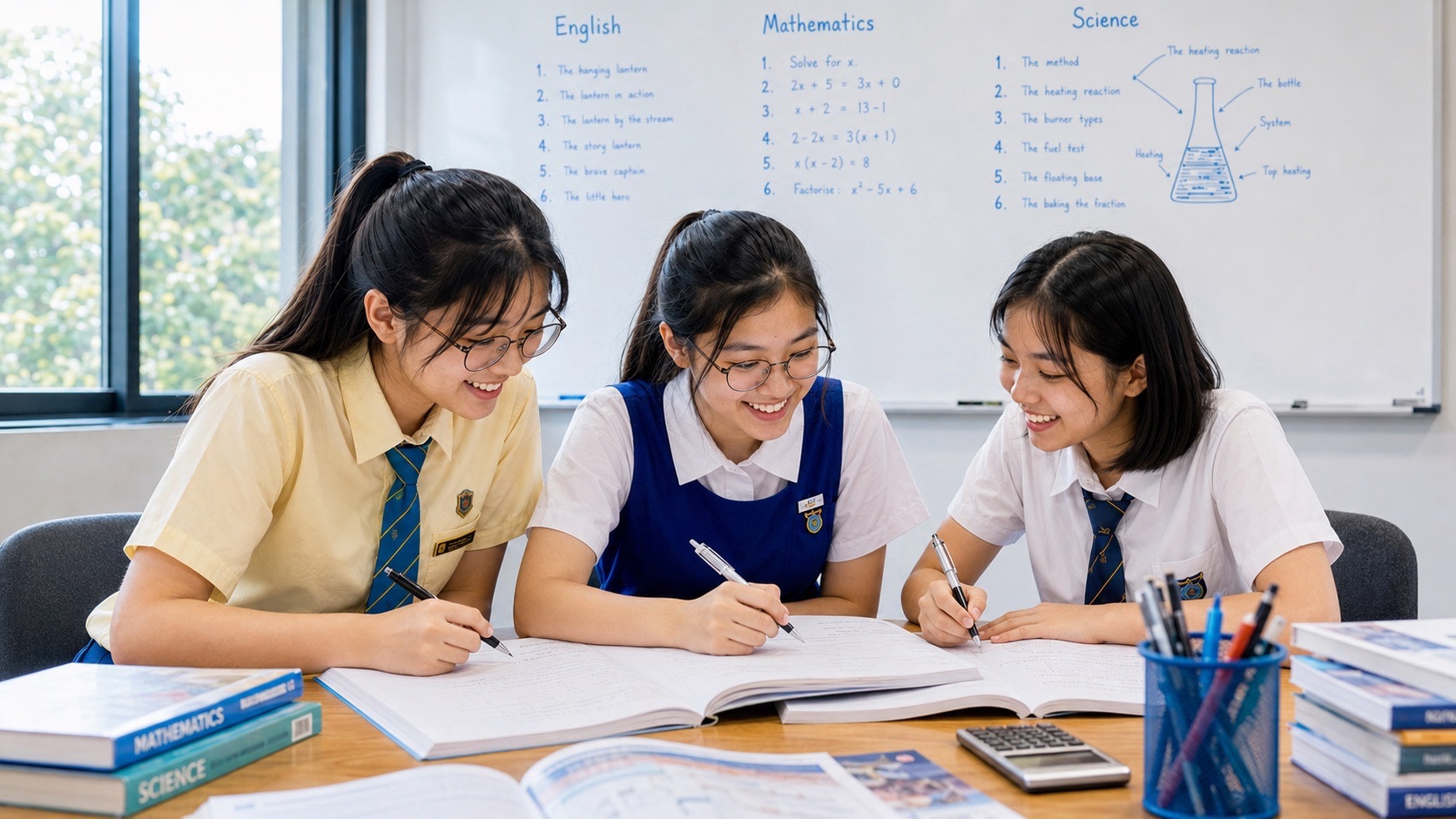
In a true three-pupil tutorial, one learner can explain a reading inference, another can show the exact supporting words and a third can challenge an overstatement. Each must then answer a different passage independently.
For writing, the tutor can inspect three distinct paragraph plans and correct the first problem in each. A 1.5-hour lesson can combine retrieval, explanation, guided practice, individual feedback and a transfer task without becoming a mass worksheet session.
The eduKate small-group approach is meaningful only if students become more independent. Families should confirm the timetable and suitable tutor for K300 before booking rather than assume every subject is offered in every time slot.
Read Secondary 4 English tuition at eduKatePunggol, the existing 2027 K300 overview, the G2 English K200 comparison and why eduKate chooses three students.
Parent questions to ask a tutor
- Has the tutor confirmed that the child is taking G3 English K300?
- Is the 250–350-word situational task taught with its audience and visual information?
- Can the student develop a 350–500-word narrative or argument that directly answers a new prompt?
- Does the child support reading inferences with accurate evidence?
- Is the Section C summary taught as an 80-word exercise in faithful meaning?
- Does listening include both twice-played and once-played conditions?
- Can the student respond thoughtfully to an unfamiliar video and oral follow-up?
- How will the tutor show independent improvement after four weeks?
Frequently asked questions
Is SEC G3 English K300 the same as K200?
No. They are different subject levels. K300 specifies its own writing lengths and assessment demands. Use the official syllabus matching the registration.
Are all four papers compulsory?
Yes. The published K300 scheme assesses Writing, Comprehension, Listening and Oral Communication with 35%, 35%, 10% and 20% weightings.
Can the candidate listen to the note-taking recording twice?
No. Section B’s recording is heard only once; Section A recordings are heard twice.
Do candidates have to describe every moment of the video in oral?
No. They give a Planned Response to the prompt and participate in a broader discussion. The syllabus says they will not be quizzed on what people said in the video.
Does using impressive words guarantee strong continuous writing?
No. Task fulfilment, coherence, accurate language, evidence and appropriate development remain essential. Vocabulary strengthens expression when it conveys meaning precisely.
The Punggol 2027 takeaway
G3 English K300 is a full communication course, not just a composition test. Strong preparation combines purposeful writing, evidence-based reading, concise summary, selective listening and adaptable oral reasoning. Choose the correct four-paper format and teach the first principle that the student has misunderstood.
Official references: SEAB 2027 G3 English K300 syllabus and G3 school-candidate syllabus register. Reviewed 29 October 2026; later official amendments and school instructions take precedence.


