
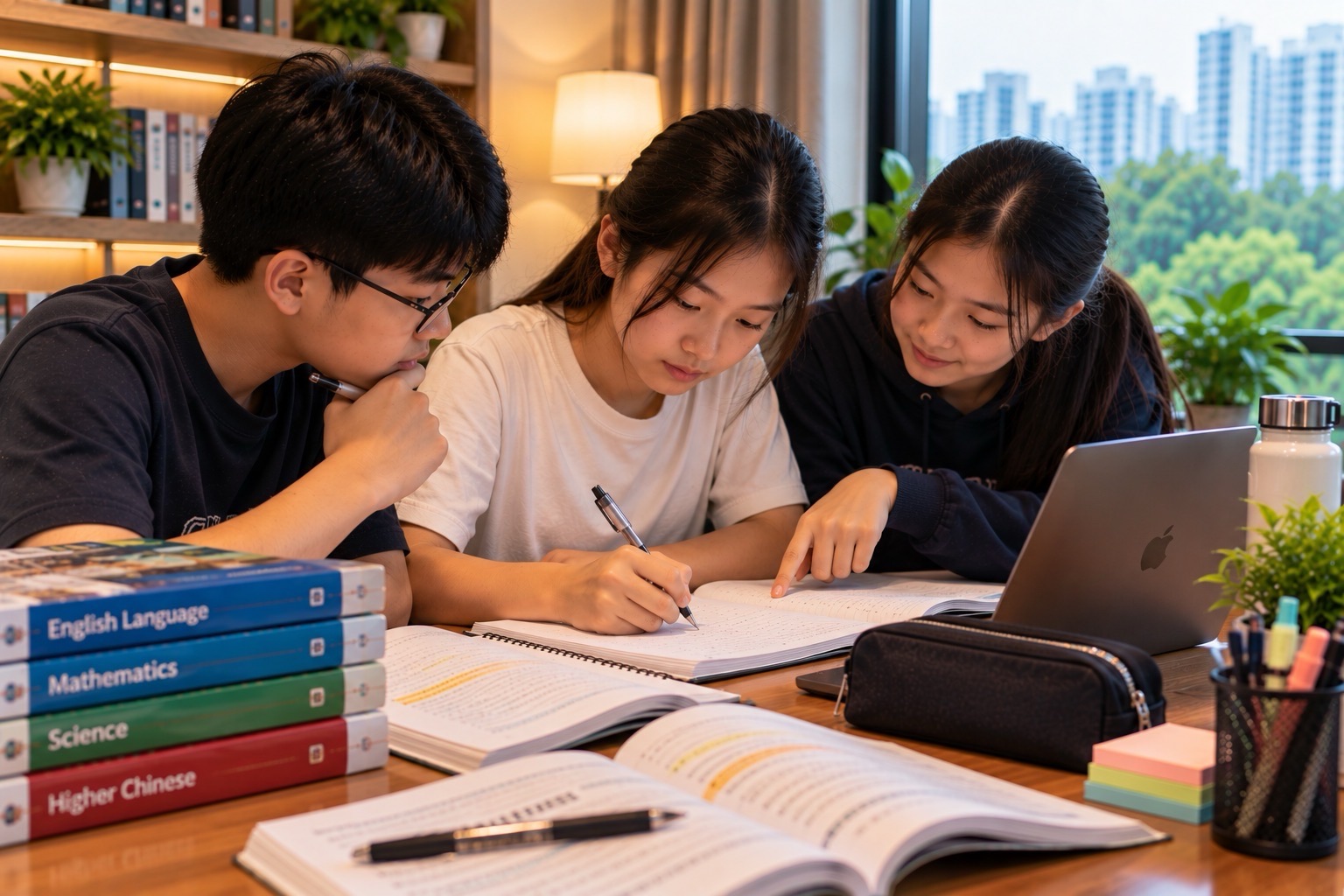
Did you know? A Secondary 4 student taking G2 Humanities (Social Studies, Literature in English) K231 at SEC 2027 has two compulsory components worth 50% each, but their examination tasks are fundamentally different. Social Studies requires evidence from sources and reasoned responses about society. Literature in English requires a close analysis of a prescribed prose work and an unseen poem. Practising only one half is not a strategy; it leaves half the examination unsupported.
A second detail deserves attention: the published 2027 K231 syllabus specifies a hardcopy Social Studies question paper with a digital answer booklet into which candidates type responses. The Literature assessment is a different paper with its own instructions. Punggol families should ask schools about the sanctioned digital examination familiarisation instead of assuming that personal laptops or unrestricted word-processing tools are permitted.
This guide is for G2 K231, not G3 Humanities K337 or standalone G2 Literature in English K228. It explains the official scheme, two original evidence exercises, a short original unseen poem and a school-aligned revision plan that makes the learner more independent.
Find the correct national syllabus before buying papers
SEAB’s 2027 G2 school-candidate register identifies Humanities (Social Studies, Literature in English) K231, formerly subject code 2127.
The official 2027 K231 syllabus defines the two papers, content themes, assessment objectives and prescribed texts.
For comparison, K229 is G2 Humanities with Geography; K230 combines Social Studies with History; K337 is the G3 Social Studies/Literature combination. K228 is standalone G2 Literature with different requirements. These are separate examination registrations, even when some literary works or thinking skills overlap.
Ask the child for their actual school programme and selected prose text. The school, not the tuition centre, decides which prescribed text is being taught.
The 2027 K231 paper structure
The official document prescribes two compulsory papers:
- Paper 1 — Social Studies: 1 hour 45 minutes, 50 marks, 50%.
- Paper 2 — Literature in English: 1 hour 40 minutes, 50 marks, 50%.
- Social Studies Section A: a 35-mark Source-Based Case Study consisting of five questions. The first four carry 25 marks together; the fifth carries 10 marks and requires multiple sources.
- Social Studies Section B: two compulsory Structured-Response Questions carrying 15 marks: one 7-mark recommendation or reasoned explanation and one 8-mark explanation of two factors or perspectives.
- Literature Section A — Prose: one question on the prescribed text studied, 25 marks. The options include one passage-based question and two essay questions for each set text.
- Literature Section B — Unseen Poetry: one question from a choice of two unfamiliar poems, 25 marks.
The Social Studies source paper is supplied in hard copy, and responses must be typed in the digital answer booklet, following the current specification. Candidates should follow school-provided guidance about the actual interface, access arrangements and permissible controls.
The two Literature answers each make up a quarter of the combined Humanities weighting. A learner cannot replace unseen poetry with a second prose essay.
What Social Studies asks students to understand
The official G2 Social Studies syllabus is organised into three issues:
- Exploring Citizenship and Governance: how people and government may work for the good of society, and how different interests create choices and trade-offs.
- Living in a Diverse Society: identity, cohesion, mutual understanding and possible responses to diversity.
- Being Part of a Globalised World: interdependence, economic effects of globalisation and responses by countries and individuals.
These themes develop informed citizenship and the habit of looking at a situation from more than one perspective. But the examination is not asking candidates to repeat slogans. It requires reasoning with the particular sources and question supplied.
If a source makes a claim about one service, a pupil should not turn it into a population-wide statistic without evidence. If a policy is proposed but not implemented, the student should distinguish intended benefits from observed results.
Worked example 1: what can a fictional source establish?
Original practice source; the following is an invented classroom exercise, not a government notice:
“A student writes: ‘Online registration for community activities is easier for my family. However, my grandfather often needs help entering the correct details, and we sometimes complete the form together.’”
Question: What does this source suggest about digital services?
A supported inference is that digital services can be convenient for some users while introducing barriers for people less comfortable with online forms. The student’s family benefits from the service, while the grandfather needs assistance.
A weak answer would claim that all older residents are banned from activities or that the website is designed to exclude them. Neither conclusion follows from the quotation.
Good source handling involves claim → relevant evidence → explanation → limitation. A clear conclusion should use precisely what the source says, not exaggerate its implications.
Worked example 2: useful evidence and unreliable generalisation
The fictional student’s statement may be useful for understanding one person’s experience and how a family responds to a difficulty. It is not sufficient to estimate what proportion of Punggol residents cannot use online registration.
Now imagine a second fictional source from a service office stating that an invented 90% of bookings in one week were submitted online. Even if accurate for that week, the number would not establish that all users found the experience easy. It could conceal those who did not apply or sought help.
The second source may be useful for operational uptake; the first may reveal individual access challenges. Their usefulness depends on the exact research question.
The student must avoid the formula “personal source = biased = useless”. Personal testimony can be important evidence for certain inquiries while being limited for others.
Worked example 3: combining sources in the ten-mark question
A fictional case study includes three sources:
- Source A: an online booking system reduces waiting time for some users.
- Source B: a small group of respondents reports difficulty accessing the website.
- Source C: a proposal suggests adding a staffed help desk but supplies no outcome data.
A multi-source judgement could explain that online booking has credible convenience benefits, while accessibility concerns make complementary assistance worth considering. But Source C is an untested proposal, so the answer should not announce that the desk has already solved the problem.
The fifth Social Studies source question expects the candidate to evaluate an issue using multiple sources, not write three unrelated descriptions with no overall answer.
A tutor can train this through an evidence grid identifying supporting statements, qualifying statements and the limits of each source. Then each student must write a new judgement unaided.
Worked example 4: a 7-mark recommendation requires a reason
Original discussion task: Suggest a way to help different age groups participate in community learning activities.
A weak answer says, “Everyone should be included.” That is an aim but not a specific measure with an explanation.
A stronger answer might recommend clear printed and online information combined with supervised assistance during registration. It can explain how this addresses people who use different communication channels, while noting resource and staffing costs.
The precise school task may call for a different solution. The reliable principle is to identify a challenge, propose one feasible strategy, explain how it works and qualify its limits.
For an 8-mark question on two factors or perspectives, the candidate should explain both with relevant knowledge and not substitute a list of examples for developed reasoning.
Literature: what is different from Social Studies?
Social Studies often evaluates statements about policy, society or collective decision-making. Literature interprets the writer’s choices in a text: characterisation, imagery, narrative perspective, form and structure.
An opinion about a character is not automatically a sound literary analysis. The student must identify details that support the reading and explain why the author’s presentation makes that interpretation plausible.
For prose, this may involve a significant choice a character makes, how a scene is narrated or why a particular object recurs. For poetry, it may involve line breaks, sound, images, tone or changes in the speaker’s perspective.
A student can know the plot and still be weak at analysing writerly choices. That is a different diagnosis from a Social Studies pupil who cannot evaluate source usefulness.
Which prose work should a Punggol pupil study?
The official 2027 K231 prescribed list includes five possibilities:
- How We Live Now, edited by Yu-Mei Balasingamchow.
- All the Light We Cannot See, by Anthony Doerr.
- Lord of the Flies, by William Golding.
- Roll of Thunder, Hear My Cry, by Mildred D. Taylor.
- The Chrysalids, by John Wyndham.
These are the list of permitted set texts, not a direction for every student to purchase and read all five. Your child’s school selects the actual work. SEAB also cautions against using abridged versions or screenplays in place of prescribed texts.
A tutor offering Literature help must verify the assigned book and edition before providing “model essays”. A confident analysis of a different novel is not a relevant response to the actual set-text question.
Worked example 5: plot summary is not literary analysis
Original fictional practice passage, not taken from any prescribed book:
“When the teacher announced the selection, Mira smoothed the folded letter until its edges matched. Her classmates were celebrating, but she kept looking at the empty chair beside the door.”
A plot summary says that a selection was announced and Mira looked at an empty chair. An analytical response might argue that Mira appears distracted or conflicted despite the class’s celebration, supported by her careful handling of the letter and repeated attention to the empty chair.
Yet the passage does not establish who should be sitting there or why Mira behaves that way. A good student qualifies the interpretation instead of inventing a family tragedy or an argument.
Ask: What contrast is created? What does the writer choose to describe? How does that choice shape the reader’s understanding? Why might the empty chair matter in a wider passage?
These questions move the learner from what happened to how meaning is presented.
Worked example 6: an original unseen poem
The following four lines were written specifically for this exercise and are not an examination or published poem:
“Under the lamp, the last page turns;
A window holds the evening rain.
My pencil rests beside tomorrow,
Then moves to write the first word again.”
Question: How does the speaker convey hesitation and renewed determination?
The resting pencil could suggest a pause or uncertainty. The reference to tomorrow introduces future possibility, while the final movement back to writing suggests renewed effort.
A learner might also explore the contrast between stillness in the earlier lines and the purposeful action of the ending. The image of the window holding rain can create a sense of enclosure or reflective quiet.
However, the poem does not prove that the speaker failed an examination or was punished. Such details would be invented. A sound response uses wording, imagery and structure to support a plausible impression.
Explain literary technique in context, not as a label
Compare “The house was quiet” with “The house held its breath.” The second personifies the building and may suggest an expectant stillness. Whether the effect is unsettling or comforting depends on the scene.
A student who writes only “The writer uses personification” has identified a device but not explained its impact. The next step is to show what the image makes the reader feel or imagine and how that impression relates to the question.
The same discipline applies to metaphors, contrasts, narrative voice and rhythm. Technique → specific effect → relevance is more useful than a list of ten technique names with no interpretation.
Different interpretations can be defensible, but they are not automatically equally supported. Evidence and coherence matter.
Why unseen poetry requires genuine unfamiliar practice
A student may memorise polished answers about five familiar poems and still be unprepared for the unfamiliar text they receive in Paper 2. The syllabus explicitly provides a choice of two unseen poems and requires candidates to answer one.
Therefore, a useful tuition programme should present fresh poems, give time for independent first reading and help students identify a central impression before teaching a device-by-device response.
Ask the pupil to explain the speaker’s situation, tonal changes, significant imagery and structure. Then compare the interpretation with the wording. If the learner relies entirely on one teacher’s pre-written meaning, independent analysis has not developed.
A short but coherent response with well-chosen textual evidence may be stronger than a long response listing every line without insight.
How the 2027 digital Social Studies answer booklet affects practice
The K231 syllabus specifically requires typed answers in a digital booklet while the Social Studies question paper remains in hard copy. The examination centre and school supply the relevant arrangements.
This calls for practical familiarity with reading printed sources and drafting concise typed answers. It does not justify assuming that candidates can browse the internet, access personal documents or use spelling assistance. Follow the approved official system.
A tutor may practise paragraph planning and basic typing comfort, but should defer to the school for exact examination-device familiarisation and access arrangements.
Literature should be taught under its own paper instructions; do not simply assume that every component uses an identical digital interface.
An error log with two separate learning lanes
- Social Studies inference: a claim lacks evidence from the given source.
- Provenance: author, purpose or context is dismissed with a generic “biased”.
- Source synthesis: the ten-mark question is answered from only one source.
- Structured response: a recommendation is offered without explaining how it would work.
- Literature plot dependence: paragraphs retell events without analysing the writer’s choices.
- Technique spotting: imagery or personification is named but its effect unexplained.
- Unseen uncertainty: the student invents plot details not found in the poem.
- Set-text mismatch: practice essays cover the wrong prescribed work.
- Timing: too much time is spent on one response, leaving another compulsory question unfinished.
Record the first incorrect decision and a specific repair. Return to a changed question after a few days to test whether the correction lasts.
A practical 2027 K231 preparation calendar
Term 1: verify code and prose text
Confirm K231, gather the student’s school-selected prose work and diagnose Social Studies source analysis and Literature close reading separately. Develop reliable factual reading and short evidence-backed paragraphs.
Term 2: build confidence with evidence
For Social Studies, compare source perspectives, reliability and meaningful policy trade-offs. For Literature, analyse brief prose extracts and original unfamiliar poems. Review corrected errors through spaced retrieval.
Term 3: practise the official two-paper scheme
Use the 1-hour-45-minute Social Studies and 1-hour-40-minute Literature durations when readiness allows. Rehearse the Social Studies 35/15 mark split and the Literature one-prose-plus-one-poem requirement.
Final SEC period: keep revision honest
Use the SEAB SEC portal and school for confirmed dates and the digital-answer arrangements. Reduce untested shortcuts and protect sleep, reading concentration and time for other subjects.
What a three-student Humanities tutorial can achieve
In a three-student tutorial, one pupil can identify a source claim, another evaluate its origin and a third question whether the conclusion overstates the evidence. The tutor then gives each child an unfamiliar source to interpret independently.
For Literature, pupils can suggest distinct readings of a short passage, compare the supporting words and explain how specific imagery affects meaning. The benefit is close feedback and accountable reasoning, not three students copying one answer.
eduKate’s 1.5-hour small-group philosophy emphasises explanation from first principles, carefully sequenced work and independent transfer. Families should confirm that a qualified K231 Humanities specialist, correct prose-text coverage and a suitable class are actually available.
Read the G2/G3 Humanities Literature comparison, the Punggol K231 Literature guide, the G3 K337 comparison and why eduKate chooses three-student classes.
Questions for a Punggol parent–student consultation
- Has the student’s registration been checked for G2 Humanities K231?
- Which of the prescribed prose books does the school actually use?
- Can the tutor teach the 35-mark source case study and the 7/8-mark structured responses?
- Does the student recognise the difference between useful personal testimony and a representative population statistic?
- Will Literature practice include fresh unseen poems rather than memorised stock answers?
- How does the tutor check analysis of language effect rather than plot retelling?
- Can a learner draft concise typed source responses using only school-approved arrangements?
- Will each feedback session include a new independent task?
Frequently asked questions
Is K231 the same as separate Literature K228?
No. K231 is a combined Humanities examination with Social Studies and a Literature component. K228 is standalone G2 Literature with its own assessment.
Does K231 include a Drama paper?
No. Its Literature component is Prose and Unseen Poetry, requiring one answer on a set prose work and one on an unseen poem.
Are both Humanities components compulsory?
Yes. Social Studies and Literature each carry 50%.
Must K231 candidates type Social Studies answers?
The published 2027 syllabus requires typed responses in a digital answer booklet for Social Studies, with printed question papers. Follow official school instructions.
Is the fifth source question an optional longer question?
No. It is the compulsory ten-mark multiple-source question within the 35-mark Source-Based Case Study.
The Punggol 2027 takeaway
G2 Humanities K231 rewards two related but distinct skills: reasoned social judgement from sources and thoughtful literary interpretation from text. The right tuition plan prepares both, knows the assigned prose text, respects the digital-answer requirement and develops evidence-backed independence.
Official references: SEAB 2027 Humanities K231 syllabus and the 2027 G2 school-candidate register. Reviewed 29 October 2026; later official changes and school instructions take precedence.


