
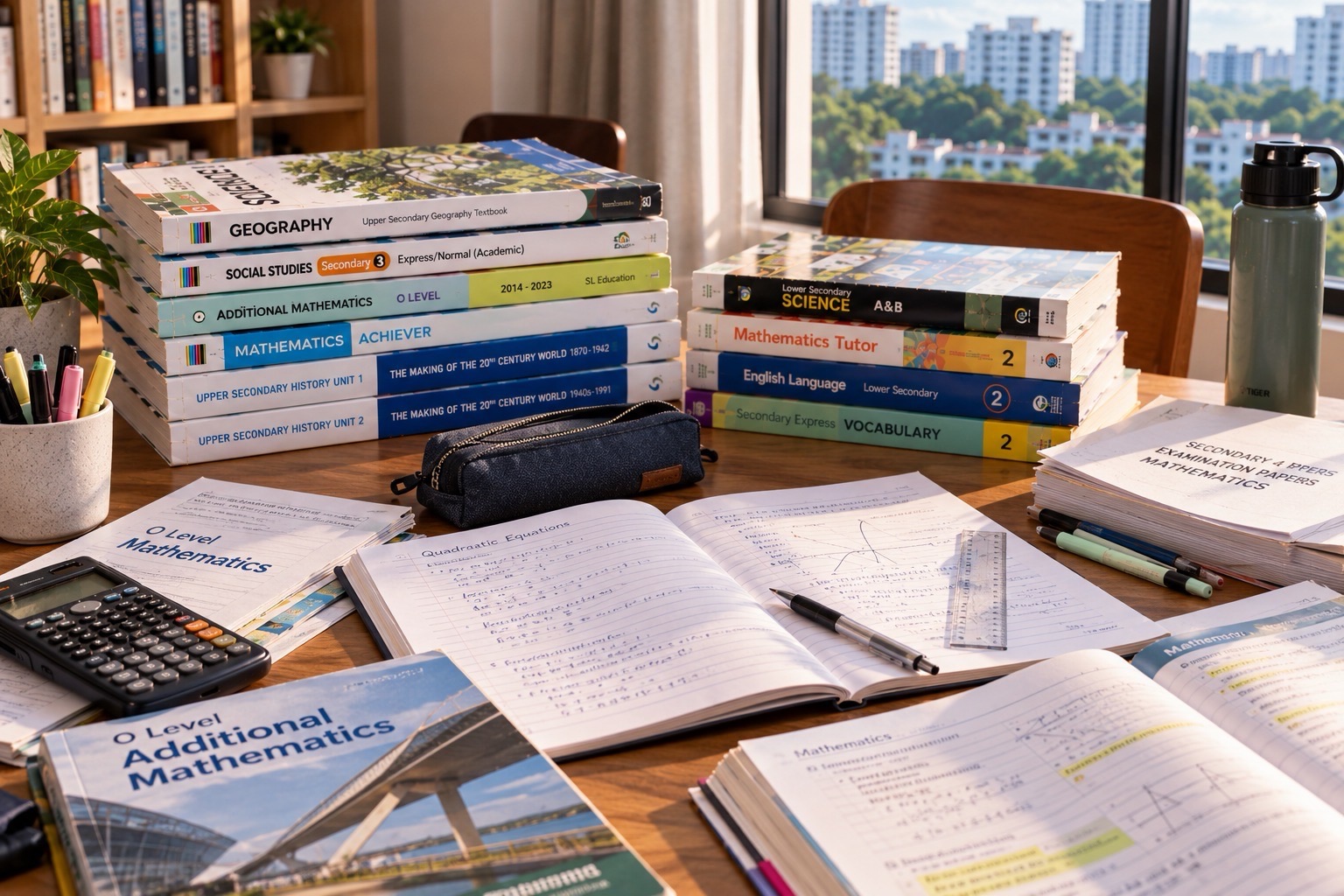
Did you know? A Secondary 4 Additional Mathematics candidate can correctly memorise a differentiation formula yet lose marks because they do not show the chain of reasoning behind a solution. The final equation may look familiar, but the examination also tests mathematical interpretation, problem solving and communication. The 2027 Singapore-Cambridge Secondary Education Certificate (SEC) G3 Additional Mathematics syllabus makes that distinction explicit.
This guide is for Punggol pupils sitting G3 Additional Mathematics K341 in 2027. It uses the published SEAB subject register and the K341 examination requirements to explain the format, common conceptual mistakes and an appropriate revision strategy. G3 K341 is separate from G2 Additional Mathematics K232; the two should not be treated as identical paper packages.
The wider change is the move to the common SEC from 2027. SEAB says overall subject standards do not change simply because the qualification name changes. Families should focus on the correct syllabus and the student’s actual readiness rather than believe that every familiar Additional Mathematics principle has suddenly been replaced.
What exactly is K341?
SEAB’s SEAB 2027 SEC G3 school-candidate syllabus register (K341) lists G3 Additional Mathematics K341 for 2027 school candidates and associates it with the previous reference code 4049. The same register distinguishes G3 Mathematics K310 from G3 Additional Mathematics K341. Students taking both have two different subjects to prepare for.
The SEAB 2027 G2 subject register separately lists G2 Additional Mathematics K232. The existence of K232 does not mean every school offers that subject combination, nor that a G3 student can interchange K232 and K341 worksheets. The actual registered code, school programme and published syllabus should guide tuition.
For the 2027 examination calendar, SEAB’s SEAB SEC overview and examination sequence places most written SEC subjects in a common period starting in October, while English and Mother Tongue Language written papers move to September. Exact dates and reporting instructions must come from the published examination timetable and the student’s school; a generic “October paper” description is not a confirmed date.
The 2027 G3 K341 paper structure
SEAB’s 2027 K341 syllabus specifies two written papers with equal weighting. Both require candidates to answer all questions. The official paper description is important when planning how much time to allocate to written mathematical reasoning.
- Paper 1: 2 hours 15 minutes, 90 marks, 50% weighting; 12–14 questions of varying lengths, up to 10 marks per question.
- Paper 2: 2 hours 15 minutes, 90 marks, 50% weighting; 9–11 questions of varying lengths, up to 12 marks per question.
- Both papers: approved calculators may be used, essential working must be shown and relevant mathematical formulae are provided.
- Numerical presentation: unless otherwise specified, non-exact answers are given to 3 significant figures, or angles in degrees to 1 decimal place, following the syllabus instructions.
- Planning implication: students need mathematical accuracy and time to explain their methods; rapid unsupported answers are not the goal.
The 2027 K341 assessment objectives distinguish three capabilities: AO1 standard techniques, AO2 solving problems in context and AO3 mathematical reasoning and communication. Their approximate weightings are 35%, 50% and 15% respectively. AO2 is therefore not a small optional skill to practise only after every routine exercise is perfected.
A tutor should use these objectives to make training purposeful: some work checks technique, some demands method selection, and some demands explanation or proof. These categories can overlap in a real question.
Where the syllabus content is concentrated
The K341 syllabus covers interconnected topics across algebra, geometry, trigonometry and calculus. Published areas include quadratic functions; equations and inequalities; surds; polynomials and partial fractions; binomial expansions; exponential and logarithmic functions; trigonometric functions and identities; coordinate geometry; differentiation; integration; and applications of these ideas. The exact subtopics and exclusions must be checked against SEAB’s detailed K341 document.
The syllabus assumes knowledge of G3 Mathematics even where that content is not directly retested. A pupil who cannot work accurately with fractions, standard form, graphs, indices or equations may struggle in an Additional Mathematics question despite knowing its more advanced formula.
This is why an effective G3 Additional Mathematics revision plan starts by identifying which prerequisite failures cause higher-level errors. Repeating a calculus question will not repair an incorrect exponent rule if that rule is the underlying problem.
Worked example 1: one quadratic, multiple exam decisions
Original illustrative problem: Consider y = 2x² − 12x + 13. Find its turning point, describe its minimum and determine when y is zero. This is a teaching example, not an official SEC question.
Complete the square: 2x² − 12x + 13 = 2(x² − 6x) + 13 = 2[(x − 3)² − 9] + 13 = 2(x − 3)² − 5. The squared term cannot be negative, so the function has a minimum value of −5 at x = 3. Its turning point is (3, −5).
For the roots, set y = 0: 2(x − 3)² − 5 = 0. Then (x − 3)² = 5/2 and x = 3 ± √(5/2). The roots are real and lie equally far from the line of symmetry x = 3.
This illustrates the connection among algebraic manipulation, graph properties and equation solving. A student might complete the square mechanically but still be unable to say why the minimum is −5. Another might give the roots correctly but sketch the graph with a maximum, contradicting the positive leading coefficient.
A useful follow-up asks when the function is positive. Because the quadratic opens upwards and has two real roots, it is positive outside the interval between the roots, and negative between them. An accurate explanation refers to the graph or a sign analysis instead of guessing an inequality sign.
Worked example 2: factor theorem is a reasoning tool
Original illustrative problem: Factorise f(x) = x³ − 4x² + x + 6 completely.
Test x = 2: f(2) = 8 − 16 + 2 + 6 = 0. Therefore (x − 2) is a factor by the factor theorem. Divide the polynomial by x − 2 to obtain x² − 2x − 3, which factorises into (x − 3)(x + 1).
The complete factorisation is (x − 2)(x − 3)(x + 1). The roots are 2, 3 and −1. Multiplying the factors back confirms the original cubic. Checking is not decoration; it can expose a sign error before it becomes a final answer.
A recurring mistake is to reason “f(2) = 0, therefore (x + 2) is a factor.” That reverses the relationship. A root at x = 2 corresponds to x − 2 = 0, and hence to the factor x − 2. The student should be able to explain this directly.
Another mistake is to stop after identifying one factor and fail to complete the remaining quadratic factorisation. The final question may require complete factorisation, roots or a subsequent inequality. Reading the command word is part of mathematical accuracy.
Worked example 3: differentiation tells a story about a graph
Original illustrative problem: Let f(x) = x³ − 6x² + 9x + 2. Identify the stationary points and decide whether each is a maximum or minimum.
Differentiate: f′(x) = 3x² − 12x + 9 = 3(x − 1)(x − 3). Set f′(x) = 0 to obtain x = 1 or x = 3. The y-values are f(1) = 6 and f(3) = 2, so the stationary points are (1, 6) and (3, 2).
Differentiate again: f″(x) = 6x − 12. At x = 1, f″(1) = −6, which indicates a local maximum. At x = 3, f″(3) = 6, which indicates a local minimum. Thus the function has a local maximum at (1, 6) and a local minimum at (3, 2).
The explanation matters because a student could correctly find x = 1 and 3 yet label both points as minima. The sign of the first derivative or the appropriate second derivative test provides the reasoning. An exam answer that states the classification without a defensible method may be weaker.
A strong tutor might ask the student to sketch the cubic’s local behaviour or construct a sign chart for f′(x). That transfers the same mathematical concept between derivative calculations and graph interpretation.
Worked example 4: chain rule is not ordinary power expansion
Original illustrative problem: Differentiate y = (2x + 1)⁵. Let u = 2x + 1. Then y = u⁵, so dy/du = 5u⁴ and du/dx = 2. By the chain rule, dy/dx = 10(2x + 1)⁴.
The common wrong answer 5(2x + 1)⁴ forgets the derivative of the inner expression. A learner should understand why the extra factor of 2 is present, not merely memorise that some questions require an extra multiplication.
Check an analogous example: for y = (3x − 4)², the derivative is 2(3x − 4) × 3 = 6(3x − 4). If a student can transfer the chain rule to a changed inner function, the method is more dependable.
Worked example 5: integration needs the constant and the conditions
Original illustrative problem: Find the indefinite integral ∫(6x² − 4x + 3) dx. Integrating term by term gives 2x³ − 2x² + 3x + C. The constant of integration C is required because differentiating any constant gives zero.
Differentiate the result to check: 6x² − 4x + 3. If a question provides an initial condition, such as the curve passing through (0, 5), substitute x = 0 and y = 5 to obtain C = 5.
A student who writes the correct antiderivative without C has missed part of the general solution. Conversely, if the question is a definite integral with limits, the method involves evaluating the antiderivative at those limits; an arbitrary +C does not belong in the final numerical result.
Mistakes worth diagnosing instead of calling them careless
- Restrictions: cancelling an algebraic factor without noting that the denominator cannot be zero.
- Sign control: squaring a negative or handling an inequality after multiplying by a negative value incorrectly.
- Factor theorem: confusing roots with the signs in the associated factors.
- Functions: misunderstanding domain or notation such as f(x + 1).
- Calculus: forgetting the inner derivative, the constant of integration or the meaning of a stationary point.
- Proof and communication: writing a correct result with missing essential logical steps.
- Precision: rounding intermediate values too early or ignoring requested exact answers.
- Time use: spending so long on a difficult opening question that easier available marks are left untouched.
An error log should preserve the first incorrect step, a corrected explanation and a later unfamiliar transfer question. If the same misconception survives after a week, the teaching strategy should change. Recopying an answer is not the same as learning to produce one.
How to schedule the 2027 G3 Additional Mathematics year
January–March: map the syllabus and diagnose prerequisite gaps
Collect current Secondary 3 and early Secondary 4 work and map strengths against K341 content and assessment objectives. Repair algebraic fractions, sign rules, graphs, indices and other prerequisites where they interfere with advanced questions. Start a short error log rather than repeatedly redrawing a total-syllabus checklist.
April–June: connect techniques to new problems
Alternate technique practice with questions requiring selection of a method. Compare two algebraic routes to the same solution when suitable, and ask which is clearer or less error-prone. Revisit topics after a gap through spaced retrieval.
July–August: add mixed and timed tasks
Use school feedback and appropriate K341-level practice to develop method selection, complete workings and numerical checks. Full 2-hour-15-minute paper simulations become more useful once basic techniques are reasonably stable. Students should practise recovering from a difficult question without abandoning the rest of the paper.
September–final written examinations: consolidate reliably
Reduce major changes to technique, review the most repeated errors and follow the official examination timetable and school instructions. Separate areas needing a brief refresh from those needing a fundamental explanation; the latter may need targeted sessions rather than last-minute frantic drilling.
A small-group lesson should show every student’s thinking
In a true three-student Additional Mathematics tutorial, students can compare factorisation, completing the square and graph-based reasoning. The tutor checks each student’s working, identifies the first invalid step and assigns a fresh question requiring independent transfer. A student who watches two classmates solve the question has not yet demonstrated mastery.
For a 1.5-hour session, a useful structure is targeted retrieval, one central concept, guided examples, independent practice and error correction. The exact balance should change as the examination approaches. A class size of three is a means to close feedback, not a guarantee of an A1 grade.
Punggol parents can read the Secondary 4 Additional Mathematics programme, the G3 A-Math explanation, and eduKate’s three-student tuition approach. The official K341 syllabus should determine actual examination preparation.
Questions parents should ask when choosing a tutor
- Does the tutor verify G3 K341 rather than use a generic Additional Mathematics paper?
- Can the student explain why a quadratic’s completed-square form reveals a maximum or minimum?
- Can they show essential working and distinguish AO1, AO2 and AO3 demands?
- Do they check restrictions, units, exact values and rounding as the syllabus requires?
- Will new questions test learning after corrections rather than reward copying?
- Does the revision plan respect both 2-hour-15-minute papers and other SEC subjects?
- What independent evidence of improved reasoning can parents review after a month?
Frequently asked questions
Is 2027 K341 simply the old O-Level 4049 with a different title?
SEAB lists K341 against the earlier reference code 4049 under the SEC framework, which continues the overall examination standard. Students should still use the published K341 document for current content and assessment requirements rather than assume every historical paper or revision book is an exact match.
Does a calculator remove the need to show workings?
No. K341 allows approved calculators, but its assessment notes state that omission of essential working results in loss of marks. Students need to present the mathematical reasoning the question requires.
Is Paper 2 optional if Paper 1 is strong?
No. Both papers are compulsory and each contributes 50% of the overall assessment. Each paper requires all questions to be answered under the published 2027 scheme.
Should every answer be rounded to three significant figures?
No. The syllabus specifies three significant figures for non-exact numerical answers and one decimal place for angles in degrees unless another accuracy is requested. Exact answers should remain exact when appropriate, and students should read the wording before rounding.
Can a student recover from weak Secondary 3 results?
There may be substantial room for improvement with accurate diagnosis and consistent independent practice. But the right plan depends on the nature of the gaps, available time and current school expectations. A good tutor offers evidence of learning, not a promise of a grade.
What if the student finishes papers but loses marks on unfamiliar questions?
That suggests the need for AO2 problem-solving and AO3 reasoning, not just more repeated routine techniques. Ask the learner to identify the relevant mathematical relationship before starting and to justify the method in a different context.
The Punggol family takeaway for SEC 2027
G3 Additional Mathematics K341 rewards dependable algebra, connected mathematical ideas, accurate methods and explicit reasoning. Use the correct SEAB syllabus, practise both compulsory papers, repair the earliest incorrect step and train independent solution selection. The aim is a student who can explain why the Mathematics works, not merely recognise a familiar answer.
Official references: SEAB 2027 SEC G3 school-candidate syllabus register (K341) · SEAB SEC overview and examination sequence. Related Punggol guidance: Secondary 4 Additional Mathematics tuition · Punggol’s primary-to-secondary learning-system guide. Reviewed 27 October 2026. Check SEAB’s official 2027 timetable and any amendments before the examinations.


