
Why can two historical sources about the same event appear to disagree without one necessarily being a forgery? One may have been written by a witness experiencing the event, while another was written decades later by a historian addressing a different question. For a Secondary 2 student in Punggol in 2027, learning to investigate who produced a source, when, why and for whom can be more valuable than memorising a perfect paragraph of dates.
The Ministry of Education’s lower-secondary G2/G3 History curriculum connects Singapore’s past with historical inquiry. Secondary 2 commonly examines the Japanese Occupation, post-war changes and Singapore’s struggle towards independence, within the relevant two-year syllabus. The school’s actual topic sequence can vary, so parents should follow teachers’ instructions instead of assuming a national SEC paper applies to a Secondary 2 pupil this year.
This guide explains source-based questions, reliability, causation, chronology and structured explanation through original exercises. It also shows how small-group feedback could help students learn to reason about evidence rather than copy paragraphs from revision notes.
What the official MOE lower-secondary History syllabus covers
Use the MOE Lower Secondary G2 and G3 History syllabus, May 2024 version. Its four main units explore:
- Unit 1: From Temasek to Singapore, 1299 to the early nineteenth century.
- Unit 2: Singapore’s development as a port city under British rule, 1819–1942.
- Unit 3: Singapore’s struggle for independence, 1942–1965, including the Japanese Occupation, post-war self-government, merger and separation.
- Unit 4: Singapore’s nation-building after independence and the development of a sense of shared identity.
The content builds across Secondary 1 and 2. A typical Secondary 2 learner may be working on later units, but the exact distribution and assessment schedule must be confirmed with the school.
The curriculum also develops historical concepts: chronology, evidence, accounts, causation, change and continuity, significance, empathy and diversity. These words describe ways to ask questions about the past. They are not just headings to memorise for a vocabulary test.
What a source-based question really asks
Suppose a student is investigating how ordinary residents experienced daily life after the Second World War. They might encounter a photograph, a newspaper item, a public notice or an oral-history interview. Each source can be useful, but each has limits.
A photograph may show a particular street or group on a particular day. It may not reveal the photographer’s motive, conditions outside the frame or what people felt. An interview may explain personal experiences but reflect memory and hindsight. A public notice can provide evidence of what an authority instructed, not necessarily proof that every person obeyed.
These distinctions help students evaluate sources without dismissing them simply because they are old, subjective or incomplete.
Worked example 1: an original fictional historical-source exercise
The following two excerpts are invented teaching examples and are not actual archival documents or quotations.
Fictional Source A, attributed for the exercise to a shopkeeper writing in 1946: “The market is crowded, but many families are still struggling to buy enough food. Customers ask whether prices will finally settle.”
Fictional Source B, attributed for the exercise to an administrator’s public report written in 1947: “Efforts to restore supply and commercial activity have begun, although recovery remains uneven across different parts of the settlement.”
Question: What can both sources suggest about economic recovery after the war? Source A focuses on the hardship observed among customers, while Source B acknowledges an uneven recovery process. Together they are compatible with the idea that trade was returning but hardship continued for some people.
The student should not claim that the sources prove the exact price of food, the condition of all Singapore households or the effectiveness of every government measure. The excerpts provide only limited statements from fictional perspectives.
A second question asks how the sources differ: one emphasises what a shopkeeper observes about daily life, while the other describes an administrative view of recovery. Different roles and purposes can shape emphasis without automatically making either source worthless.
The provenance check: who, when, what, why and for whom?
Provenance means the origin of a source. A useful framework asks:
- Who produced the document or image?
- When was it produced, relative to the event described?
- Where did it originate, and what circumstances surrounded its creation?
- Why was it produced: to inform, record, persuade, complain or commemorate?
- For whom was it intended?
- What relevant information can be supported by its content?
A pupil might say, “This source is unreliable because it is a newspaper.” That is too sweeping. Reliability depends on the claim being tested, the newspaper’s evidence and purpose, its context, and comparison with other sources.
Similarly, a personal account may be very useful for understanding an individual’s experience while not representing the entire population. Usefulness and reliability must be judged in relation to a specific historical inquiry.
Worked example 2: comparing sources rather than describing each separately
Take the same fictional excerpts. A weak answer says: “Source A talks about families. Source B talks about the economy.” This is a description, not a complete comparison.
A stronger answer identifies a shared point: both suggest that economic conditions were not fully restored. It then explains a difference in emphasis: Source A centres on hardship experienced by customers, whereas Source B uses broader administrative language about recovery.
The pupil should support the comparison with a relevant detail from each excerpt. A comparison with no common criterion can become two unrelated mini-summaries.
Next, the tutor can give a changed question: “Which source is more useful for understanding a shopkeeper’s experiences?” Source A may be closer to that particular experience, but the answer still needs to acknowledge its limited viewpoint and provenance.
Worked example 3: cause, trigger and consequence
A common History mistake is to present a list of events as though listing them automatically explains their relationship. For example, a student may write “The Japanese Occupation ended; the British returned; Singapore gained self-government” without discussing the long sequence of political, economic and social developments in between.
A stronger explanation distinguishes background conditions, events or decisions and consequences. In studying the period from 1942 to 1965, the official syllabus asks learners to consider wartime experiences, changes in perceptions of colonial rule, post-war policies, political participation, merger and separation.
A causal answer needs a link: how did an experience or policy influence people’s views, opportunities or actions? The writer should avoid asserting a single inevitable cause where multiple factors and perspectives were involved.
Chronology supports causation, but it does not replace it. Knowing that one event happened before another does not by itself prove that the first caused the second.
Worked example 4: why the same date can have several meanings
Singapore’s merger with Malaysia in 1963 and separation in 1965 are important chronological facts. But a student asked why different groups supported or opposed merger should not respond with dates alone.
A useful answer identifies the perspectives and considerations relevant to the question, including political, economic and social reasons found in the sources or taught context. It explains how those interests could lead people to different judgements.
Similarly, describing independence in 1965 requires an understanding of the circumstances leading to separation and what followed. A student should not write as if all parties held identical aims throughout the whole period.
The point of a historical explanation is to reconstruct the past from evidence and context, not judge earlier people using only present-day assumptions.
Reading a photograph or poster critically
A historical photograph can be a valuable record, but it captures a chosen moment from one viewpoint. Ask what is visible and what the photograph cannot show. A poster may deliberately communicate a persuasive message through symbols, slogans and composition.
When discussing a hypothetical public-information poster, distinguish the message the creator wanted people to believe from evidence that people actually acted on that message. Intended persuasion and observed public response are different facts.
The student should also know that modern captioning, cropping and digital circulation can affect how a source is encountered. A photo reposted without its original date or location must be verified before its details are asserted as history.
This is a particularly important twenty-first-century skill when circulating old photographs of Singapore housing estates or claims about local Punggol heritage.
Where can Punggol students look for genuine historical evidence?
Start with school-approved material and official public collections such as the National Archives of Singapore and National Library Board’s digital newspaper collections. These can help students learn what genuine provenance information looks like.
For a Punggol neighbourhood investigation, a student might compare a dated government planning notice with a photograph of an earlier landscape, while checking the original publication date, creator and place. This can teach change and continuity without pretending that Punggol’s recent development is the same curriculum topic as Singapore’s struggle for independence.
Never invent a quotation or assign a fictional witness to a real historical event. In a research project, label any teaching simulation plainly, use original captions accurately and keep a record of where each source came from.
How to write a structured History answer
Suppose a task asks, “Explain one reason a particular policy affected people’s lives.” A complete response requires a reason, a relevant historical detail and a clear explanation of its effect.
A weak sentence merely names a policy. Another weak answer retells a long sequence of unrelated events. A more effective response follows a logical sequence: identify the factor, explain how it operated, provide relevant contextual evidence, and connect the factor to the stated impact.
This approach should be applied to the exact taught period and evidence; students must not fill gaps with invented statistics or dialogue. History can require uncertainty where the evidence does not permit a definite claim.
An error log for Secondary 2 History
- Chronology error: placing events in the wrong order or mixing years.
- Unsupported inference: claiming a source proves an emotion it does not express.
- Weak provenance: ignoring a document’s author, date or intended audience.
- Description instead of comparison: paraphrasing two sources without identifying similarity or difference.
- Unreasoned reliability label: calling a source biased or unreliable without explanation.
- Missing causal link: listing factors but not explaining how they changed an outcome.
- Presentism: assuming historical actors should have known future events or shared today’s attitudes.
- Poor task reading: writing a long essay when asked to describe one factor or make one inference.
A tutor should identify which error caused the lost marks and teach that skill through a second unfamiliar source rather than simply handing the pupil a model answer to memorise.
A 2027 Secondary 2 History learning calendar
Term 1: check knowledge and chronology
Map the school’s current units against the MOE syllabus. Build a simple timeline with key developments and ask the pupil to explain their relationships rather than recite dates alone.
Term 2: source inference and provenance
Practise one source type at a time: image, document, public notice, newspaper excerpt or oral-history testimony. Ask who, when, why and for whom before drawing conclusions.
Term 3: comparison, causation and perspective
Use pairs of short sources addressing the same inquiry. Require a supported similarity or difference, then practise a concise structured paragraph explaining a factor or consequence.
Term 4: prepare for Secondary 3 subject decisions
Review the child’s interest, classroom feedback and independence with source analysis. Ask the school about its upper-secondary History or Humanities subject offerings. A 2027 Secondary 2 student normally has school assessments, not a national graduating SEC exam this year.
Why three-student History tuition could help
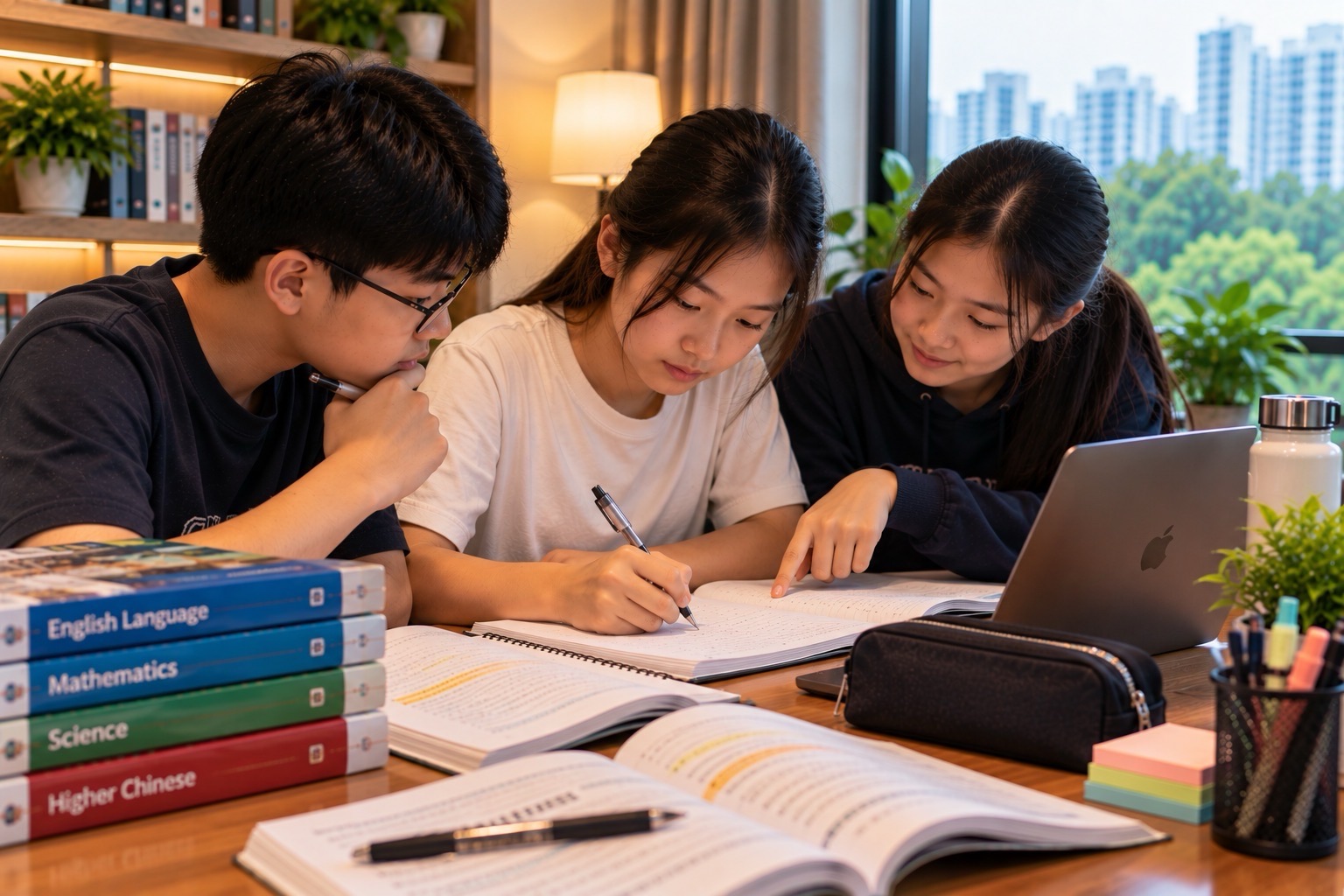
Three students can analyse one short source from different angles: one identifies what it says, another examines provenance, and a third asks what additional evidence would be needed. The tutor can correct overclaims and then assign each student a new document to interpret independently.
eduKate’s true three-pupil, 1.5-hour teaching philosophy is designed for frequent individual feedback, clear explanations from first principles and carefully sequenced practice. Families should verify the actual availability of History tuition and a suitably qualified tutor before booking a consultation; a tuition-centre article alone is not proof of an offered class.
Related material: Secondary 2 History merger and separation, Secondary 2 History source comparison, and Punggol History tuition hub.
Questions parents should ask
- Does the tutor follow the actual Secondary 2 MOE G2/G3 History content and the school sequence?
- Can the student identify historical evidence separately from their own inference?
- Are sources evaluated for provenance and usefulness in relation to the question?
- Will the child explain cause and consequence rather than memorise only a chronology?
- Can the tutor demonstrate how to compare two sources using evidence from each?
- Is the student encouraged to recognise multiple perspectives without inventing equal validity for unsupported claims?
- What independent written answer shows progress after a month?
Frequently asked questions
Does Secondary 2 History in 2027 use a national SEC paper?
No. Secondary 2 pupils generally complete their school’s lower-secondary curriculum and assessments. The SEC is a later graduating examination. Check the school for termly requirements.
Is a source always unreliable because it is biased?
No. A source’s perspective, origin and purpose affect how it should be interpreted. It may still be useful evidence for some inquiries, while inadequate for others. Explain what claim it can support.
Must students memorise every date in the textbook?
Knowing key chronology helps, but History also requires evidence, causation, change and interpretation. Dates alone do not explain why events occurred.
Can Punggol heritage walks replace the taught Singapore History units?
No. Local heritage can motivate curiosity and reinforce skills such as source comparison, but classroom coverage must still follow the school and MOE syllabus.
Why are multiple historical accounts valuable?
They can reveal different experiences, priorities or questions. A learner must evaluate them against evidence and context rather than assume all accounts are equally accurate.
The Punggol 2027 takeaway
Secondary 2 History teaches students to ask what happened, how we know and why people interpreted events differently. Learning to read a source carefully, explain change and build an evidence-based argument is useful for school and for responsible citizenship. Use the correct MOE syllabus, original historical evidence and focused feedback rather than memorised unsourced paragraphs.
Official source: MOE 2021 Lower Secondary G2/G3 History syllabus, May 2024 update. For real primary sources, consult the National Archives of Singapore and school-approved collections. Reviewed 27 October 2026; the school’s teaching sequence and subject-combination rules take precedence.


