
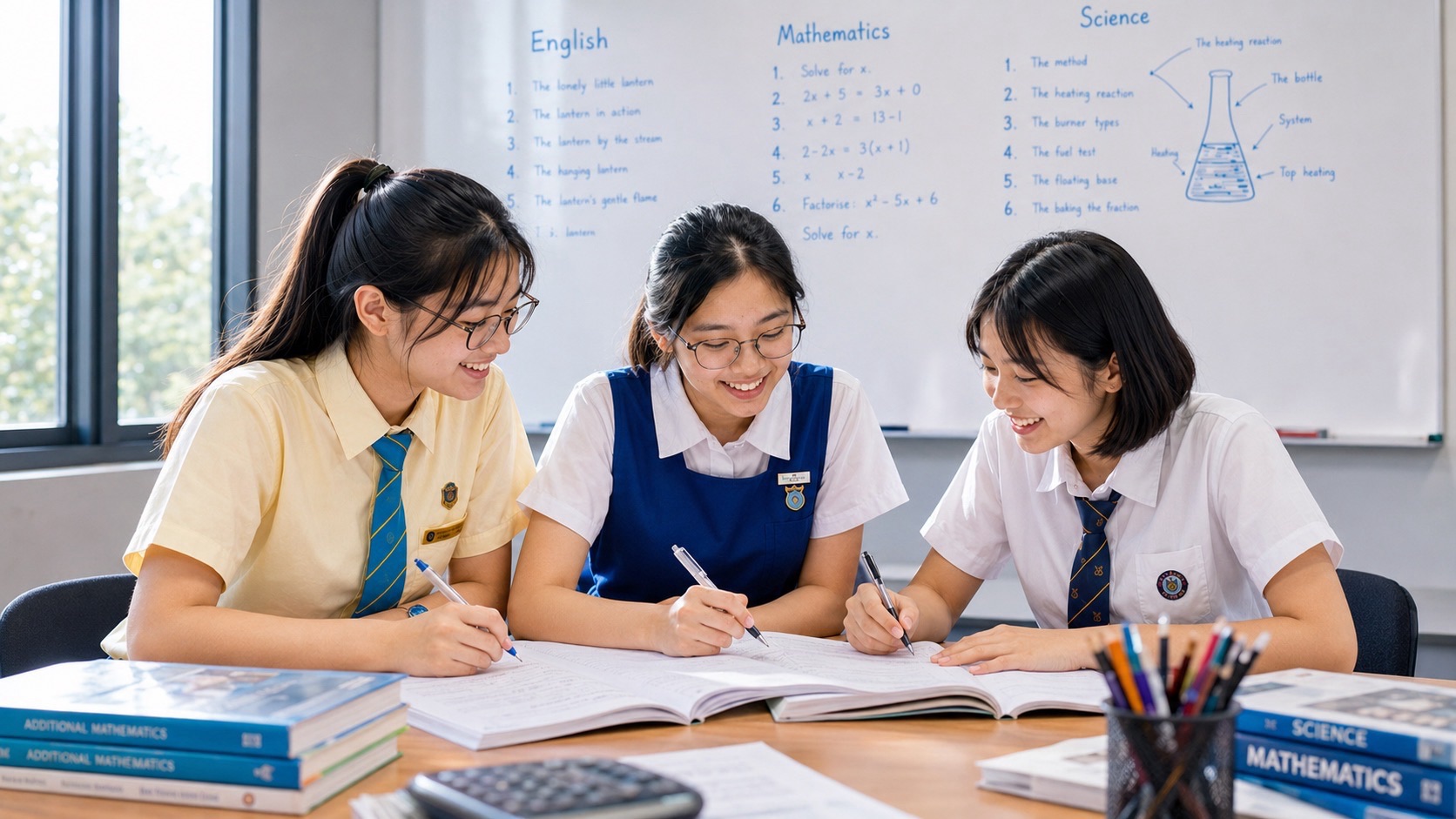
History becomes easier to navigate when the next step has a name. Perhaps your child needs to infer from a picture, explain why a change occurred or decide which examination syllabus applies. Those are different jobs, and they deserve different starting points.
History learning combines accurate knowledge, chronology, cause and consequence, source analysis and clear written explanation. This Punggol History Tuition hub connects Secondary 1, Secondary 2, Secondary 3, Secondary 4 and SEC G2/G3 guides so parents and students can choose a level route, practise a specific skill and continue to the relevant sibling article.
Start with the school’s current subject and assessment requirements. The series teaches practical historical thinking; it does not promise a particular class arrangement or examination grade.
Find your next learning step
Start with the question closest to today’s schoolwork. Read the explanation, try the practice, then return to check your reasoning.
Understand the subject · Try the worked practice · Plan the next step · Full contents
Choose your next History route: Series hub · Secondary 1 · Secondary 2 · Secondary 3 · Secondary 4 · SEC G2/G3
Article contents — open to choose a section
| Route | Main reader job | Continue |
|---|---|---|
| Secondary 1 | Turn source details into supported inferences; connect events in time | Singapore history and source-based questions |
| Secondary 2 | Make revision notes explain causes, consequences and relationships | History revision notes, cause and effect |
| Secondary 3 | Use relevant knowledge in upper-secondary explanations and essays | Elective History, Pure History and essay writing |
| Secondary 4 | Combine SBQ, essays and revision under the right conditions | O-Level History SBQ and exam revision |
| SEC G2/G3 | Confirm the 2027 route, syllabus code and component requirements | History syllabus and exam preparation |
A level is a useful starting point, not a fence around a skill. A Secondary 4 student can revisit Secondary 1 inference without restarting the whole subject. A secure Secondary 2 learner can explore an upper-secondary explanation method without assuming it is already part of their assessed course.
Look at one recent answer. If it repeats the source, work on inference. If it lists events, work on causation. If it makes claims without support, work on evidence. If it explains well with help but struggles alone, work on removing prompts and retesting.
This is the reader route adapted from the immutable eduKateSG Secondary 1 Mathematics tutorial reference: identify the unstable point, rebuild it, practise and check independent application. The reference remains a Mathematics page; its fees, class details and location are not History service claims.
For the History-specific teaching process, read personalised learning plans. This hub organises the progression series; existing skill guides remain the destinations for deeper component teaching.
Contents · Previous chapter · Next chapter
Original practice scenario: An imaginary town record states that more ships visited a harbour after a new warehouse opened. A student writes, “The warehouse caused all the trade growth.” What should be checked?
First, chronology: the warehouse opened before the recorded increase. Second, mechanism: storage might have helped traders handle goods. Third, evidence and alternatives: the record does not isolate the warehouse from other possible influences. Sequence supports a question about causation; it does not prove a complete explanation.
A stronger statement: The warehouse may have supported increased trade by providing storage, but the record alone does not establish that it caused all the growth. More information about shipping demand, policy and other harbour changes would help test the explanation.
If the student struggles with the first step, begin with chronology and source foundations. If the mechanism is missing, use cause-and-effect explanations. If weighing alternatives is the challenge, use essay reasoning. This is a route selector, not a scored test of overall ability.
Contents · Previous chapter · Next chapter
- SBQ, inference and reliability — connect source detail to a defensible conclusion.
- Comparison and cross-referencing — compare the same issue and test independent support.
- Purpose, audience, provenance and bias — investigate how a source’s setting affects its use.
- Political cartoons and visual sources — read visual choices without inventing the message.
- Timelines, chronology and cause-and-effect — keep sequence and explanation distinct.
- Essay writing and structured questions — select evidence and explain its relationship.
- How-far-do-you-agree evaluation — make a judgement that the evidence can carry.
- Revision notes and active recall — make knowledge available when the question changes.
- Time management and answer planning — organise work within the actual paper.
Choose one skill destination at a time. If an essay is inaccurate because the topic is not understood, a time-management article is unlikely to be the first repair. The order should follow the evidence from the learner’s work.
Contents · Previous chapter · Next chapter
Set one clear outcome: “Explain a cause using one accurate example” or “Support an inference with a source detail”. Model it, practise it, then give a different question without prompts. Return later to see whether the improvement remains.
Keep preparation and performance distinct. A learner may understand a discussion yet struggle to write an independent answer. Another may write well without a clock yet struggle in a complete paper. Those observations guide the next task; they should not become permanent descriptions of the student.
For school assessments, confirm the assessed units and instructions. For national examinations, confirm examination year, subject and level. The SEC guide explains why 2027 standalone History and Humanities with History require separate checks. The Secondary 4 guide connects diagnosis with timed revision.
Contents · Previous chapter · Next chapter
Stay within the History series when the difficulty is historical evidence, context or explanation. Use eduKatePunggol Contents & Learning Routes when the family needs a wider education or subject route.
Clear language matters in History, but elegant writing cannot replace evidence. A student may need help understanding the command word, forming a precise explanation or editing an overlong paragraph; return that language work to the actual History question so it remains useful.
For a local enquiry, send the level, exact subject name, examination year and one observed difficulty. Confirm current support directly. The aim is a suitable next step for the student’s work, rather than a generic recommendation for more tuition.
Contents · Previous chapter · Next chapter
Which guide should we read first?
Use the level table if the whole course feels unfamiliar. Use the skill links if a marked answer shows a precise recurring problem. Choose the SEC route guide if the subject code or component is uncertain.
Are the examples official examination questions?
No. The miniature scenarios are original teaching exercises and are labelled as such. Use school and SEAB materials for actual assessed content, instructions and examination arrangements.
Does reading a lower-level guide mean my child is behind?
No. A specific earlier skill may need attention even when other parts of the subject are secure. Repair the point the evidence identifies and reconnect it to the current task.
Contents · Previous chapter · History series hub
Choose your next History route: Series hub · Secondary 1 · Secondary 2 · Secondary 3 · Secondary 4 · SEC G2/G3
For a family learning enquiry, use Contact eduKatePunggol. Bring the student’s subject name, level, examination year, school topic list and a recent marked answer. Ask about current History support and suitability; this learning guide does not establish class availability, fees or a timetable.
Apply the skills to historical topics
Continue from the level foundations into five focused guides. Each article connects verified historical background with a worked question and a route back to the relevant History skill guide.
| Level | Historical focus | Read the guide |
|---|---|---|
| Secondary 1 | Artefacts, context and early Singapore | Historical sources and artefacts |
| Secondary 2 | Occupation, money and personal testimony | Japanese Occupation, banana money and oral history |
| Secondary 3 | Peace terms, institutions and explained consequences | Treaty of Versailles and League of Nations |
| Secondary 4 | Cold War involvement, chronology and document use | Korean War and SBQ revision |
| SEC | Assessed coverage and prescribed case studies | Essay questions and source-based case studies |
The Korean War guide is relevant to the 2027 G3 Humanities route; the SEC coverage article explains why its status should not be transferred to G2 Humanities. Use the enrolled subject code to check fit before allocating revision time.
More topic guides and a revision routine
Continue from port development to political change, international conflict and a practical examination revision plan. Choose the guide that matches your school’s topic coverage and examination year.
| Level | Next guide | Learning focus |
|---|---|---|
| Secondary 1 | British Settlement in 1819 and Singapore’s Trading Port | Connect conditions to port development |
| Secondary 2 | Singapore Merger and Separation, 1963–1965 | Distinguish motives, tensions and decisions |
| Secondary 3 | Hitler’s Rise to Power and Nazi Germany Essay Questions | Separate rise from consolidation |
| Secondary 4 | Vietnam War Revision, Causes and Consequences | Connect actors, escalation and outcomes |
| SEC | History Revision Timetable, Error Logs and Timed Practice | Repair, retest and plan practice |
Check the prescribed coverage for your subject and year. The articles provide learning methods and linked historical sources; they do not establish current History class availability.


