
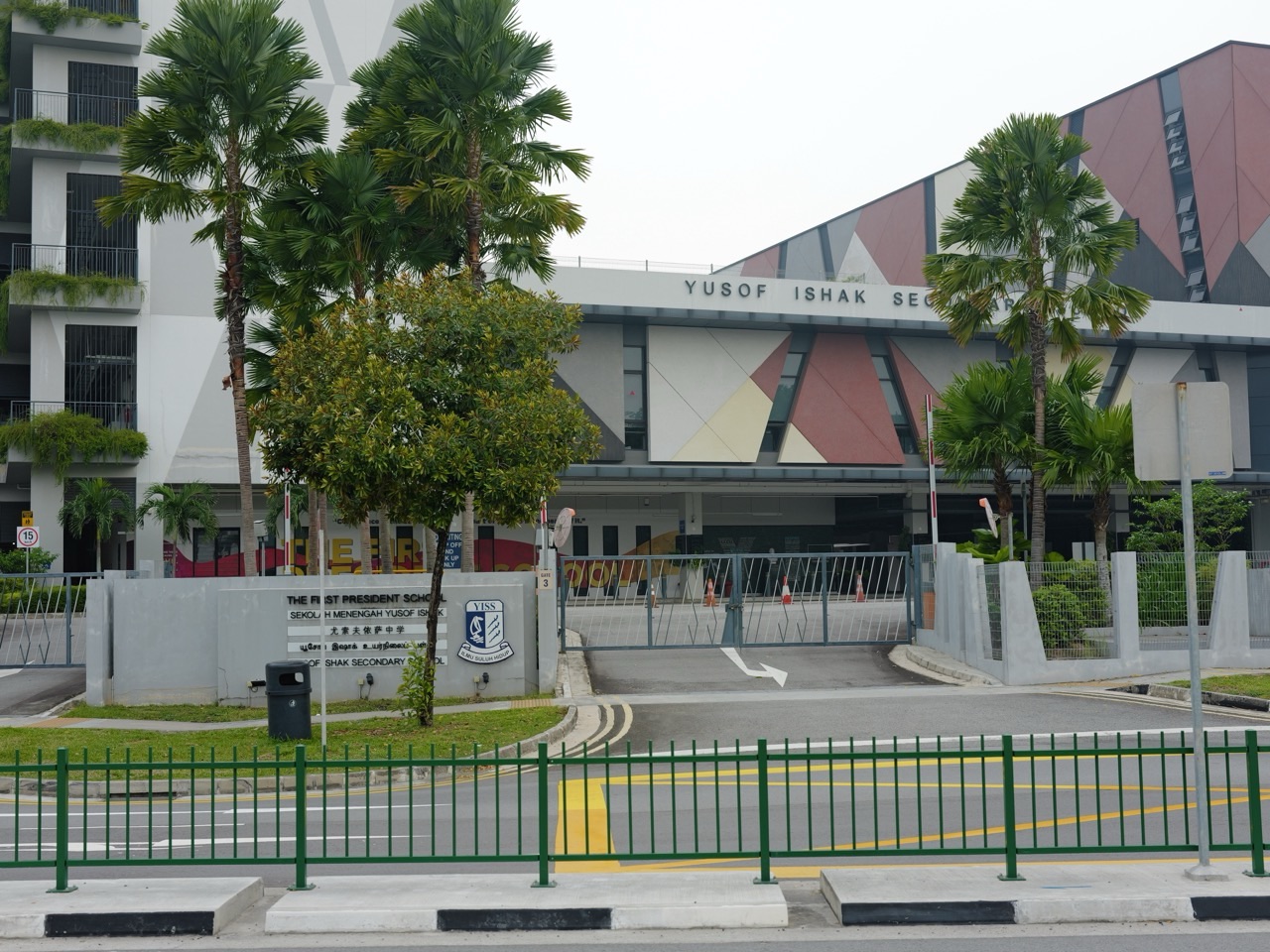
Yusof Ishak Secondary is inviting families for its 2026 Open House
Quick answer, verified 23 October 2026. Yusof Ishak Secondary School’s official Open House 2026 webpage invites families to register through go.gov.sg/yissoh2026. Multiple current secondary-school open-house calendars identify Saturday, 21 November 2026, with a planned 8 am–12.30 pm window. The school’s public text does not itself spell out those hours, so the registration confirmation and the school’s current instructions must take precedence. The address is 8 Sumang Walk, Singapore 828676.
The visit matters to families comparing Punggol secondary schools for the 2027 intake. Yusof Ishak Secondary describes distinctive learning opportunities in STEM for a sustainable and smart city, student leadership, coding, robotics and responsible use of digital devices. These are real programmes described on its own website, not broad claims inferred from the campus’s proximity to Punggol Digital District. Parents should use the open house to ask how the programmes work for ordinary students and which activities are elective or selection-based.
The school’s motto and leadership emphasis can be introduced during a visit, but admission is determined through the national posting and school rules, not by enthusiasm at an exhibition. A pupil should leave with a clearer understanding of where they might learn well and what questions need further verification.
The facts families should verify before leaving home
School: Yusof Ishak Secondary School. Official venue: 8 Sumang Walk, Singapore 828676. 2026 Open House: advertised by the school, with independent calendars listing 21 November and 8 am–12.30 pm. Registration: the school provides an official go.gov.sg link that redirects to a government form. A registration link does not, by itself, establish a confirmed booking or a free walk-in entitlement.
The school’s contact page lists telephone 6500 9800 and email yiss@moe.edu.sg. Ask the school if the timing, accessibility arrangements or a tour registration remains unclear. The regular school office hours are not the same as a Saturday event’s hours.
Families should avoid using a Punggol school name as the only navigation instruction. Yusof Ishak Secondary is at Sumang Walk, while Punggol Secondary, Edgefield Secondary and Greendale Secondary are separate institutions. Double-check the full address and official invitation.
Why the open house is relevant to the 2027 transition
A Primary 6 learner moving to Secondary 1 will encounter new subjects, teachers, classmates, responsibilities and a more independent daily routine. A school visit can make those changes more concrete. The pupil may see academic work, CCA displays or student presentations and gain a sense of how learning is organised in that environment.
This is not a school-ranking exercise. The right questions concern subject options, learning support, school culture, co-curricular interests and the journey from home. A lively demonstration can be impressive while still telling only part of the story. Parents should ask about normal timetables and how the school helps students when a topic becomes difficult.
The open house can influence preferences, but official Secondary 1 posting remains governed by MOE. Neither a school presentation nor an earlier cut-off point is a guarantee of admission.
The school’s signature Applied Learning Programme
Yusof Ishak Secondary’s official Applied Learning Programme webpage names its approach S4TEM@YI: STEM for the Strategic Development of a Sustainable and Smart City. It includes urban farming, coding, aeronautics and interdisciplinary experiences connected to sustainability and climate concerns. The programme extends beyond an ordinary display of gadgets because it asks students to consider how Science and technology apply to real community problems.
The school describes STEM Experience through Inter-disciplinary Work (STEMx IPW), where students engage with issues that cannot be understood through one school subject alone. A sustainability problem may require biology, quantitative reasoning, engineering design, communication and public awareness. This integration is one of the reasons the ALP can be interesting to young learners.
Parents should ask what activities are provided across the cohort, how teachers structure a project and what additional opportunities depend on student interest or selection. No school webpage promises that every child will attend every competition or partner programme.
Urban farming is a classroom for more than Biology
The school’s ALP describes soil-based and hydroponic growing activities, along with learning spaces such as the YI AgriSphere Lab and Garden. These provide an example of how students might connect plant science with observation and technology. When a plant grows slowly, the learning task is to identify plausible influences and determine what evidence could distinguish them.
A student may need to consider water, light, nutrients, plant condition, temperature and the reliability of measurements. A visually attractive hydroponic setup does not prove that the system is always efficient or that one variable caused a particular result. Scientific explanation matters as much as the finished display.
If the school demonstrates a project during the open house, ask the child to explain the question it investigated and how the answer was checked. This is more useful than asking only how much the equipment costs.
An original plant-growth Mathematics exercise
Imagine two fictional plants observed over two weeks. Plant A increases from 4 cm to 11 cm, while Plant B increases from 5 cm to 9 cm. The measured growth is 7 cm for A and 4 cm for B. A has the greater change in this simplified example. That conclusion does not establish why the difference occurred, because the growing conditions are not specified.
Ask a Secondary student what must be held consistent for a fair test. The two plants may have different initial conditions, light exposure, watering or measurement methods. An improved experiment needs a clear plan and enough observations to interpret variation. This is a useful combination of subtraction, variables and scientific reasoning.
The numbers are created for this article, not taken from Yusof Ishak Secondary’s laboratory or student results. Distinguishing a teaching illustration from school performance data is an important source-checking habit.
Robotics and Python at Yusof Ishak Secondary
The school’s Robotics Club webpage describes LEGO SPIKE work, Python programming, and manual and autonomous drone-learning activities. It links the club with problem-solving, engineering design and responsible exploration of technology. Students may encounter different opportunities depending on cohort, CCA allocation, training and the specific programme being offered.
For a family comparing schools, the useful question is not merely ‘Does the school have robots?’ Ask how students progress from beginner instructions to building and testing reliable designs. Do they document failures and explain why a change helped? Which learning experiences are accessible to all and which are part of competition teams?
A school CCA webpage does not permit visitors to fly drones at the campus or bring their own devices into controlled areas. The open house’s rules and safety supervision apply, and drone activities elsewhere have their own regulatory boundaries.
Robotics is also Mathematics, English and teamwork
A learner who programs a toy robot must express instructions in a precise sequence. If the robot turns incorrectly, the student needs to inspect the intended action, the actual result and the conditions of the test. The problem may involve code, hardware or an incorrect assumption. This resembles multi-step reasoning in Mathematics and fair testing in Science.
A group needs clear communication, too. One member may build, another write instructions and another record observations. A credible explanation identifies what each contributed rather than crediting the entire outcome to the loudest participant. The child can practise describing a result before using technical jargon.
During the open house, students should be allowed to ask ordinary questions such as, ‘What do beginners learn first?’ That may reveal more about fit than watching only an advanced team perform.
A simple fictional robot-distance calculation
Suppose a model robot’s wheel is assumed to travel 15 cm per complete rotation. Under ideal conditions, four rotations would produce 4 × 15 = 60 cm of travel. If a test shows 55 cm, the discrepancy is 5 cm. That does not prove a fault in the motor; the estimate could ignore slipping or contain measurement error.
For older students, the exercise illustrates why a model should identify its assumptions. An engineering challenge has both a mathematical expectation and a real physical result. The comparison provides a clue for investigation, not a guaranteed explanation.
This is an independent educational example, not a specification or competition result for the LEGO SPIKE devices used at Yusof Ishak Secondary.
The Learning for Life Programme: YI LEAD+
Yusof Ishak Secondary’s Learning for Life Programme is called YI LEAD+ — Nurturing Honourable Leaders for Tomorrow. It focuses on leadership, character, community contribution and making choices responsibly. Leadership development involves more than holding a formal title. It can include understanding different perspectives, organising small projects and following through on promises.
Parents may value the programme if their child enjoys service, group activities or opportunities to grow confidence. But it should not be sold as a guarantee that every learner becomes a prefect or receives a particular external award. The school can explain how experiences are structured and how students participate.
A useful open-house question is how teachers respond when a pupil makes a mistake in a leadership role. Growth often depends on reflection and constructive feedback, not simply recognition for an initially successful event.
Student leadership can begin with everyday responsibilities
A Secondary 1 pupil may not be ready to manage a large project, but can still learn to listen, keep an agreement and explain a decision. A classroom representative who collects feedback respectfully may practise leadership even without giving a public speech. Community service requires similar habits: considering the needs of others and not treating beneficiaries as props for a portfolio.
The school publishes examples of values-driven learning and projects that involve real stakeholders. Families can ask which activities integrate with Character and Citizenship Education and how pupils are prepared to participate with sensitivity.
Good leadership education helps students develop judgement under constraints rather than chase the largest list of titles.
Digital learning and the personal learning device
The school’s Personalised Digital Learning Programme explains how Yusof Ishak Secondary uses Apple iPads as personal learning devices to support learning and digital competency. A device can help with research, communication, assessment and organising work, but its value depends on teaching practices and a student’s responsible habits.
Parents should ask about device requirements, costs or assistance, school rules, digital wellbeing and what happens when a student struggles to focus. Do not assume that having a personal device guarantees strong independent learning. Devices make many activities possible; teachers and students still have to use them effectively.
Digital learning can bring issues of privacy, passwords, source checking and screen management. A school visit offers a chance to ask how these are taught and supported, not only which device is supplied.
Full Subject-Based Banding and flexible subject levels
Singapore’s Full Subject-Based Banding arrangements move beyond the old academic-stream distinction and allow relevant subjects to be learned at G1, G2 or G3 levels under eligibility and school rules. Families should ask how the school supports progression and movement in individual subjects, rather than assuming one score permanently describes a child’s learning.
The 2027 Singapore-Cambridge Secondary Education Certificate is part of the national examination changes. It does not follow that every subject, assessment method or student pathway becomes identical. Specific eligibility and offerings remain important.
An open house should help parents understand how actual pupils are supported, not encourage unsupported promises that any subject combination is available on demand.
Subjects first, enrichment in context
A STEM ALP can be compelling, but strong academic foundations remain important. A child interested in building robots needs clear mathematical reasoning and the ability to read instructions. A child fascinated by urban farming benefits from scientific explanations, careful measurement and accurate written conclusions.
Parents can ask what teaching looks like when students disagree or make errors. The school’s academic departments, teacher feedback and learning-support routines all influence the child. A confident demonstration on open-house day is only one part of the picture.
Compare these fundamentals across schools fairly. A school with a different ALP may still serve a particular child’s interests or learning needs better. The goal is fit, not a declaration that the most technological display is always superior.
What to ask CCA members
Pupils may be excited by a performance, robotics demonstration or sports showcase. Ask student members what an ordinary week looks like, what skills beginners practise and how a learner can ask for help. The training schedule and selection arrangements should be verified from the school’s current guidance, as webpages may change across years.
CCA learning can build friendships, perseverance and responsibility. It also affects homework and travel time. A child may benefit more from one CCA pursued consistently than from trying to accumulate as many activities as possible.
Parents should help the child consider sleep, schoolwork and travel rather than making a CCA choice only on the excitement of an open-house demonstration.
How to decide whether Sumang Walk is practical
Yusof Ishak Secondary’s official contact page lists access via the Punggol MRT/LRT system, including Soo Teck and Sumang LRT, and nearby bus options. It identifies the campus at 8 Sumang Walk. A family should check current transport arrangements because journey time depends on where they start, when they travel and the walking route.
A hypothetical journey may involve 8 minutes of walking, 14 minutes on a service and 5 minutes of waiting, giving 27 minutes. This is not an actual travel estimate to the school. A door-to-door trial at a realistic time will be more useful than an invented generic number.
Long journeys can affect the energy available for homework, co-curricular commitments and family life. Convenience is not the only educational criterion, but it is a legitimate one.
The difference between an open house and admissions
Yusof Ishak Secondary’s open house can explain school experience and provide a way to ask questions. It does not itself process the national Secondary 1 posting decision. Parents must follow MOE’s current official instructions for the relevant cohort and avoid treating a prior cut-off score as a guaranteed admission threshold.
The MOE SchoolFinder can help families examine programmes, subjects, CCAs and location. Ranking choices should reflect actual preference and eligibility rather than the popularity of a particular showcase.
If a child previously applied through DSA, the family should check the separate DSA rules and outcome. An open-house registration does not alter those commitments or selection processes.
A calm plan for parents before 21 November
Read the official school announcement and follow its government-form registration route. Record the event date and the confirmed reporting time; independent guides suggest 8 am–12.30 pm, but the school controls the final details. Then examine the school’s STEM ALP and leadership LLP so the pupil has a meaningful question ready.
Choose two or three topics that matter most to your child: academic support, a favourite subject, a CCA or school culture. A packed open house can be tiring, and trying to speak with every booth may reduce the quality of each conversation. Let the student take part rather than make the parent the only person asking questions.
Keep the confirmation and directions private. Do not publish a registration QR response or student identifiers in community chats.
A method for comparing observations after the visit
Create a short table with columns for what we observed, what was explained by staff, what was read from an official page and what still needs checking. For example, seeing a hydroponic demonstration is an observation; a teacher explaining cohort participation provides context; the school webpage documents the existence of the ALP. None alone guarantees the same experience for every future intake.
A family can score categories qualitatively as ‘good fit’, ‘uncertain’ or ‘not a current priority’ without claiming mathematical precision. Discuss why the child feels that way and whether the concern is based on accurate information.
This respects the fact that school choice has several dimensions which are not easily reduced to one public ranking.
Why 2027 readiness still begins with fundamental skills
Before entering Secondary school, a pupil can review reading comprehension, clear explanation, algebraic reasoning and simple scientific inquiry. An academically challenging school environment becomes easier to navigate when a learner can identify where they are uncertain and ask a meaningful question.
As an algebra example, solve 2(3x + 1) = 20. Expand to 6x + 2 = 20, subtract 2 to get 6x = 18, then divide by 6: x = 3. Check: 2(9 + 1) = 20. Now change the numbers and ask the child to explain the method without copying every step.
The immutable eduKate Secondary 1 Mathematics small-group example reflects diagnosis-first teaching. A Punggol parent can apply the principle of repairing the reasoning gap without assuming the actual Clementi tutorial arrangements apply locally.
Another useful experiment: decide what evidence is missing
Suppose a student sees an impressive robot completing a route. Ask whether the demonstration reveals how often the robot fails, how it responds to obstacles or whether its performance changes on another floor surface. The visible success is real but limited to the observed run.
A stronger scientific question proposes repeated trials and relevant controlled conditions. The aim is not to diminish the students’ achievement. It is to learn how evidence becomes more reliable when a claim is tested beyond one exciting moment.
This mindset is valuable in school Mathematics, Science and later work with AI and data systems.
Frequently asked questions
When is YISS Open House 2026? Current independent calendars list Saturday, 21 November 2026, 8 am–12.30 pm; the school itself confirms the 2026 open house and registration link, but its public text does not specify the timing. Follow the school confirmation. Where? 8 Sumang Walk, Singapore 828676. How to register? Use go.gov.sg/yissoh2026.
What are the signature programmes? S4TEM@YI in smart-city sustainability and STEM, and YI LEAD+ in leadership. Does the school have robotics learning? Its CCA website describes LEGO SPIKE, Python and drone experiences. Does attending guarantee admission? No.
Can any pupil choose any G3 subject? Subject levels and offerings depend on MOE rules and school-specific eligibility. Is this Greendale Secondary? No. Yusof Ishak Secondary is at Sumang Walk, and Greendale Secondary is a different Punggol institution.
Preparing a child to ask their own question
A Primary 6 child may feel shy when approaching older students at a booth. Instead of speaking for them throughout the visit, a parent can rehearse one question at home. For example: ‘What did you find hardest when you joined Secondary 1?’ This invites a real response and can make the transition seem less abstract. If the child is anxious, allow them to listen first and ask when ready. The goal is gradual confidence, not a public performance.
The difference between a signature programme and a job pathway
A STEM sustainability project can develop useful habits without predicting that its participants will become engineers. The same reasoning skills support healthcare, law, policy, business and other work. Families should therefore avoid describing the ALP as a guaranteed placement into Punggol Digital District. It is a school learning environment with real opportunities, some of which involve external partners under their own rules. The most responsible question is what students actually learn and demonstrate.
A fair reading of student achievements
Schools often highlight awards and successful CCA teams during open houses. These are legitimate accomplishments, but visitors should not assume every learner receives the same recognition or that a competition result measures the whole school’s teaching quality. Ask how programmes support beginners, provide feedback and create pathways for students with different interests. Understanding ordinary learning conditions is as important as appreciating exceptional student work.
The importance of home–school communication
A new Secondary 1 student has to learn how to read school notices, organise homework and ask for help. Parents can ask which official channels the school uses and how it supports transitions without assuming every communication will come as an individual phone call. A clear family routine for checking messages and discussing difficulties can reduce avoidable stress. Technology can help, but children still need to develop responsible independence with supportive adults nearby.
How to make a decision without inventing a winner
Two schools may offer different signatures, travel experiences and cultures. A child may feel strongly interested in Yusof Ishak Secondary’s STEM opportunities, while another might value a different school’s activities or location. Both preferences can be reasonable. Rather than creating a universal numerical ranking, ask which aspects of each school match the specific child and which important facts remain uncertain. An evidence-based shortlist is more valuable than a confident but arbitrary claim that one campus is best for everyone.
S4TEM@YI and the Robotics Club are related but distinct
A school-wide STEM Applied Learning Programme and a specific robotics CCA can reinforce similar skills, yet they do not have identical participation rules or timetables. Parents should ask which activities are delivered through normal lessons, which are electives and which require successful CCA choice or team selection. A child interested in coding might enjoy the ALP even without joining the Robotics Club. Another may prefer a performing-arts or sports CCA while still learning from sustainability projects. Clear distinctions avoid giving a family a false promise that every displayed technology belongs to every student.
The daily effect of a personal learning device
An iPad can make research and collaborative learning more accessible, but it can also introduce the need for stronger organisational habits. Ask the school how a student checks assignments, stores files, obtains help after a technical issue and avoids distractions. A device programme should be assessed together with teacher feedback and cyber-wellness guidance, not merely by the hardware specification. Parents can support the transition by helping children develop consistent charging, storage and homework routines without assuming the device will do the planning for them. Effective digital learning still depends on human judgment.
What makes a leadership experience meaningful
A leadership badge or formal title can create an opportunity to learn, but real growth depends on responsibility and reflection. A pupil might organise a small service project and discover that listening to a partner’s needs is more important than the number of photographs collected. Families can ask whether students are taught to seek consent, work respectfully and evaluate outcomes. These habits support the school’s published YI LEAD+ emphasis on honourable leadership. Not every child needs to lead a large team in Secondary 1 to begin developing integrity, empathy and the ability to cooperate.
Choosing a school is not choosing a career at age twelve
A student who enjoys robotics in Primary school may later be interested in software, engineering, design, social policy or something entirely different. A STEM-focused ALP can develop transferable reasoning without predetermining a career. Parents should therefore ask how the school gives students opportunities to explore diverse subjects and interests alongside its signature strengths. An open house can reveal possibilities, but it is too early to promise a direct route to a degree or workplace. A successful transition is one in which the child learns well, develops confidence and retains room to grow.
A practical source-checking habit for families
If a forwarded message says Yusof Ishak Secondary’s open house starts at a particular hour, compare it with the current official webpage and accepted registration instructions. Independent guides presently indicate 21 November from 8 am to 12.30 pm, while the school provides a registration link without those details in accessible text. Parents should use the school’s written confirmation to determine arrival arrangements. Do not confuse the event’s registration with Secondary 1 posting, DSA allocation or a place in a particular programme. Each has its own official process and rules.
Primary sources and wider Punggol education reading
- Yusof Ishak Secondary — official Open House 2026 invitation
- Yusof Ishak Secondary — government-form registration link
- Yusof Ishak Secondary — address and transport details
- Yusof Ishak Secondary — S4TEM@YI Applied Learning Programme
- Yusof Ishak Secondary — YI LEAD+ Learning for Life Programme
- Yusof Ishak Secondary — Robotics Club and Python learning
- KiasuParents — independently compiled 2026 secondary open-house dates
- eduKatePunggol — Full SBB, school choice and 2027 SEC context
Editorial note, checked 23 October 2026. The school’s official site confirms its open house and registration, while independently compiled calendars supply the stated 21 November and 8 am–12.30 pm schedule. Programme descriptions come from official school pages. Worked examples are fictional and are not school assessment materials.


