
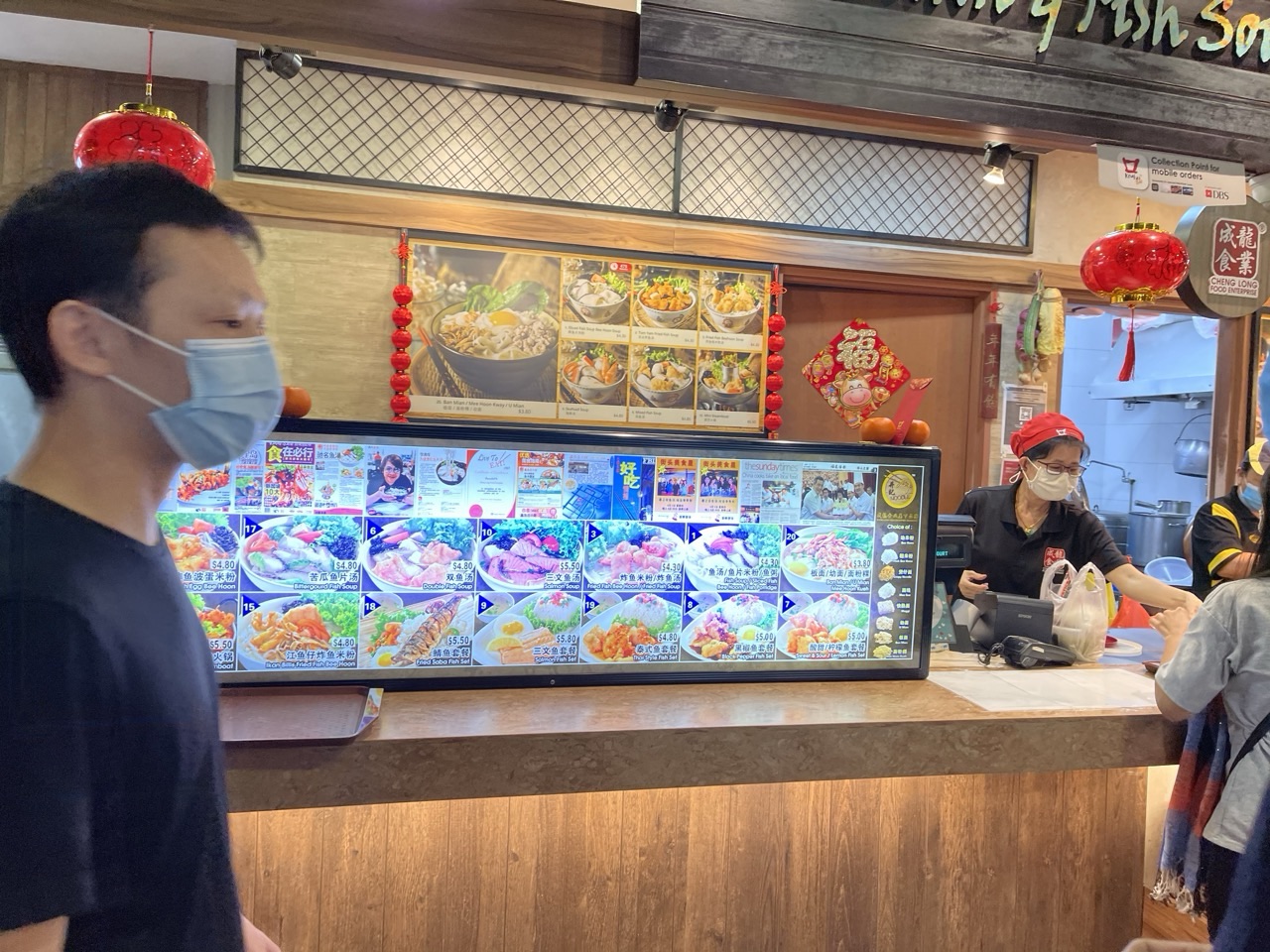
Waterway Point at 83 Punggol Central is a convenient place to eat near Punggol MRT, but choosing lunch with a family can take more planning than choosing a dish. Our original October 2026 photographs show a fish-soup-and-rice stall in the mall’s food court, a restaurant queue, a juice counter, takeaway food and breakfast customers. Together, they raise useful questions: where should you eat, what if the queue is long, how do you balance different food preferences, and how do you avoid buying first and struggling to find a suitable seat?
This is a photo-led lunch decision guide, not another list of top-rated restaurants. The existing Waterway Point Food Guide covers the wider dining directory. Here we concentrate on reading the real food environment, helping parents make sensible choices and understanding what the photographs establish. Individual stalls, menus, prices, certificates, promotions, hours and queues can change; the current operator and staff always outrank a static picture.

Waterway Point family lunch: the useful facts
- Mall: Waterway Point, 83 Punggol Central, Singapore 828761, beside Punggol MRT/LRT.
- Official visitor directions: mall operator Frasers Property advises Punggol MRT/LRT Exit A, although always follow current station signs.
- Mall hours: the operator advertises general mall opening hours of 10am–10pm; individual dining outlets can have different opening and last-order times.
- Photographed in October 2026: food-court fish soup and rice, a restaurant queue, a juice stall, takeaway counters and breakfast dining.
- Not verified from photographs: exact food-court stall roster, current prices, opening hours, food allergen information, certification, quality ratings or queue lengths on other dates.
- Food courts are not the same as every restaurant: a mall can contain independent outlets, cafés, takeaways and a shared food court with different payment and seating arrangements.
- For dietary needs: ask each food establishment about ingredients and preparation; SFA advises consumers with allergies to check directly and avoid cross-contact.
- For drinks: HPB encourages smaller sugar intakes and offers current Nutri-Grade information to help people compare choices.
- For finishing meals: follow tray-and-crockery return signs at the relevant dining place and clear litter responsibly.
Official sources include Waterway Point’s visitor page, SFA’s food-safety advice, SFA’s food allergy guidance, HealthHub’s practical food choices and NEA’s Clean Tables information. The article separates their general rules from what our particular photo shows.
What the fish-soup photograph tells us
The photo-library title identifies a fish-soup-and-rice stall at Waterway Point’s food court. It offers a recognisable picture of the counter and eating environment, but no complete dated menu or audited list of ingredients. A photograph taken on one day cannot confirm the size, cost, current availability or composition of a bowl ordered weeks later.
A parent may use the photo to explain one possible food category to a child: soup served with rice. The exact ordering options depend on that establishment’s current menu. If a family member needs ingredients excluded or has a serious food allergy, a warm-looking bowl in a photograph offers no assurance. Ask the counter before placing the order, and choose another dish if the answer is uncertain.
Food-court dining and restaurant dining are different decisions
A mall food court usually offers several counters with shared dining arrangements, while a sit-down restaurant can have its own queue, host, menu and table-management process. Some mall outlets are primarily takeaways, others are cafés. Choosing among these is as much about the group’s time and comfort as about the food.
A family of five may prefer several cuisines from a food court so different people can order what they want. Someone meeting a friend may choose a sit-down restaurant for a quieter conversation. A parent racing to school pickup might want a straightforward takeaway. None of those options is universally best; they suit different circumstances.
How to read the restaurant queue in the photographs
One new image is labelled ‘Restaurant Queue at Waterway Point’. It shows a queue at a photographed moment, not a measurement of peak periods or proof of a particular restaurant’s quality. A short queue can move slowly if tables remain occupied; a longer line can move quickly if service is efficient. The visible number of people isn’t a reliable stopwatch.
If timing matters, ask about the current waiting estimate in a way that doesn’t block the entrance. Decide ahead of time how much of the outing can be spent waiting. A family can enjoy a meal without proving that a popular-looking line was worth every minute.
The lunchtime choice begins before anyone orders
It is tempting to buy the first meal that looks appealing and look for seats while holding a hot tray. That can be inconvenient with children or an older visitor. Start by checking how the food service works, whether your group has a suitable place to eat and which people need supervision. Different premises may have different seating or collection rules.
Make a quick group plan: who orders, who stays with the children, where the group will reconnect and what to do if the first option is unavailable. This is not an excuse to leave a small child alone guarding a table. A simple, safe plan beats a complicated effort to maximise speed.
A food court is a small system of shared responsibilities
Shared food-court seating involves diners, individual stallholders, cleaners and the premises operator. Vendors prepare meals, customers move to collect them, diners use communal tables and used crockery returns for processing. When any step becomes crowded, the surrounding space can feel less comfortable.
Thinking in systems helps a family behave considerately. Avoid blocking counter access while discussing menus. Carry hot food carefully through the agreed route. Finish by clearing the table and using the designated return point. These ordinary actions give other diners room to complete their own journeys.
Why the whole group does not need the same dish
One child may want rice, another noodles, while a grandparent prefers something easy to eat. A mall with several food outlets provides choice, but it can also make decision-making harder. Agree on one or two acceptable options per person before everyone wanders to different counters.
Parents can help younger children decide between a small number of realistic possibilities rather than demand that they inspect every menu board. An older child can be responsible for comparing actual prices or asking a polite clarification, under suitable supervision. The goal is a comfortable meal, not an exhausting taste survey.
What counts as a sensible main meal?
HealthHub suggests practical changes to common Singapore eating-out choices, such as selecting vegetables, considering wholegrains where available and moderating oily gravies. Its advice includes choosing clear-based soups in some situations, while also noting that soup itself can contain substantial sodium. Those points are general nutrition guidance, not an assessment of a particular photographed fish-soup recipe.
A meal should suit the person’s age, appetite and individual needs. Avoid judging another family’s food choices from a tray. For yourself, read the current menu and decide what balance makes sense over the day. If a specific medical diet applies, follow qualified advice and the actual ingredient information rather than a generic blog description.
Fish soup is not automatically a low-sodium meal
The words ‘fish soup’ may sound like a lighter choice, but the total salt content depends on stock, seasoning, sauces and how much soup is consumed. HealthHub notes that even clear-based soups can contain significant salt. A photograph cannot tell us the salt concentration in a particular bowl.
If sodium intake matters, ask about possible modifications and follow applicable health guidance. Don’t announce exact nutrition figures without verified laboratory or menu data. This is a good example of why a food category is not a nutrition label. A parent can explain that two fish-soup recipes may be quite different.
The juice-stall photo and the sugar question
Our October collection includes a fruit juice stall at Waterway Point. A colourful drink may look refreshing, but the photograph cannot establish ingredients, whether sugar or syrup is added, serving size or a drink’s current Nutri-Grade classification. Ask the outlet directly if those details matter.
HPB and HealthHub explain that beverage sugar can be a significant part of people’s overall intake and encourage lower-sugar choices. Plain water remains a straightforward option. A family may choose juice sometimes while still making an informed decision about size and sugar. Avoid turning the photo into a health claim for a drink not independently analysed.
What Nutri-Grade does and does not tell you
Singapore’s Nutri-Grade scheme uses grades A through D for relevant beverages based on sugar and saturated fat thresholds. It is useful when the product is covered and labelled in a form that the scheme requires. But a photograph showing a fruit juice counter does not provide a readable certified grade for every possible custom drink.
A parent should check the current label or displayed information and avoid guessing. A child can learn that packaging and menu information is different from advertising photography. The skill is not memorising that all juice is good or bad; it is asking what is actually in the cup.
Coffee and toast are different from a full lunch
The photo collection includes customers at Toast Box and a queue associated with Ya Kun Kaya Toast. Such breakfast or snack stops can serve different purposes from a food-court main meal. A family may choose toast as a quick break while a group expecting a hearty lunch needs a more substantial option. Neither business’s exact menu or hours should be inferred from the photographs.
Think about the timing of the day and the people eating. A child who has just finished sports might be hungrier than one having a short snack between errands. Avoid using queue length to decide nutritional adequacy. The appropriate question is what meal the family needs, not which counter appears busiest in one picture.
Takeaway counters belong in the plan too
One photo identifies a WOK HEY counter. A cooked-to-order takeaway can be useful for a family heading home, but waiting and collection procedures differ across outlets. The photographed store’s continuing location, menu and prices need current verification. Do not promise an exact number of minutes based on a snapshot.
Takeaway also changes responsibility after purchase. Food should be carried safely, hot containers handled carefully and meals eaten without unnecessary delay. SFA advises consumers to buy takeaway close to when they intend to leave and take care over food holding and handling. A sensible plan includes the journey from collection to home, not just the queue.
Before ordering: check today’s displayed price
Prices in Singapore food outlets can change, as can portion sizes and optional extras. Photo filenames rarely capture all those variables. Look at the menu and ask whether additional ingredients, a larger serving or a drink changes the final amount. A family’s budget should use actual displayed prices rather than an invented ‘Waterway Point average’.
If a child is learning to order, model a short polite question: ‘Does that price include rice?’ A vendor may answer while serving other customers, so keep the question clear. The aim is to understand what is being purchased, not to delay the whole queue with a debate.
A family budget example that isn’t a fake price list
Imagine a hypothetical family of four allocating S$52 for lunch and drinks. If four main meals total S$35.20 and beverages total S$9.60, the remaining allowance is S$7.20. These are deliberately illustrative numbers, not verified prices of any Waterway Point stall. The arithmetic helps an older child understand a running budget.
The family can then discuss what to do with the remainder: save it, reserve it for another errand or choose one additional item if the group wants it. Budgeting is about choices, not spending every dollar. Replace the example with actual purchases before making decisions. An invented worksheet should never become a public claim about a vendor.
Why queues are not reliable taste rankings
A food-counter queue can be long because many people like the food, because an order takes time to prepare, because one family is buying several portions or because the counter has fewer staff at that moment. A photograph cannot distinguish those explanations. A popular-looking line is not a scientific quality ranking.
Ask what matters to your family: dietary suitability, waiting time, price, portion size or a familiar flavour. Different people can reasonably choose different counters. Ranking by perceived demand alone overlooks important constraints and can be unfair to a less photographed business.
An everyday time-management example
Suppose the family has a hypothetical thirty minutes before another commitment. A restaurant estimates twenty minutes before seating, leaving little time to order and eat. A food-court option appears to have a shorter queue. The better choice may be to eat elsewhere, order takeaway or postpone lunch rather than risk missing the next appointment.
These are planning examples, not verified queue times. Real timing depends on the day and the outlet. Parents can work backwards from a school pickup or booked activity, including time to collect food, eat, clear a table and reach the next place. That is often a more useful calculation than choosing the highest-rated photo.
Hot soup and young children
Hot bowls, sauce and drinks can cause injury if spilled. Before carrying soup through a crowded food court, decide which adult will handle it. Don’t place a very hot container where a child can pull it down, and don’t ask a small child to navigate a busy aisle with a heavy tray. If a spill occurs, warn people nearby and seek staff assistance.
Children can gradually learn safe habits by helping in appropriate ways—perhaps carrying an empty water bottle or checking that their belongings are together. Supervision should match the child and the environment. A calm five-minute delay is better than a rushed burn risk.
When a family member has a food allergy
SFA’s current consumer guidance recommends checking whether a retail dish contains the allergen and considering possible cross-contact during preparation. Ingredients can appear in sauces, toppings or cooking oils. A familiar dish name is not a complete ingredient list.
Ask staff specific questions and explain the seriousness of the restriction. If the stall cannot reliably confirm what is needed, choose a safer alternative. Don’t tell somebody that the food is allergy-safe because it looks plain in the photograph. For severe allergic reactions, follow appropriate emergency medical guidance.
Halal, vegetarian and other dietary requirements
A halal logo or certificate, where displayed, is a factual certification claim about an identified establishment and should be checked for current validity. The presence of a familiar meat-free dish does not automatically mean a place is vegetarian or able to avoid animal-derived ingredients during preparation.
Ask the business and consult the relevant certifying authority when necessary. This article does not classify every vendor at Waterway Point, because the October photographs do not provide a reliable current certification inventory. Readers need accurate answers about the precise meal they intend to buy.
What food hygiene photographs can and cannot prove
A clean-looking counter may be reassuring, but a picture cannot establish food storage temperatures, inspection results, cross-contact controls or licensing status. Nor should a single used dish in a background image be treated as evidence that an outlet is unhygienic. SFA explains the responsibilities of consumers and food establishments and how licensing information can be checked.
Observe the actual venue sensibly, ask questions where appropriate and rely on the competent regulator for enforcement records. A good local guide neither invents accusations nor gives false guarantees. Visual impressions have their place, but health-related decisions require better evidence.
Finding a place to sit without pressure
Communal tables are shared. During a busy period, choose a suitable area calmly and avoid standing over diners in a way that makes them feel hurried. A family should not block a large table for an uncertain group when others need seats. Leave appropriate circulation space for staff and people using mobility aids.
If the seating area is full, be willing to change plans. Buying a hot tray first and then searching anxiously is not always wise, especially with young children. Takeaway or a later meal may be a better fit. The point is to eat together comfortably, not to win a contest for the nearest table.
What a food-court tray-return habit teaches
Singapore’s clean-table rules apply in food courts as well as hawker centres and coffeeshops. Diners are expected to clear table litter and return used trays and crockery as directed, while cleaners continue handling other tasks such as sanitising surfaces and processing returned items. Read the facility’s signs rather than guess where a tray should go.
A school-age child can learn to check for used tissues, food wrappers and forgotten belongings before leaving. Adults should manage hot or heavy dishes safely. It helps to model the habit without threatening children with fines; a shared table is simply better when each group leaves it ready for the next.
An exception does not cancel good manners
A tray-return station may occasionally become full or temporarily unavailable. NEA’s guidance explains how full return-point situations are treated. The sensible response is to look for an appropriate alternative or ask staff, without stacking plates dangerously or blocking walkways.
The aim of the rule is a clean, safe environment. If something is genuinely unusable, use judgement consistent with the guidance rather than force a risky workaround. This is a useful real-world lesson in why responsible behaviour involves both following rules and understanding their purpose.
With a grandparent who prefers a slower lunch
A three-generation family may want different food and a different pace. Ask older relatives about their preferences rather than assume that every senior wants help ordering or carrying food. Some may prefer a quiet restaurant; others enjoy choosing dishes independently from several counters.
Choose seating and routes that work for the actual person, including any mobility needs. Allow time to pause after eating if space permits, while also being considerate of others waiting. An enjoyable family meal is measured by comfort and company, not how quickly everyone finishes.
With a stroller and a toddler
The practical problem is supervision while one adult collects food. Decide who will remain with the child and where the group will reunite. Don’t leave a stroller blocking a counter entrance or tray-return point, and don’t use an unattended bag to hold a seat. If you are alone with a toddler, one straightforward order may be better than four separate queues.
Check for current accessible seating or amenities that actually fit your needs. A mall’s general accessible facilities are not necessarily positioned next to every restaurant. Ask staff instead of treating a photograph’s apparent open space as proof of a suitable route.
With a child learning to order independently
Older children can practise reading menus, asking for a portion and checking a payment amount, but independence develops with supervision and consent. Agree on a spending limit and an appropriate collection point. A parent may stay nearby while the child orders, rather than send them through a crowded mall alone.
Afterward, ask what went well. Did the child listen to the reply? Were they polite? Did the food match the order? These are practical communication skills. They matter beyond lunch, and they don’t require making a restaurant worker responsible for a school exercise.
How to turn lunch into a simple English lesson
Ask a child to describe the observed photo with clear verbs: waiting, ordering, serving, carrying and eating. Then ask which things are not established. For example, a picture of a restaurant queue doesn’t reveal whether anyone is hungry or impatient. The child learns to avoid making claims about strangers’ feelings.
A Secondary 1 pupil might write a balanced paragraph explaining why mall dining offers variety but creates choices about budget, queueing and time. Support the paragraph with specific observations while labelling any invented family scenario. This is better writing than a generic list of adjectives about delicious food.
A small Mathematics model of queueing
Imagine, only as a learning exercise, that a counter completes one order every three minutes and there are four separate orders ahead. A simple sequential model estimates twelve minutes before a new customer reaches service. Real food counters may prepare several meals in parallel, and one person may buy multiple dishes, so actual waiting time can differ significantly.
Ask the student which assumptions would be needed to make the estimate useful. A queue’s visible length and processing speed are not the same measurement. This is why a snapshot cannot supply a trustworthy real-time wait, no matter how precise the arithmetic looks.
A Social Studies lesson about shared public services
A mall food court is not a public service in exactly the same way as a school or library, but it is still a shared social environment. Workers, operators and customers need rules so food service and seating function fairly. People may arrive with different incomes, cultural food preferences and time constraints. A good dining environment allows many of those needs to be managed respectfully.
A student can consider the different roles without inventing a vendor’s profit margin or a worker’s salary. Ask what diners control, what operators control and which issues require government food-safety oversight. The goal is to understand coordination and responsibility in a familiar setting.
Photographing people while they eat
Food photography can become intrusive if it focuses on identifiable strangers or children at tables. A wide scene may be sufficient to show a crowd or food counter. If you are photographing your own family, keep the composition respectful and comply with the mall’s current rules. Don’t block a checkout queue for a staged picture.
Use descriptions such as ‘diners at Waterway Point’ rather than imagining their relationships, employment or reasons for visiting. Someone holding a takeaway bag is not automatically a delivery rider. A good local photograph documents the space without assigning an invented identity.
What to do if a queue or outlet is no longer there
Restaurants and food counters can change tenants, menus and schedules. A photo taken in October 2026 might be historically accurate while an outlet has since moved or closed. If your visit depends on a named vendor, check the mall’s current tenant directory and the establishment’s own communication.
If the business is no longer there, use the broad food guide for other options or choose a different meal. A dated photograph remains a useful record, but it should not be treated as a live guarantee. That distinction is especially important for someone travelling from outside Punggol solely for one dish.
A parent-friendly fifteen-minute decision plan
Start by checking the time available, dietary needs and seating or takeaway preference. Choose no more than two realistic dining options to inspect. If both have long waits, switch to a practical alternative rather than touring the entire mall while the child grows hungry. Confirm the actual order details before paying.
After collecting food, prioritise safe carrying and a comfortable place to eat. Finish by using the appropriate clearing process and checking that nobody has left a water bottle or bag behind. The fifteen minutes here describes a method of decision-making, not a verified guarantee that any outlet can serve lunch within that time.
A parent-friendly relaxed meal plan
If the family has more time, allow everybody to share what they want and browse a manageable set of choices. It can be enjoyable to compare a food-court main with a sit-down restaurant or a light takeaway. Keep the choices proportional to energy levels rather than turn the outing into a scavenger hunt for an imaginary best dish.
Leave room for changing plans. A toddler may need rest, a grandparent may prefer to sit and a teenager may want to buy a drink separately. The most successful plan is often the simplest one that treats every person’s needs as legitimate.
What the photo series tells us about Waterway Point
The October images cover multiple kinds of dining: a food-court stall, a restaurant queue, a juice counter, breakfast venues and takeaway. That range illustrates why Waterway Point is more than a single dining hall. It is a mall where food is connected to shopping, transport and everyday Punggol errands.
But the photographs are not an independently verified comprehensive directory. A site can be useful without pretending its camera captured every food business. The current Waterway Point website owns today’s tenant list; this article owns the practical story of how a family chooses and uses a dining space.
A final short checklist for a comfortable family lunch
Identify the right mall: Waterway Point at 83 Punggol Central. Check today’s dining options, actual prices and relevant dietary information. Decide whether you need shared food-court seating, restaurant service or takeaway. Agree on supervision and food collection, allow a realistic margin for queues and carry hot dishes with care.
When finished, clear litter and return crockery as directed. If the day changes, choose another option without treating it as a failure. The October photographs make the choices familiar; the live venue information makes your actual meal possible.


Frequently asked questions about eating at Waterway Point
Where is Waterway Point?
83 Punggol Central, Singapore 828761, beside Punggol MRT/LRT. The mall operator directs MRT travellers to Exit A.
Does Waterway Point have a food court?
Yes. The photo set includes a food-court fish-soup-and-rice stall, and the mall has other independent restaurants and takeaway outlets.
Is the fish soup counter still open?
Its continued current operation has not been independently confirmed. Check the up-to-date tenant directory or the stall itself.
Can I find current prices in these photos?
No reliable full price list is established here. Current menu boards and counter information take priority.
Which stall is the best?
The article does not rank stalls. A queue is insufficient evidence of food quality, value or suitability for your dietary needs.
Is fish soup always healthy?
Not necessarily. Ingredients and sodium can vary. HealthHub offers general guidance, but a specific meal needs actual nutritional information.
Does a juice photograph establish its sugar content?
No. Ask the actual counter and consult relevant Nutri-Grade information where available.
What if somebody has a serious allergy?
Check the precise food and cross-contact risks with the establishment. Do not rely on photographs or dish names for allergy safety.
Are all outlets halal-certified?
No blanket claim is made. Verify the current certificate of the precise establishment where relevant.
Can I eat with a stroller?
A family may be able to use appropriate dining spaces, but seating width, access and current arrangements must be checked on site.
Do I need to return trays?
Follow the food court’s posted tray and crockery return requirements and clear litter; NEA’s clean-table rules apply to public dining venues.
Can we use any restaurant’s seats to eat food from another outlet?
Do not assume so. Some seats belong to individual restaurants while food courts have shared seating; follow the operator’s rules.
How long do queues take?
Queue time is variable and cannot be predicted accurately from an October photograph. Ask the current outlet if timing matters.
What is the mall’s general opening time?
Waterway Point advertises general 10am–10pm hours, but individual food outlets may operate differently.
Does the photo show where every counter is located?
No. It shows selected venues, not a current complete floor directory. Check official mall signage and the tenant directory.
How can a child learn from a meal?
They can practise reading menus, budgeting, polite requests, time estimates and clearing the table in an age-appropriate way.
Are food-court and restaurant queues the same?
No. Shared food-court counters and table-service restaurants may have different ordering and seating workflows.
What if a meal is served incorrectly?
Politely check the order against the receipt and seek assistance from the business; keep personal payment data private.
Can the photographs certify hygiene?
No. They do not establish food safety inspections, temperatures or handling practices. Refer to SFA and current premises evidence.
Where can I find a broader dining list?
See the existing Waterway Point Food Guide, linked in this article, for the directory-level purpose.
Are these photographs new?
They were newly reviewed from the site’s October 2026 Waterway Point media collection. They are a dated visual record, not a live inventory.
Sources and related Punggol reading
- Waterway Point — official address, MRT exit and concierge information.
- Waterway Point — current store directory.
- Singapore Food Agency — Food Safety Tips.
- Singapore Food Agency — Food Allergies.
- HealthHub — Healthy Hawker Eats.
- Health Promotion Board — Nutri-Grade.
- National Environment Agency — Clean Tables Campaign.
- Waterway Point Food Guide 2026 — venue and cuisine directory.
- Waterway Point Mini Train Photo Guide — a separate family activity.
- Complete Punggol Guide
Photo and editorial note, 23 October 2026. Images are original October 2026 eduKatePunggol media-library records of selected dining counters and mall spaces. Specific business menus, hours, prices, diet certifications, safety records and present queue conditions are not verified by photography. The visitor and food-safety sections use current official Frasers, SFA, NEA and HPB guidance. No photographed person’s identity, occupation or personal relationship is inferred.


