
Quick answer. Singapore’s Junior Sports Academy (JSA) is an MOE programme for primary-school pupils with stronger abilities in the physical domain. It is intended to help children discover their sporting strengths through several different sports, rather than force ten-year-olds to specialise immediately. The National Youth Sports Institute (NYSI) supports talent identification, sports science and development in partnership with MOE. A child does not need to be a national champion in one sport to have relevant physical potential. The exact 2026 entry route matters. An official Jurong West Primary School notice issued on 26 January 2026 says that MOE’s JSA selection trials took place in March for interested Primary 4 and Primary 5 pupils. Parents and teachers could nominate through the child’s school. Trials evaluated agility, balance, coordination, speed and power, not a single sport’s advanced techniques. The notice explicitly stated no special test preparation was needed, with time to become familiar with trial items. Selected pupils were expected to begin from Term 3, subject to the offer and family decision. These are dates for the 2026 cohort; future trials require new school notices. There is a significant difference between the age groups. A learner selected in P4 in 2026 enters a four-sport-module, two-year sequence, from P4 Semester 2 through P6 Semester 1. A learner selected in P5 is offered a shorter two-module, one-year sequence through P6 Semester 1. Both routes help pupils explore movement, sport choices, cooperation and broader physical competence. A JSA invitation does not guarantee admission to Singapore Sports School, a Secondary 1 DSA offer, participation in the national team or a medal. For a family living in Punggol, the child remains enrolled in their own primary school while joining the selected programme. Sessions may involve designated host schools or specialist venues, with an actual timetable and travel plan that must be confirmed. Parents should check genuine enjoyment, weekly family capacity, safety and ordinary schoolwork before making a commitment. This comprehensive guide explains nomination, physical trials, modules, NYSI youth-development principles, sport science, original Maths and movement reasoning tasks, Punggol logistics and later secondary pathways. Evidence checked on 23 October 2026.
1. JSA is a talent-development opportunity, not a school
The Junior Sports Academy operates as a development programme alongside a child’s primary education. It does not replace their MOE school, form teacher, subjects or primary examinations. Pupils continue their normal school life while accessing selected additional sport experiences.
Its purpose is to discover potential across movement skills and give children a chance to experience sports before making later choices. A young child may have strong coordination but little exposure to a particular activity because of family resources or school CCA offerings.
That distinction is the reason to understand JSA separately from Singapore Sports School, which is a different institution with its own admissions and qualifications.
2. Why MOE recognises physical strengths
Children’s abilities develop in more than examination subjects. Some learn quickly through movement, demonstrate unusual balance or agility, and thrive when experimenting with different games.
JSA gives recognition and developmental opportunities to pupils showing physical potential without implying that every other child lacks sporting value. All pupils still benefit from Physical Education, active play and suitable CCAs.
A parent should avoid treating an invitation as a permanent ranking of bodies or talent. The point is to support development at the stage where the child’s interests and movement skills can broaden.
3. MOE and NYSI have related roles
MOE administers the national schooling framework and operates JSA as part of its opportunities for primary pupils. NYSI provides sport talent identification and development expertise, including selection-trial design and sport science guidance.
An external club coach should not claim to decide JSA entry just because they prepare pupils for competitions. The child’s school is the route through which nominations and official notices are managed.
Families should read MOE’s current JSA guidance and NYSI’s programme page together. Each explains an aspect of the system, while the exact invitation and schedule belong to the actual cohort.
4. P4 and P5 can be nominated
NYSI’s current JSA page says parents and teachers can nominate eligible children for the selection trial through the child’s school. The 2026 Jurong West Primary notice confirms this arrangement for Primary 4 and 5 pupils.
An independent parent does not submit an official national JSA application simply by paying for a private sporting test. The school communicates the genuine process and any documentation or consent needed.
A Punggol parent whose child has never joined an interschool sports team can still ask the child’s PE teacher about the relevant nomination opportunity. Prior medals are not the sole premise of the programme.
5. The 2026 nomination and trial timeline
The official 26 January 2026 Jurong West Primary letter invited parent nominations by 13 February and described MOE’s March JSA selection trials. Selected pupils and families were expected to be informed around mid-May and invited to a parent-engagement session.
These dates are an example of the 2026 cohort’s administration, not a universal deadline for every later year. The January 2026 letter is not proof a new October 2026 trial has opened.
For a future cohort, families should look for the next official school communication. A reliable guide never promises a place in a completed trial.
6. What the physical trial assesses
The 2026 school letter identifies agility, balance, coordination, speed and power as primary selection dimensions. The intention is to observe general motor potential rather than ask a pupil to demonstrate an advanced Hockey tactic or elite Canoeing manoeuvre.
A child who has not specialised in any sport should not automatically be dismissed. The programme was designed to broaden opportunity across different movement patterns.
A family can encourage age-appropriate active play and a positive disposition, but should avoid intensive training aimed solely at gaming the test. The official letter states that no specific trial preparation is needed.
7. No elaborate trial drilling is required
Some commercial services may advertise an exact JSA selection-test formula or a guaranteed pass after paying for classes. Such promises are not supported by the official nomination and assessment process.
Children have different growth and maturation rates. NYSI’s talent-development guidance warns about over-specialisation, injury and burnout when young athletes are pressured to train excessively.
A helpful parent response is to let the child enjoy movement, learn basic safety and arrive at an official trial rested and properly informed. The opportunity should develop curiosity about sport, not create fear of one selection afternoon.
8. P4 offers the full four-module sequence
The 2026 school notice states that Primary 4 entrants join a two-year programme from P4 Semester 2 to P6 Semester 1 and complete four sport modules. The child can therefore experience multiple types of activity at different points.
This helps develop a broad physical foundation and exposes a learner to skills they may not have encountered in their regular school CCA or community sports programme.
Four modules do not mean four separate national qualifications, nor does completing them automatically produce a DSA offer. They are developmental experiences with sport-specific coaching and related learning.
9. P5 offers a shorter two-module sequence
The same 2026 official notice provides a one-year route for pupils selected at Primary 5, starting in Term 3 and completing two sport modules through P6 Semester 1. This is a valid but shorter exposure opportunity.
Parents should not tell a P5 child that they must complete four modules before PSLE when their official intake offers two. Nor should a pupil expect to restart the entire P4 programme at an older age without the programme’s approval.
The actual enrolment notice will explain which modules are available and when. A shorter route can still help pupils identify a sport they enjoy for secondary school.
10. General movement skills transfer between sports
Running, balancing, changing direction, controlling an object and coordinating hands and eyes appear across multiple activities. A child who explores several sports can notice how a skill learned in one helps another.
For example, anticipating an opponent’s movement matters in a net game and can also support a territorial invasion game. The specific technique and rules differ, but attention and decision-making may carry over.
The goal is not to pretend all sports are identical. It is to build broad competence before deciding which more specialised training, if any, fits the learner later.
11. The sports categories encourage variety
NYSI’s programme history describes groups including general sports, territorial or invasion sports, net/barrier games and target or striking-fielding activities. Different activities develop movement patterns and strategic thinking.
A pupil may select one module from several categories under the actual module process. The current available menu and placement depend on the official cohort and training sites, so historical lists should not be presented as a permanent promise.
Parents can use the categories to explain breadth: learning a target skill, a team-game skill and a general movement skill may provide different educational challenges.
12. Examples from the historical multi-sport menu
NYSI’s historical report names activities including Athletics, Swimming, Wushu, Basketball, Floorball, Football, Netball, Badminton, Table Tennis, Tennis, Volleyball, Fencing, Shooting and Softball among the categories offered or considered at that time.
These examples show the diversity of the underlying model. They are not a verified list of all modules available at the family’s assigned 2026 venue or in every subsequent intake.
The actual 2026 student selection message and MOE module information should determine what parents and children may choose. A marketing brochure should not override the official offer.
13. The NYSI physical-development perspective
NYSI explains that young people develop at different rates and that physical maturation can affect selection. Its youth coaching guidance cautions against choosing children only because they were born earlier in a cohort and may be temporarily taller or stronger.
This does not mean selection cannot be conducted. It means adults should interpret one trial as an opportunity to identify potential rather than a final biological verdict.
A pupil who does not receive a JSA invitation should still be encouraged to take part in ordinary PE, school CCAs and community sports appropriate to their interests and health.
14. Early specialisation can create trade-offs
NYSI’s youth coaching resources discuss possible overuse injuries, burnout and sport dropout when children specialise very early under excessive training pressure. Broad experience can allow learners to develop different movements and find enjoyment.
The right training volume depends on the child, sport and qualified guidance. Parents should not infer from a generic online recommendation that one fixed number of hours is medically right for every learner.
JSA’s design encourages exploration before later commitment. This is particularly useful for children who enjoy movement but have not chosen one discipline as their main sport.
15. Sports education includes more than technique
NYSI describes JSA-related education about strength and conditioning, nutrition, psychology and ethics. Physical skill development can therefore be connected to understanding training, recovery and responsible behaviour.
A child might learn that practice quality and rest matter, or that a competitive team depends on fair play and clear communication. Such ideas can support wellbeing outside sport.
Parents should not turn a sports science workshop into medical advice for a particular child. Individual pain, injury or health needs require suitable qualified assessment and the actual programme’s safety guidance.
16. Strength and conditioning should be age appropriate
NYSI provides a JSA guide explaining how suitable strength and conditioning can support movement patterns, coordination and resilience. Young pupils are not simply smaller adults who should copy every heavy training exercise they see online.
Coaches can adjust equipment, intensity and activities to the child’s developmental stage. A school-age learner should understand safe movement and appropriate supervision before attempting unfamiliar exercises.
Parents should avoid unsupervised high-load drills or risky challenges marketed as a way to pass the JSA trial. The core goal is safe and enjoyable physical development.
17. An original agility comparison task
Imagine a fictional child completes a simple marked shuttle route in 18 seconds, then later completes a comparable route in 16 seconds. The difference is two seconds, or about 11.1% of the original 18-second time.
That calculation does not prove an 11.1% increase in every measure of agility. The route, timing and physical state would need to be comparable, and skill involves more than elapsed time.
A learner can use the data to ask better questions: was the turn tighter, the start faster or the recording more accurate? Mathematical reasoning supports sport without reducing the child to one stopwatch score.
18. Balance and coordination are different from speed
A child may run quickly but struggle to maintain balance during a slow change of direction. Another may have strong control of an object but lower endurance. General motor assessment considers multiple abilities rather than one universal athletic number.
Coaches can design safe tasks targeting different movements and observe how pupils respond. Parents should avoid training only the fastest sprint because they think it is the entire JSA trial.
Children benefit when they learn to appreciate varied strengths and improve over time. Speed alone does not determine their potential in every sport.
19. Original Mathematics task: a jumping pattern
Suppose a student records safe, supervised standing broad-jump distances of 92 cm, 100 cm and 97 cm in three trials. The arithmetic mean is (92 + 100 + 97) ÷ 3 = 96⅓ cm.
The longest trial is 100 cm; it would be wrong to call the mean “the child’s best jump”. Different summaries answer different questions, and a small sample contains ordinary measurement variation.
Ask the learner to explain when average and maximum are appropriate. The data are invented for teaching and are not actual JSA trial scores or thresholds.
20. Percent change is not the same as centimetre change
A child improves a fictional measured jump from 80 cm to 88 cm. The absolute improvement is 8 cm; the percentage relative to the starting value is 8 ÷ 80 × 100 = 10%.
A second child improves from 120 to 128 cm, also gaining eight centimetres but a different percentage increase of about 6.7%. Neither comparison alone establishes which child has greater long-term sporting potential.
The exercise helps families discuss progress accurately rather than use selective statistics to rank children of different ages, sizes or development stages.
21. A parent nomination is not selection
A primary school can submit a parent or teacher nomination for the trial. That simply allows the student to be considered through the official process. It is not an acceptance into the JSA modules.
The physical trial, MOE assessment and any subsequent programme offer remain separate stages. Parents should wait for official communication before announcing a fixed training schedule or paying for transport arrangements.
This distinction also protects children emotionally. Being nominated is an opportunity to explore, not a promise that adults should turn into pressure for a perfect result.
22. The school remains the child’s normal school
A pupil selected for JSA ordinarily continues their primary curriculum at the original school, with separate sport modules at authorised venues. The programme does not transfer the child’s P4 or P5 classroom to an elite sports campus.
The home school can advise on academic timetable, CCA commitments and current programme communications. The sport organisers provide the particular training details.
Parents should maintain school and JSA contacts separately rather than assume the PE teacher at school can change every external training venue or session without organiser approval.
23. The Punggol logistics question
A selected student from Punggol may attend modules at designated host schools or specialised sports facilities elsewhere in Singapore. The actual venue may differ across sports or modules and can change over the programme.
Wait for the official assigned location, then test travel from home or school at the scheduled time. Include food, safe pickup, weather and the child’s age. A family’s ability to manage the route affects sustainable participation.
A public court at Punggol Waterway is not automatically an authorised JSA training centre just because children play sport nearby.
24. School PE and JSA should complement each other
Physical Education gives broad movement and health learning to mainstream pupils. JSA provides a selected developmental opportunity for children showing stronger abilities in the physical domain. Neither makes the other irrelevant.
A JSA participant still has ordinary schoolwork, PE and potentially a school CCA or other activities according to their actual arrangements. Parents should confirm whether existing commitments fit the programme.
The learner should enjoy movement and learn safely without assuming every available sporting activity must be added to the weekly timetable.
25. Does JSA guarantee sports DSA?
No. A pupil may later be interested in Secondary 1 Direct School Admission under a sport category, but the receiving school uses its own selection and academic requirements. JSA participation can be relevant experience without constituting an automatic offer.
MOE’s DSA application guidance includes a child’s JSA participation in school-shared information where applicable. That is a record of experience, not a binding school admission decision.
The correct reason to join JSA is developmental opportunity. Parents can support genuine progress and later explore DSA honestly if the child chooses to pursue a sport.
26. JSA and secondary SP-CCA are distinct programmes
JSA is for selected primary pupils and allows multi-sport sampling. Strategic Partnership CCA (SP-CCA) serves eligible secondary pupils who want designated sports not offered by their own school’s regular CCAs.
A child can develop interest through JSA and later investigate a school sports CCA, SP-CCA, community academy or other appropriate opportunity. The path is not automatic.
Families should review the current entry and safety requirements at each stage, rather than expect a JSA completion certificate to grant a compulsory SP-CCA place.
27. Selection is not a lifetime talent verdict
A trial observes a child’s motor abilities at a particular developmental stage. NYSI’s own coaching guidance explains that young people mature at different rates, and apparent advantage can reflect age and growth as well as skill.
A learner who is not selected can still find enjoyment and competence in another sport later. Successful selected pupils likewise need ongoing learning, feedback and suitable training.
Parents should resist public ranking of children by the trial outcome. The programme is an opportunity to develop, not a permanent statement of human potential.
28. The 2026 letter should be read as an example, not a Punggol directive
Jurong West Primary’s 2026 notice is valuable because it documents a real selection process, trial purpose and module duration. However, its local parent-nomination deadline is attached to that school’s communication for that year.
A Punggol parent should use the actual child’s school for current nomination forms and official deadlines, not send Jurong West’s Parents Gateway document as if it were the local enrolment portal.
The broad programme mechanism is national; the school-level administration and timing must be verified for the family concerned.
29. An invitation should lead to a family decision
Once a child is selected, MOE’s published 2026 process includes a parent-engagement session before the opt-in programme begins. This gives families a chance to understand module selection, timing, coaching and the practical commitment.
An invitation is not a command to participate regardless of health, homework or transport capacity. The family should discuss genuine interests, recovery and realistic scheduling with the organisers.
A selected child who feels anxious about making a permanent sport choice can be reminded that JSA aims to broaden experience. The programme does not require every participant to declare a lifelong athletic career at age ten.
30. Multiple sports do not guarantee multiple medals
A programme covering several sports provides opportunities to develop movement and judgement, but does not promise competition wins in all activities. A child may be naturally comfortable in a net sport but need time to develop confidence in a team invasion game.
Learning involves both success and difficulty. A well-designed developmental experience allows the child to respond to feedback and notice which activities are rewarding.
Parents should ask what new skill the learner can perform and explain, not simply how many trophies appeared on a social-media post. That protects the intended spirit of broad exposure.
31. Sport skill is not identical to NAPFA performance
Singapore schools use Physical Education and relevant physical fitness assessments, but the JSA selection emphasises general motor ability under its own process. A good fitness score alone should not be represented as the official JSA acceptance formula.
A child who excels at one endurance measure may still be learning coordination or balance. Others demonstrate strong agility but need age-appropriate conditioning.
Families should read the actual programme criteria. Avoid building unofficial selection cutoffs from isolated NAPFA scores or comparing children whose age and maturation differ.
32. A Punggol child can have strengths outside organised clubs
Not every family can afford multiple private coaching programmes, and some children discover their sporting interest through ordinary PE, playground games and safe physical activity. The programme’s broad movement focus recognises potential beyond extensive specialist experience.
A pupil who enjoys balancing, catching or changing direction may be interested in the official school nomination route. Parents should encourage participation without claiming that informal play proves selection.
For real training, use qualified coaches and authorised facilities. The child does not need unsupervised high-risk activity to create an impressive application story.
33. How schools can identify candidate strengths
The child’s PE teachers may observe movement skill, confidence, coordination and motivation across ordinary school activities. Parent nominations also allow families to bring a child’s interest to the school’s attention under the established procedure.
A useful description is specific: for example, the pupil enjoys trying different games and maintains good balance in age-appropriate tasks. An exaggerated claim that the child is “Singapore’s fastest athlete” without evidence is not helpful.
The trial assesses the relevant motor skills. Family observations may support an enquiry, but they do not replace the official selection outcome.
34. A careful parent note about sporting interest
When contacting the school, identify the child’s level, interest and any relevant ordinary participation without inventing medals. Ask whether nominations for the intended intake are open and how the school communicates trial details.
Do not circulate sensitive medical information in a parent group to persuade strangers that the child deserves selection. If a health consideration affects participation, speak through the appropriate school channel.
Short, factual communication is useful. The student should understand the opportunity as something they may explore, not a family status campaign.
35. Physical development should preserve wellbeing
A child may be motivated to practise additional sport outside JSA, but training and rest should be suitable for their age and health. NYSI warns that excessive early specialisation can increase risks such as overuse injuries and burnout.
Parents should seek qualified sport advice for sustained pain or training concerns. A general article cannot prescribe the correct number of jumps, sprints or hours for every child’s body.
Sleep, meals, ordinary play, friendships and academic participation remain part of healthy development. More practice is not automatically better when the child is exhausted.
36. Strength and conditioning must be supervised
The NYSI JSA guide introduces appropriate warm-up, movement preparation and physical conditioning ideas for youth athletes. Its principles may involve safe activation, mobility and gradual progression, not copying elite adult training loads.
A student should understand the purpose of an exercise and follow the coach’s directions. Equipment, intensity and sequence vary with the activity.
Families should not attempt unapproved strength tests at home to compete with other candidates. The programme’s value comes from appropriate development, not a private contest over how much weight a child can lift.
37. Nutrition and recovery are educational topics
Sport science workshops can introduce the importance of hydration, suitable meals and recovery. These support both learning and physical participation, but they are not a universal diet prescription.
A child returning late from a training venue may need a realistic meal and sleep schedule. Parents should consult appropriate professionals when specialised nutritional or health advice is required.
The broader educational lesson is to make informed and safe decisions, rather than copying a social-media diet associated with an older professional athlete.
38. JSA is distinct from a secondary-school CCA
A P4 or P5 child may already have a primary-school CCA while exploring JSA. The school’s current arrangements determine how participation and scheduling are coordinated. It would be misleading to promise that every selected pupil is automatically exempt from all other school activity.
The JSA sport modules broaden experience and assist future choice. Secondary-school CCA selection follows the later school’s rules and the student’s interests.
Families can use JSA as useful information about what their child enjoys, while remaining open to sports, arts or other CCAs in secondary school.
39. The difference from elite athlete development
NYSI’s longer athlete development framework provides pathways for youth who subsequently demonstrate strong specialised potential. JSA can contribute to early exploration, but it is not itself a national-team selection contract.
A pupil who enjoys a module may later join an appropriate school CCA, sports association or community club under the relevant age and skill criteria. Those decisions remain separate.
Parents should avoid telling a selected P4 child that every future holiday must be spent training for elite representation. Broad development and enjoyment are legitimate ends in themselves.
40. A genuine athletic skill can support academic learning
Learning a new sport involves observation, pattern recognition, planning, interpreting feedback and adjusting decisions. These are also useful habits for Mathematics and Science, although a good sprint does not automatically raise examination marks.
A student who learns to compare two movement strategies might become more comfortable explaining why a different approach works in class. The transfer depends on reflection and suitable teaching.
Parents can ask how a child solved a new challenge rather than assume sport and school are competing for attention in every situation.
41. A sport data task about averages
A fictional learner records three sprint times of 12, 11.5 and 11 seconds for comparable distances. Their arithmetic mean is (12 + 11.5 + 11) ÷ 3 = 11.5 seconds. The fastest measured trial is 11 seconds, not the mean.
A pupil who announces that their “speed was 11.5 seconds” has mixed units—seconds measure time, whereas speed uses distance per unit time.
This illustrates why numeracy, measurement and technical language are useful in sport. It is not actual JSA trial data, and three observations do not prove a long-term performance trend.
42. A sport science task about fair comparison
Imagine a pupil jumps farther after changing shoes and performing an extra warm-up. The child credits the shoes alone. That conclusion is not justified because the warm-up also changed.
A better inquiry holds the relevant conditions comparable while studying one variable, under qualified supervision and appropriate safety. The learner records multiple trials and acknowledges normal variation.
The principle matters beyond sport. Evidence must support claims, whether a student is studying plant growth, a robot or a movement pattern. A clear explanation is stronger than an exciting but unsupported result.
43. How parents can compare two sport modules
Suppose the child may select between a net sport and a team invasion sport. Ask which movements they enjoy, whether the schedule fits, what safety prerequisites apply and whether the programme’s module choices are open to that pupil.
The objective is not to rank every sport as universally superior. One learner may enjoy one-to-one decision-making; another may prefer passing and team coordination.
A family should wait for the actual current module menu. Historical JSA sport lists demonstrate breadth but do not guarantee every activity is open in a given intake or venue.
44. A family time budget after selection
Imagine two hours of weekly sport training and an illustrative one-hour return journey each way. That would total four hours for the training day, before equipment preparation, meals or related activities.
The travel values are hypothetical and not a measured journey from Punggol to an assigned JSA site. A real route should be tested once the training location and session are confirmed.
The family can then see how the programme fits homework, sleep and other commitments. A well-planned schedule supports participation without forcing a young child to absorb all the logistical burden.
45. Community sport facilities are useful but not official JSA venues by default
Punggol’s parks, playgrounds and sports areas can offer safe opportunities for active play, following site rules. Such environments may help children enjoy movement and explore interests.
However, a nearby basketball court or waterfront is not automatically an official JSA training venue. Selected pupils must attend their assigned modules at authorised locations.
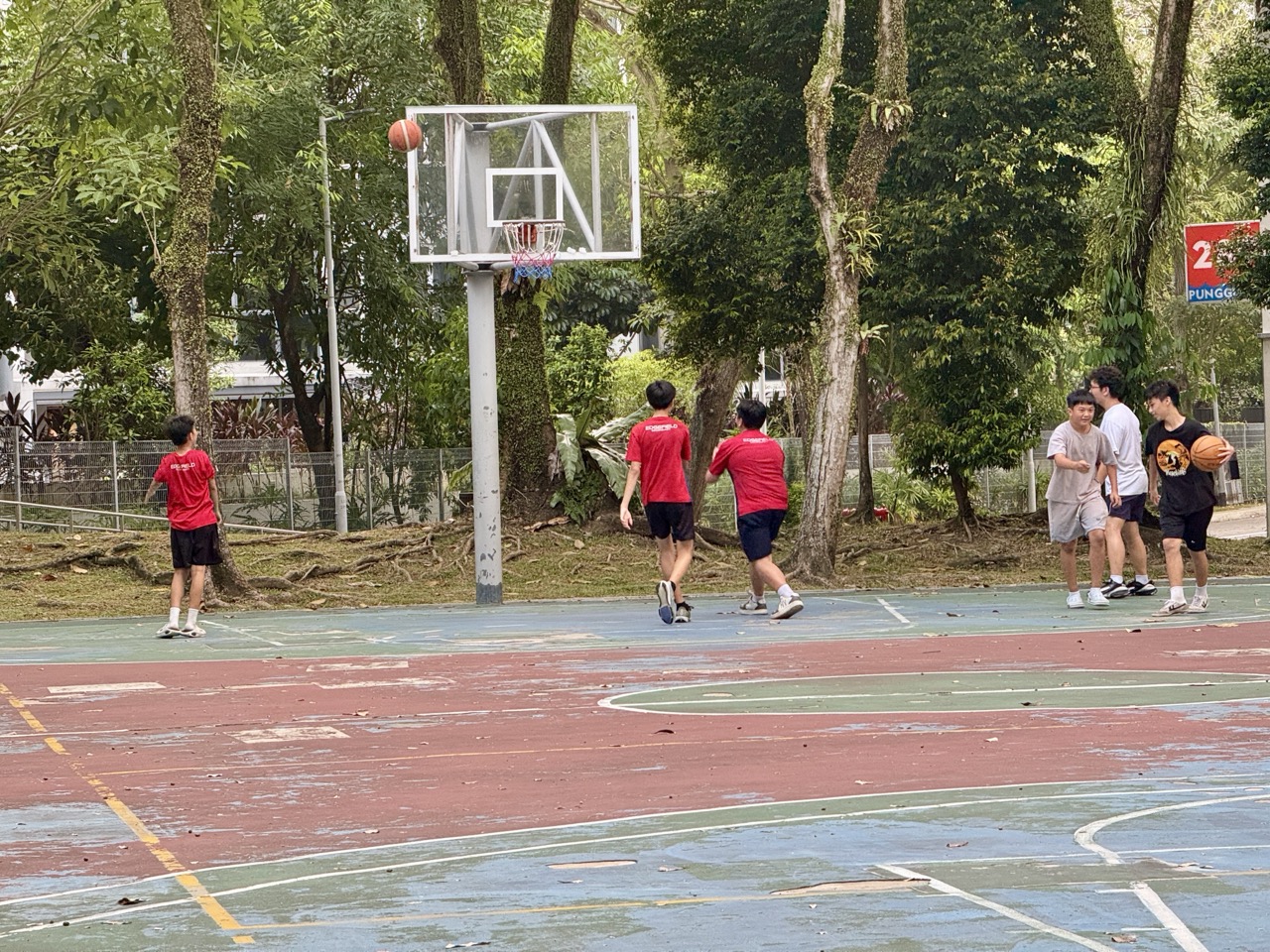
Families should separate ordinary local activity from programme attendance. A photograph of a Punggol court is a neighbourhood illustration, not evidence that a JSA session took place there.
46. A four-week family preparation plan
Week 1: ask the child’s primary school about the current JSA nomination route and confirm the student’s level and interest. Do not use an old form from another school.
Week 2: read MOE and NYSI’s programme objectives. Encourage enjoyable, safe movement rather than intensive trial-specific drills.
Week 3: assemble the relevant official trial information and any necessary consent, with sufficient rest and practical travel planning.
Week 4: if selected, review the module choices and assigned timetable at the engagement session; if not selected, support the child’s ordinary PE, CCA and sport interests positively.
47. A four-week start after a JSA offer
Week 1: confirm the sport module, reporting venue, coach contact and family travel routine. Explain safe attendance and what the child should do if a caregiver is delayed.
Week 2: ask the child what movement was unfamiliar and which feedback helped. Avoid comparing them with older or more physically mature children.
Week 3: monitor the combination of schoolwork, physical training, food and sleep. Raise sustained pain or distress appropriately.
Week 4: review whether the child remains interested and can manage the commitment. Progress in enjoyment and skill matters more than immediate competition success.
48. An older sibling’s success does not guarantee the younger child’s place
Two children may develop movement skills at different times, enjoy different sports and have different physical maturation. A sibling who completed JSA cannot create automatic priority for a younger pupil.
The younger child’s teacher or parent may make an appropriate nomination when eligible, but the official trial and selection remain independent.
Families should encourage both children without turning the selection into a household competition. The opportunity should help each learner discover what they enjoy, not establish a permanent family ranking.
49. Common myths that deserve correction
JSA is not Singapore Sports School, nor is it the secondary SP-CCA. It does not require prior advanced sport technique under the official general-motor trial design. It does not promise automatic DSA, a national team place or sports scholarship.
A P4 entrant’s four-module route differs from a P5 entrant’s two-module route in the verified 2026 notice. Parents should not apply the longer sequence indiscriminately.
Most importantly, a selection result is information about a particular opportunity at one point in development, not a permanent judgement on physical potential.
50. The educational purpose to keep in view
The Junior Sports Academy widens developmental experiences for selected children with physical strengths. Multi-sport exposure can help them discover preferences, build motor skills, learn from coaches and make more informed later choices.
A Punggol family should identify the current school nomination route, understand that selection is genuine, and make an honest decision about the timetable and the child’s wellbeing.
Support curiosity, safe participation and independent reflection whether the learner receives an invitation or not. The most useful outcome is a child who keeps growing and enjoys an active life.
Frequently asked questions
What is the Junior Sports Academy?
An MOE programme with NYSI expertise to help selected primary pupils with physical strengths experience several sports.
Can P4 children be nominated?
Yes. Current NYSI and 2026 school notices describe Primary 4 nominations and selection trials.
Can P5 children be nominated?
Yes, with a shorter programme under the verified 2026 intake structure.
Who nominates a child?
Teachers or parents, with nominations submitted through the child’s school.
Are national sports medals required?
No. Trials evaluate general motor ability rather than advanced skill in one named sport.
What is tested at selection?
The 2026 official school letter lists agility, balance, coordination, speed and power.
Should a child buy a special preparation programme?
The 2026 notice says no test-specific preparation is needed, with familiarisation given during the trial.
When did 2026 selection trials occur?
Schools were informed of MOE trials in March 2026; specific nomination deadlines are school communication and cohort dependent.
When was the 2026 JSA intake expected to start?
Term 3 of 2026 for selected pupils who opted in, according to the referenced school notice.
How many modules does a P4 entrant complete?
Four modules across about two years from P4 Semester 2 to P6 Semester 1 in the 2026 structure.
How many modules does a P5 entrant complete?
Two modules across about one year from P5 Semester 2 to P6 Semester 1 under the 2026 notice.
Does every student take exactly the same sports?
No. Module selection follows the official menu and current allocation and venue arrangements.
Does JSA replace the pupil’s primary school?
No. The child continues mainstream primary education while participating separately.
Is JSA a sports-focused secondary school?
No. Singapore Sports School is a separate institution with its own selection and educational programmes.
Is JSA the same as SP-CCA?
No. JSA serves selected primary pupils; SP-CCA widens certain secondary CCA options when the home school lacks them.
Does JSA guarantee DSA-Sec?
No. Later DSA decisions are made by secondary schools under their own criteria.
Is JSA participation recorded for DSA?
MOE’s application guidance includes such participation among relevant school-shared information where applicable.
Is JSA only for children with private coaches?
No. The programme’s purpose includes recognising general physical potential beyond one sport.
Does the selection result define lifelong talent?
No. Young pupils develop and mature at different rates; NYSI highlights long-term development and the limitations of early selection.
Why does JSA use multiple sports?
To expose pupils to different movement patterns and help them identify interests before later specialising.
Are sport science workshops involved?
NYSI describes strength and conditioning and wider topics supporting youth athlete development.
Does JSA guarantee free transport?
Do not assume so. Use the actual intake’s financial and travel instructions.
Are all sessions held in Punggol?
No such guarantee exists. Selected modules can use host schools or specialised sport venues.
Can parents register without the primary school?
The current nomination route runs through the child’s school.
What should parents do if the child is not selected?
Continue appropriate PE, CCAs and community sport, recognising that the selection is not a permanent judgement.
What’s the first step for a Punggol family?
Ask the child’s actual primary school about current P4/P5 JSA nominations, then read MOE and NYSI programme information.
MOE, NYSI and Punggol reference links
- MOE Junior Sports Academy official overview
- MOE JSA choosing sport modules
- NYSI JSA current selection and P4–P6 timeline
- SportSG JSA collaboration 2026
- Jurong West Primary JSA Selection Trial letter, 26 January 2026
- NYSI multi-sport programme explanation and history
- NYSI youth talent identification and maturation
- NYSI sport-coaching guidelines for younger pupils
- NYSI benefits of multi-sport participation
- NYSI strength and conditioning resource
- MOE DSA Secondary overview
- MOE SchoolFinder for Punggol primary schools
- Punggol SP-CCA secondary cross-school sport opportunities
- Punggol school sports, NSG and SYF guide
- Immutable Clementi first-principles education benchmark
Editorial check, 23 October 2026. The 2026 P4/P5 selection dates and four/two-module distinction are sourced to an MOE school’s official letter and NYSI. Historical sport lists are not presented as guaranteed current modules. Every numerical and pupil example is fictional; no DSA admission, national-team selection or athletic result is promised.


