
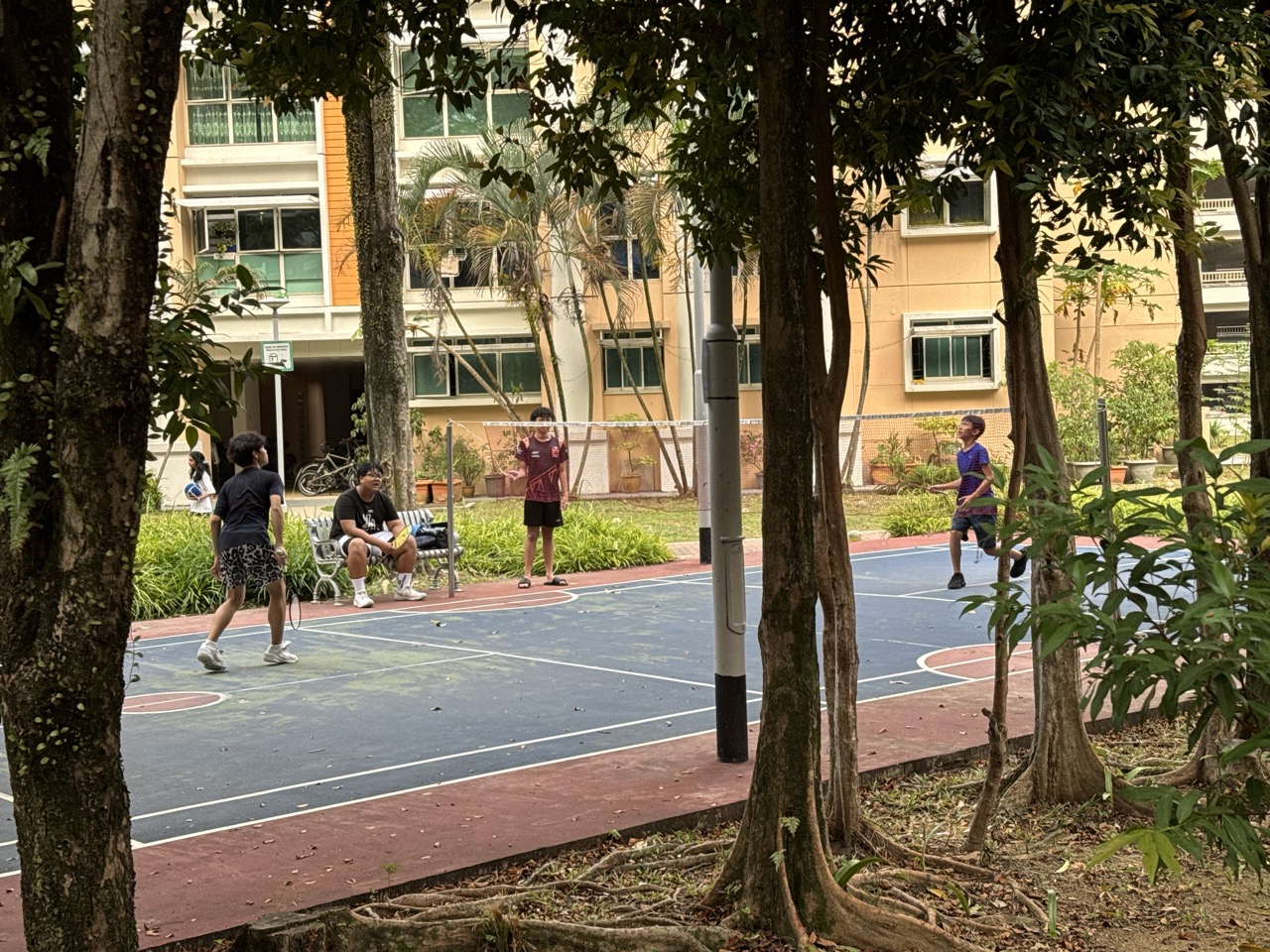
Badminton doubles becomes much easier to enjoy when the four players agree on three things before the first serve: which lines count, who serves, and how the score determines the correct service court. Our new Punggol photographs show an outdoor badminton game in the residential area labelled Playground 295 in the media library. They make a helpful introduction to a practical problem: people are happy to rally until someone says ‘Wait, shouldn’t we be standing on the other side?’
Under the badminton rules applicable in October 2026, a conventional game uses rally-point scoring to 21, with a two-point lead needed at 20-all and a maximum winning score of 30. When the serving pair has an even score, the server stands in the right service court; when it has an odd score, the server stands on the left. In doubles, players in a pair only swap their tracked service courts when they score a point while serving. Those fundamentals will resolve many friendly arguments before they begin.

Doubles badminton in one minute
- Players: two on each side, with teammates sharing responsibilities.
- Current formal scoring, October 2026: normally best of three games, each to 21 points; win by two at 20-all, up to 30.
- Rally point: each completed rally gives one point to the side that wins it, whether it served or received.
- Serving side’s score even: serve from the right service court.
- Serving side’s score odd: serve from the left service court.
- Service target: the diagonally opposite service court; doubles service uses the doubles service boundaries rather than simply the full rally court.
- Partner rotation: partners change their service-court positions when their own side wins a rally while serving, not automatically after every rally.
- Practical caveat: a photographed neighbourhood space may not have a full regulation net or clearly marked BWF dimensions. Check the actual setting before claiming a formal match.
The Sport Singapore / ActiveSG simplified badminton rules explain Singapore’s ordinary 21-point format and doubles service. BWF’s published Laws of Badminton are the technical authority. Badminton’s international scoring framework is scheduled to change in 2027, so readers should always check the rules version for a future competition rather than assume a 2026 article governs it permanently.
The existing Badminton for Beginners in Punggol introduces the sport and venue search. The outdoor shuttlecock and wind guide owns the physics. This article has a distinct job: make a real doubles game understandable, from the first rally to a fair result.
Begin with four names, not a complicated score sheet
Suppose the teams are A and B against C and D. That is enough to reason about doubles without identifying anyone in the photographs. Agree on the partners, starting ends, serving team and initial receiver before beginning. A short confirmation avoids a long argument about who should have served after the first point. The names in this example are imaginary and not the names of the photographed players.
An informal group can use a phone note or a small paper record for the initial server and teams. The record should not include private contact details or photographs of unrelated court users. If the group decides to play a shorter friendly game because the players are beginners, say so clearly and do not claim it was an official BWF match.
Rally-point scoring means someone scores on every completed rally
Some people learned an older badminton system in which a side could score only on its own serve. In the modern rally-point format used in October 2026, the winner of each completed rally receives a point. If A and B serve and lose, C and D gain a point and the right to serve next. If A and B serve and win, they gain a point and keep serving from the alternate court.
That is why a newcomer should learn ‘who won the last rally?’ before learning any more elaborate service sequence. It changes both the score and who is entitled to serve. A let is treated differently because the rally is replayed without adding a point. When playing outdoors, agree on a fair way to resolve an uncertain interruption.
Why a normal game stops at 21 but can go beyond
At 20–19, the side on 20 can win the next point and finish 21–19. At 20–20, however, the first to 21 does not immediately win; a two-point margin is needed. That could produce 22–20, 23–21 or a higher result. At 29–29, the side that scores the 30th point wins the game. Those rules are part of the 2026 21-point format.
Families sometimes mistake this for ‘play to 21 regardless of the opponent’. A quick example makes the difference clear. If both sides reach 20, the next rally creates 21–20, but the game remains alive. The leader must either win again for 22–20 or the opponent levels it. This is a useful small lesson in the difference between reaching a target and satisfying a margin condition.
Even score: the right service court
At 0–0 the serving side has an even score, so the initial server serves from the right. The same is true when the serving side has 2, 4, 6 or another even number of points. A learner can use the last digit of the serving team’s score to decide without memorising an elaborate diagram.
Be precise: use the score of the team currently serving, not the total points in the game and not the opponent’s score. If the teams are 5–4 and the side on four is serving, its even score indicates the right service court. A beginner who looks only at the first number may select the wrong side.
Odd score: the left service court
When the serving pair has 1, 3, 5, 7 or another odd score, the serve comes from the left. The diagonal receiver on the other side must be ready. The service is not a random lob anywhere into the opponent’s half; formal play has specific service-court and height requirements that apply to the shot.
An easy verbal cue is ‘my team’s score chooses my service side’. A player who just won a rally while serving will continue serving from the alternate court, automatically matching the changed score parity. That relationship is the logic behind the service rotation rather than an arbitrary command to swap places.
What changes when the server wins the rally
Imagine A serves from the right at 0–0 and A–B win the rally. Their score becomes 1–0. The same person A serves again, now from the left. The two teammates change their tracked right–left service positions as prescribed. C and D do not automatically switch places just because they lost the point.
The first service and one successful rally are often enough to make the rule click. Play the sequence slowly, stop between points and name the score aloud. There is no need to rush into a long match while someone is still uncertain. The point is to learn why a side change follows the serving pair’s own successful rally.
What changes when the receiver wins
Continue the example: A–B are leading 1–0 and A serves from the left. C–D win the rally. The score becomes 1–1, and C–D obtain the next serve. Players do not all swap places. The new serving team’s score is one, so its correct server serves from the left according to the service-order rules.
This is the moment when many casual games become confused. A person hears ‘service over’ and assumes both pairs should rotate. Under the current doubles system, that is not correct. Keep track of the partners’ positions and the initial service sequence. The BWF simplified doubles table gives a worked progression for exactly this type of question.
A six-rally miniature score exercise
Try this imaginary sequence. At 0–0 A–B serve; A–B win, so 1–0. Then C–D win, so 1–1 and service changes. C–D win again, so 1–2. A–B win, so 2–2 with service change. A–B win again, so 3–2. C–D win, so 3–3 with service change. Each score follows the rally winner.
Ask the group to pause at every step and say whether the serving side’s score is even or odd. The side follows parity; the actual serving person follows the preserved sequence and tracked court positions. A match can continue indefinitely in principle, but understanding six rallies correctly is a more meaningful beginner exercise than stumbling through an entire game with unexplained rotations.
Who receives the service
In doubles, the designated receiver stands diagonally opposite the server in the appropriate service court. The players are not free to decide mid-serve that a different teammate will receive simply because the shuttle happens to fly closer to them. Once a legal service is returned and the rally begins, either partner may strike a later shot within the rules.
That difference between service and rally movement is important. In a rally, players may travel into different court zones to retrieve shots. The fixed serving-and-receiving relationship applies to the start of the rally, not to every stroke after it. A learner can practise facing the correct diagonal before adding actual movement.
The short service line and back service line
A regulation doubles service court is not identical to the full area used during a rally. A serve must clear the short service line and land within the relevant diagonal service area, including its correct back boundary. During a rally, doubles sidelines extend wider than singles sidelines. This combination confuses newcomers who see several overlapping lines on a formal court.
Our outdoor Punggol photographs do not establish that all BWF regulation lines are painted on the specific neighbourhood space. If the markings are incomplete, agree on an informal game or choose a verified full court when formal scoring matters. Do not invent boundary lines in the article, paint public property or pressure other users into moving for your improvised setup.
A line counts as in under the formal rules
In normal badminton, a shuttle landing on the applicable boundary line is in. But the phrase ‘the line’ is incomplete if players are unsure whether they are discussing a singles sideline, doubles sideline or service boundary. The relevant court changes with whether a shot is a serve or an ordinary rally stroke.
A quick way to avoid a disputed call is to identify the right court area before the game starts. In a friendly match with a hard-to-see line, agree that uncertain calls will be replayed or settled respectfully. A player who wins an argument may still have spoiled an otherwise enjoyable family outing.
Why doubles positioning differs from a singles game
Two players covering one side can divide space and responsibilities. When under attack, a common coaching pattern is side-by-side defensive coverage; when attacking with an opportunity at the net, a common pattern is front-and-back. These are strategic principles rather than automatic legal requirements, and the correct formation depends on the shuttle’s trajectory and players’ abilities.
Beginners do not need to sprint into a perfect diagram after every hit. The first aim is to avoid both players chasing the same shuttle and colliding. Calling ‘mine’ or ‘yours’ at the appropriate time, and practising coverage gently, can be more helpful than memorising a high-level doubles rotation chart.
A side-by-side defensive position
When a powerful shot may come towards either half, two partners often spread laterally to cover their side. That can reduce the distance each must travel to return a smash or deep drive. The players should remain balanced and able to react rather than planting their feet on imaginary markers.
This is a coaching suggestion, not a requirement that every defensive shot begins with identical spacing. An older adult and a young child may use a simplified arrangement to avoid collisions. The most useful questions are whether both can see the shuttle and whether their responsibilities are clear. Defensive positioning should improve communication, not become a source of blame.
A front-and-back attacking position
When one partner is pressing near the net, the other may cover the rear court and prepare to follow up lifted returns. This front-and-back arrangement can support attacking play because the pair occupies complementary spaces. Beginners should practise it slowly with cooperative feeds instead of attempting spectacular smash sequences on a crowded public court.
Remember that a formation is a response to the situation, not a permanent identity. The player who is stronger at the net may still need to retreat, and the rear player might move forward after a short return. Teach flexible movement through easy rallies. It is not helpful to tell a beginner that standing in the ‘wrong’ place at one frozen photographic moment proves poor technique.
What to say when both players run for one shuttle
The first response should be safety, not accusation. Two people converging on the same shuttle may collide or strike a partner accidentally with a racket. During beginner practice, decide who will cover which approximate zone and use a clear call before moving. If there is serious uncertainty, it may be safer to leave the shuttle than force a dangerous contact.
Afterwards ask what cue was missing. Did nobody call? Did both assume the other would move? A small correction—agreeing on who normally takes a shuttle between them—can make the next rally more comfortable. Teamwork is learned through shared decisions, not by assigning permanent blame to one partner.
Serving technique begins with a calm setup
Stand inside the correct service court, set the shuttle and racket, and check that the diagonal receiver is ready. Formal rules govern the server’s and receiver’s feet, the proper continuous motion and the shuttle’s contact conditions. A first-time player benefits from rehearsing the setup without hitting before trying to serve accurately.
Do not turn an informal coaching cue such as ‘keep the serve low’ into a complete statement of the law. BWF’s actual service provisions are more technical, including contact height and receiver positioning. Use a qualified coach or the current rules for competition. At a neighbourhood court, the immediate task is a safe, honest and repeatable serve that suits the agreed format.
A simple short-serve exercise
One partner serves ten times towards an appropriate diagonal target while the receiver observes or catches the shuttle safely. Count how many would land in the intended service area under the assumed boundaries. Begin without competitive pressure, then adjust aim gradually. Where a formal net or markings are absent, use a clearly labelled training target rather than pretending to play a regulation game.
Accuracy improves more reliably when one thing changes at a time. Do not instruct a child to use full force to compensate for weak placement. The goal is controlled trajectory and consistent preparation. The exercise can also become a simple fraction: seven accurate serves out of ten is 7/10, or 70%, under those same conditions.
A first service return
The receiver should be prepared to move safely after the service, rather than standing so close to a partner that their rackets overlap. A calm return directed into open space is a better beginner task than attempting to win the rally instantly. The receiver’s responsibility includes respecting the service setup and not creating an unnecessary distraction.
Begin with cooperative feeds to the correct side. Once the learner can return several serves reliably, add simple choices between a gentle lift and a controlled net return. Avoid aggressive lunges on a slippery or unsuitable surface. The learner’s comfort, balance and awareness are more important than the number of points won.
Why outdoor wind changes the feel of a fair rally
A shuttlecock can be affected strongly by air resistance and wind, which is one reason outdoor badminton sometimes behaves differently from an indoor competition court. A gentle lift may travel unexpectedly, and a serve that seemed consistent may drift. Both players experience changing conditions, although not necessarily in the same way at every moment.
Our Punggol shuttlecock physics guide explores the science. In this doubles article, the practical response is to keep the first rallies cooperative, stop if conditions become unsafe and agree on fair treatment of genuinely disputed shots. Do not invent weather data for the time the photographs were taken.
Agree on informal adaptations before the first serve
A neighbourhood court may not have a regulation net or full set of lines. Families can still enjoy gentle shuttle exchanges, but they should not present them as official competition if the required equipment or court conditions are absent. Agree whether points matter, which boundaries apply and how to replay a disrupted rally. Keep adaptations simple and considerate of the space.
Formal tournament rules and friendly recreation serve different purposes. It is fine to say, ‘We are playing a ten-point practice game without formal doubles service boundaries.’ What matters is that everyone understands the agreement. Conflicts are more likely when one person expects international rules and another expects a casual backyard format without either saying so.
A twenty-minute family doubles session
Try a hypothetical session: three minutes of light movement, five minutes of gentle diagonal serving, five minutes of side-to-side passing, five minutes of cooperative rallies and two minutes to review one lesson. This is an adjustable example, not a medical exercise prescription or a formal coaching programme. Shorten it whenever conditions, age or fatigue warrant.
The review question can be very specific: did the pair remember which score meant right or left service, or did they communicate better before moving? A child can succeed at doubles without winning a full game. Reliable service orientation and a kind relationship with their partner are worthwhile outcomes in their own right.
Teaching a child to call the score clearly
Before serving, say the score so everyone can hear it. In a simple doubles practice, one person can be responsible for announcing the current score and identifying the serving side. If uncertainty arises, reconstruct the last few rallies calmly rather than accusing anyone of cheating. A small paper score record helps when the group is learning.
This is everyday numeracy and communication. A child practising score announcements must distinguish the serving team’s points from the receiver’s and remember that zero is even. Asking ‘Why are you serving from the right?’ should produce an explanation based on parity, not ‘because somebody told me’. That explanation shows understanding.
A four-person serving-position thought experiment
Imagine A and B begin against C and D, with A initially serving from the right at 0–0. A–B win: A serves from the left at 1–0. C–D then win, so they become the serving pair at 1–1. The specific new server follows the original receiver and service sequence, not an arbitrary pick. C–D keep the same tracked court positions when gaining the serve.
Students can trace the full sequence using BWF’s simplified doubles table, which carefully distinguishes when teammates swap and when they stay. The right or left court can be determined from the serving score, but the right person to serve also depends on the preceding positions. Correct doubles play requires both pieces of information.
The ‘we always switch after winning’ misconception
That slogan is incomplete. A pair swaps its tracked right and left service positions after winning a rally while serving. If the receiving pair wins the rally and gains the service, they do not automatically swap just for gaining the right to serve. This distinction is central to the modern doubles service order.
A useful memory phrase is ‘serve and win, swap and serve again’. It is a practice cue, not the full Laws of Badminton. For more complex errors, consult the official regulations and score history. This rule becomes easier when beginners stop running through it in their heads during a fast rally and instead pause calmly before the next serve.
What a ‘let’ is not
A let is not the same as a side scoring a point and giving it back. Under the laws, a let means the rally does not count and is replayed, with the relevant service arrangement continuing. There are specific reasons for lets; not every poor shot or disagreement automatically qualifies. In a casual game, players can agree to replay an uncertain point as a gesture of fairness.
If people continuously argue about lines, the recreational problem may be larger than the rulebook. The sensible solution can be to check the boundaries, use a better-marked venue or choose cooperative practice instead of competition. A fair game is one where people understand the conditions before they begin.
Doubles is partly a study of available space
Two partners must use the court without obstructing each other. If both stand at the front, deep shots can become hard to retrieve. If both stand too far back, a delicate net return may be difficult. The best arrangement changes with the shuttle and the type of attack or defence. This makes doubles a simple form of real-time spatial reasoning.
A student can sketch two rectangles representing halves of a court and place two points for teammates. Ask what space is poorly covered when both points occupy one corner. That exercise is more instructive than criticising how strangers were positioned in a frozen photo, because the picture cannot show the rally’s full movement.
Badminton and fractions at Primary level
If a fictional pair wins 12 rallies out of 20 during a short practice, its proportion is 12/20, which simplifies to 3/5 or 60%. That can help a pupil connect scores to fractions and percentages. But a game may contain lets, practice feeds or unequal difficulty, so the student must define which attempts were included.
Do not treat the result as a player ranking. A pair practising difficult serves may succeed less often than a pair doing easy cooperative rallies. The purpose of recording a figure is to notice improvement under similar conditions, not pressure a child to perform in front of other users.
Badminton and probability at Secondary level
Imagine two fictitious pairs with a given probability of winning each independent rally. A classroom model might use 0.6 and 0.4, but real rallies are not necessarily independent or identical in difficulty. Service, player fatigue and wind can alter outcomes. Therefore an elegant probability calculation may describe a model rather than the reality of an outdoor match.
The value lies in identifying assumptions before applying formulas. A student can ask whether rally outcomes depend on previous play, whether the same probability should apply at 20–20 and how the win-by-two rule changes the probability of a game outcome. It is an advanced extension, not a claim that the photographed players had particular success rates.
Why court booking cannot be inferred from the photo
The local media library labels an outdoor badminton court near Playground 295. The photos show people using it, but do not establish the official civic address, whether it is reservable, its lighting schedule, or whether equipment is available. A family wanting a formal doubles game must check appropriate current court facilities and booking rules.
The site’s Punggol badminton, tennis and pickleball court guide handles designated booking options. Do not assume that a residential court follows the ActiveSG booking system simply because the sport is the same. Follow signs and respect people already using the space.
Photographs cannot identify the players
Our images document a public outdoor badminton moment in October 2026. They do not provide the players’ names, schools, occupations, ages or skill levels. It would be inappropriate to say ‘competitive doubles players’ unless an actual competition is verified. A person holding a racket may simply be practising with a friend.
The article deliberately focuses on rules and techniques independent of any personal inference. If you photograph a community game, avoid unnecessary close-ups of identifiable people or children and comply with relevant venue requirements. Public sport can be discussed without turning its participants into unconsenting characters.
Weather and a responsible stopping decision
Outdoor courts can become slippery after rain; heat and humidity affect comfort, and lightning is an obvious reason not to remain in exposed recreational areas. A flexible group checks current conditions and stops when play is unsafe. Four people arriving with rackets does not justify ignoring a wet surface or a facility restriction.
Families should bring appropriate water and take breaks according to actual needs. If an older relative or child becomes uncomfortable, the group can end early and still have enjoyed the session. Learning doubles should be a positive experience, not a requirement to complete a 21-point game regardless of the conditions.
An easy scorekeeping routine for the next outing
Before play, write down the teams, starting server and initial receiver. Announce the score before each service. Use the serving pair’s score to choose right or left, then use the preserved service order and positions to identify the correct server. If uncertain, reconstruct the previous rally outcome rather than guessing or quietly changing positions.
At the end, discuss one thing the pair learned: perhaps better communication in the middle, remembering service parity, or using a gentler shot when wind moved the shuttle. A short reflection makes the next visit easier. It doesn’t need a ranking, a social-media video or a formal tournament bracket.
What the outdoor photographs contribute to Punggol’s story
A few people playing a racket game in a local residential space may not look as significant as a new sports stadium. Yet community courts make recreational movement possible without a major outing. The October 2026 images preserve that everyday side of the town. They show that an ordinary court can be part of family life when it is appropriate and available.
That observation is different from claiming the court is a professional training venue or that every resident prefers badminton. The wider Punggol 295 family guide explains the setting, while this article lets readers leave understanding a doubles game rather than a list of nearby attractions.


How many people play doubles badminton?
Four players, two on each side.
How many points win a game in October 2026?
Under the applicable BWF 21-point format, normally 21, with a two-point lead required from 20-all and a cap at 30.
Who gets a point when the receiving pair wins?
The receiving pair gains a point and the right to serve next.
When does the server stand on the right?
When the serving side’s score is zero or another even number.
When does the server stand on the left?
When the serving side’s score is odd.
Do both pairs swap after every rally?
No. In tracked doubles service positions, partners swap after their own pair wins a rally while serving.
Does the serve go straight ahead?
No. A correct serve is directed to the diagonally opposite service court.
Are the doubles service lines the same as rally boundaries?
Not entirely. The doubles service area has its own back boundary, and rallies use the appropriate doubles sidelines and back line.
If the shuttle lands on an applicable line, is it in?
Yes, under the formal court rules.
What happens at 20–20?
Play continues until one side leads by two, subject to the 30-point cap in the 2026 format.
What happens at 29–29?
The side winning the next rally reaches 30 and wins that game under the 21-point rules.
Can we agree on a shorter casual game?
Yes, if all players understand that it is an informal adaptation rather than an official full-match result.
What is a let?
A rally that does not count and is replayed under the applicable rules.
What is a useful basic doubles formation?
Side-by-side coverage is a common defensive idea; front-and-back coverage is a common attacking idea, with movement adapting to play.
Can I play regulation badminton on the pictured court?
The photos do not verify its full net, court dimensions or official booking and opening status. Check locally.
Does wind affect an outdoor shuttle?
Yes, shuttle flight is sensitive to air and wind; the separate Punggol physics article explores this.
Can children practise service with a parent?
Yes, where the space, equipment, intensity and supervision are appropriate.
How can a child remember the correct side?
The serving team’s even score means right; odd score means left.
Where are official rules published?
BWF publishes the laws, and Sport Singapore offers a simplified local explanation.
Will 2027 badminton rules necessarily match 2026?
No. Check the effective rules version for any later formal match; a new scoring framework has been scheduled for 2027.
Sources and related Punggol articles
- Sport Singapore — Simplified Badminton Rules and Doubles Service.
- Badminton World Federation — Laws of Badminton.
- Badminton for Beginners in Punggol.
- Outdoor Badminton Wind and Shuttlecock Physics in Punggol.
- Playground 295 and Family Sports — Photo Guide.
- Badminton, Tennis and Pickleball Courts in Punggol.
- Complete Punggol Guide
Reviewed October 2026. Original images of outdoor badminton near the community area labelled Playground 295 are used only for photographic evidence of recreation. The sport rules are date-specific; BWF scoring revisions have been scheduled to take effect from January 2027. Facility identity, measurements, access and participants’ identities cannot be inferred from the images. For competition, verify the current laws, court and organiser’s instructions.


