
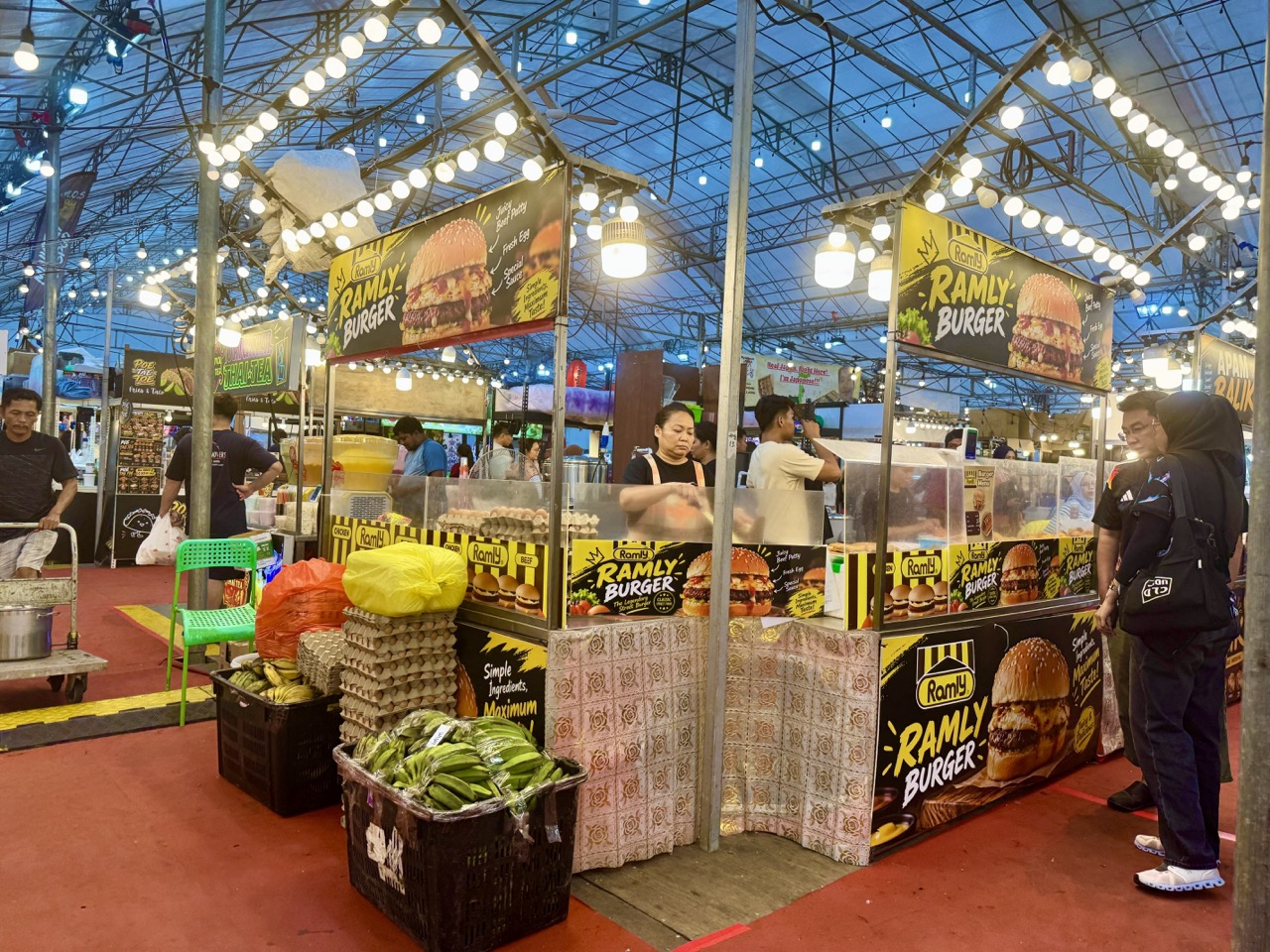
What can a Punggol pasar malam teach us about business? The easiest lesson is also the most important: a long queue is not the same thing as high profit. Our new October 2026 Punggol photographs show a Ramly burger stall, a queue for nasi biryani, macaroni and cheese, sugarcane drinks and other customers moving around a temporary food market. Behind every purchase are decisions about ingredients, working time, equipment, pricing, stock, compliance and how many orders can be served before the event ends.
This particular Punggol pasar malam was reported to run from 30 September to 31 October 2026 at the grass field beside Waterway Point near Punggol MRT Exit B, with advertised hours of noon to 10pm daily. That describes a dated October event, not a permanent trading address. For how to visit, what food appears in the pictures, routes and family comfort, read our separate October Punggol Pasar Malam Visitor Guide. Here, we look at the business mechanics rather than repeating a food guide.

The Punggol night-market business in 60 seconds
- Time limit: a temporary trading period ending 31 October 2026, rather than a permanent year-round site.
- What a customer sees: food, prices on current menus, payment, queues and order collection.
- What a business manages: ingredients, labour, preparation, equipment, stock, transactions, waste and approval requirements.
- Economic distinction: revenue is money from sales; simplified profit is revenue minus relevant expenses.
- Queue distinction: a photographed line shows waiting, not the total number of transactions or quality of food.
- Regulatory distinction: the event organiser’s temporary-fair permit is different from individual food-preparation stall licences coordinated through the organiser.
- Educational rule: all numerical examples below are fictional; they must never be attributed to photographed stallholders.
The applicable Singapore regulatory framework is described by the Singapore Food Agency (SFA) temporary-fair requirements and permit and food-stall licence application details. The event’s October dates and field location appear in a dated 6 October 2026 local report. For current events, never substitute a past photo for a new organiser announcement.
The stall has a clock as well as a cash register
The event lasts for a defined period. A stall cannot assume that it will sell food from exactly the same pitch indefinitely. That makes setup costs, transport, staffing and remaining trading days relevant from the first morning. A permanent restaurant may build repeat custom at one address over years; a temporary fair brings visitors together for a shorter, less predictable period.
An interested teenager can start by asking what work must happen before the first burger is sold. Equipment needs arranging, ingredients must arrive, food handlers have duties and price or payment information needs to be visible. Our photo shows only the public-facing part of that work. It would be inappropriate to guess the stallholder’s private contract or inventory from a photograph.
A long biryani queue is evidence of waiting, not a financial statement
The biryani photographs show shoppers waiting for a food stall. That is a genuine observation about the photographed moment. It does not tell us how many meals were sold that day, whether the stall made a profit, or whether those shoppers had been waiting two minutes or twenty. A queue might grow because customers arrive together, preparation takes time or a stall temporarily operates below its usual capacity.
Parents can ask children to separate three statements. ‘People were standing in line’ is an observation. ‘Perhaps the dish is popular’ is an inference. ‘The vendor earned the most at this market’ requires sales and cost evidence we do not possess. This approach is especially important when publishing about small businesses: guesses about a named vendor’s finances should not become public facts.
What the burger counter reveals about an order
A customer may experience the order as a quick sequence: choose, pay, wait, collect. For the cook, a finished burger involves ingredients, heat, assembly, packaging and communication. Several portions might be prepared at once, but some steps may require individual attention. This turns the counter into a simple production system with inputs and completed outputs.
Invite a student to draw boxes labelled ‘order’, ‘prepare’, ‘cook’, ‘assemble’, ‘wrap’ and ‘handover’. Discuss which steps could overlap and which must follow another. This is a hypothetical teaching model, not a claim about the exact workflow in the photograph. A good explanation can be precise without pretending we have interviewed staff or inspected the cooking area.
Revenue is not profit
Suppose an entirely imaginary food counter sells 40 meals for S$8 each. Its sales revenue is S$320. If the ingredients and packaging cost S$3 per meal, 40 portions cost S$120 in that simplified variable-expense category, leaving S$200 in contribution before fixed and other costs. The S$320 number was never its net profit.
Real businesses may have event fees, transport, wages, power, rent, equipment depreciation, payment expenses, spoilage and other costs. The exact classification can vary. The useful habit is to state which costs your calculation includes and which it omits. A confident answer with the wrong cost categories is not better than an honest approximate model. None of these figures describes a Punggol stall.
How break-even works in plain English
Continue the fictional example: each S$8 meal has S$3 of variable costs, giving S$5 contribution per unit. If the model’s fixed costs total S$500 for the relevant period, 100 meals would provide S$500 of contribution. In this deliberately simplified calculation, 100 is the break-even quantity. The formula is fixed costs divided by contribution per unit.
Students sometimes hear ‘break-even’ and imagine it means the owner has already taken money home. It only means costs defined in that model have been covered. It says nothing about omitted expenses, taxes, fluctuating demand or the owner’s time. Label the time horizon and the assumptions before using the calculation. That is how Mathematics becomes a useful decision tool rather than a trick with a neat answer.
Why an extra dollar in ingredient cost changes everything
If the fictional unit cost rises from S$3 to S$4 while the selling price remains S$8, contribution falls from S$5 to S$4. With fixed costs still at S$500, the simplified break-even quantity rises from 100 to 125 meals. That is a meaningful change in the number of sales needed, even though the advertised selling price has not changed.
Would the vendor increase the price? Perhaps, but the answer depends on customers, competitors, product quality and demand. A seller may choose other responses, and not every response is feasible or fair. We cannot infer what the photographed stallholders chose. The student should explore scenarios rather than invent someone’s business strategy.
A hypothetical profit function for secondary pupils
Let q represent units sold. Under the fictional S$8 price, S$3 variable cost and S$500 fixed cost, simplified profit is P(q) = 5q − 500. At 60 units, P(60) = −200. At 100 units it is zero; at 140 units it is 200. Draw a straight-line graph to see the break-even crossing. This connects a market situation to algebra and graphs.
The straight line rests on assumptions: constant price, constant variable cost and fixed costs over the specified period. Actual pricing, waste and staffing can change the relationship. A student should be able to say why the line’s gradient is five and the intercept is negative five hundred, then say what the model leaves out. This is more valuable than attaching the equation to an actual stall name.
The problem of too much stock
Food businesses face a choice between preparing enough for customers and avoiding unusable leftovers. A market may be busy at one time and quiet at another. A seller who buys every ingredient on the assumption of constant evening demand could waste resources. A seller who prepares too little may miss purchases. The right balance is difficult because demand is uncertain.
A forecasting exercise can use fictional low, medium and high sales scenarios. Suppose 30, 60 or 90 meals sell in three different conditions. Ask how much stock might be sensible, what the cost of unsold prepared food is and how safety rules affect storage. The correct real-world answer needs actual vendor data and safe-food requirements. A photograph does not reveal either.
A queue grows when arrivals outpace completed orders
Imagine a made-up counter receives 15 orders every ten minutes and finishes ten. If those rates persist, the backlog grows by five orders per ten-minute interval. The workers could be continually cooking while the line still becomes longer. Thus a queue cannot, by itself, prove that employees are slow or disorganised.
Real queues change from minute to minute. Some orders contain several servings, preparation may overlap and customers may leave. A student can identify these omitted variables and learn to treat the simple arithmetic as a model rather than measurement. Use this exercise at home or in class; do not turn actual shoppers into an unconsenting study group.
Where a bottleneck appears
Suppose a fictional kitchen can cook 12 portions in ten minutes but pack only eight in the same period. Packaging could become the limiting stage, even if the grill is capable of more. An extra burner would not necessarily increase completed orders until the constrained step changes. This is the idea of throughput and bottlenecks.
Cooking, payment and wrapping can overlap, so identifying an actual bottleneck requires proper operational evidence. A wide photo of people behind a counter cannot establish their individual task capacity. The useful student question is ‘Which stage would you measure next?’ not ‘Which worker is to blame?’ This also develops an empathetic approach to business analysis.
Price reflects more than a customer’s first impression
A family sees a displayed price and decides whether it fits the budget. The stallholder has different information: ingredient and preparation costs, expected demand and operational obligations. It would be inappropriate to call a vendor greedy or generous purely because one dish appears dearer than another. Portions, products and constraints can differ.
A child can make a sensible statement about their own purchase: ‘This costs more than we planned, so we will choose something else.’ That conclusion needs no speculation about private profits. Good consumer literacy means comparing available choices while recognising that sellers also have to run sustainable operations.
Macaroni and cheese as product differentiation
The new photographs show macaroni and cheese sold alongside burgers and rice-based meals. The counters serve different tastes and occasions. Someone wanting a snack may make a different choice from a teenager looking for a filling dinner. A collection of distinct dishes can attract a group that would not all choose the same food.
Economists call such differences product differentiation. It can involve ingredients, convenience, portion, presentation and customer experience. That does not mean a photo proves exactly who buys each dish or which product is the most profitable. The observation is variety; the explanatory idea is that sellers may compete on more than price.
Why competitors can attract customers together
It may seem counterintuitive that several food stalls benefit from operating near competitors. Visitors can compare options, walk with friends and find meals for people with different tastes. A larger variety may make the entire fair more attractive. At the same time, every stall competes for attention and household spending. Those effects can coexist.
To measure whether one vendor benefits from being at the market, we would need suitable data about sales, location, prices and alternatives. We do not have such information. An older student can propose how the question might be tested without surveying strangers or disclosing confidential records. This is a good illustration of the difference between a plausible mechanism and a proven result.
A drink changes the total cost of dinner
A main dish is often the first item a family budgets for, but drinks, desserts and game purchases may follow. The sugarcane drink photograph is a reminder to count the whole outing. Suppose a hypothetical family buys two mains at S$9.50 and S$8.80 plus two drinks at S$2.60 each. Its total is S$23.50, leaving S$6.50 from a S$30 food allowance.
These figures are expressly invented for practice and should not be quoted as Punggol market prices. A Primary pupil can show the two additions and final subtraction. The deeper skill is knowing that every extra purchase changes the amount left for later. Budgeting is a conversation about priorities, not a demand that a child feel guilty about buying a drink.
Opportunity cost: the meal we did not choose
Suppose one suitable dish has a hypothetical 15-minute queue while an acceptable alternative has a five-minute queue. Choosing the first may mean giving up ten minutes that could have been spent eating, chatting or going home. The forgone alternative is an opportunity cost. It is not necessarily a mistake to make that choice; value depends on the person and occasion.
A parent can ask, ‘Would you prefer to wait for the food you really want or eat something else sooner?’ There may be several reasonable answers. This makes economics a useful language for thinking about ordinary decisions, not a judgement that everyone must optimise the same way. Remember that real queues must be assessed on the day.
Why event dates affect decisions
The photographed Punggol fair was a temporary event with an advertised end on 31 October 2026. An organiser and vendors must plan within a finite time frame, and customers cannot assume the same tents will be there in November. A permanent hawker centre has a different operating context even though both sell food.
Our separate One Punggol Hawker Centre guide explains the permanent venue at One Punggol. Mixing those locations in one undated ‘Punggol food market’ entry can misdirect readers. An accurate business story keeps temporary conditions attached to the date when they applied.
Weather creates uncertainty for temporary stalls
Outdoor events face rain, heat, humidity and lightning, all of which may change how visitors behave and what activities are safe. A sunny photograph cannot guarantee conditions later in the month. A vendor may encounter a busy early evening followed by weather-related disruption. Forecasting must allow for uncertainty.
Students can model three fictional outcomes rather than assume constant customers every hour. The result should explain what would change in stock planning and preparation, not suggest that traders ignore safety instructions to keep earning. Real decisions depend on the organiser, current warnings and each business’s circumstances.
SFA licensing: two levels of responsibility
Singapore Food Agency requires permits for applicable temporary fairs and licensing for individual stalls handling or preparing food and drink at those fairs. The fair organiser coordinates applications, approvals and site arrangements; the food stall has its own applicable conditions. The official rules refer to appropriate washing, storage, temperature control, food display and waste facilities.
Crucially, the existence of a regulatory requirement does not give a passer-by grounds to accuse a named photographed vendor of noncompliance. A photograph is not an inspection. The correct way to learn the rules is the current SFA requirements. The correct way to raise a genuine concern is through appropriate official channels with suitable evidence.
The event permit fee is not the vendor’s full bill
SFA’s application page explains the temporary-fair permit process, while the individual temporary-fair food-stall licence has no separate licensing fee. This does not mean organising a fair or operating a stall costs nothing. Site use, equipment, utilities, staffing, ingredients and other expenses may arise according to the actual arrangement.
A student should avoid treating one published administrative fee as the entire business cost. The first step in financial analysis is correctly identifying who pays an amount, what it covers and when it applies. The difference between government processing fees and private commercial arrangements can be larger than the fee itself.
Food handling and consumer trust
A temporary venue still needs safe food preparation and appropriate handling. SFA addresses where ingredients come from, covering displays, training food handlers, washing facilities, temperature control and waste management. These obligations protect customers while shaping the work a vendor must do.
A consumer with an allergy or dietary restriction cannot infer ingredients or halal certification from a food photograph. Ask the stall directly, check current certificates where relevant and choose an alternative if something essential cannot be established. This article describes the broad system; it does not certify any of the photographed stalls.
Sugarcane drinks are not just a cup of liquid
The image of sugarcane and other drink counters suggests another production sequence: sourcing, storing, processing or dispensing and serving. The details differ from grilling burgers. SFA’s temporary-fair requirements and accompanying stall conditions provide the relevant food-handling obligations for beverages, including appropriate equipment, water supply and hygiene.
Do not read a food-safety inspection result into a blurry photo of machinery. The correct observation is that drinks were offered in the photographed market setting. The next useful question is which official standards apply to this class of operation. A young student can learn that different products require different workflows without pretending to inspect a real vendor.
Waste and disposal are part of operations
Food fairs produce wrappers, scraps, cups and other waste. SFA requires organisers to provide adequate lined litter receptacles and maintain site cleanliness, with proper clearance after the fair ends. The logistics of disposing of waste are part of operating a temporary event rather than an optional extra after customers leave.
Families help by using the proper bins and not blocking walkways with discarded packaging. An older student can discuss the trade-off between convenient disposable containers, hygiene and waste, while recognising that safe alternatives depend on the food and event. Avoid claiming that a particular vendor uses an unsustainable practice merely because a cup appears in one photo.
Why gross crowd size is a poor quality ranking
A bustling image can suggest energy and interest. It cannot reveal what customers thought after eating or whether their requirements were met. A queue may form because only one person is taking payment, because a batch is still cooking or because the stall is drawing returning customers. These explanations have different implications.
A proper assessment of quality would need evidence relevant to quality, collected fairly. A parent can still choose food according to taste and budget without declaring a universal winner. The honest article gives readers useful questions rather than an unsupported ‘best stall’ badge.
A Primary Mathematics exercise with ratios
Imagine two completely fictional counters that sell 36 and 24 portions in an equal time period. Their ratio is 36:24, which simplifies to 3:2. Together they have sold 60 portions. A pupil should show how both terms are divided by 12 to reach the simplified ratio.
The next question exposes a limitation: did the first counter make more profit? The ratio alone cannot say. One item may cost more to prepare or sell at a different price. This is a strong introduction to data interpretation. Mathematical accuracy includes identifying what a number represents, not only simplifying correctly.
A Secondary Mathematics exercise with capacity
Suppose a fictional counter receives 75 orders per hour and completes 60. If those rates were constant, the backlog grows by 15 per hour. After two hours, 30 uncompleted orders would accumulate, assuming no cancellations or starting backlog. The result is simple subtraction, but its usefulness depends on its assumptions.
Real arrivals are uneven; orders differ in complexity and customers may abandon queues. A student can improve the model by using separate time intervals or drawing a step chart. The image of a line of customers does not contain the data needed to validate the model, which is exactly why the calculation must be labelled hypothetical.
A short writing exercise about work
Invite a pupil to describe the visible actions in a stall photo with precise verbs: ordering, heating, assembling, waiting and collecting. Then ask what work probably happened before the picture was taken. The second question should be framed as inference, because the photo cannot show the earlier preparation.
A good paragraph can explain that an apparently simple meal relies on coordinated tasks without inventing dialogue or claiming to know a worker’s emotions. This integrates English and economics. Children practise separating description from reasoned interpretation while learning to respect the people whose labour supports an enjoyable market visit.
Why a market is not a free research laboratory
Students may feel tempted to measure queue times, question stallholders or publish close-up photographs as part of a school activity. Vendors are busy working, and customers have privacy interests. Research is not automatically legitimate simply because the activity takes place in public.
Use hypothetical datasets, publicly displayed menus and official regulations for basic learning. If interviewing a vendor is genuinely necessary, request permission, explain the purpose, choose an appropriate time and accept refusal. Avoid collecting unnecessary personal data. Respectful fieldwork produces more credible analysis than an intrusive survey.
What families can discuss after the meal
A parent might ask three gentle questions: why did we choose this food, what did we wait for and what work went into preparing it? For younger children, simple answers about hunger, taste and the person who served them are enough. Older children may notice that a queue is a system and a price has costs behind it.
Keep the discussion conversational. A night market is a family outing, not a compulsory business case study. The best learning often occurs when a child is genuinely curious. Let the meal remain enjoyable, and use the photographs later if everyone wants to explore the topic more deeply.
How this October guide remains accurate later
After 31 October 2026, the photographs remain a record of a time-limited market. They do not establish where vendors will trade next or whether the same event will return. The economic concepts remain useful, but the trading location and dated references must be clearly identified.
A future reader should be able to distinguish ‘this stall was photographed in October 2026’ from ‘this stall is available here now’. When an article respects that boundary, its value can outlast the event instead of becoming a misleading live directory.


Frequently asked questions
Where and when was this Punggol market?
The October 2026 edition was advertised from 30 September to 31 October beside Waterway Point and Punggol MRT Exit B.
Is the market a permanent food centre?
No. It was a temporary fair with a specified run; One Punggol Hawker Centre is a separate permanent venue.
Can the photos tell which stall earned the most?
No. Revenue, expenses and net profit require business records that the photos do not provide.
Does a long line mean the food is best?
No. Queue length can reflect customer arrivals, preparation time, workflow and other factors.
What is revenue?
The total amount earned from sales before deducting the relevant expenses.
What is contribution per item?
In a simplified model, selling price minus the variable cost per item.
How do we calculate break-even?
Divide the assumed fixed costs by contribution per unit, assuming constant prices and costs.
Are the sample S$8 meal and S$3 cost real?
No. They are fictional teaching numbers, not vendor pricing or costs.
Why does a queue grow?
It can grow when new orders arrive faster than the counter completes them for a period.
What is a bottleneck?
A limiting stage of a process that constrains completed output.
Are temporary food stalls regulated?
Yes. SFA publishes rules for qualifying temporary fairs and applicable food-preparation stall licences.
Does a government fee cover every stall expense?
No. Administrative fees and the private costs of business operations are different categories.
Can a photo prove a stall is halal or allergy-safe?
No. Check current certificates, ingredients and preparation information directly.
Why can nearby competitors be beneficial?
A variety of choices may attract customers to a shared market, though the effect on one vendor requires evidence.
What can a Primary 4 pupil practise?
Addition, subtraction, ratios and budget choices using actual receipts or clearly invented values.
What can a secondary student practise?
Linear equations, break-even, sales scenarios, arrivals versus service rates and model limitations.
Can we interview workers for homework?
Only with appropriate permission and respect for their work and privacy; public data and hypothetical examples may be sufficient.
Are the stalls guaranteed to return next month?
No. Temporary market participation and future locations must be checked from new announcements.
Verified reading and connected Punggol guides
- SFA — Temporary Fair and Food Stall Requirements.
- SFA — Application Process and Fee Details.
- SethLui.com — Punggol Pasar Malam October 2026 Report.
- Punggol Pasar Malam 2026: Food and Family Visitor Guide.
- One Punggol Hawker Centre: Permanent Food Venue.
- Punggol for Money-Smart Families.
- Punggol in Pictures: October 2026.
Photo and editorial note: 23 October 2026. Images are eduKatePunggol’s newly uploaded October photographs. Financial examples, quantities, sales, queue rates and costs are fictional and are not presented as findings about the photographed vendors. This article is educational, not an assessment of any stall’s profits, compliance or business prospects. Current on-site arrangements and SFA regulations take precedence.


