
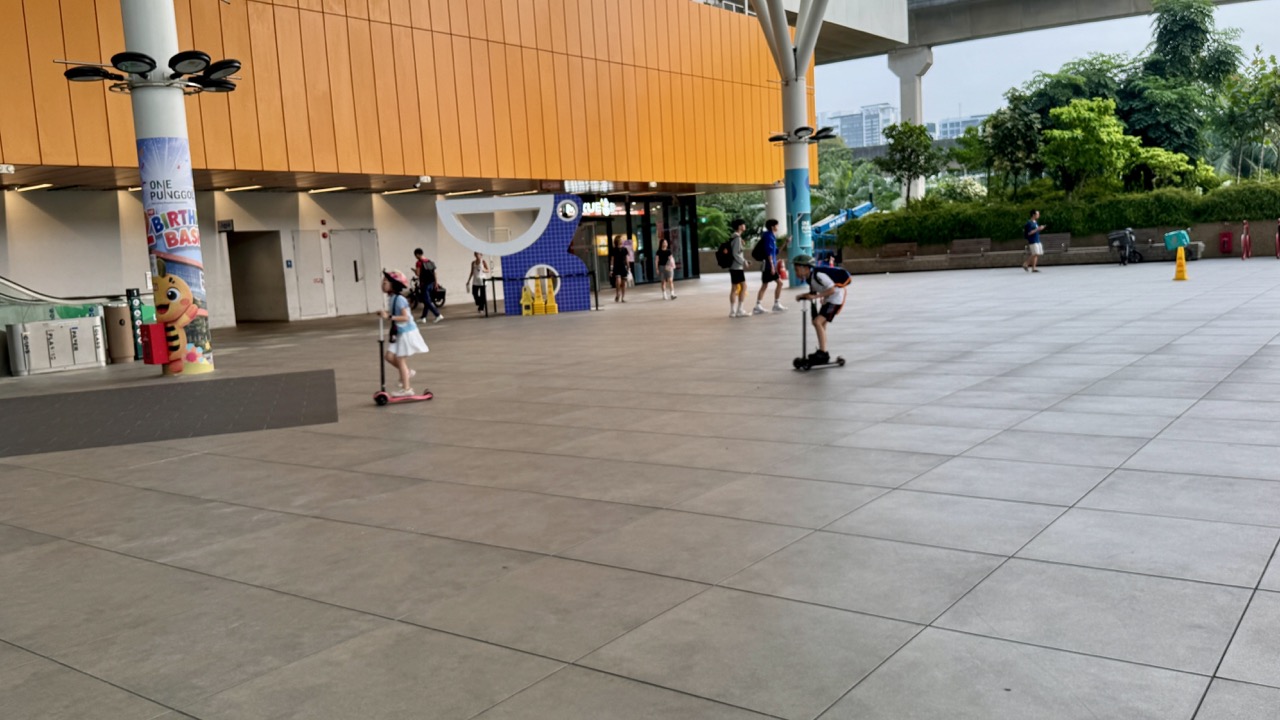
Can children ride scooters at One Punggol? The safe answer begins with the difference between a photograph, a public-path rule and a property’s own rules. One of our new October 2026 images shows children on scooters in an open area at the One Punggol community hub. That proves the scene was photographed, but it does not prove that every scooter type is allowed there, that riding is permitted at all hours, or that the whole open space is a public cycling path. Families should check current signs and management instructions before riding.
Singapore also distinguishes non-motorised kick-scooters, motorised e-scooters and mobility aids. The legal rules are not interchangeable. In 2026, the Land Transport Authority allows non-motorised personal mobility devices on ordinary footpaths and designated cycling/shared paths within the applicable rules, but riding on pedestrian-only paths is generally prohibited. E-scooters are restricted to cycling paths, not footpaths or roads. A shopping or community hub can add site-specific rules for its own areas. This guide is about understanding those differences and protecting fellow users, not declaring One Punggol’s plaza an authorised scooter track.

Quick answers before bringing a child’s scooter
- What our photo shows: children using scooters at One Punggol during a photographed moment.
- What it does not show: a management permit, legal path classification, permanent permission or the exact device specifications.
- Kick-scooter: generally a non-motorised personal mobility device under Singapore’s active-mobility framework.
- E-scooter: motorised personal mobility device, legally restricted to appropriate cycling paths and subject to additional requirements.
- Ordinary footpath: non-motorised scooters may be allowed, subject to applicable rules and a maximum general path speed of 10km/h.
- Pedestrian-only path: bicycles and personal mobility devices generally must not be ridden on it, subject to statutory exceptions for limited crossing or obstruction circumstances.
- Within One Punggol: follow the actual property manager’s current signs or staff instructions; public access is not blanket scooter permission.
- Safest family action: choose a clearly appropriate route, move slowly, give priority to vulnerable pedestrians and dismount when the environment becomes unsuitable.
Read the Ministry of Transport’s active-mobility rules, LTA’s current rules and code of conduct and the Active Mobility Act’s pedestrian-only path provision, updated with 2026 amendments. For One Punggol’s actual public-space rules, the People’s Association is the responsible starting point.
One Punggol is a community hub, not a scooter park
One Punggol at 1 Punggol Drive combines community, library, hawker and public-service facilities. The large open areas connect people moving between activities, including children, older visitors, pram users and those attending organised events. A wide floor may look attractive for scooting, but width alone doesn’t define permitted use.
The image should be understood as a piece of local documentation, not an invitation to bring any wheeled device. The management may control activities to protect pedestrians or to accommodate events. Before a family travels for scooting, verify where it is permitted. When permission is uncertain, use a suitable designated path or a different facility rather than testing the rule by riding.
A photograph records what happened, not what is authorised
A still picture cannot show whether a person received permission, whether staff directed them, or whether a rule changed afterwards. It also cannot show all signs or the boundary of the property outside the frame. This is why an image of riding is weak evidence for a practical claim such as ‘scooters are allowed everywhere here’.
Parents and students can use the scene to practise the distinction between observation and policy. Observation: ‘Children were photographed with scooters.’ Policy question: ‘What does the operator permit in this specific space?’ The second needs a current source. A good neighbourhood guide respects that boundary even when the photo looks cheerful.
A kick-scooter and an e-scooter are not the same thing
A kick-scooter is propelled by the rider rather than an electric motor. Under Singapore rules, it is a non-motorised personal mobility device. An e-scooter uses motor propulsion and is subject to different path restrictions, registration and equipment rules. An image taken from a distance may not show enough detail to classify the device correctly.
Never use the term scooter loosely when the legal category matters. An adult’s motorised mobility scooter is different again: it is a personal mobility aid intended for people with mobility difficulties. Confusing these categories can lead to misleading statements about where devices are allowed and who may use them.
What ordinary footpath rules say
LTA’s device-location guidance identifies ordinary footpaths—unmarked paths beside roads and within HDB estates—as places where non-motorised personal mobility devices can be used subject to rules. The infographic gives a general 10km/h speed limit on footpaths. The rider still has responsibility to use the path considerately, particularly near pedestrians.
However, not every paved open space inside a managed community facility is automatically an ordinary public footpath. Property management rules may restrict riding, and a designated pedestrian-only path follows its own statutory limits. The legal classification and site conditions must be checked in the actual location.
What a pedestrian-only path means
Singapore introduced markings and enforcement for pedestrian-only paths, including footpaths beside designated cycling paths. The Active Mobility Act’s section 15 generally prohibits riding bicycles and personal mobility devices on these paths, with limited statutory exceptions for crossing or avoiding certain obstructions. That is different from an ordinary shared path.
A child may see a broad smooth stretch and assume it is perfect for scooting. Teach them to look for ‘Pedestrians Only’ markings and signs, and to follow those instructions. If the family is uncertain about a section, dismounting and walking the device is a practical way to avoid conflict while seeking the correct route.
Shared paths carry different expectations
A shared path may display pedestrian and cyclist logos, signalling that users are expected to share space. Non-motorised scooters can be permitted on appropriate shared and cycling paths under LTA’s rules, with specific limits and code-of-conduct duties. But being legally present does not give a rider priority over pedestrians.
An adult should teach a child to slow when others approach, avoid weaving and leave space for people who use walking aids. A shared path is not a racetrack. If a group is waiting or the area becomes crowded, riding slowly may still be inappropriate; dismount and walk when needed.
Why the 10km/h sign is not a target speed
A legal maximum is a ceiling, not an instruction to ride at that speed. Ten kilometres per hour is too quick for many situations involving small children, pets, people changing direction or limited sightlines. The correct safe speed depends on the environment and the rider’s ability to stop.
Families should focus on control rather than numerical speed. Can the child stop promptly without swerving? Can they wait when a pedestrian passes? Can they move predictably through an open designated path? If not, more basic practice in an appropriate low-traffic setting is better than a busy public hub.
The significance of the scooter’s braking ability
A young rider can easily become enthusiastic and forget that stopping takes distance and time. Wheels, surface condition, footwear and rider balance affect control. A photograph doesn’t reveal whether the equipment is suitable or well maintained. Adults should check the scooter’s physical condition before use.
Practise starting, stopping and stepping off in a safe permitted area, away from traffic and crowds. A child who cannot reliably stop on command is not ready for a busier environment. There is no reason to use a crowded civic plaza as the first braking practice session.
Why a dry-looking floor can still be slippery
A sheltered area may have damp surfaces after rain, spills from nearby dining areas or patches with different friction. Smooth flooring can behave differently from rough outdoor pavement. Do not infer grip from colour or architectural finish. A child should avoid accelerating across a surface that looks wet or uncertain.
Choose footwear appropriate for riding and inspect the intended area before movement. If there is a spill, maintenance activity or temporary obstruction, keep clear and tell appropriate staff. The safe decision may simply be to put the scooter away for that part of the visit.
Pedestrians are not obstacles in a slalom course
In a large shared public area, people walk toward entrances, turn unexpectedly or stop to read a directory. A rider who weaves rapidly between them creates risk, even if no contact occurs. Children need to understand that everyone has a legitimate reason to be there and may not be watching for a scooter.
Teach a simple principle: pass slowly, leave generous space and be willing to stop completely. Do not blame a pedestrian for being in a pedestrian area. The person using a mobility aid or holding a toddler’s hand should not have to evade an enthusiastic rider.
Strollers and scooters require different space
A family pushing a stroller may need a wider turning area and cannot change direction as quickly as an unencumbered adult. Scooter riders should not approach a stroller from behind at speed or assume that a parent can simply move aside. The same applies to wheelchairs and walkers.
A child can learn by watching how other people use the space. ‘Can that person turn easily here?’ is a better question than ‘Can I squeeze past?’ It encourages empathy without guessing the person’s medical condition. If the passage is narrow, wait or dismount.
Children must not be left to ride without agreed supervision
A public hub can feel familiar enough that adults are tempted to let a young child ride several metres away while they order food or consult a phone. The appropriate supervision depends on the child’s age, judgement and actual environment. A large open space still has entrances, other visitors and possible vehicle approaches nearby.
Decide on clear boundaries and keep the child in sight at an appropriate distance. If the adult cannot both supervise and complete another task safely, pause the riding activity. A shared family visit should not turn into an unplanned independent transport experiment.
Scooters near the hawker centre
Level 2’s hawker centre attracts diners carrying hot meals and drinks. Even if a route through the wider hub is open to pedestrians, do not treat a dining area or its narrow circulation routes as a suitable scooter circuit. Follow the venue’s signs and staff directions for wheeled devices.
Hot food, trays and unpredictable children are a poor combination. Keep scooters parked or folded only where permitted without obstructing exits or circulation. The main purpose of a food hall is safe eating, and all visitors need space to reach tables and return used crockery.
Scooters near the library
Punggol Regional Library is a public-learning space, not a general indoor riding facility. Library entrances also serve children, older visitors and people using assistive devices. Do not assume that a child may ride a kick-scooter into reading areas because the wider hub contains open space.
If bringing a scooter along as transport, check whether the library permits storage, folding or carrying and where it should be kept. Respect library staff. A child can enjoy a reading visit and then use a legally appropriate path elsewhere; the two activities do not need to occur simultaneously.
Scooters at public events
Community hubs host organised events that can temporarily change how a public area is used. A space ordinarily open for walking may contain seating, queues, stalls or cables during a programme. A photograph from a quiet day cannot guarantee that same movement space exists during a weekend event.
Check current barriers and organiser instructions. If the area is occupied, choose an appropriate alternative without riding through an event crowd. The safest plan is to treat present conditions as authoritative, rather than insist a previous photo showed an empty floor.
The yellow facade is a landmark, not a riding direction
One Punggol’s distinctive yellow architectural elements can help a family recognise the building. But a visual landmark cannot tell you which entrance is for a scooter, whether a ramp permits riding or where a path changes category. Follow signs and markings as you approach.
A parent can use the building’s address and current transport information to reach the location, then walk with the scooter until a clearly appropriate riding space is found. The fact that a structure is easy to spot has no bearing on the legal status of the pavement in front of it.
The road beside One Punggol is never a scooter shortcut
Photographs in the same October collection show vehicles at Punggol Drive and an LRT structure overhead. A non-motorised personal mobility device is not generally permitted on public roads under the path rules. Children should not ride from the plaza into the carriageway simply because a destination is visible across the junction.
Use legal pedestrian crossings, dismount where required and supervise children carefully. Do not chase a scooter into the road if it rolls away; alert an adult and act safely. Public roads and shared civic spaces have very different movement risks.
Punggol LRT paths are not all equivalent
Near Sam Kee LRT, the photographs show pedestrian and cycling path areas alongside elevated tracks. Path markings and legal status can change from one segment to another. Even two neighbouring strips of pavement may have different restrictions. Do not generalise from the appearance of one broad path to every walkway under the LRT.
LTA’s active-mobility device matrix is the appropriate starting reference. It distinguishes ordinary footpaths, pedestrian-only paths, cycling paths and shared paths. The final decision still depends on the current signs at the actual segment you intend to use.

What about motorised e-scooters?
LTA’s current OneMotoring information says e-scooters are allowed only on cycling paths, not ordinary footpaths or roads. They are also subject to registration and technical requirements. A parent should never infer permission for an e-scooter because a photograph appears to show a child on a small non-motorised device.
Some devices look similar at a distance. Whether a scooter has a motor, and the specifications of that motorised device, can fundamentally change the rules. If a family is choosing a device, understand its legal category before using it in public.
Mobility scooters are personal mobility aids
A personal mobility aid such as a mobility scooter is intended to assist someone who has difficulty walking. It is not interchangeable with a child’s kick-scooter or a recreational e-scooter. Singapore updated PMA controls in 2026, including a 6km/h speed limit for motorised PMAs on public paths and dimensional requirements.
Be considerate toward people using mobility aids and avoid assuming the user should move aside for recreational scooters. Some needs are not visible. The safe public-space principle is to give room and move predictably without making personal judgements about someone’s condition.
Avoid turning path rules into a game of technical exceptions
The Active Mobility Act contains limited exceptions allowing necessary crossings of pedestrian-only paths or short movements around certain obstructions. These do not create a blanket permission to use a pedestrian-only path for recreation. A child should not be taught to exploit exceptions to race along a restricted walkway.
For everyday family decisions, follow the primary rule: read the markings, use a permitted route and dismount when uncertain. If a complex route requires careful legal interpretation, consult the current authority’s guidance rather than relying on a casual social-media tip.
A simple first lesson: start, slow, stop
Before riding in any appropriate area, teach three reliable actions. The child should be able to start under control, reduce speed smoothly and stop without swerving into someone else’s space. These abilities can be developed gradually and with suitable supervision.
Do not choose the busiest possible venue for the first attempt. A quiet, legal practice area with good visibility is better. The goal is to build control and judgement before introducing more people, route decisions or distractions.
Second lesson: look ahead, not only at the wheel
Young riders often stare down at the scooter and overlook people approaching. Encourage them to keep their eyes on the route ahead while staying aware of the surface. A scooter that moves forward while the rider looks backward creates predictable problems.
During supervised practice, ask the child to name a visible obstacle in advance and describe what they would do. If they cannot respond safely, stop the trial. Developing observation is as important as developing balance.
Third lesson: stopping is allowed
Children sometimes experience stopping as failure, especially when friends are continuing. Explain that choosing to dismount near a crowd, a narrow path or unclear sign is good judgement. A careful rider protects others and themselves.
A parent can model this behaviour by walking a bicycle or scooter through an uncertain section rather than trying to find a loophole. The lesson is especially helpful in a mixed-use community hub where the number and movement of pedestrians change across the day.
A simple route-reading exercise for Primary pupils
Use a printed or digital diagram that labels an ordinary footpath, pedestrian-only strip and cycling path. Ask the child to match each with its basic allowed uses under current LTA guidance. Do not label every paved area in the actual One Punggol photograph from guesswork—the diagram is an educational model.
Then discuss what a rider should do at a change of marking: slow, stop, check and use the appropriate path. This is a practical form of information literacy that can help children understand why different symbols exist in their neighbourhood.
A Secondary-school analysis of shared-space trade-offs
Why might authorities introduce pedestrian-only paths beside cycling routes? One reason is to reduce conflicts between riders and walkers while leaving suitable space for each. But physical space is limited, so good design also needs clear markings and workable crossings. LTA and MOT policy materials explain the transition and enforcement framework.
A student can identify competing needs without blaming people. A person in a wheelchair may need predictable pedestrian space; a cyclist may need a route that does not repeatedly intersect walkers. An honest analysis should distinguish official policy objectives from measured local outcomes, which cannot be extracted from one picture.
A mathematics example about distance and stopping
Imagine an illustrative model in which a rider needs 2 metres to stop at one speed, with reaction and braking behaviour held suitably simplified. Doubling speed does not necessarily double total stopping distance; braking-distance components can grow more strongly with speed. Exact values depend on equipment, friction and human reaction.
Do not use invented distances to calculate a safe following distance for an actual child. The useful conclusion is qualitative: more speed reduces the margin for unexpected events. Teach children to stay well below maximum legal speed when people are nearby and to stop before a narrow or busy space.
Wet weather makes a familiar path different
After rain, water may collect on floors or footpaths and change grip. A sheltered-looking public plaza does not guarantee the surface is completely dry, and puddles can occur near entrances. If the path is wet or visibility is poor, postpone riding or walk the scooter appropriately.
Lightning is a separate safety issue for outdoor activities. A large overhead roof is not a universal lightning refuge, and an LRT viaduct should not be treated as a substitute for suitable shelter. Follow official weather guidance.
When a scooter is not the right activity for the day
A young child may be tired, distracted, overexcited or unwell. A busy hub might also be hosting an event. In any of these situations, switching to a different activity can be the sensible choice. One Punggol offers library, food and community options, but they have distinct rules and operating conditions.
Families do not need to justify choosing a quiet book or a short meal instead of scooting. The best public-space behaviour comes from respecting actual conditions rather than insisting that a plan must be completed.
Parking, folding and carrying a scooter
A scooter left across a passage can create an obstruction even when nobody is riding it. Check where it may be parked, folded or carried, and do not block exits, ramps, tactile guidance or the movement of mobility-aid users. Venue staff can explain current arrangements if signs are unclear.
Do not leave a child’s scooter unattended with personal belongings attached. The family’s responsibility continues after riding ends. A well-managed visit includes how the device will be taken home without inconveniencing other users.
Photography and children’s privacy
Our new image record includes children on scooters. It would be intrusive to identify them, infer their school or publish their routine from the scene. A photograph can document the general activity without turning children into public profiles. Avoid unnecessary close-ups and respect any venue photo policy.
When making an educational guide, caption the image accurately: ‘Children on scooters in an open space at One Punggol, photographed October 2026.’ Do not caption it ‘official scooter area’ unless you have a verified management source. That small choice protects both readers and the families pictured.
A family checklist before choosing a riding route
Check the scooter type, its condition, the rider’s ability to stop, the current weather and the path markings. Then check the site’s management rules, including any temporary event restrictions. Agree on adult supervision and a clear boundary. The child should understand that a change of rule or crowded section means stopping or walking.
These checks are not meant to remove the fun of scooting. They help keep a simple outing enjoyable for everybody sharing the area. A family that accepts ‘not here today’ can often find a more appropriate place without argument.
Why this matters beyond One Punggol
The same reasoning applies to sheltered HDB spaces, public libraries, malls, park connectors and town squares: a surface’s appearance does not automatically tell you what a device may do there. Public law and property rules can both matter. Different users also need different amounts of space and safety margin.
The October photograph is a useful starting point for a wider habit: describe what you see, verify the relevant rule, decide whether the activity is suitable and respect the people nearby. Good judgement is portable; it will still help when the route or signage changes.


Frequently asked questions
Does the new photo prove scooters are allowed at One Punggol?
No. It proves that children were photographed with scooters. Current management rules and path classification must be checked.
Are kick-scooters legal on Singapore footpaths?
Non-motorised PMDs may be used on ordinary footpaths within current rules, but not generally on designated pedestrian-only paths.
Can an e-scooter use an ordinary footpath?
No. LTA restricts e-scooters to appropriate cycling paths, with additional device requirements.
Are kick-scooters and e-scooters the same category?
No. Motor propulsion changes the legal classification and applicable conditions.
What is the speed limit on a normal footpath?
LTA’s general ordinary-footpath matrix shows 10km/h; always ride more slowly when conditions require.
What about pedestrian-only paths?
Riding bicycles and PMDs is generally prohibited, subject to narrow statutory exceptions. Follow current signs.
Can a child ride inside the library?
Do not assume so. Follow NLB and venue rules; a library is not a general indoor scooter circuit.
Can a child ride through the hawker seating area?
Treat the food hall primarily as a pedestrian dining space, and obey the venue’s current restrictions. Never endanger people carrying hot food.
Are mobility scooters the same as recreational scooters?
No. Mobility scooters are personal mobility aids used for people with mobility needs and governed by different rules.
Does the One Punggol yellow facade identify a riding path?
No. A visual landmark is not a legal path marking.
How should a child approach a crowd?
Slow, give way, and dismount or stop when appropriate rather than weave between pedestrians.
Can children practise braking in the plaza?
Only if that specific use is allowed and the location is suitable. A separate permitted low-traffic area may be more appropriate.
What if a footpath becomes marked pedestrian-only?
Follow the current markings and adjust the route or walk the device.
Can scooter users ride on the road beside One Punggol?
Personal mobility devices are not generally authorised on public roads. Follow the specific device rules and never improvise road shortcuts.
What if the plaza is hosting an event?
Follow organisers’ instructions, barriers and crowd conditions. A quieter photograph does not override temporary restrictions.
Does a scooter have to be folded in every building?
Rules vary by venue and transport operator. Check the conditions for the actual facility.
How do we protect pedestrians using wheelchairs or walkers?
Leave ample space, avoid sudden approaches and prioritise predictable safe movement.
Can a photo tell me the scooters’ exact legal category?
Not reliably, especially if motors and other technical details are not visible.
What source is best for path law?
LTA, MOT and Singapore Statutes Online for the current active-mobility framework.
What source is best for One Punggol plaza permission?
The People’s Association or the facility’s actual management and current on-site notices.
What is the key parent lesson?
A happy picture is not permission. Check rules, protect others and choose the right place for the activity.
Official rules, venue information and connected guides
- Ministry of Transport — Active Mobility Rules and Code of Conduct.
- LTA — Where Devices May Be Used and Safety Rules.
- Singapore Statutes Online — Active Mobility Act, Section 15.
- LTA OneMotoring — E-Scooter Rules.
- LTA OneMotoring — Mobility Scooter Rules and 2026 Changes.
- People’s Association — One Punggol Community Hub.
- One Punggol High-Roof Plaza and Community Space.
- Understanding Punggol Cycling, PMDs and Park Connectors.
- Complete Punggol Guide
Editorial note, 23 October 2026. The featured image is a genuine October 2026 eduKatePunggol photo described as children on scooters at One Punggol. Neither the image nor this article certifies permission to ride in the photographed area. Device rules and venue-specific conditions are separated deliberately. Respect other visitors and follow the current authority and venue guidance.


