
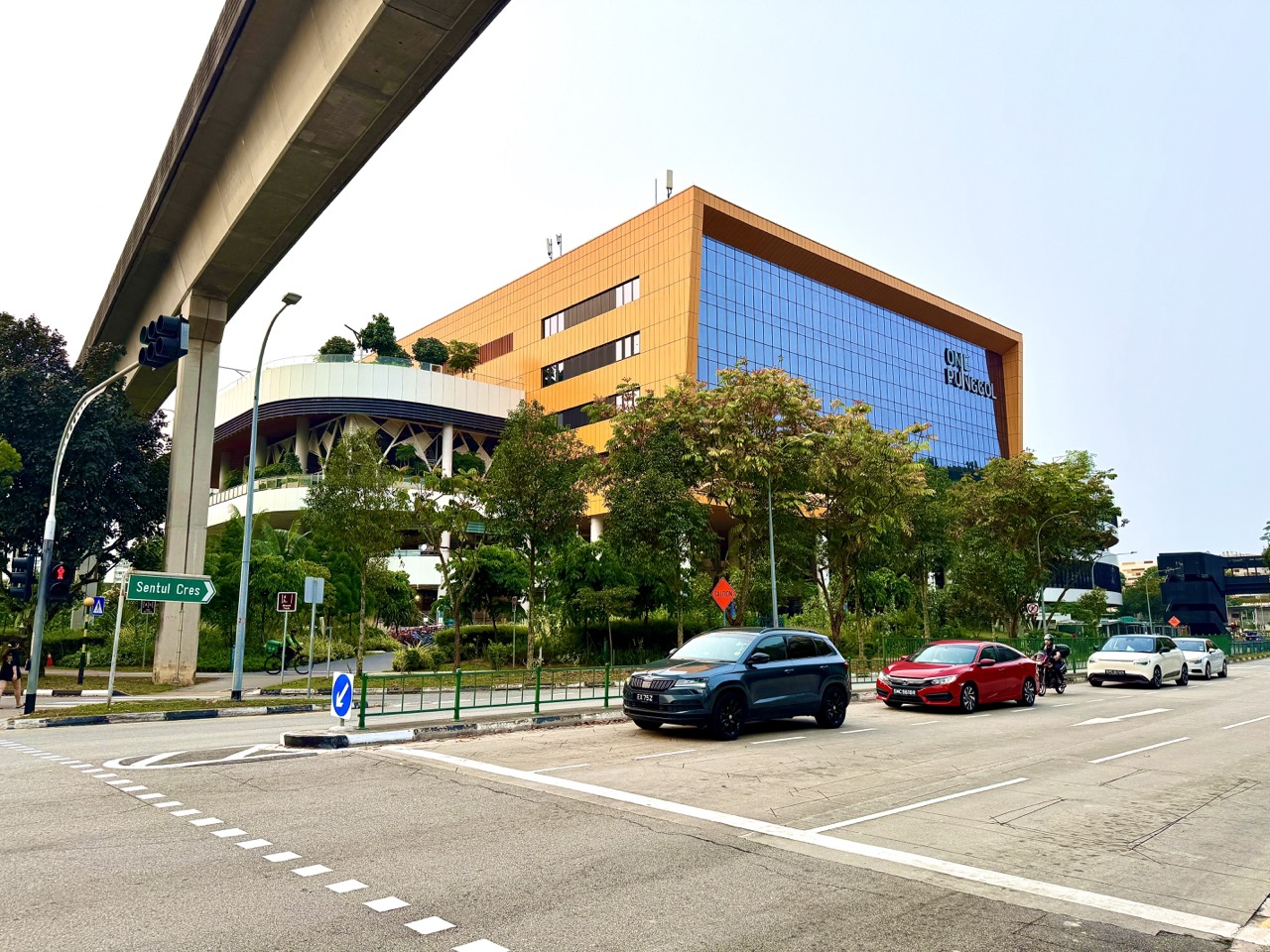
Quick answer, updated 23 October 2026: Punggol’s self-driving passenger services are moving beyond fixed shuttle loops towards bookable, direct trips between approved pick-up and drop-off points. Grab’s public guidance, updated 5 October 2026, says its on-demand autonomous vehicle (AV) service had expanded by September. The next developments to watch are additional designated stops, fleet growth, service reliability, accessible journeys and the long-term relationship between paid on-demand rides and existing free fixed-route services.
This is not a claim that a resident can summon a driverless vehicle to any block or choose any destination in Singapore. “On demand” in this Punggol context still means travel within an operator’s approved service area and between its permitted pick-up and drop-off points. Fares and availability must be checked at the time of booking.
For a current route-by-route rider guide, see Punggol Autonomous Shuttle Guide: routes, stops, hours and booking. The article here is different: it explains the future service model and what would make the next phase genuinely useful to people living in Punggol.
The present status and the announced next steps
- 2025: autonomous shuttles begin initial testing in Punggol; public-facing operations are not yet a general ride service.
- January 2026: community rides help operators gather early feedback.
- 1 April 2026: Grab and WeRide open Ai.R fixed-route public rides in Punggol.
- 29 July 2026: LTA and Grab announce an on-demand direct-routing pilot between existing Route 1 and Route 3 pick-up/drop-off points, with more stops planned progressively.
- By September 2026: Grab subsequently states that its service has expanded into on-demand AV rides.
- 14 September 2026: Grab outlines a plan to expand its AV fleet from 10 to 50 vehicles over the following six months; this is an announced expansion target, not a verified October fleet count.
- What comes next: wider stop coverage, evaluation of operating performance, a clearer balance of fixed routes and commercial rides, and any further service areas only where regulators approve.
Why the shift from a fixed loop matters
A fixed loop is easy to understand. A shuttle follows a predefined route, stopping where the route says. That arrangement works well for discovering whether a new vehicle can operate safely and for trips that happen to align with its stops. But real-life errands do not always fit a loop. Residents may need to travel directly from a housing precinct to a clinic, from a school to a transport hub, or from a market to home.
When a direct route becomes possible, the meaningful improvement is not necessarily vehicle speed. It may be the absence of a detour around unrelated stops. A ten-minute trip that becomes simpler and more predictable can feel more valuable than a faster vehicle travelling the wrong way around a loop.
Yet direct routing is not magic. Riders must still reach a permitted pick-up point, wait for an available vehicle, follow the operator’s booking instructions and alight at a designated stop. If the closest point is far from the actual destination, the first or last segment of the journey remains a problem. More appropriate stops may be more useful than a larger fleet operating within the same limited stop network.
What residents told LTA
LTA’s 29 July 2026 announcement said more than 11,500 unique riders had used the AV shuttles as at 12 July. Among approximately 900 respondents to post-ride surveys, 99% said they felt safe and would recommend the ride. The same update reported responses from around 270 Punggol residents; almost 60% indicated a preference for choosing where to board and alight, and around 40% wanted a more direct route.
Those are useful indicators of user experience, but they need to be read carefully. A positive answer from somebody who completed a ride is not a comprehensive safety audit, nor does a survey sample represent every Punggol resident. The feedback explains why operators are changing the service design. It does not prove a proposed future network is perfect.
For planning purposes, the most useful message is that residents asked for control over their journey, not merely a chance to try a novel technology. Service design should therefore be judged against everyday travel needs rather than the number of autonomous kilometres logged alone.
How on-demand AV rides work—and what they do not promise
Grab describes a passenger selecting approved pick-up and drop-off locations, booking a dedicated autonomous vehicle and taking a more direct journey than a fixed-loop shuttle. The permitted stop network is the crucial boundary. The operator’s booking interface and live availability remain authoritative for any particular trip.
This is not the same as a normal taxi service that can serve almost every legal kerbside address. A driverless vehicle’s authorised operating area, stops and road conditions are shaped by ongoing testing and regulatory oversight. A resident should not assume it can pull into a condominium driveway, school loading bay or sheltered carpark unless that location is explicitly available for the service.
It is also distinct from a driverless cargo robot moving on a footpath. Passenger-carrying AVs operate in road-transport conditions; small delivery or cleaning robots at Punggol Digital District are covered by different trial arrangements. For the latter, see our Physical AI robotics testbed overview.
More stops: what expansion should solve
Grab said additional AV pick-up and drop-off points would be considered progressively with LTA and the Punggol community. That is a direction of travel, not a published promise that every housing cluster will receive a stop by a particular date.
The most useful future stops might be those that shorten awkward first- or last-mile journeys. Think of neighbourhood clinics, frequently used food centres, transport interchanges and places where people currently walk a long way to reach a bus connection. But a destination’s popularity is only one consideration. The operator must also examine safe stopping areas, pedestrian conflicts, accessible boarding, local road conditions and how easily vehicles can approach and leave.
A stop placed beside a busy entrance might be close on a map but difficult for an older resident or a family with a pram. Conversely, a safer stop slightly farther away could work better if it is connected by an easy sheltered route. Consultation should focus on these details, not just a pin on a map.
Fixed-route versus on-demand: two different purposes
Why keep a free shuttle loop?
LTA said existing fixed-route services would continue alongside the enhanced option and remain free during the interim phase. That gives residents a way to experience autonomous vehicles and can offer a predictable trip along the published route. But it is not a promise that fixed-route rides will remain free forever. The operator or regulator must confirm any later fare change.
Why would someone pay for a direct AV trip?
A paid on-demand ride could make sense if it saves enough detour, waiting or transfer inconvenience for a specific journey. The rider should compare the total amount charged, the walking distance to the stop, waiting time and alternative travel options. For some journeys, a bus or the existing shuttle may remain the more sensible choice.
Will the future network replace ordinary buses and trains?
Nothing in the announcements establishes a wholesale replacement of Punggol’s public transport network. The reported intent is to test how AVs can complement existing mobility options. MRT, LRT and regular buses remain important for high-volume routes. Autonomous services have to show where they add genuine value rather than duplicating a well-served connection at higher cost.
How the fare story has changed in 2026
Earlier discussions about planned AV fares can become outdated quickly. The July 2026 LTA announcement linked the start of commercial operations to the enhanced on-demand model; Grab’s October-updated guide describes on-demand rides with commercial fares, while its fixed-route shuttles are still described as free in the interim.
Do not treat an old proposed flat fare or promotional ride as a guaranteed price for a booking today. Different service types and operator phases may have different charging conditions. Check the amount shown by the official booking channel before confirming a ride. This is especially important for families planning several trips in one day.
For an honest cost comparison, add the fare to the full journey. A higher-priced direct trip might be worthwhile for an occasional difficult connection; a regularly recurring trip requires a separate budget calculation. No published figure in this article is a substitute for live pricing.
How to judge fleet expansion without exaggeration
On 14 September 2026, Grab said it planned to increase its AV fleet from 10 to 50 vehicles over the following six months. Five times as many vehicles would be a substantial capacity increase if achieved, but an expansion plan is not evidence that 50 vehicles were already running in October. It also does not tell us how many vehicles will be assigned to each specific Punggol route or on-demand service.
More vehicles can reduce waits only if the other constraints can support them: sufficient safe stopping points, depot and charging capacity, suitable roads, trained oversight staff, software availability and demand concentrated where the vehicles operate. A larger fleet without improved stop coverage can leave many households facing the same walk to the nearest pick-up.
Grab also discussed service possibilities beyond Punggol, subject to regulatory approval. That ambition should be reported as a possible later expansion rather than a confirmed island-wide launch. The future of Punggol AV services is interesting precisely because it may generate the evidence used to decide what can safely expand.
People still matter: safety operators and remote monitoring
A driverless-vehicle service still needs human responsibility. Grab has described trained safety operators and remote-operator roles in its programme. The company reported in July 2026 that more than 20 safety operators had been certified and six had progressed towards remote-operator training. That workforce picture may evolve as the trial develops.
It is important to distinguish different roles and stages. Someone supervising from inside a vehicle is not the same as someone monitoring a fleet remotely, and a statement about autonomous driving technology does not by itself establish that every ride is unattended. The current operator guidance and regulatory permissions control what is actually allowed.
Families should follow the safety instructions provided for their specific ride: seatbelts, boarding, terms and any requirements for children. Do not infer from the term “driverless” that ordinary passenger safety procedures have been waived.
Accessibility is the test that matters most to many households
An AV service will not be genuinely convenient for everyone simply because it can be booked on a phone. Think of a passenger who uses a mobility aid, someone with low vision, an older resident unfamiliar with app booking, a caregiver travelling with a child and bags, or a person who needs a quieter and more predictable boarding process.
Before booking, check whether the selected vehicle and stop meet the passenger’s needs. Relevant questions include wheelchair access, boarding arrangements, whether mobility aids can be carried, how assistance is requested and what happens if a rider cannot locate the vehicle. The announced Punggol expansion does not establish a uniform accessible-vehicle specification for every service.
A meaningful rollout should make stop information understandable, display pricing before payment, provide a way to get help, and reduce pressure to rush across roads to reach the vehicle. Those are reasonable evaluation criteria, not unverified features attributed to Grab or ComfortDelGro.
Three realistic family journeys
A parent heading to a clinic
A direct AV may be attractive if there is a permitted pick-up near home and a stop near the clinic. The family should still compare the total walking distance and waiting time. A promise of more stops in the future is not enough for a medical appointment that is happening this week.
A student travelling to Punggol Coast MRT
The value lies in an improved first-mile connection, especially where the existing route involves an inconvenient loop. But an MRT or LRT connection should be the starting point for comparison. A direct AV trip is not automatically quicker or cheaper once booking and boarding are included.
A family returning with groceries
A vehicle that stops closer to home could be helpful, but the family must know the approved alighting point, luggage capacity and whether a ride is available at the relevant time. Do not book expecting a door-to-door drop-off that the interface does not offer.
What residents can reasonably ask operators to measure
- Median and worst-case waiting times, separated by busy and quiet periods.
- How far passengers walk from homes and destinations to approved boarding points.
- Trip completion and cancellation rates, not just the total number of rides.
- Accessibility of booking and boarding, including the availability of assistance.
- How the vehicles perform around schools, pedestrian crossings and heavy rain.
- Transparent cost per complete journey compared with other transport options.
- How service incidents, complaints and passenger feedback are handled.
These questions are more useful for the future than treating every growth statistic as success. The aim should be a safe, repeatable journey a household can plan around.
How the town might look in 2027
If more stops are approved, vehicles are deployed successfully and residents continue using the service, Punggol could become a useful demonstration of neighbourhood-scale, mixed-mode transport: rail for longer connections, buses and LRT for regular services, walking and cycling for nearby trips, and selective direct AV journeys for gaps between those options.
That is a reasonable scenario, not an official promise for 2027. The result will depend on the trial, commercial sustainability, operational safety, user demand and further LTA decisions. An announcement about fleet expansion alone cannot establish future service frequencies or a stable price.
The broader physical network matters, too. Covered routes and good pedestrian crossings influence whether a person can reach an AV stop comfortably. Read our guide to Punggol planning and land use for context; stop suitability must still be verified against the operator’s actual map.
How to keep your information current
Use LTA for regulation, public service announcements and programme updates. For current routes, reservations, fares and eligibility, use the relevant operator: Grab Ai.R and ComfortDelGro’s autonomous service information. An older news article may describe the plans correctly for its publication date while being out of date on the service’s latest stage.
When reading updates, look for the difference between “to be introduced”, “pilot available by invitation”, “now bookable” and “public commercial operations”. These phrases are not interchangeable. Also check whether a statement refers to Grab’s services, ComfortDelGro’s services or all approved Punggol operators.
Frequently asked questions
Can I book a driverless car anywhere in Punggol?
No. On-demand rides are limited to the operator’s approved pick-up and drop-off locations and live operating conditions. Use the official service interface to confirm your exact trip.
Has on-demand service started?
Grab’s own guide, updated on 5 October 2026, states that the service had expanded to on-demand AV rides by September 2026. Do not repeat July’s “launching in the next few months” language as though nothing has changed. Live booking availability may still vary by phase and user.
Are the fixed-route shuttles still free?
LTA and Grab described the fixed-route services as remaining free in the interim while enhanced services developed. Verify any current charges with the operator because fare policies can change.
Is there a single fixed fare for on-demand rides?
This article does not assert one. Commercial fares apply to the enhanced service according to Grab’s current guidance; the booking channel should show the relevant fare before you commit.
Will 50 AVs operate in Punggol by March 2027?
Grab announced a plan in September 2026 to grow its wider AV fleet from 10 to 50 over six months. That is an intention at announcement time, not a guarantee of delivery date or a claim that every vehicle will operate a Punggol ride.
Will there be a stop outside my block?
Not unless the operator adds and publishes it. Additional pick-up and drop-off points are to be introduced progressively according to consultation, operational conditions and regulatory decisions.
Does “autonomous” mean there is no safety supervision?
No such blanket conclusion is justified. Operator programmes may involve in-vehicle safety staff, remote monitoring and intervention systems. Confirm the stage and passenger conditions for the specific service you use.
Sources and verification
- Grab, guide updated 5 October 2026 — states on-demand operations had expanded by September 2026 and distinguishes the interim fixed-route service.
- LTA, 29 July 2026 — survey figures, planned direct-routing pilot, service changes and regulator’s position.
- Grab, 29 July 2026 — original announcement, stop expansion intention and fleet-operations context.
- CNA, 14 September 2026 — reported 10-to-50-vehicle expansion target and approval caveat.
- Grab, 1 April 2026 — fixed-route public-service launch history.
Update and scope note: As at 23 October 2026, reported plans for further stop and fleet expansion should not be mistaken for a universal on-demand taxi service. Routes, permitted pick-up points, fare amounts, accessibility and passenger instructions must be checked against the live operator service.


