
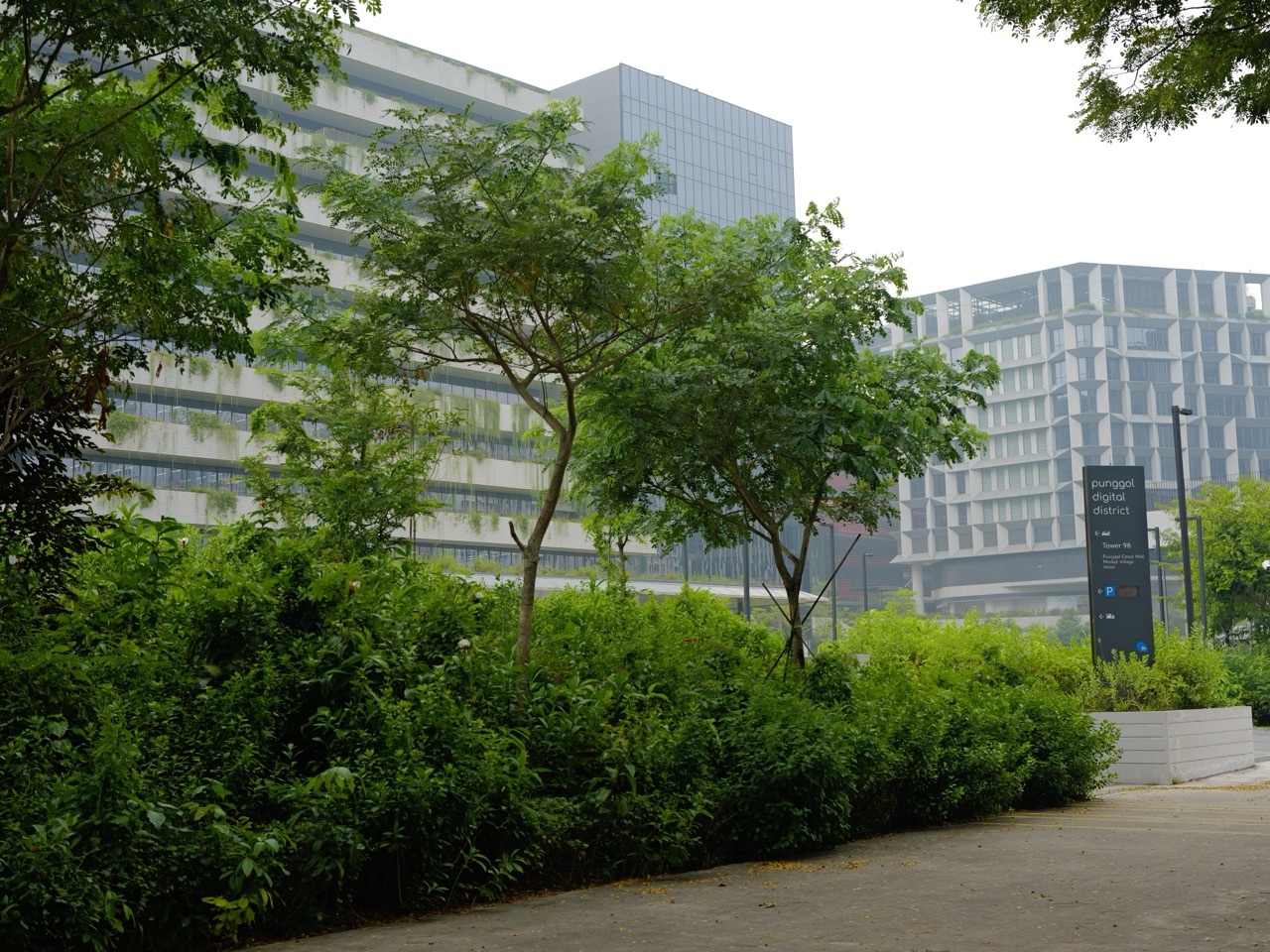
Punggol Digital District is becoming a place where university learning and technology businesses share an address, but its next education opportunity is more subtle than another formal school. JTC plans to establish LaunchPad @ Punggol Digital District in phases from late 2026. It is intended to house startups working in smart-city technology, fintech, robotics and cybersecurity, with potential to test solutions in the district’s real systems. For students, aspiring founders and families, the significance is the kind of learning that happens when an idea meets a difficult practical problem.

That opening timetable is a phased plan, not a statement that every startup space, mentorship event or laboratory was already open on 23 October 2026. JTC’s March 2026 announcement describes the new LaunchPad’s proposed role and the larger LaunchPad network’s approach to community building. Details such as which local workshops may be available, who can attend them, and whether public participants can access particular data are not established simply because the district is launching startup spaces.
This guide therefore answers a different question from an office-space or opening-status guide. It asks: what could Punggol students and adults learn about problem-solving, entrepreneurship and engineering as a new startup ecosystem grows beside SIT? The answer begins with a reality check. Entrepreneurship is not a motivational slogan about becoming wealthy. It is the disciplined process of finding a genuine problem, testing a feasible solution, understanding cost and safety, and learning from results that sometimes contradict the founder’s assumptions.
What is actually planned for LaunchPad @ PDD?
JTC describes the Punggol LaunchPad as an extension of its national startup ecosystem, established in phases beginning late 2026. The area is part of the 50-hectare Punggol Digital District, which integrates the Singapore Institute of Technology, businesses and community amenities. Punggol Digital District’s focus includes artificial intelligence, cybersecurity, robotics, fintech and smart-city solutions.
The district has an Open Digital Platform (ODP), developed by JTC with GovTech, that brings together data from infrastructure and building systems to improve operations and support innovation. It also enables digital-twin modelling—a representation of physical systems and their behaviour for testing ideas before real-world deployment. JTC describes examples in which selected innovators may test solutions with district infrastructure, including gantries, doors and lifts, after appropriate development and evaluation.
A crucial distinction follows: ODP is not a freely accessible public student database, and a JTC description of access for innovators is not an authorisation for any student to connect to live infrastructure. Permissions, technical controls, data governance, operational safety and the terms of any partnership matter.
JTC’s March 2026 announcement also describes a larger LaunchPad strategy involving collaboration, mentor connections, workshops and hackathons. Much of that announcement specifically concerns the established LaunchPad @ One-North ecosystem. Those nationwide programmes are evidence of JTC’s startup-development direction, but they are not a confirmed calendar of identical public events at the forthcoming Punggol LaunchPad.
For a prospective founder, the first official reference is JTC’s LaunchPad information. For Punggol’s district-specific status, use Punggol Digital District’s business and LaunchPad page. This prevents the common mistake of treating a national startup policy announcement as a confirmed invitation to a particular room in Punggol.
Why this is an education story, not only a real-estate story
A university teaches disciplinary knowledge and evaluates what a student understands. A startup tries to develop something useful under conditions of incomplete information, limited resources, competing constraints and real users. When the two interact well, academic learning can become more practical without sacrificing rigour.
Consider a student who understands how to write software but has never watched an elderly customer struggle with an interface. The issue is no longer only whether the code runs. The student must discover whether the product is usable, accessible, safe and worth maintaining. That requires observation, communication, testing, design and perhaps a redesign of assumptions that were comfortable in class.
Now consider a young engineer working on a robotic delivery system. A classroom prototype might move reliably over a clean surface. A real precinct introduces uneven routes, people, weather, variable lighting, delays, connectivity problems and safety obligations. The engineering problem becomes a systems problem. How is the robot prevented from obstructing a wheelchair user? How are failures communicated? Who can stop it? What does success mean after one hundred trips rather than one demonstration?
A district that makes such questions visible can be educationally valuable. But the student only benefits if appropriate opportunities actually exist and there is mentoring, curriculum alignment and permission for participation. A startup tenancy does not automatically create a student internship.
The difference between a startup, incubator, research lab and school programme
These words are often mixed together in discussions of Punggol’s future. A startup is a business attempting to develop and validate a product or service. An incubator or startup-support environment may provide space, introductions, mentoring and access to an ecosystem. A research laboratory investigates a defined technical question. A school or university programme has learning outcomes, entry rules, instruction and assessment.
The same organisation may be involved in several roles, but they are not interchangeable. A startup might collaborate with SIT researchers. That does not make its office an academic classroom. A technology demonstration may take place in public view. That does not entitle nearby pupils to participate in the test. A university capstone can be inspired by district challenges without becoming a paid assignment from the company.
For parents, this distinction matters when evaluating advertised enrichment and “real industry exposure”. Ask who runs the activity, what students do, who supervises them, whether learning objectives exist, how safety and privacy are managed and what tangible work the participant completes.
A credible programme should be able to answer those questions. Merely taking a photograph near a robot or listing the Punggol Digital District name on a certificate is not evidence of practical learning.
The five skills a future Punggol founder will actually need
Problem discovery comes first. Students must learn to interview people without turning questions into disguised sales pitches. “Would you use my brilliant app?” is a weak question. “Can you show me the last time this task was difficult?” may reveal what actually happens.
Evidence and measurement come next. An idea needs a way to be tested. If someone proposes a queue-management tool, the outcome might be median waiting time, accessibility or whether staff spend fewer minutes correcting errors. Before claiming improvement, the learner needs a baseline and an honest method.
Technical literacy matters even for non-technical founders. They should understand what a system can and cannot do, which tools are reliable, what data they may use and where qualified engineering or cybersecurity expertise is required. A prototype can be simple without being reckless.
Communication and collaboration become crucial once different people must understand the solution. A coder, a designer, a facilities manager and a user may describe the same problem in different language. The startup team must translate between them without losing the essential constraints.
Commercial and ethical judgement decides whether a solution should be deployed. The product may be clever but too expensive, intrusive or unsafe. Learning to stop or change an idea is a sign of progress, not failure.
These skills can be practised before a student enters university. They are not restricted to teenagers who plan to found a company. A scientist, teacher, doctor or community organiser also benefits from being able to identify a problem and assess evidence.
A Punggol classroom example: the school arrival bottleneck
Imagine a hypothetical school near a busy Punggol junction. Parents complain about congestion around dismissal time. A student team proposes a simple information display and a staggering reminder to make pickup smoother.
A weak project begins by designing the app immediately. A better project first asks what can be observed legally and safely. Which entrances are in use? Which travel behaviours are allowed by the school? Does congestion occur every day, or mainly on rainy afternoons? Are there students with mobility needs? Is the bottleneck caused by communication, road geometry, or something else?
The team should not film children, collect licence plate data or change traffic arrangements without proper permission. Instead, it can begin with a fictional dataset or aggregated, consented observations provided by a school partner. It can test two message designs with volunteers, compare understanding, document limitations and decide whether the proposed solution is useful.
This small project teaches design thinking, statistics, ethics and communication. It is not presented as an announced LaunchPad programme or a real school’s traffic experiment. It illustrates the kind of disciplined entrepreneurship Punggol’s emerging district makes worth learning about.
A second example: the district energy dashboard
Punggol Digital District includes ambitions around sustainable infrastructure and smart energy operations. Students might imagine a dashboard explaining energy use to non-technical users. But knowing that a district collects data is not the same as having permission to retrieve actual readings.
For a school exercise, generate or use properly licensed sample data. Ask students to plot electricity consumption against time, identify peaks, distinguish temperature correlation from causation and suggest which additional measurements would help. Then ask an accessibility question: could a resident unfamiliar with kilowatt-hours understand the chart without an explanation?
The team could prototype two visualisations and test them with volunteers. One may be visually impressive but hard to interpret. The other may be plain, accurate and actionable. The resulting learning is substantial even if no physical system is touched.
This is how a future smart district can influence ordinary education responsibly: not by granting unrestricted access to critical infrastructure but by supplying real-world questions that students can explore with safe methods and transparent assumptions.
A third example: delivery robots and human safety
JTC’s announcement mentions the possibility of testing autonomous delivery across real district infrastructure. That is an engineering challenge with implications for route planning, lifts, access control and interaction with people. It also offers an educational topic that can be studied without deploying a robot onto the pavement.
A student team could design a tabletop simulation. Two routes lead to a destination; one is shorter but crosses a busy pedestrian area, and the other is longer but less obstructive. The team compares travel distance, delays, safety rules and the ability to stop safely when conditions change.
They might discover that the shortest route is not the best when social and accessibility constraints matter. This teaches optimisation under constraints, which connects directly to secondary Mathematics and later computing and operations research.
An inappropriate version of the project would have students attempt to bypass a building’s access-control systems or experiment with unauthorised devices in shared public space. A genuine engineering project respects the boundaries between simulation, supervised testing and lawful deployment.
What Punggol primary schools can do now
Primary pupils do not need venture-capital vocabulary or adult business plans. They can learn the beginnings of entrepreneurship through age-appropriate questions about usefulness, evidence and improvement.
One activity is to redesign a classroom stationery arrangement. Pupils count how often a shared item is difficult to find, propose a new system and compare the result over several days. They learn to define a problem, use numbers and report honestly whether the change helped.
Another is to create a clear sign for a classroom recycling point. Pupils can test whether classmates understand the sign, improve it and explain how they decided. This links English communication, art, science and the ethics of fair observation.
The best version does not overstate a small exercise as “running a company”. The purpose is to develop agency: noticing a problem, respecting other people’s experiences, trying a solution and changing one’s mind when evidence requires it.
What secondary schools can add
Secondary students can build stronger prototypes and compare trade-offs. They may use spreadsheets, simple code, diagrams, sensor simulations and surveys with appropriate consent. They can practise writing an experiment plan that specifies what would count as success before seeing the results.
A useful school project report includes the background, the actual user problem, constraints, data source, proposed method, test results, uncertainty, ethical concerns and next iteration. That format is more valuable than a polished pitch deck with no testing behind it.
A student interested in fintech might design a fictional budget tool that makes hidden fees clearer; they should not handle real bank credentials. A cybersecurity learner might evaluate password-strength principles using dummy accounts and authorised teaching environments, never by probing live systems. A robotics learner might simulate routes with obstacles, never by tampering with public robots.
Such distinctions train both technical capability and civic responsibility. They also make future portfolios stronger because the work can be explained and reproduced.
What SIT students and adult founders should investigate
A university student should distinguish between an independently proposed project and a formally supervised industry project. A proper collaboration needs an agreed scope, evaluation criteria, confidentiality provisions, intellectual property treatment, project supervision and an understanding of who owns resulting work.
A founder should ask a potential startup ecosystem whether it offers workspace, community contacts, mentor programmes, introductions to relevant companies, test-bedding opportunities and access to appropriate technical support. They should also ask what is not available.
Being near the Open Digital Platform does not mean every startup obtains API keys, real-time building data or direct control of infrastructure. Being near SIT does not guarantee laboratory access, student staffing or an academic partnership. Each is an arrangement to be evaluated separately.
A resident with an early-stage idea can begin by identifying a genuine problem, interviewing possible users where appropriate and developing a small, safe prototype. Formal company formation, intellectual property advice, cybersecurity reviews and commercial deployment become relevant as the project matures.
The value of failure that can be explained
Many students are conditioned to hide mistakes because school marks reward correctness. Innovation requires a different relationship with error. The central question becomes whether a failed test produced reliable new knowledge.
Suppose a team designs a scheduling tool and discovers that users prefer an existing WhatsApp group. That finding may be discouraging if the goal was to impress judges. It is valuable if it reveals that a new tool adds complexity without solving a real problem.
A responsible report can say: “We predicted that reminders would reduce missed appointments. In our small simulated trial, there was no meaningful change. The sample was limited and the messages were unclear. We will test a simpler wording before adding features.” That is stronger thinking than declaring success on the basis of one enthusiastic comment.
Good mentors should encourage the documentation of counterexamples, uncertainty and decisions not to proceed. Students who learn this are better prepared for scientific research, engineering quality assurance, medicine and public service as well as entrepreneurship.
Where mentorship fits — and where it does not
JTC’s broader LaunchPad strategy describes mentor connections and structured community-building. Mentorship can help founders see industry realities that cannot be learned from a textbook alone: procurement cycles, safety compliance, customer needs, pricing, staffing, contracts and why apparently simple products fail to scale.
But not every person calling themselves a mentor offers reliable advice. A student should ask what experience the mentor has, whether there are commercial conflicts and what evidence supports a recommendation. Advice about legal compliance, health, financial products or technical certification needs suitable expertise and, where applicable, licensed professionals.
Mentorship is most useful when it has a defined purpose. “Build a startup” is too vague. “Review five customer interviews and tell us which assumptions remain unsupported” is a productive mentoring brief. The learner can then act on feedback and test the next decision.
Until a specific LaunchPad @ PDD programme is announced, families should not publish or rely on a made-up local mentoring timetable. Interested founders can use JTC’s official channels to enquire about the ecosystem.
Are all future workshops open to Punggol residents?
No such blanket entitlement has been announced. JTC’s national LaunchPad material describes workshops, hackathons and collaboration as part of its startup-community approach. It does not establish that every forthcoming Punggol workshop will be public, free, open to minors or available without company or institution affiliation.
An event could be restricted to confirmed startups, students in an identified university programme or invited partners. Another event might later welcome the public. The only responsible approach is to check the event’s actual organiser, eligibility, safeguarding provisions, fee and registration instructions once published.
Punggol families can already use public libraries, school assignments and suitable open educational resources to learn the underlying skills. Local business development should enrich the educational environment, not pressure children into programmes that are not designed for them.
How does this differ from a conventional business-park story?
The business-park story asks when offices open, what companies arrive and how to enquire about space. That is covered in our LaunchPad @ PDD opening and enquiry guide. A broader cultural account appears in Crazy Rich Punggol’s LaunchPad essay.
This education guide has narrower ownership: what learners should study, how responsible project-based learning works, how startup mentorship must be verified and what families should not assume about public access. It does not pretend to list current tenancies, prices, an open enrolment programme or a guaranteed startup placement.
The district’s SIT living-labs and work-study article covers formal university-industry education. Here, the focus is an entrepreneur’s learning cycle: identify the problem, test something small, understand regulation, learn from users and decide whether the idea deserves to become a company.
A practical 2026–2027 learning timeline
Late 2026: Track JTC’s phased LaunchPad @ PDD announcements. Students can already practise problem interviews, project documentation, mathematics and prototyping in safe school or home contexts. An aspiring founder can prepare a clear problem statement and make an official enquiry about startup ecosystem eligibility without claiming a guaranteed place.
During 2027: As the district’s startup community develops, watch for actual published opportunities to collaborate, attend events or test technology through proper channels. Confirm whether a particular opportunity is designed for companies, university learners, adult founders or the general public. No specific universal student-access calendar is established at this point.
Longer term: Evaluate what changes for education rather than counting new logos on buildings. Do students get relevant project briefs? Are ethical and safety requirements taught? Can learners measure results? Are industry partners offering appropriate supervision? These are better measures of educational value than the number of grand-opening photographs.
This is a decision timeline, not a claim that all these activities will materialise on a fixed date.
Common mistakes that create false expectations
Mistake: “LaunchPad opens in late 2026, so every facility is operational by January.” Correction: JTC states that the development opens in phases.
Mistake: “Students can access all Open Digital Platform data for projects.” Correction: access, permission and data governance are separate matters. No unrestricted student access is established.
Mistake: “JTC has announced hackathons at One-North, so the same event is booked in Punggol.” Correction: the national programme direction and the Punggol event calendar are not interchangeable.
Mistake: “A startup office is the same as a degree programme.” Correction: formal curriculum, attendance, assessment and academic credit require a recognised educational arrangement.
Mistake: “Building a prototype means we have found a market.” Correction: a prototype demonstrates a possibility; market demand and feasibility require evidence.
Mistake: “The most complex technological idea must be the best.” Correction: usability, safety, costs and the real user’s problem often matter more.
Frequently asked questions
When is LaunchPad @ Punggol Digital District expected to begin?
JTC states that it will be established in phases from late 2026. There is no single published date on which all spaces and activities should be assumed open.
Is LaunchPad a new primary or secondary school?
No. It is a planned startup ecosystem and workspace initiative, not an MOE mainstream school.
Can a Punggol teenager join a LaunchPad programme automatically?
No. Any particular event or internship needs an organiser, published eligibility and a registration route. Those details cannot be inferred from JTC’s district plan.
Which technology areas does LaunchPad @ PDD target?
JTC highlights smart-city solutions, fintech, robotics and cybersecurity, aligned with Punggol Digital District’s wider ecosystem.
Will startups be able to test with real building systems?
JTC describes district test-bedding possibilities through the Open Digital Platform and approved infrastructure interactions. Individual access and operational permission are not automatic.
Are mentorship and hackathons confirmed for the Punggol site?
JTC has described such activities in its wider LaunchPad strategy. Do not attribute a specific date or open public invitation to LaunchPad @ PDD without a local organiser’s published announcement.
How can a primary child benefit now?
Through age-appropriate observation, measurement, design, feedback and reflection—not by assuming participation in a commercial startup programme.
How can a university student prepare?
Build an evidence-based portfolio, study a real problem, document ethical safeguards and verify industry-project eligibility through their university or relevant organisation.
Does proximity to SIT create automatic partnerships?
No. Collaboration needs agreement on access, teaching roles, supervision, assessments and intellectual property.
Where should a founder ask for current details?
Use JTC LaunchPad or the Punggol Digital District business site. Their live information supersedes forecasts.
Sources and scope
The key public source is JTC’s 2 March 2026 LaunchPad masterplan announcement. It establishes the phased Punggol LaunchPad plan, targeted technology fields and examples of the district’s proposed testing ecosystem. JTC’s Punggol Digital District website explains how academia and industry are intended to interact. The examples of student projects in this article are educational models, not claims about activities already offered at LaunchPad @ PDD.
Fact review: 23 October 2026. The status of specific startup tenants, workshop schedules, student access and test-bed permissions must be verified through current official notices.
What the next generation can gain
The most valuable education change may not be a new course title at all. It may be an environment in which students see that real products require evidence, cooperation and responsibility. A good education prepares someone to notice a problem without exploiting its users, calculate without overstating certainty and build technology without neglecting safety.
LaunchPad @ PDD is still a phased development, but the skills needed to contribute to a place like it can be cultivated now. Punggol’s future will be more interesting if its young people learn not merely how to admire new machines and companies, but how to ask whether an idea is useful, test it honestly and improve it when the world gives a different answer.


