
Quick answer. Student Care Centres (SCCs) supervise eligible school-age children outside school hours, helping parents manage the time between dismissal and evening pickup. They are distinct from preschool childcare, MOE Kindergarten Care and specialist tuition. In Punggol, both school-based and community-based centres can be relevant, but a primary-school place does not guarantee an SCC place.
MSF’s Student Care Fee Assistance (SCFA) is a means-tested subsidy for eligible children at centres registered to administer it. In 2026, ordinary SCC income thresholds are $4,500 gross monthly household income (GHHI) for households of four or fewer, or $1,125 per-capita income (PCI) for households of five or more. From 1 January 2027, those thresholds rise to $6,500 and $1,625, with revised tiers. The scheme also has citizenship, parental-employment and centre conditions.
SCFA can provide up to $290 per child monthly and an eligible one-time Start-Up Grant up to $400. These are maximum benefits, not a blanket parent payment. For instance, a fictional qualifying child at a centre with a $295 fee and the maximum $290 monthly subsidy would have a $5 tuition-fee co-payment before any additional charges. The amount must be officially assessed.
This parent guide explains the revised 2027 scheme, MSF applications, centre choices, actual Punggol school examples, homework and recreation, meals, safe transfers and family planning. Source check: 20 October 2026.
1. What student care provides
Student care solves a daily practical problem: young primary pupils may finish lessons hours before adults finish their work. A centre supervises the child, provides a structured environment and may organise meals, activities and homework time.
The content depends on the operator. A parent should ask how much of the afternoon is spent on study, play, social development and rest. A long list of enrichment activities does not automatically indicate good care.
The best arrangement suits the child’s needs and the caregivers’ realistic schedule. It should reduce stress without creating a second exhausting school day.
2. SCC is not the same as tuition
Student care may provide a place for a pupil to start homework or receive general academic support, but it does not guarantee specialised tutoring in dyslexia, Science or Mathematics. Parents should find out whether staff merely supervise completion or diagnose and explain errors.
A child can complete every worksheet with an adult’s hints but still lack independent understanding. If a recurring misconception appears, school teachers or suitable specialists may need to intervene.
The centre’s first responsibility is the agreed care service. Academic help can complement schooling without being misrepresented as intensive tuition.
3. SCC, childcare and KCare use different systems
Childcare and infant care belong to early-childhood services, while Kindergarten Care supports eligible MOE Kindergarten children. School-age SCCs have different programmes and funding requirements.
A family with a K2 child and a P3 child may use two separate care services and subsidy schemes. Do not treat an ECDA preschool fee subsidy as automatic entitlement to MSF SCFA.
The application, age limits, withdrawal and parent communication can differ. Keeping separate records avoids mistakes at a school transition.
4. School-based student care in Punggol
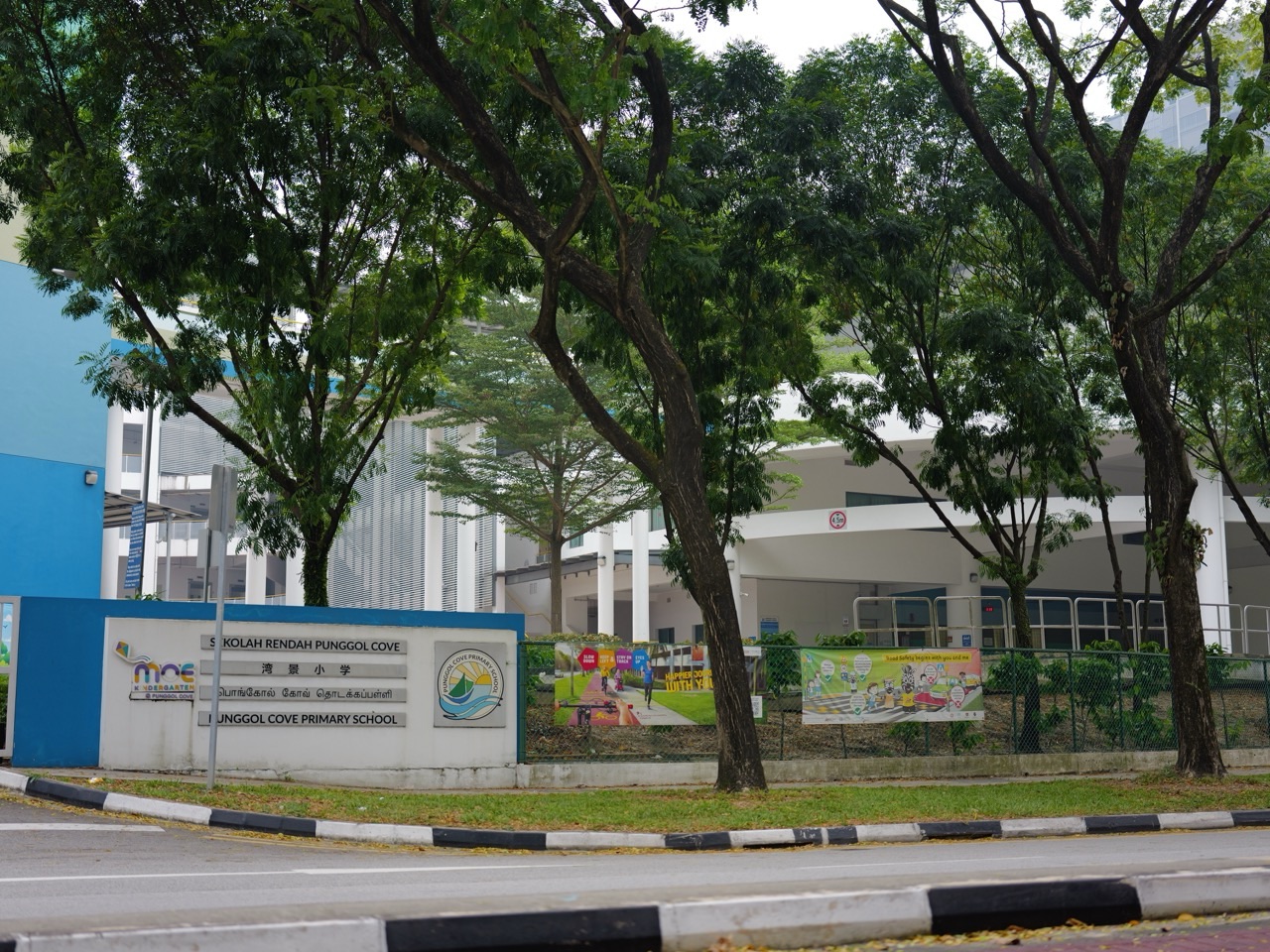
Punggol Cove Primary School’s 2026 Primary 1 parent orientation describes a school-based SCC handover: P1 pupils wait in their classroom after dismissal, and student care staff take over. Its material also explains that parents should liaise directly with the centre regarding early dismissal.
This is a grounded example of one school’s system. Another Punggol campus may use a different handover point, operator and timetable.
Ask the actual school how enrolment works, who accounts for pupils at the transition and whether a care place is available. The operator, not a school’s general admission offer, should confirm enrolment.
5. Waterway Primary publishes hours
Waterway Primary School’s August 2026 visitor page lists its school SCC operating during term from 10am to 7pm and during holidays from 7:30am to 7pm. This is a useful concrete illustration of why care can cover more than the classroom afternoon.
These hours are specific to Waterway Primary at that publication date, not a promise for every Punggol centre. Actual holiday schedules, closure days and pickup rules require direct verification.
A family should ask for the current calendar and test the route from its home and workplace before deciding that the schedule is practical.
6. Student care enrolment is a separate administrative step
Primary admission is governed by MOE, whereas an SCC operates its own enrolment, vacancies, fees and contract conditions. Being posted to a school does not entitle a child to care at that campus.
Ask when SCC applications open, whether a deposit is required, how a waiting list works and whether priority applies to any particular pupils. Do not wait until the first P1 day to learn that the desired service is full.
A backup caregiver plan may be necessary if the family has not received formal confirmation. The child should never be left with an unclear pickup arrangement.
7. School-based versus community SCC
A school-based centre often reduces the journey immediately after school. A community SCC near home, a caregiver or a transport connection may be more convenient for evening collection.
Compare actual time, supervision between locations, meals, homework space, holiday arrangements, staff stability and total monthly fees. A cheaper advertised rate can lose its advantage if an extra bus journey or paid collection service is needed.
A good family comparison uses the whole day’s routine rather than a simple map distance. The best option may change when work hours or sibling needs change.
8. The 2026 ordinary SCFA age range
MSF’s published ordinary SCC SCFA scheme is generally for children aged 7 to 14 in the calendar year support begins, covering school-age pupils such as Primary 1 through the relevant secondary years.
The scheme’s age condition is not a description of every centre’s willingness to admit a child or of Special Student Care Centre eligibility. Individual operator and specialised-care rules differ.
Confirm the child’s age, enrolment and programme type before applying. A parent should not assume a P6 pupil is ineligible merely because the child is preparing for PSLE.
9. The 2026 income threshold
For ordinary SCC assistance in 2026, MSF states the GHHI ceiling of $4,500 for eligible households with four or fewer members. For eligible households of five or more, the alternative assessment is PCI up to $1,125.
These are ceilings for consideration, not promises of the maximum monthly subsidy. The government uses specified household and income definitions.
A family at $4,800 monthly income with four members would be above the 2026 ceiling. That fact should not be transferred blindly to a January 2027 application because the new threshold is higher.
10. The January 2027 increase
From 1 January 2027, MSF raises the relevant ordinary SCC thresholds to GHHI $6,500 for households with four or fewer members, or PCI $1,625 for households with five or more.
The higher ceiling can make previously ineligible working families eligible for means-tested assistance. MSF says the 2027 expansion should support around 13,000 students and families.
A family qualifying at the higher income end should not assume it receives the lowest-income band’s maximum $290. The revised schedule has several subsidy rates and limits.
11. Why family size matters
A larger household may have more dependants, so MSF applies a PCI test according to its rules. The calculation divides the eligible gross household income by eligible family members under the scheme’s definition.
Do not include every distant relative casually or remove income sources because they appear inconvenient. The government defines which family members count, including specified grandparents and dependent siblings in suitable circumstances.
The Household Means Eligibility System uses official income records and may request supporting information. The relevant answer is the government assessment, not an informal calculation alone.
12. Worked PCI illustration
Imagine a fictional household of six eligible members with gross monthly household income of $5,400. PCI would be $5,400 ÷ 6 = $900 under those assumptions.
This is below the revised 2027 $1,625 ceiling, but the household still needs to meet the citizenship, work-hours and registered-centre conditions. The PCI number alone cannot determine which subsidy tier is approved.
The family should report the actual eligible members and income sources. An attractive arithmetic result created by an incorrect household definition has no entitlement value.
13. Citizenship requirements
MSF specifies that eligible SCC children are Singapore Citizens or PRs, with the additional condition that a PR child has at least one immediate family member in the same household who is a Singapore Citizen.
A foreign child cannot assume ordinary SCFA eligibility simply because the child attends a Singapore school or has a Punggol address. The actual scheme conditions must be satisfied.
Confirm identities through the official application. Sensitive documents should not be sent to random agents promising fast approval.
14. Why the 56-hour employment rule matters
MSF generally requires both parents to work at least 56 hours per month each under the ordinary scheme. It is designed to support working families needing care during employment.
A parent with irregular shifts or self-employment should clarify what proof or assessment is used. A single-parent or changed-employment circumstance may require the specific current process or appeal rather than a simplistic online guess.
Provide genuine information. The purpose is stable care and household support, not making a timesheet appear more favourable than reality.
15. The SCC needs to administer SCFA
The family’s eligibility is only one part of the scheme. The enrolled centre must be registered with MSF as an SCFA administrator. A care provider can exist without offering this particular government subsidy.
Ask the operator to confirm its registration and explain how it deducts an approved amount from the monthly bill. Do this before accepting a price that assumes a benefit.
MSF’s registration requirements cover supervision, physical environment, health, safety and structured programming. It is more meaningful to ask how the centre meets these requirements than rely on its promotional colour scheme.
16. How much can a family receive monthly?
MSF’s revised SCFA schedule allows a maximum ordinary monthly fee subsidy of $290 under qualifying lowest-income and fee circumstances. The amount changes across income bands and can depend on the centre fee.
The maximum is not deposited as unrestricted cash to every family. Under normal administration, the subsidy is applied to eligible student care fees and the remaining co-payment must be met by the family.
Ask the SCC for the official net amount once approved, and clarify meals, holiday charges and any additional services separately. A low-income example cannot be presented as the price everyone pays.
17. Worked $295 monthly-fee example
MSF uses a monthly SCC fee of $295 in its published examples. With an approved $290 subsidy, the simple fee co-payment is $295 − $290 = $5.
A family should not automatically copy that $5 into a budget simply because its own SCC also costs $295. The subsidy depends on the child’s eligible income tier and other scheme conditions.
This calculation illustrates the policy’s potential impact, not an award notification. The official approval and centre billing define the real payment.
18. A second worked higher-income scenario
Suppose a fictional SCC charges $300 and the child is entitled to a maximum $59 monthly subsidy under the relevant 2027 band and fee calculation. The illustrative remaining fee is $300 − $59 = $241.
A parent who sees only “up to $290” might budget too optimistically. Different income bands exist because the subsidy is means tested rather than universal.
Use the actual MSF award and final centre bill to calculate the household’s net cost. Include meals, transport and holiday programmes separately if they are not in the stated fee.
19. The Start-Up Grant helps with initial costs
MSF also describes a one-time Start-Up Grant of up to $400 for an eligible child. This can help with qualifying initial student-care enrolment expenses under its terms.
The grant is not an additional $400 paid every month, nor should it be assumed to cover any item a family chooses to buy. Ask which fees it can offset and when the centre or authority administers it.
Starting a new care arrangement can create a temporary cash-flow problem through deposits and registration. Separating the grant from monthly subsidy gives parents a more accurate payment plan.
20. Applying before January 2027
MSF states that parents can submit SCFA applications via SupportGoWhere from up to six months ahead of the intended effective date. It gives July 2026 onwards as an example for care beginning in January 2027.
A parent planning a P1 start should therefore check eligibility and the centre well before the first school day. An SCC place and an SCFA application are connected but distinct processes.
The effective month and application status should be confirmed in the official system. A saved form on a parent’s phone is not necessarily a completed approved application.
21. How SupportGoWhere and HOMES fit together
SCFA is submitted through the official SupportGoWhere route. The means test uses the Household Means Eligibility System (HOMES), which can assess income from appropriate CPF and IRAS information and request further documents where necessary.
Families should enter accurate household details, review consent requirements and respond to legitimate official follow-up. Self-employment, variable wages or unusual arrangements may require further clarification.
Protect personal information. A centre can guide parents through the scheme, but an unrelated messaging account claiming to approve subsidy in exchange for payment should not be trusted.
22. Approval and review points
MSF’s updated guidance allows SCFA approval for up to 36 months per instance, subject to conditions and fixed review points, including Primary 3 and Primary 6 for ordinary SCCs. This is an extension from the earlier 24-month context described in the 2026 reforms.
Approval does not mean that household or care circumstances are irrelevant forever. Families must follow any change-of-circumstances, renewal and review requirements.
Keep the official decision, next review month and centre fee agreement in the same family record. This avoids a surprise when a child moves level or the parent’s job changes.
23. What if the remaining co-payment is unaffordable?
MSF’s scheme page describes the ability to seek a case-by-case SCFA appeal through the SCC where the approved monthly co-payment still creates difficulties. Supporting documents can explain the specific circumstances.
An appeal is not automatic additional assistance. It must be assessed under the responsible authority’s conditions and the centre’s proper process.
Contact the SCC early rather than allowing payments to lapse without communication. The child benefits when the adults develop a stable lawful care plan instead of a sudden unexplained withdrawal.
24. Special Student Care is a different service
Special Student Care Centres (SSCCs) support some children with additional needs under a separate arrangement. MSF’s published framework covers eligible children aged 7–18, with its own means-test thresholds of $9,200 GHHI or $2,300 PCI according to the household-size rules.
The ordinary SCC age limit of fourteen should not be applied to every SSCC applicant. Nor does a developmental diagnosis alone guarantee a specialised care place.
Families can consult SG Enable’s Enabling Guide and the relevant provider to discuss eligibility, support needs, transport and actual capacity.
25. Accessibility is more than saying “inclusive”
A child may need predictable routines, an adapted physical environment, communication support or a quieter place after an overstimulating day. Ask how the centre handles genuine needs, staff training and safe handover.
For example, a visual timetable might help a pupil who is distressed by sudden transitions. Another pupil may need specific assistance with movement or meals under professional guidance.
A responsible provider gives precise information about what it can safely deliver. Parents should not rely on a vague claim that all care arrangements suit every child identically.
26. Homework time is not necessarily remedial education
A student care centre can organise a quiet time to attempt homework, but there is a difference between completion and mastery. Staff may supervise pupils or help them follow instructions without conducting systematic academic diagnosis.
A learner may copy a model fraction solution correctly while retaining a misconception about unlike denominators. An educator can identify the difficulty and communicate it to school or family.
The goal is cooperation, not duplication: school teaches curriculum, SCC offers agreed care and homework support, and targeted teaching is arranged when the actual learning gap requires it.
27. Original worked place-value diagnostic
A fictional Primary 2 pupil chooses 29 as larger than 32 because nine exceeds two. The result reveals comparison of ones digits while ignoring tens.
Use groups of ten and singles. Thirty-two consists of three tens and two ones, while twenty-nine has two tens and nine ones. Three tens already exceed two tens, so 32 is greater.
Try 41 versus 38. If the pupil now explains four tens compared with three tens without hints, the concept has started transferring. This is why meaningful correction is more valuable than simply demanding the worksheet be completed.
28. Play, rest and relationships matter
The child’s afternoon should not become another full day of timed tests. Appropriate play, movement, meals, friendships and rest contribute to wellbeing and capacity to learn the next day.
Ask the centre how its timetable balances homework, recreation and free choice. A pupil who has been working hard in school may need a short calm transition before beginning additional tasks.
An attractive schedule is only helpful if it works in real life. Observe whether staff respond respectfully to distress and whether children can engage safely in ordinary social activities.
29. Safe pickup and school-to-centre transfers
At Punggol Cove Primary, the published 2026 P1 orientation describes student care staff taking over pupils after school dismissal from their classrooms. This is one example of a documented safety handover.
Ask the actual centre who accounts for each pupil, where families collect them, which adults are authorised and what happens when a parent is delayed. School bus and student-care providers may need separate notifications.
A young child should not be asked to leave campus or wait at an unfamiliar public location simply because an adult sent a casual message.
30. Holidays, CCAs and centre operating times
Waterway Primary’s August 2026 visitor page lists different SCC hours during the school term and holidays. That shows the need to check full-day availability and closure dates separately.
A P3–P6 pupil may also have CCA or remedial activities that delay arrival at student care. Parents should ask which staff manage handover from the activity and how the centre is informed.
A centre’s advertised closing time may not explain its late fee or special-event arrangements. Obtain the real timetable and family obligations in writing.
31. Pick the care location after mapping the full day
A household near Punggol Central and one in Northshore can face very different routes to the same school or community centre. Calculate school dismissal to care, care to home and the caregiver’s actual return from work.
Walking minutes on a map can hide lifts, crossings, LRT waiting and a young child’s slower pace. Test the route at the real pickup time and repeat the calculation for rain.
The best SCC need not be the one whose address looks closest on a brochure. A safe, sustainable journey can improve evening meals, sleep and next-day learning readiness.
32. Worked two-sibling fee calculation
Suppose a fictional family has two children at a centre charging $295 monthly each. Without SCFA the monthly total is $590. If both separately qualify for the maximum $290 subsidy under the scheme, the illustrative combined fee co-payment is $10.
But one child’s award does not create automatic entitlement for a sibling. Each enrolment and eligibility assessment must be confirmed, and additional centre expenses may remain.
Record the approved net amount for each child and the actual bill rather than multiplying an advertised maximum and calling it household savings.
33. Worked budget with a middle subsidy amount
Imagine a fictional SCC charge of $295 and an approved fee subsidy of $118 monthly under the relevant tier. The remaining fee is $295 − $118 = $177, excluding separately billed items.
This is a different outcome from the published $5 lowest-tier illustration even though the care charge is identical. The income tier and scheme calculations materially affect affordability.
A parent can compare the final net fee with other centres, adding any required transport or holiday-care expenditure. Avoid claiming an exact subsidy before the official award is issued.
34. School Student Care opening hours must be checked
The term “school-based” says where the service is located, not necessarily what time it opens during holidays or how it handles early dismissals and special events.
Waterway Primary’s published schedule provides one real reference, but other campuses can have different operating hours. Ask when children may arrive, whether meals are included and which days are excluded.
A family with shift work should also check late collection terms. A centre that closes at 7pm may be unsuitable when a parent’s ordinary commute regularly ends later.
35. The parent’s real test of programme quality
Watch whether adults greet children respectfully, explain routines clearly and respond to ordinary disagreements. Ask how homework completion is supported without humiliation and how pupils are encouraged to play and socialise.
A provider should be able to describe who supervises each activity, how it responds to distress and how parents receive important information. A pleasant room is only one part of quality.
The child can provide useful feedback after a settling-in period: Do they know whom to ask for help? Can they eat comfortably? Do they feel safe waiting for pickup?
36. A Punggol P1 family beginning in 2027
Imagine a fictional four-person Punggol household earning $5,000 gross monthly with both parents meeting the work-hours rule. Under the 2026 ordinary ceiling, its income exceeds $4,500; under the revised January 2027 ceiling, $5,000 is within the $6,500 range.
That may make the household eligible for a tiered subsidy, provided the remaining criteria are met. It does not automatically qualify for the maximum $290 monthly amount.
The family confirms an actual SCC place, applies through SupportGoWhere and waits for official net fees before finalising the budget and pickup plan.
37. When the parent’s working hours change
Employment hours may change after an employer adjusts a roster, a caregiver loses work or a parent returns to employment. Because SCFA has employment-related criteria, families should check their obligations when circumstances materially change.
Do not conceal a change or assume the existing award continues permanently without any review. Seek the centre’s guidance and the relevant official process for reassessment or appeal.
A stable arrangement matters to the child. If assistance changes, adults should explore lawful alternatives early instead of leaving care decisions unresolved at school dismissal.
38. Medical needs and food information should stay private
A child may have allergies, medication instructions or developmental support needs that affect afternoon care. Share necessary functional and emergency information through the operator’s designated secure channels.
Do not put a child’s medical record in a general parent messaging group or assume the care provider can handle every health condition without discussion. Appropriate professional advice and centre capacity should guide any individual arrangement.
The objective is a safe, respectful care routine. It should protect the child’s dignity and minimise confusion in the event of an illness or emergency.
39. Student care is part of the education system, not a replacement for school
Good SCC operations can support primary schooling by keeping children safe, offering predictable routines and allowing working adults to maintain employment. Homework guidance may help the child organise tasks, but subject knowledge still develops through school teaching and suitable independent practice.
If a pupil has a recurring English or Mathematics misconception, ask school teachers for a precise assessment and next step rather than expecting SCC staff to provide an unspecified tuition solution.
This distinction makes the entire family system work better: the school teaches, the SCC provides agreed care, adults coordinate pickup and specialists contribute when an individual need requires it.
40. A four-week pre-enrolment plan
Week 1: identify SCC options using MSF’s locator and actual school information; check age, places, prices and whether the centre administers SCFA.
Week 2: examine daily programme, meals, homework, special needs, authorised pickup and the complete holiday calendar. Time the real family route.
Week 3: use the correct 2026 or 2027 MSF eligibility rules, gather required documents and submit through official SupportGoWhere when appropriate.
Week 4: confirm approved fees and centre enrolment separately, establish emergency contacts and practise the child’s first-day handover with a calm routine.
41. Common mistake: treating the subsidy as a cash allowance
The maximum ordinary SCFA rate is a fee subsidy, typically deducted through the administering SCC. It is not the same as a child allowance that families can spend on books, groceries or tuition at will.
If a family receives the maximum $290 on a $295 fee, the arithmetic yields a $5 fee co-payment under the stated conditions, not a $290 bank transfer. The centre explains its actual billing.
This distinction helps parents avoid double-counting the subsidy when preparing a budget or comparing student care costs.
42. Common mistake: treating every SCC as an administrator
A school-based or community care centre may provide legitimate services without being eligible to administer SCFA. The family must confirm both the child’s eligibility and the centre’s participation.
An operator’s advertising slogan does not substitute for official scheme registration. Ask for the correct government application guidance and written net fee after approval.
This matters most when families choose a centre partly on the belief that a government subsidy will make it affordable. An unverified assumption can create immediate financial stress.
43. Common mistake: confusing 2026 and 2027 rules
October 2026 is a transition period. The current ordinary SCC ceiling is $4,500 GHHI or $1,125 PCI for the defined household-size categories, while the raised limits of $6,500 and $1,625 take effect on 1 January 2027.
A parent planning January entry should read the new policy alongside the actual effective date. Do not tell an October applicant the new ceiling has already applied to every preceding month.
Dates are part of financial eligibility. Recording the intended start month prevents a correct number from being used in the wrong period.
44. The child’s perspective matters when choosing care
A centre may offer excellent hours and an affordable net rate yet be a poor fit if the child consistently feels unsafe, cannot eat comfortably or struggles with unfamiliar routines.
Ask about settling in, friendship support, quiet areas, predictable activities and respectful staff response. Observe changes over time rather than judging one difficult first day as a complete outcome.
A good decision combines national funding rules with the child’s actual wellbeing. Affordability is essential, but it is only one dimension of suitable care.
45. Final decision: safety, suitability, affordability and reliability
Before enrolling, the family should be able to explain who has custody of the child after school, when and where pickup happens, which centre fees apply and what government assistance has actually been approved.
Compare term and holiday schedules, routes, staff practices and the child’s needs. Keep written emergency and collection arrangements available to authorised caregivers.
The goal is a child who is supervised, respected and able to return home ready for family life and the next school day. Accurate MSF rules make this decision more manageable without offering invented guarantees.
Frequently asked questions
What is an SCC?
A Student Care Centre supervises school-age children outside school hours. Programmes vary by operator and are not automatically specialist tuition.
Is student care the same as KCare?
No. KCare supports kindergarten children under its arrangement; an SCC is a separate school-age care service.
Does getting a school place also give an SCC place?
No. School admission and student care enrolment are separate applications with their own vacancies.
What was the ordinary SCFA income ceiling in 2026?
For qualifying households of four or fewer, $4,500 GHHI; for eligible families of five or more, $1,125 PCI.
What changes on 1 January 2027?
The respective ordinary SCFA ceilings increase to $6,500 GHHI and $1,625 PCI, with revised income tiers.
Can SCFA cover up to $290 per month?
Yes for qualifying circumstances, but it is a maximum fee subsidy and not a universal cash entitlement.
What is the one-time start-up grant?
An MSF grant of up to $400 per eligible child for relevant starting costs under the scheme’s rules.
Why does household size affect the calculation?
MSF uses GHHI for the specified smaller-household category and PCI for eligible larger households under defined membership rules.
Do both parents need to be working?
The ordinary scheme generally requires each parent to work at least 56 hours per month, subject to the official process and circumstances.
Can a PR child qualify?
A PR child may qualify when an immediate SC family member is in the same household and all other conditions are met.
Are all student care centres eligible to administer SCFA?
No. The centre must be registered with MSF as an SCFA administrator.
How do parents apply?
Use the current official SCFA service through SupportGoWhere and provide accurate household and enrolment information.
Can I apply before my child starts school?
MSF allows applications from up to six months before the intended care start, subject to its current application rules.
Does approval last permanently?
No. MSF describes up to 36 months with review checkpoints at relevant primary levels and applicable conditions.
How is the maximum $290 reflected in fees?
Usually as a deduction from the relevant SCC fee under the administrator process, not a free-spending deposit.
What if a family cannot afford even the co-payment?
MSF describes a case-by-case appeal process through the SCC with supporting documents.
How old must a child be for ordinary SCFA?
The ordinary scheme targets eligible children aged 7–14 in the calendar year subsidy begins.
What about specialised student care?
SSCCs have separate eligibility and subsidy arrangements for qualifying children aged 7–18; check MSF and SG Enable.
Does Waterway Primary have published SCC hours?
Yes. Its August 2026 website lists term and holiday SCC schedules; families should confirm current details.
What does Punggol Cove’s 2026 P1 material explain?
It describes a classroom-to-student-care handover supervised by SCC staff after dismissal.
Does student care guarantee homework mastery?
No. Centres may supervise homework, while conceptual teaching and targeted remediation are distinct.
Do SCCs operate through school holidays?
Some do; opening, meals, closure dates and full-day charges vary and must be confirmed.
What happens when CCA finishes late?
Ask the school and operator who supervises and transfers the child and how parents should report timetable changes.
Can a family assume its 2026 subsidy stays unchanged in 2027?
No. Eligibility and tiers must be assessed according to the relevant effective dates and circumstances.
How do I check whether a centre is suitable for my child?
Review staff supervision, safety, meals, homework routines, inclusion needs, pickup and actual child experience.
What should a Punggol parent do first?
Confirm a viable SCC place and family route, then verify MSF SCFA eligibility and the official net fee for the intended year.
Official sources and Punggol reading
- MSF Student Care Fee Assistance: 2026 and January 2027 limits
- MSF Student Care Centre locator and service overview
- MSF COS 2026 SCFA enhancements
- MSF SCFA administrator registration requirements
- MSF SCFA operational procedures
- Official SupportGoWhere
- Waterway Primary SCC contact and hours, August 2026
- Punggol Cove Primary P1 student care handover, 2026
- Punggol Cove Primary student care information
- Punggol Cove KCare distinction
- Punggol Preschool and MK guide
- Punggol school costs and MOE FAS guide
- Immutable Clementi teaching reference
Editorial review, 20 October 2026. The 2027 SCFA thresholds are future-effective until 1 January 2027. Example households and fees are illustrative and do not constitute approvals. MSF and the operator control eligibility, enrolment and actual service conditions.


