
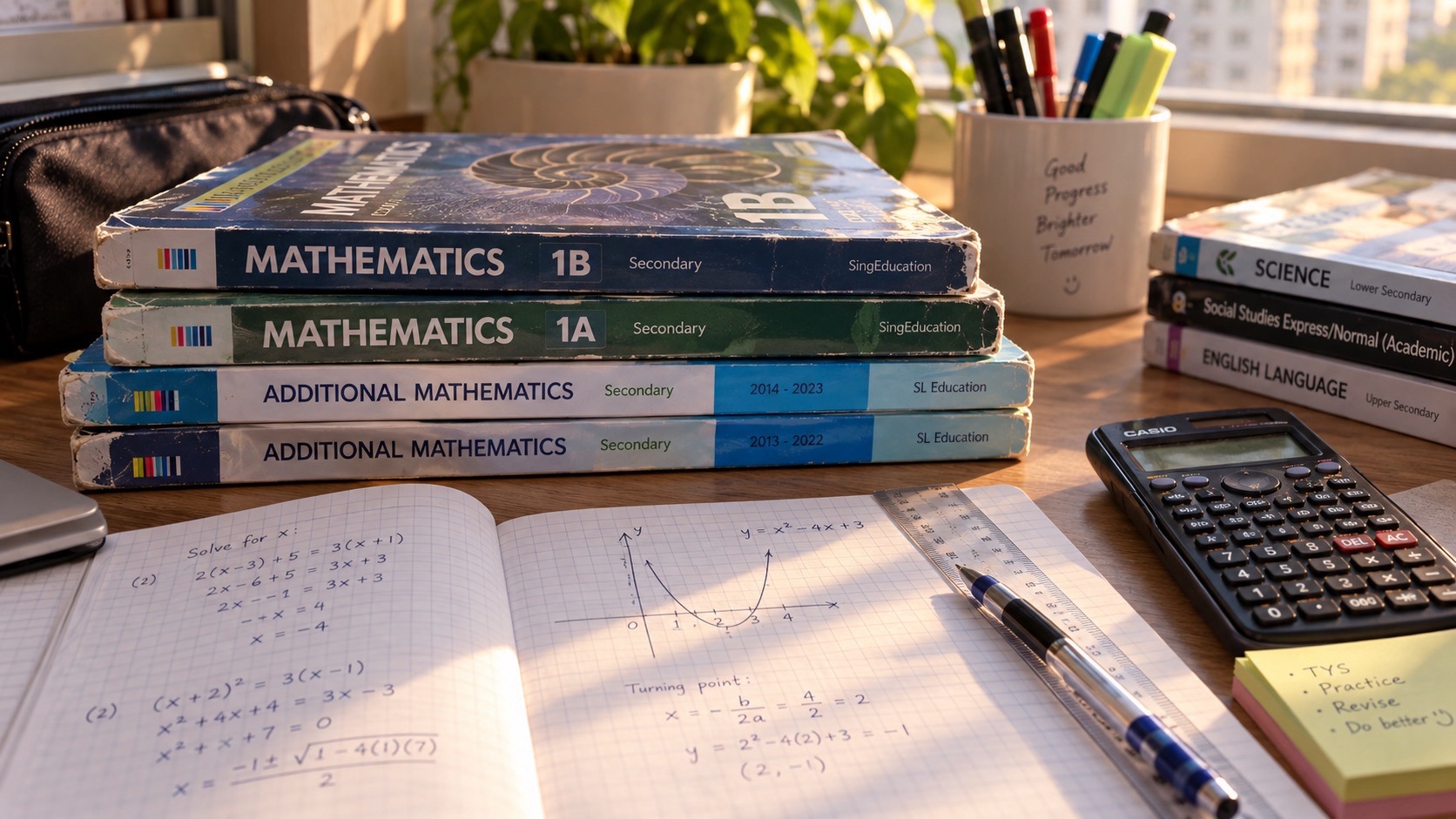
G3 Additional Mathematics K341 in the 2027 Singapore–Cambridge Secondary Education Certificate includes A5 Binomial expansions and A6 Exponential and logarithmic functions. The G2 Additional Mathematics K232 syllabus does not include those as corresponding compulsory A-Math topics. That is the immediate distinction parents in Punggol need when choosing practice materials or comparing subject levels.
The binomial theorem counts selections from repeated brackets. Exponential functions put a variable in the exponent. Logarithms are inverse questions: which exponent produces a known positive number? Students understand these ideas more reliably when they can explain the structure, apply a condition, check an answer and transfer the method to a new problem without hints.
This detailed guide uses the official 2027 syllabus, original mathematical examples, error diagnosis, parent questions and a small-group teaching sequence. It describes Singapore’s national curriculum; whether a particular Punggol school offers a combination is an individual school question, not a fact implied by the syllabus.
FAST FACTS: 2027 G3 A-Math is K341. A5 covers positive-integer binomial expansion; A6 covers exponential and logarithmic functions. G2 K232 has a different algebra list. Key learner habits: read operations, preserve domains, justify each law and verify an independent result.
Contents: go straight to a decision
- What the official K341 syllabus actually says
- Earlier number sense becomes symbolic structure
- Why the binomial theorem is a counting result
- Factorials and the general term
- Signs in a scaled binomial
- Find just the coefficient requested
- A power function is not an exponential function
- Increasing and decreasing exponential graphs
- Natural exponentials and the bridge to calculus
- A logarithm asks for a missing exponent
- Logarithms and their allowable real inputs
- The product law is not a sum law
- Quotients and powers preserve specific operations
- Change of base with a plausibility check
- Solving exponential equations intelligently
- Log equations can have forbidden polynomial roots
- Inverse functions have reflected graphs
- Exponential models are assumptions, not forecasts
- A Clementi-standard learning and parent review cycle
- 35 original worked checks
- Five diagnostic cases
- Parent FAQ
- Sources and onward routes
What the official K341 syllabus actually says
K341 includes positive-integer binomial expansion, factorial and combination notation, and the general term. Its published exclusion states that knowledge of the greatest term and properties of binomial coefficients is not required. The wording matters: not every visually similar university-level binomial-series question belongs on the SEC syllabus.
The named exponential and logarithmic content covers the graphs of a^x, e^x, log_a x and ln x; laws, equivalence, change of base, simple equations and models. K232 G2 Additional Mathematics has a different algebra list. It should not be described as a failed G3 course, nor should a school’s old textbook decide examination scope.
Parents should write down the subject code, examination year and student’s registered level before comparing tuition notes. If a worksheet mixes K232 foundations with K341 extensions, the teacher ought to explain why. A syllabus PDF is an authoritative content boundary, not a promise of school placement.
Earlier number sense becomes symbolic structure
Young learners first encounter powers through repeated multiplication: 2^4=2×2×2×2. In lower-secondary Mathematics, index laws formalise this: multiplying powers with the same base adds exponents. Adding those powers does not. The false equation x²+x³=x⁵ ignores the operation printed between the terms.
The actual sum x²+x³ factors as x²(1+x). At x=2, the sum is 12 while x⁵ is 32. A numerical counterexample explains the difference immediately. Students also need to understand that a negative exponent indicates a reciprocal, not a negative output.
Ask for comparisons among x²x³, x²+x³ and (x²)³. These produce x⁵, x²(1+x) and x⁶. The notation looks similar, but the governing operation differs. Reliable classification is more valuable than memorising many formulas in isolation.
Why the binomial theorem is a counting result
The cube (a+b)³ means multiplying three copies of (a+b). In each bracket one may select a or b. The collected expansion a³+3a²b+3ab²+b³ records the number of selections producing each power arrangement, so the coefficient three is a count rather than magic.
For the fifth power, the coefficient when b is selected twice is the number of ways to choose two positions among five. That is C(5,2)=10. The remaining three positions contribute a. This physical selection story gives meaning to the general term and provides a way to reconstruct it after forgetting notation.
A good first lesson expands a square and cube by ordinary multiplication, groups like terms and only then introduces combination notation. This sequence reduces formula dependence. Ask the learner to explain why the middle coefficient of (a+b)^4 is six before evaluating more difficult coefficients.
Factorials and the general term
The symbol n! multiplies the whole numbers from one through n, while 0! is defined as one. The combination C(n,r)=n!/[r!(n−r)!] counts the selections of r positions from n when order does not matter. It is used with n a nonnegative integer and valid r.
For (a+b)^n with positive integer n, a term selecting b exactly r times is C(n,r)a^(n−r)b^r. Its exponents add to n because each bracket contributes one selected factor. This sum-of-exponents check is useful when catching errors before lengthy arithmetic.
In (2+x)^5 the x³ coefficient is C(5,3)2²=40. A student who uses 2³ has forgotten that only two brackets supply the constant. The appropriate repair is to count selected brackets aloud, not merely rewrite the formula in larger handwriting.
Signs in a scaled binomial
The x² coefficient in (3−2x)^5 is C(5,2)3³(−2)²=1080. It is positive because two negative factors are selected. By contrast, selecting the negative variable term three times gives a negative sign. The combination count itself remains nonnegative.
Students sometimes memorise the row of Pascal coefficients but lose the sign or scale factor. Separate the calculation into how many selections, how many constant factors, and how many variable factors. Then decide the sign before multiplying large numbers.
Change one feature at a time during instruction: (1+x)^4, (1−x)^4, then (2−3x)^4. Require the learner to explain the role of the negative power. A delayed unseen coefficient test reveals whether this distinction has become independent.
Find just the coefficient requested
A question asking only for the x⁴ coefficient of (1+x)^7 can be answered as C(7,4)=35 without writing eight complete expansion terms. The general term is a tool for efficient selection, not a decorative formula.
The constant term of (5−2x)^6 is 5^6 because none of the brackets contributes x. The highest-degree term is (−2x)^6, so its coefficient is 64. These two extreme terms provide fast checks against a mistaken full expansion.
A student should still show which r was selected and how the two factors were powered. Writing an unexplained coefficient might conceal a guess. Essential working lets the teacher see whether the answer is the result of genuine counting.
A power function is not an exponential function
In y=x², the exponent is fixed and the base is the variable. In y=2^x, the base is fixed and the exponent changes. At x=3 their values are nine and eight; at x=0 they are zero and one. The distinction determines the graph and how the quantity varies.
For y=2^x, inputs −1,0,1,2 yield 1/2,1,2,4. The function is positive, meets the y-axis at one and approaches y=0 as x decreases without bound. It never touches the horizontal axis.
Let the child calculate two exact points before sketching. A curve through the origin is inconsistent with 2⁰=1. Deriving a graph from an input-output table creates meaning more reliably than drawing an unlabelled textbook curve from memory.
Increasing and decreasing exponential graphs
When a positive base a exceeds one, a^x increases as x increases. When 0<a<1 it decreases. Both remain positive for real inputs. The function y=(1/2)^x produces 1, 1/2 and 1/4 at x=0,1,2.
Equal changes in x multiply the output by a constant factor. This is the key distinction between exponential and ordinary linear change. A decreasing exponential is not a negative function; the output approaches zero without becoming negative.
Comparing two graphs on identical axes helps. Students should label intercepts and explain the direction from the base value. When the curve is moved or rescaled in an unfamiliar question, the meaning of the base continues to guide reasoning.
Natural exponentials and the bridge to calculus
The function e^x is an exponential with a fixed positive base. Its special calculus property is that its derivative is e^x. K341 includes exponential functions and the derivatives of e^x in its calculus strand, but graph understanding should precede mechanical differentiation.
For y=e^(3x), the chain rule gives derivative 3e^(3x). The additional three comes from differentiating the inner expression 3x. Forgetting it is a rule-selection error rather than a mystery about the constant e.
An appropriate lesson contrasts y=e^x, y=e^(3x) and y=3e^x. The last two look similar yet differentiate differently. Have the student identify inner and outer functions before writing a result.
A logarithm asks for a missing exponent
The statement 2⁵=32 has the equivalent form log₂32=5. That logarithm means ‘the exponent on base two that produces thirty-two’. It is not a product of the word log and the argument.
Solving log₃x=4 therefore gives x=3⁴=81. A child who divides four by three has not read the notation correctly. Translate exact powers to logarithms and back until this inverse relationship becomes secure.
This foundation matters before adding logarithm laws. A list of rules learned without understanding the inverse idea can generate plausible-looking working that no longer preserves the original equation’s meaning.
Logarithms and their allowable real inputs
For real log_a x, the argument must be positive and the base must be positive and different from one. Thus log₄(x−3) requires x>3. At three, the argument equals zero, and below three it is negative.
Domain checking is essential when an equation yields algebraic candidates that are invalid in the original logarithms. It is the same mathematical discipline as not dividing an equation by a variable without checking whether the divisor could be zero.
A helpful habit is to write the domain beside the original expression, then revisit it when checking candidates. This is more robust than waiting for a calculator error message after a long solution.
The product law is not a sum law
For positive u and v, log_a(uv)=log_a u+log_a v. The reason is the index relationship a^m a^n=a^(m+n). Multiplication inside the logarithm becomes addition of exponents.
The identity log(a+b)=log a+log b is generally false. In base ten, log10+log100=3 but log(10+100)=log110, not three. The law concerns a product of arguments, not their sum.
Ask the student to create a counterexample independently, then find an expression where the product rule really applies. Understanding both its domain and its failure conditions helps prevent a confident wrong first line.
Quotients and powers preserve specific operations
The logarithm quotient law log_a(u/v)=log_a u−log_a v requires positive arguments. The power law log_a(u^n)=n log_a u also assumes a positive argument in the real setting. Both come from familiar rules of exponents.
Examples with easy exact values make the mechanism visible. In base ten, log1000−log10=2, consistent with log100. And log₂(8³)=3log₂8=9. A student should be able to convert these answers back into powers.
Choosing a law is a reading task. If the inner expression is a sum, there is no corresponding general law that simply separates its terms. Ask students to name the operation before transforming a logarithm.
Change of base with a plausibility check
The exact identity log_a b=ln b/ln a is valid when b>0 and a>0 with a≠1. It permits calculation of unfamiliar bases using an appropriate scientific calculator and also shows that the choice of consistent logarithm base in the ratio does not change its value.
For log₂7, write ln7/ln2. Since 2²=4 and 2³=8, the answer must lie between two and three. Reversing the fraction would calculate log₇2 and yield an implausible number below one.
Teach the sequence estimate, transform exactly, calculate if asked, and interpret. This makes calculator work verifiable instead of a black-box procedure.
Solving exponential equations intelligently
For 4^x=8, convert to base two: 2^(2x)=2³, hence x=3/2. This method is efficient because both sides are straightforward powers of the same base.
For 3^x=7, no simple common integer power settles the equation. Taking natural logs gives x ln3=ln7, hence x=ln7/ln3. Its value must lie between one and two because 3¹=3 and 3²=9.
A good student can explain why the first problem is best solved by matching bases and why the second benefits from logarithms. Recognising method choice is one of the abilities that makes later mixed SEC questions less intimidating.
Log equations can have forbidden polynomial roots
Consider log₂x+log₂(x−2)=3. The original domain is x>2. Combining the logs gives log₂[x(x−2)]=3, so x²−2x=8 and (x−4)(x+2)=0.
The algebraic candidates are four and negative two. Only four lies in the original domain. Substitution confirms log₂4+log₂2=2+1=3; the negative candidate would require undefined real logarithms.
A tutor should treat a student reporting both roots as a domain misconception, not an inability to factorise. The repair must be practised on a different log equation without prompts.
Inverse functions have reflected graphs
Because y=2^x and y=log₂x are inverses on their natural domains, their graphs reflect in y=x. The point (0,1) on the exponential corresponds to (1,0) on the logarithm, and (1,2) corresponds to (2,1).
The exponential has positive outputs and a horizontal asymptote y=0. The logarithm accepts positive inputs and has vertical asymptote x=0. The domain-range exchange explains both features.
Students should be able to describe the reflected points and identify the asymptotes before drawing a smooth curve. A neat unlabelled graph does not establish that an inverse relationship is understood.
Exponential models are assumptions, not forecasts
A fictional quantity N(t)=100×2^(t/3) starts at one hundred and doubles every three time units. At t=6 it equals four hundred. When N=500, the model gives t=3log₂5.
The arithmetic is exact for this model, but it is not evidence that a real Punggol household budget, population or examination performance doubles in this way. Real use requires a justified model, units, a domain and awareness that conditions change.
Ask a student to state the starting value, meaning of t, doubling factor and assumptions before manipulating the formula. Mathematical modelling should make real-world reasoning clearer, not create unjustified certainty.
A Clementi-standard learning and parent review cycle
A first lesson should diagnose indices and notation, not launch immediately into difficult coefficients. Subsequent teaching can move through selecting terms, exact exponential tables, logarithmic inverse relationships, rules, domains, and mixed problems. A six-week sequence is a planning example, not a universal promise about how quickly a student will learn.
In a three-student discussion, one learner can justify a binomial coefficient, another can challenge a false logarithm law and a third can check an equation’s domain. That discussion is useful only if every learner then completes a new problem independently. Group size alone does not guarantee learning.
Parents should request three kinds of evidence: the student’s original wrong line, an explanation of why it was invalid, and a later fresh problem solved without help. A correct final answer copied from a model solution is not the same as independent mathematical competence.
35 original worked checks
These are original classroom teaching examples, not reproduced SEC past-paper questions. They include prerequisite index questions, K341 A5/A6 applications and brief syllabus-linked calculus extensions. Use the learner’s actual subject code to select appropriate practice.
1. Index multiplication
Question: Simplify 2³×2².
Correct reasoning: 2⁵=32.
What the teacher should notice: Both factors share the same base and are multiplied.
Independent check: Contrast with 2³+2².
2. Index addition trap
Question: Simplify x²+x³.
Correct reasoning: x²(1+x), not x⁵.
What the teacher should notice: The terms are added, not multiplied.
Independent check: Test x=2.
3. Power of a power
Question: Simplify (x²)³.
Correct reasoning: x⁶.
What the teacher should notice: Exponents multiply here.
Independent check: Expand the repeated powers.
4. Negative index
Question: Evaluate 3⁻².
Correct reasoning: 1/9.
What the teacher should notice: A negative index means reciprocal.
Independent check: Check by multiplying 3².
5. Combination value
Question: Find C(5,2).
Correct reasoning: 5!/(2!3!)=10.
What the teacher should notice: Five positions supply two selected variable terms.
Independent check: Explain the selection verbally.
6. Cubic expansion
Question: Expand (1+x)³.
Correct reasoning: 1+3x+3x²+x³.
What the teacher should notice: The middle terms come from three selections each.
Independent check: Multiply the brackets.
7. Coefficient with scale
Question: Find x² coefficient in (1+2x)^4.
Correct reasoning: C(4,2)2²=24.
What the teacher should notice: Both selected variable factors contribute a two.
Independent check: Reconstruct the general term.
8. Negative odd coefficient
Question: Find x³ coefficient in (1−3x)^5.
Correct reasoning: C(5,3)(−3)³=−270.
What the teacher should notice: Three negative factors give negative sign.
Independent check: Compare with an even power.
9. Mixed coefficient
Question: Find x² coefficient in (3−2x)^5.
Correct reasoning: C(5,2)3³(−2)²=1080.
What the teacher should notice: The constant is selected three times.
Independent check: Check exponent total five.
10. Highest power
Question: Find x⁵ coefficient in (2−3x)^5.
Correct reasoning: (−3)⁵=−243.
What the teacher should notice: No constant factor remains.
Independent check: State C(5,5).
11. Constant term
Question: Find constant in (5−2x)^6.
Correct reasoning: 5⁶=15625.
What the teacher should notice: Selecting any x would no longer be constant.
Independent check: Set x=0.
12. Seventh power
Question: Find x⁴ coefficient in (1+x)^7.
Correct reasoning: C(7,4)=35.
What the teacher should notice: Four of seven brackets supply x.
Independent check: Give the general term.
13. A scaled constant
Question: Find x⁴ coefficient in (x+2)^6.
Correct reasoning: C(6,4)2²=60.
What the teacher should notice: Two brackets supply the constant two.
Independent check: Check exponent sum.
14. A scaled x
Question: Find x³ coefficient in (1+2x)^6.
Correct reasoning: C(6,3)2³=160.
What the teacher should notice: Three variable factors each contribute two.
Independent check: Check sign.
15. Exponential values
Question: Find 2^x at x=−1,0,1,2.
Correct reasoning: 1/2,1,2,4.
What the teacher should notice: The exponential remains positive.
Independent check: Plot four points.
16. Exponential decay
Question: Find (1/2)^x at x=0,1,2.
Correct reasoning: 1,1/2,1/4.
What the teacher should notice: The output decreases but does not become negative.
Independent check: Identify the asymptote.
17. Power versus exponential
Question: Compare x² and 2^x at x=3.
Correct reasoning: Nine versus eight.
What the teacher should notice: The fixed exponent and fixed base are different structures.
Independent check: Compare at x=0.
18. Exact log
Question: Calculate log₂32.
Correct reasoning: Five.
What the teacher should notice: It is the missing exponent of two.
Independent check: Convert to 2⁵=32.
19. Solve a log
Question: Solve log₃x=4.
Correct reasoning: x=81.
What the teacher should notice: Reversing the exponential relation solves it.
Independent check: Substitute x.
20. Log domain
Question: Domain of log₄(x−3).
Correct reasoning: x>3.
What the teacher should notice: The argument must be positive.
Independent check: Test x=3.
21. Log product
Question: Evaluate log₂4+log₂8.
Correct reasoning: Five.
What the teacher should notice: The arguments multiply to thirty-two.
Independent check: Contrast with log₂12.
22. Log quotient
Question: Evaluate log1000−log10 in base ten.
Correct reasoning: Two.
What the teacher should notice: The arguments form a quotient of one hundred.
Independent check: Explain why log990 is wrong.
23. Log power
Question: Evaluate log₂(8³).
Correct reasoning: Nine.
What the teacher should notice: Three multiplies the logarithm of eight.
Independent check: Check 8³=2⁹.
24. False sum law
Question: Is log(10+100)=log10+log100?
Correct reasoning: No, the left is log110 and the right is three.
What the teacher should notice: The valid law is for a product.
Independent check: Create a counterexample.
25. Base change
Question: Express log₂7 using ln.
Correct reasoning: ln7/ln2.
What the teacher should notice: The order of the quotient matters.
Independent check: Bound between two and three.
26. Common base
Question: Solve 4^x=8.
Correct reasoning: x=3/2.
What the teacher should notice: Rewrite both sides as powers of two.
Independent check: Substitute.
27. Unmatched base
Question: Solve 3^x=7.
Correct reasoning: x=ln7/ln3.
What the teacher should notice: Taking logarithms isolates the exponent.
Independent check: Estimate between one and two.
28. A log equation
Question: Solve log₂(x−1)=3.
Correct reasoning: x=9.
What the teacher should notice: Require x>1.
Independent check: Verify log₂8=3.
29. Two logs
Question: Solve log₂x+log₂(x−2)=3.
Correct reasoning: x=4 only.
What the teacher should notice: The other algebraic root violates x>2.
Independent check: Check original equation.
30. Inverse points
Question: Find inverse pair points for 2^x and log₂x.
Correct reasoning: (0,1)↔(1,0), (1,2)↔(2,1).
What the teacher should notice: Inverse swaps coordinates.
Independent check: Sketch reflection in y=x.
31. Model value
Question: If N(t)=100×2^(t/3), find N(6).
Correct reasoning: 400.
What the teacher should notice: Two doubling intervals have elapsed.
Independent check: State units.
32. Model time
Question: Find t if N(t)=500.
Correct reasoning: t=3log₂5.
What the teacher should notice: Divide the initial hundred first.
Independent check: Check by substitution.
33. Chain-rule extension
Question: Differentiate e^(3x).
Correct reasoning: 3e^(3x).
What the teacher should notice: The inside derivative is three.
Independent check: Compare with 3e^x.
34. Log calculus extension
Question: Differentiate ln(2x+1).
Correct reasoning: 2/(2x+1), x>−1/2.
What the teacher should notice: The original logarithm sets the domain.
Independent check: Identify inner function.
35. Select the method
Question: Coefficient x³ in (1+x)^5 or solve 3^x=7?
Correct reasoning: Use C(5,3) for first, logarithms for second.
What the teacher should notice: Different structures require different methods.
Independent check: Explain selection before calculation.
Five diagnostic cases: first wrong line to repaired method
The binomial coefficient is right, but the sign is wrong
A learner writes C(5,3)=10 correctly for an odd negative x term but gives a positive final coefficient. The mathematical count was correct; the sign of the selected negative factor was lost. Require a verbal explanation of the power parity, then an independent new question with an even selected exponent.
A log law is used on an ordinary sum
The first wrong line is log(a+b)=log a+log b. A counterexample comparing 10+100 and 10×100 reveals the error. Repair the difference between addition and multiplication inside the argument, then interleave genuine product and sum examples so method choice cannot be automated by the worksheet heading.
A forbidden root survives a correct quadratic step
The learner correctly factors x²−2x−8 but reports x=−2 in a logarithmic equation requiring x>2. The repair is not more factorisation. It is attaching the original domain to the solution process and checking every candidate in the untouched equation on a later independent problem.
A calculator value contradicts easy powers
A child computes log₂7 below one after reversing the change-of-base quotient. Because 2²<7<2³, the answer must lie between two and three. The tutor should teach estimation before calculator entry, then ask for a new logarithm whose value can be bounded by two adjacent integer powers.
A G2 family receives an unlabelled G3 worksheet
Parents should ask whether the child is registered for K232 or K341 and why the particular extension is being taught. Optional enrichment may be suitable once foundations are stable, but the existence of K341 A5/A6 content does not turn it into a compulsory K232 requirement. Record the teaching purpose and the trade-off in study time.
Frequently asked parent questions
Does 2027 G2 K232 include these as named compulsory topics?
K232 does not list the corresponding G3 A5 and A6 algebra topics. Its own official syllabus remains the guide.
What does positive integer n mean?
The specified binomial expansion has a whole-number positive exponent, producing a finite number of grouped terms.
Is the greatest binomial term required?
K341 explicitly says knowledge of greatest term and coefficient properties is not required.
Why do combination coefficients appear?
They count how many selections of brackets produce each power pattern.
Are y=x² and y=2^x the same kind of graph?
No. The input is the base in the first and the exponent in the second.
Can a real log argument be negative?
No. The real logarithm argument must be positive and its base must be positive and not one.
Does log(a+b)=log a+log b?
No. The product law concerns multiplication of arguments, not their sum.
What is change of base for?
It represents a logarithm in a different consistent base, for instance log₂7=ln7/ln2.
What is an extraneous log equation root?
A candidate satisfying transformed algebra but invalid in an original logarithm’s domain.
Why is e^x in later calculus?
K341 includes its derivative, alongside the calculus of specified trigonometric and logarithmic functions.
Does G3 A-Math automatically guarantee an advanced course place?
No. School offers and later institutions impose their own current criteria.
What should independent improvement look like?
A corrected wrong line plus a new problem solved without prompts after a time gap.
How should three students work in one tutorial?
Peer comparison can support learning, provided the tutor checks each student’s individual understanding and written work.
Verified national syllabus and related Punggol guides
Fact-check date: 18 October 2026. The examination topic statements are based on official 2027 SEAB G3 K341 and G2 K232 syllabuses. The examples and family scenarios are original teaching illustrations; school offerings and individual progression are not assumed.
- SEAB K341 official SEC G3 Additional Mathematics syllabus (2027)
- SEAB K232 official SEC G2 Additional Mathematics syllabus (2027)
- SEAB 2027 G3 school candidates
- Punggol Primary to University A-Math overview
- Punggol A-Math algebra foundations
- Punggol K232 K341 subject and papers guide
- Immutable Clementi teaching standard
This article is a specialist chapter in Understanding the Additional Mathematics Education System of Punggol, connecting prerequisite Mathematics, SEC subject-level decisions and post-secondary planning.


