
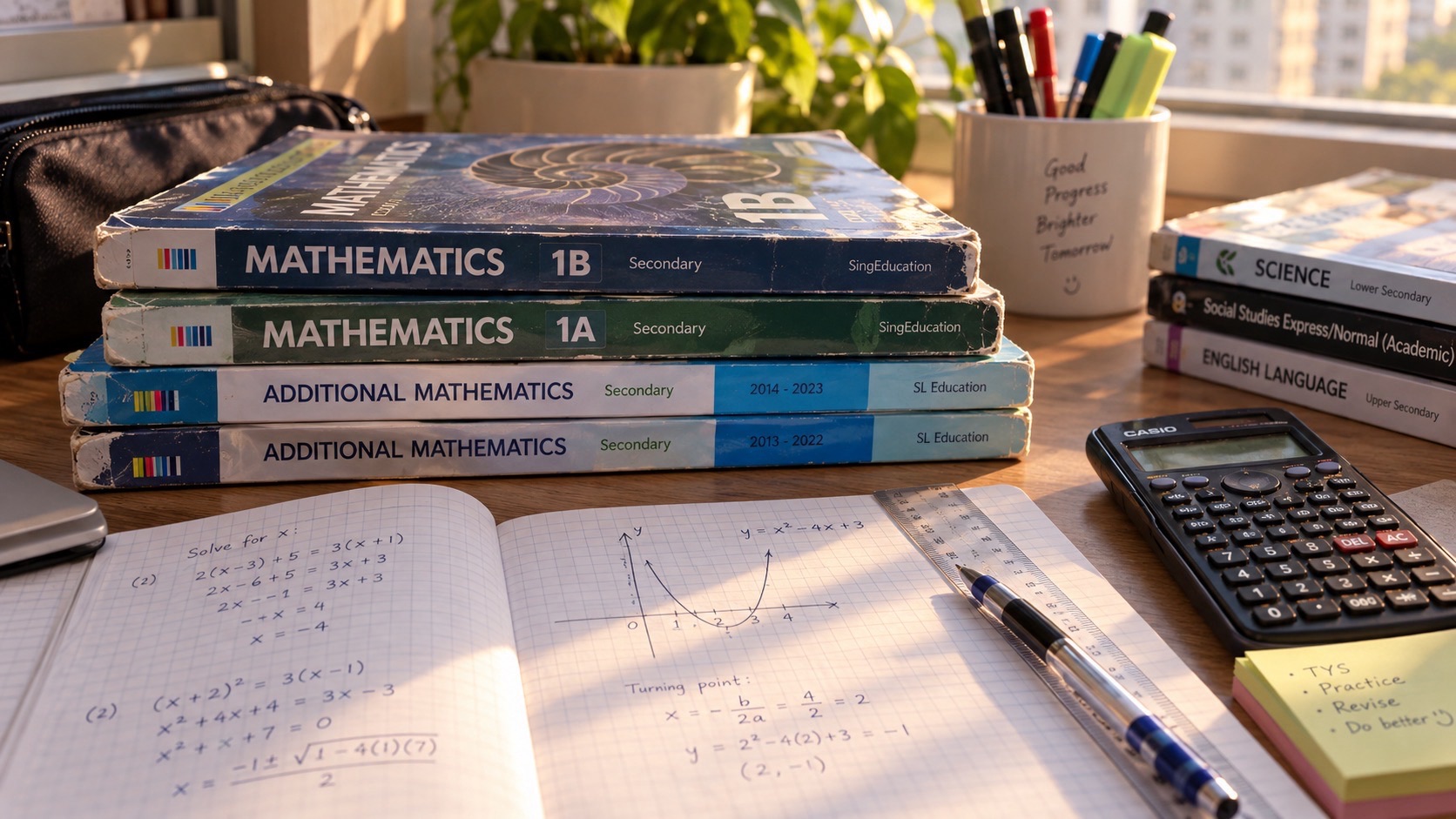
Tangents, normals and stationary points are included in both the 2027 SEC G2 Additional Mathematics K232 and G3 Additional Mathematics K341 calculus syllabuses. The derivative gives the gradient of a tangent; the normal is perpendicular to that tangent; and a stationary point has derivative zero. A stationary point is not automatically a maximum or minimum. These related facts solve different mathematical questions, and confusing their outputs is a recurring source of lost marks.
Find the next relevant Additional Mathematics guide
Start with the requested concept, then follow the linked SEC 2027 G2 K232/G3 K341 and post-secondary guides. The earlier roadmap explains the wider Punggol Primary-to-University journey.
- Primary–University Additional Mathematics roadmap
- 2027 G2/G3 12-week exam revision
- Connected Rates, Geometry and Units
- Integration, Signed Area and Curve–Line Regions
- SEC Additional Mathematics to JC H2 Mathematics 9758
- Definite Integrals: G2/G3 Area and G3 Motion
- Optimisation, Maxima, Minima and Constraints
For a curve y=f(x), at x=a a finite tangent gradient is f′(a), and the corresponding point is (a,f(a)). With a finite nonzero tangent slope m, the normal has slope −1/m. When the tangent is horizontal, its normal is vertical with equation x=a: the normal does not have a finite numerical gradient. A stationary point may be a maximum, minimum or stationary inflexion; classification takes more reasoning than setting f′(x)=0.
Consider y=x²−4x+1. Differentiating gives 2x−4; at x=2, the tangent gradient is zero and the point is (2,−3). The tangent is y=−3 and normal x=2. The quadratic’s positive leading coefficient and completed-square form (x−2)²−3 show a minimum, not a maximum.
This reader-first Punggol article uses the immutable Clementi first-principles quality floor: identify the first wrong mental move, explain the correct relationship, practise independently, and revisit it after a delay. It describes Singapore’s national curriculum, not a neighbourhood-specific syllabus. Individual subject availability and eligibility must be confirmed with the student’s school.
Source-led reading: the official curriculum
- Official SEAB 2027 G2 Additional Mathematics K232
- Official SEAB 2027 G3 Additional Mathematics K341
- Official SEAB 2027 H2 Mathematics 9758
- Immutable Clementi mathematical teaching benchmark
Direct navigation: method first
- A derivative answers a different question from a function value
- From two-point average gradient to an instantaneous tangent
- The 2027 K232 and K341 calculus requirements
- Use point-slope form to protect the tangent equation
- Perpendicular gradients and the normal line
- The horizontal tangent and vertical normal special case
- Derivative of a sum and polynomial
- Product, quotient and chain rules in tangent questions
- Stationary x-values and full stationary coordinates
- Maximum and minimum using second derivatives
- The second derivative can be inconclusive
- Increasing and decreasing intervals explain shape
- Tangency by discriminant and by differentiation
- Tangent point, line contact and the domain
- Quadratic stationary points without differentiation
- Optimization is a constrained decision, not just f′=0
- Interpret tangent gradients in units
- G3-only derivative types and curriculum fit
- What a strong response includes under exam conditions
- Six-week parent evidence plan
- 44 worked questions
- Eight diagnostic examples
- Parent FAQ
A derivative answers a different question from a function value
For a function y=f(x), the value f(a) is the vertical coordinate on the curve at x=a. Its derivative f′(a), if defined, gives the tangent gradient there. Those are two different quantities. The school problem may ask for only one, or may require both in order to construct a line.
Take f(x)=x²+1 at x=3. The value is ten and derivative is 2x, giving gradient six. The point is (3,10). When the function describes distance in metres and x represents seconds, f(a) has metre units while f′(a) has metres-per-second units. This distinction often reveals whether an apparently correct number answers the question.
From two-point average gradient to an instantaneous tangent
A secant line connects two distinct points on a curve and its slope is a difference quotient. For y=x² between x=2 and x=2+h, the quotient is ((2+h)²−4)/h=4+h for nonzero h. As h approaches zero it approaches four, which is the local tangent slope.
That limiting explanation makes the derivative understandable. A learner who can draw a secant and tangent and describe the difference has a conceptual foundation for differentiating unfamiliar functions. If the word tangent is merely associated with ‘use dy/dx’ without any geometric meaning, later rate problems can become formula-selection guesses.
The 2027 K232 and K341 calculus requirements
Both K232 G2 and K341 G3 Additional Mathematics list derivative as tangent gradient and rate of change, second derivatives, stationary points, product and quotient derivatives, chain rule, increasing and decreasing functions, and applications to tangents, normals and maxima or minima. Those shared ideas justify a common foundational lesson.
K341 additionally specifies derivatives of trigonometric, exponential and logarithmic functions. A K232 learner need not treat every K341 function-type extension as compulsory practice. Check the official examination year and registered subject code before assigning exercises. A local school determines its offered combination and teaching sequence; the published national syllabus does not guarantee placement.
Use point-slope form to protect the tangent equation
For a curve f at input a, the tangent equation is y−f(a)=f′(a)(x−a). The student should first compute the point and gradient separately. This makes it harder to replace a tangent equation by a bare numerical slope or by a line through the origin.
For y=x²+1 at x=3, the equation is y−10=6(x−3), or y=6x−8. Check both conditions: the line has slope six, and substituting x=3 gives y=10. A learner writing y=6x has preserved the gradient but ignored the required point. The repair is coordinate geometry, not differentiation.
Perpendicular gradients and the normal line
The normal is perpendicular to the tangent at the contact point. For finite nonzero tangent gradient m, the normal gradient is −1/m. It must pass through the same point (a,f(a)). A normal with the right gradient but wrong intercept is not the requested line.
Let f(x)=(x+1)² at x=0. The contact point is (0,1), tangent slope two and normal slope negative one-half. Therefore the normal is y=−x/2+1. The slopes multiply to negative one. A common wrong answer y=−2x+1 merely flips the tangent’s sign; it is not the negative reciprocal.
The horizontal tangent and vertical normal special case
When f′(a)=0, the tangent is horizontal at a smooth stationary point. Its equation is y=f(a). The perpendicular normal is vertical x=a and has no finite gradient. The expression −1/0 is not a number to be evaluated.
For f=x²−4x+1, x=2 gives f′=0 and f(2)=−3. The tangent is y=−3 and the normal x=2. Ask the student to sketch both lines and name their orientations before trying a formula. The exception becomes obvious geometrically rather than a rule memorised for special exams.
Derivative of a sum and polynomial
For a polynomial, differentiate term by term: d(x^n)/dx=nx^(n−1) for the applicable exponent and differentiability conditions. Constants differentiate to zero. For f(x)=3x⁴−5x²+7, f′(x)=12x³−10x, not 12x³−10x+7.
A student’s first error may be an exponent change, a negative coefficient or treating a constant as variable. Those weaknesses require different corrections. Use expansion or a numerical difference quotient to check plausibility. If a function contains a rational power, first confirm where the real function and its derivative exist.
Product, quotient and chain rules in tangent questions
The product rule differentiates u(x)v(x) as u′v+uv′. The quotient rule differentiates u/v as (u′v−uv′)/v² where v is nonzero. The chain rule adds the derivative of the inside of a composite function. These are method-choice skills: the expression’s structure determines the technique.
For f(x)=x²(x+1), expanding to x³+x² yields f′=3x²+2x, agreeing with the product rule. For f(x)=(3x+2)^4, f′=12(3x+2)^3. For f(x)=(x²+1)/x with x≠0, rewriting x+1/x gives derivative 1−1/x². Comparing methods is a useful independent audit.
Stationary x-values and full stationary coordinates
A stationary point requires f′(a)=0 and the derivative must exist. The equation f′=0 supplies candidate x-values; substituting into the original function supplies their y-coordinates. A point is an ordered pair, so giving only x when asked for coordinates leaves a task unfinished.
For f(x)=x³−3x, differentiate to 3x²−3 and set it to zero. The stationary inputs are negative one and one. Their corresponding outputs are two and negative two, giving points (−1,2) and (1,−2). No classification follows solely from those coordinates.
Maximum and minimum using second derivatives
When f′(a)=0 and f″(a)>0, the point is a local minimum; when f″(a)<0, it is a local maximum. This is a locally applicable classification test, not a replacement for domain checks, endpoints or the question’s actual wording.
For f=x³−3x, f″=6x. At negative one the second derivative is negative, so (−1,2) is a local maximum; at one it is positive, so (1,−2) is a local minimum. A student should write the test and conclusion together rather than simply marking a plus or minus in the margin.
The second derivative can be inconclusive
When f′(a)=0 but f″(a)=0, the second derivative test does not decide the nature of the stationary point. It is incorrect to label every such point an inflexion. A separate sign or function-shape argument is needed.
For f=x³ at zero, f′=3x² stays nonnegative on both sides and the concavity changes, giving a stationary inflexion. For f=x⁴ at zero, f′=4x³ changes from negative to positive and f(x)≥0, giving a minimum. These counterexamples prevent a fragile one-line rule from becoming automatic.
Increasing and decreasing intervals explain shape
A positive first derivative indicates increasing function values as x increases locally; a negative derivative indicates decreasing values. For f=x²−4x+1, f′=2x−4 is negative before x=2 and positive afterwards. This proves the graph decreases toward x=2 and increases after it.
A derivative sign chart can classify a stationary point without relying only on f″. It is also useful when the second derivative test is inconclusive. Ask students to justify their interval statements with a factor or test value, not by drawing arrows based solely on how an unscaled sketch looks.
Tangency by discriminant and by differentiation
A line tangent to a parabola is sometimes found by equating its equation with the curve and imposing a repeated real solution. The discriminant-zero route connects quadratic algebra to geometry. Differentiating the parabola and matching the line gradient often gives a second route.
Set y=x²−4 equal to y=2x+b. The quadratic x²−2x−(4+b)=0 has discriminant 20+4b, so tangency requires b=−5. Differentiation gives parabola slope 2x; matching the line slope two gives x=1 and y=−3, which also produces b=−5. The two approaches agree.
Tangent point, line contact and the domain
A line touching a quadratic at a repeated intersection root has a specific contact point, not merely a parameter. After solving the condition b=−5 in the previous example, substitute the repeated x=1 into either original equation to obtain (1,−3).
If a curve is defined only for x≥0 or excludes a denominator zero, a proposed tangent must be checked at an allowed differentiable point. A formally differentiated expression at an excluded input is not automatically meaningful. Students should read the curve’s domain before reporting a contact point.
Quadratic stationary points without differentiation
Completing the square offers a separate route for quadratic extrema. For −x²+6x−5, rewrite as −(x−3)²+4, showing a maximum value four at x=3. Differentiation gives f′=−2x+6, zero at three, and f″=−2 confirms the maximum.
Two consistent mathematical representations give confidence in the result. The student should explain why a negative squared term makes an upper bound and why a positive squared term makes a lower bound. This is more useful than learning two formulas that appear unrelated.
Optimization is a constrained decision, not just f′=0
Consider a fictional rectangular area model A=x(10−x)=10x−x² on 0≤x≤10. Its derivative 10−2x vanishes at five and second derivative is negative, giving maximum 25 square units. The endpoints have area zero.
If an additional constraint restricts x to 1≤x≤4, the stationary input five is not permitted. On this smaller interval, the maximum occurs at x=4 with area 24. The original unconstrained calculation remains correct mathematically but is not the answer to the revised decision problem.
Interpret tangent gradients in units
Suppose a hypothetical position s(t)=t²+2t metres, where t is measured in seconds. Its derivative v(t)=2t+2 metres per second. At t=2, position equals eight metres while velocity equals six metres per second. Reporting eight as the instantaneous speed is a meaning error.
Writing units beside each value reveals the distinction. A tangent gradient for a position-time graph is measured in distance per time; a rate of area change is area per time. A useful tutor asks which quantity the derivative represents before evaluating it.
G3-only derivative types and curriculum fit
K341 names trigonometric, exponential and logarithmic derivatives. For y=e^x at x=0, the point is (0,1) and tangent gradient one, giving tangent y=x+1 and normal y=−x+1. These are valid G3 extension examples but are not the same prescribed function types as the narrower K232 list.
Student interest in advanced problems is welcome when foundations are secure. Parents should check that an extension’s purpose is explicit and that the child has not been diverted from gaps in quadratic or polynomial fundamentals. The existence of an advanced example is not evidence that every learner should practise it under a timed mock.
What a strong response includes under exam conditions
A complete tangent response identifies the point, derivative, gradient, line equation and any required interpretation. A complete stationary-point response finds all candidate inputs, evaluates coordinates, classifies the nature and writes a conclusion matched to the command.
SEAB says omission of essential working loses marks. The goal is not maximum length but verifiable reasoning. A pupil can use a calculator for a numerical check while still supplying the algebra that establishes a mathematical claim. Show the right relationship, not just a remembered final number.
Six-week parent evidence plan
Week one checks linear gradients and derivative meanings. Week two introduces tangent equations with point verification. Week three teaches normal gradients and the vertical-line case. Week four finds stationary coordinates and classifies maxima, minima and inflexions. Week five combines discriminant tangency with optimization. Week six interleaves topics without announced chapter labels.
For each error, keep the original first wrong line, the mathematical repair and a fresh independent task after several days. A carefully facilitated three-student lesson can compare alternative solutions, but every learner needs individual evidence. The schedule is an example, not a grade guarantee or an assertion that every Punggol centre uses this format.
44 original worked problems and independent checks
These exercises are original teaching diagnostics, not national past-paper reproductions. The G3 named function-type extensions are labelled. Each result must be matched to the specific task and checked in the original function.
1. Straight-line gradient
Question: Points (1,3) and (4,9).
Correct mathematics: Gradient (9−3)/(4−1)=2.
Reason, trap and independent verification: Reversing both differences preserves sign, reversing only one does not.
2. A curve value
Question: f=x²+1, x=3.
Correct mathematics: f(3)=10.
Reason, trap and independent verification: This is a y-coordinate, not the tangent gradient.
3. Tangent gradient
Question: Same curve at x=3.
Correct mathematics: f′=2x, so slope six.
Reason, trap and independent verification: Report a number rather than a line.
4. Tangent equation
Question: Same point.
Correct mathematics: y−10=6(x−3), so y=6x−8.
Reason, trap and independent verification: Check the line contains (3,10).
5. Normal gradient
Question: Tangent slope two.
Correct mathematics: Normal slope −1/2.
Reason, trap and independent verification: Product of gradients −1.
6. Normal line
Question: f=(x+1)² at x=0.
Correct mathematics: Point (0,1), normal y=−x/2+1.
Reason, trap and independent verification: Verify tangent slope two.
7. Horizontal tangent
Question: f=x²−4x+1 at x=2.
Correct mathematics: y=−3.
Reason, trap and independent verification: f′=0 and f(2)=−3.
8. Vertical normal
Question: Same function and point.
Correct mathematics: x=2.
Reason, trap and independent verification: Do not assign a finite slope.
9. Polynomial derivative
Question: f=3x⁴−5x²+7.
Correct mathematics: f′=12x³−10x.
Reason, trap and independent verification: Constant seven has zero derivative.
10. Product derivative
Question: f=x²(x+1).
Correct mathematics: f′=3x²+2x.
Reason, trap and independent verification: Expand or use product rule; compare results.
11. Composite derivative
Question: f=(3x+2)^4.
Correct mathematics: f′=12(3x+2)^3.
Reason, trap and independent verification: Chain rule adds the inner derivative three.
12. Quotient derivative
Question: f=(x²+1)/x.
Correct mathematics: f′=1−1/x² for x≠0.
Reason, trap and independent verification: Simplify as x+1/x first.
13. Cubic stationary inputs
Question: f=x³−3x.
Correct mathematics: f′=3(x²−1)=0 gives x=±1.
Reason, trap and independent verification: All stationary x-values must be found.
14. Cubic stationary coordinates
Question: Same f.
Correct mathematics: (−1,2) and (1,−2).
Reason, trap and independent verification: Substitute into original function.
15. Cubic max
Question: Same f at x=−1.
Correct mathematics: f″(−1)=−6<0, local max (−1,2).
Reason, trap and independent verification: Report nature and point.
16. Cubic min
Question: Same f at x=1.
Correct mathematics: f″(1)=6>0, local min (1,−2).
Reason, trap and independent verification: Compare derivative sign.
17. Quadratic minimum
Question: f=x²−4x+1.
Correct mathematics: (2,−3), min.
Reason, trap and independent verification: Complete square or f′=0, f″=2.
18. Quadratic maximum
Question: f=−x²+6x−5.
Correct mathematics: (3,4), max.
Reason, trap and independent verification: Negative second derivative confirms.
19. Inflexion example
Question: f=x³ at x=0.
Correct mathematics: Stationary inflexion at origin.
Reason, trap and independent verification: f′ positive on both sides; concavity changes.
20. Second derivative inconclusive
Question: f=x⁴ at x=0.
Correct mathematics: Minimum, not inferred from f″.
Reason, trap and independent verification: Use x⁴≥0 or f′ sign.
21. Increasing region
Question: f=x²−4x+1.
Correct mathematics: x>2.
Reason, trap and independent verification: Because f′=2x−4>0.
22. Decreasing region
Question: Same function.
Correct mathematics: x<2.
Reason, trap and independent verification: Derivative negative.
23. Tangency parameter
Question: y=x²−4 and line y=2x+b.
Correct mathematics: b=−5.
Reason, trap and independent verification: D=20+4b=0 or match derivative two.
24. Contact point
Question: Same tangency.
Correct mathematics: (1,−3).
Reason, trap and independent verification: Repeated root x=1, substitute.
25. A fictional optimization
Question: A=x(10−x), 0≤x≤10.
Correct mathematics: Maximum 25 at x=5.
Reason, trap and independent verification: Derivative zero and negative second derivative.
26. Restricted optimization
Question: Same A, 1≤x≤4.
Correct mathematics: Maximum 24 at x=4.
Reason, trap and independent verification: Unrestricted vertex excluded.
27. Position function
Question: s=t²+2t at t=2.
Correct mathematics: s=8 metres.
Reason, trap and independent verification: Function value.
28. Velocity function
Question: Same s at t=2.
Correct mathematics: s′=6 metres/second.
Reason, trap and independent verification: Derivative as rate.
29. Tangent at (0,1)
Question: f=(x+1)² at x=0.
Correct mathematics: y=2x+1.
Reason, trap and independent verification: Check point and slope.
30. Normal at (0,1)
Question: Same f.
Correct mathematics: y=−x/2+1.
Reason, trap and independent verification: Perpendicular slopes.
31. Square root tangent
Question: f=√x at x=1.
Correct mathematics: Slope 1/2.
Reason, trap and independent verification: Derivative applies for x>0.
32. Square root boundary
Question: f=√x at x=0.
Correct mathematics: No finite usual derivative there.
Reason, trap and independent verification: Function value exists; derivative does not.
33. Line evaluation
Question: Does y=6x−8 go through (3,10)?
Correct mathematics: Yes, 18−8=10.
Reason, trap and independent verification: Contact point check.
34. G3 exponential tangent
Question: y=e^x at x=0.
Correct mathematics: y=x+1.
Reason, trap and independent verification: Gradient one, point (0,1).
35. G3 exponential normal
Question: Same f.
Correct mathematics: y=−x+1.
Reason, trap and independent verification: Normal slope −1.
36. G3 sine tangent
Question: y=sin x at x=0.
Correct mathematics: y=x.
Reason, trap and independent verification: Derivative cos0=1, point (0,0); radians.
37. A stationary cosine point G3
Question: y=cos x at x=0.
Correct mathematics: Horizontal tangent y=1.
Reason, trap and independent verification: Derivative −sin0=0.
38. Polynomial stationary count
Question: f=x³+3x.
Correct mathematics: No stationary point.
Reason, trap and independent verification: f′=3x²+3>0.
39. First-derivative sign test
Question: f=x⁴ near zero.
Correct mathematics: decreasing then increasing.
Reason, trap and independent verification: f′=4x³ switches negative to positive.
40. An efficient choice
Question: Given quadratic vertex requested.
Correct mathematics: Complete square may be shortest.
Reason, trap and independent verification: Differentiation also valid when explained.
41. Unit comparison
Question: For position versus velocity.
Correct mathematics: metres versus metres/second.
Reason, trap and independent verification: A correct number with wrong unit answers the wrong quantity.
42. Point versus slope
Question: At x=3 f=x²+1.
Correct mathematics: (3,10) and gradient 6.
Reason, trap and independent verification: Never substitute gradient as y-value.
43. Tangency via derivative
Question: Line y=2x+b tangent to x²−4.
Correct mathematics: x=1, b=−5.
Reason, trap and independent verification: Set derivative 2x=2, then use point.
44. One more quadratic
Question: f=2x²−8x+3.
Correct mathematics: minimum at x=2, y=−5.
Reason, trap and independent verification: f′=4x−8; f″=4>0.
Eight first-wrong-line diagnostic cases
Right gradient, wrong line
A student calculates f′(3)=6 for f=x²+1, then writes y=6x instead of the tangent through (3,10). The mistake is failing to use the known contact point. Show point-slope form and ask for substitution into the proposed line.
A later variation should use a different x-value and a shifted function; the learner must form the full line without a tutor naming the missing step.
Negative, but not reciprocal
A normal to a tangent gradient two is reported as gradient −2. Perpendicular finite slopes must multiply to −1, so the correct normal slope is −1/2. Draw the two lines and compare the slopes.
Give the pupil a tangent slope of −3 and ask for the normal slope +1/3 and a corresponding line equation through a point.
An undefined normal gradient is treated as a failure
At a horizontal tangent a student tries to evaluate −1/0. This is not a finite number, but it does not mean a normal line cannot exist. The perpendicular normal is vertical, x=a.
Rotate a simple cross showing one horizontal and one vertical line. Then ask for the normal equation at a new quadratic vertex.
f″=0 mistaken for inflexion proof
At x=0 for f=x⁴, the learner observes f′=0 and f″=0 and writes ‘stationary inflexion’. Since x⁴≥0 and f′ changes negative to positive, the origin is a minimum. The second derivative was inconclusive.
Contrast f=x³, which has a stationary inflexion. Require a first-derivative sign argument for a fresh example.
Stationary x without y
A student solves f′=0 correctly for x=−1 and x=1 in f=x³−3x but stops. When the question asks for stationary points, their full coordinates are (−1,2) and (1,−2).
Underline the word points in a new question and require substitution into f to find both y-values before classification.
Invalid optimum outside a domain
The unconstrained maximum of x(10−x) is at x=5, but a question permits only 1≤x≤4. The learner reports five anyway. The missing skill is reading constraints; differentiation was correct.
Ask the pupil to compare all valid stationary points and interval endpoints. A second restricted-domain example tests transfer.
Gradient mistaken for value
At x=2 for s=t²+2t, a student calls s(2)=8 the instantaneous velocity. The correct velocity is s′(2)=6. Units distinguish metres from metres per second.
Set a new cubic position model and ask for position and velocity separately, with units and one sentence of interpretation.
G2 paper assigned G3-only functions
A group worksheet contains logarithmic derivative tasks for every learner even when some are registered for K232. The official K341 syllabus names these function types; K232 has its own defined calculus list.
Separate compulsory K232 practice from explicitly labelled extension. Ask each student to explain a task at the subject level they actually study.
Frequently asked Punggol parent questions
Do both K232 and K341 include tangents and normals?
Yes. Both 2027 SEC Additional Mathematics syllabuses list the derivative and applications to tangent and normal lines.
What is the normal gradient?
Negative reciprocal of a finite, nonzero tangent gradient. A horizontal tangent has a vertical normal.
Is every stationary point a turning point?
No. A stationary point of inflexion may have derivative zero without a maximum or minimum.
What does f″(a)=0 tell us?
The second-derivative test is inconclusive; use a valid first-derivative, sign or function analysis.
Is a point the same as an x-value?
No. A coordinate point requires both input and output values.
Does a derivative describe position?
It describes how the function changes per unit input; the function value itself describes position in a position-time model.
Can calculus be taught using exact graph intuition?
Yes. Secant gradients and tangent sketches help explain why the rule works.
Must K232 students study exponential derivatives?
K341 names those function types explicitly; use the K232 list for required G2 content.
Should a pupil show working on the SEC paper?
Yes. The official syllabuses state that omission of essential working results in loss of marks.
Does a tutoring group guarantee understanding?
No. Each learner must be observed and later solve a fresh problem independently.
When should parents review progress?
After a targeted sequence, compare baseline errors with independent delayed transfer rather than counting worksheets.
What is the first useful home check?
Ask for point, gradient, tangent, normal and classification on one appropriate quadratic.
Official-source and attribution note: mathematical syllabus statements are based on the 2027 SEAB K232 and K341 PDFs linked at the beginning of the article. Every worked example is an educational construction and is not presented as an exam paper. This chapter supports the Punggol Additional Mathematics Primary-to-University roadmap.
Eight advanced tangent and turning-point diagnostic case studies
A curve point is used twice, but the student inserts two different x-values
A learner differentiates y=2x²−8x+3 and finds a tangent slope at x=1, but uses the function value at x=2 when constructing the line. Both individual calculations may be correct yet the final line cannot be tangent at the requested point because they refer to different inputs. At x=1, the point is (1,−3) and the tangent gradient is −4, so the tangent is y+3=−4(x−1), or y=−4x+1.
Ask the student to place a single chosen a at the top of the page and compute both f(a) and f′(a) from that same input. On a fresh example, insist that the final line passes through the original contact point.
A stationary point is found by solving f′, but the student forgets the allowable domain
For a restricted model f(x)=x²−6x+8 defined only on 0≤x≤2, derivative zero would occur at x=3, outside the allowed interval. The unrestricted parabola’s vertex is real, but it is not a stationary point within the interior of the stated model’s domain. For optimisation over [0,2], compare the endpoint values f(0)=8 and f(2)=0.
This is a conceptual distinction between a function’s algebraic formula and the actual model being studied. The learner should state the domain before applying a turning-point or optimisation rule.
The derivative sign is positive on both sides of a stationary input
For f(x)=x³, derivative f′=3x² equals zero at x=0 and is positive at neighbouring nonzero points on both sides. Calling the origin a local minimum merely because derivative zero is invalid: the curve continues increasing through the point. Its concavity changes, giving a stationary inflexion.
Contrast with f(x)=x⁴, which has negative derivative to the left and positive to the right and therefore a genuine minimum. Reconstructing these sign charts without hints is the independent learning check.
A slope of zero is incorrectly described as ‘no tangent’
For f(x)=x² at x=0, the derivative is zero. The tangent is the horizontal line y=0, not a nonexistent line. A derivative equal to zero tells us that the tangent has no vertical change per horizontal unit locally; it does not invalidate tangency. The corresponding normal is x=0, a vertical line.
A simple sketch and point-slope statement repair the misconception. The learner should describe both line orientations before calculating an equation in a new quadratic problem.
A point where a function exists but has no finite usual derivative
The real function f(x)=√x is defined at x=0, where f(0)=0, but its right-hand secant slopes from zero to h>0 equal √h/h=1/√h and grow without bound as h approaches zero. The usual finite derivative does not exist at that endpoint. A student who assumes every plotted point has a finite tangent slope has overlooked differentiability.
Ask the learner to compare x=0 with x=1, where the derivative is 1/2. The educational focus is distinguishing function domain from derivative domain.
A tangency discriminant is valid but the contact coordinate is omitted
A pupil correctly obtains b=−5 for the line y=2x+b tangent to y=x²−4, then stops even though the task asks for the point of contact. Equating curves at b=−5 gives (x−1)²=0, so x=1 and y=−3. A discriminant condition supplied the parameter, not the complete coordinate pair.
Explain what each mathematical step was asked to deliver. A fresh line-curve task can require parameter, repeated root and coordinate separately so the learner practices meeting the exact command.
A normal to a vertical tangent is treated as requiring −1/∞
At a point where a smooth curve has a vertical tangent, its perpendicular normal is horizontal. At such a point the standard finite derivative may not exist, so blindly computing −1/f′(a) is inappropriate. The geometry may still allow a tangent/normal description when the problem supplies the appropriate information.
This is an enrichment illustration of geometric meaning, not a claim that non-differentiable endpoint problems are compulsory in K232 or K341. Draw the orientations first and avoid inventing a finite tangent gradient.
An answer uses the right derivative but claims a global maximum without checking the interval
The second derivative test gives a local maximum or minimum under its conditions. A problem asking for the greatest value over a specified closed interval must also compare valid stationary candidates with the endpoints. For f(x)=−x²+4x on 0≤x≤1, the unrestricted vertex lies at two, outside the interval, and the maximum on [0,1] is f(1)=3.
The correct strategy combines calculus and interpretation: identify all permitted candidates, evaluate the function and state the greatest value for the actual domain. This is a strong transfer check after a lesson on stationary points.


