
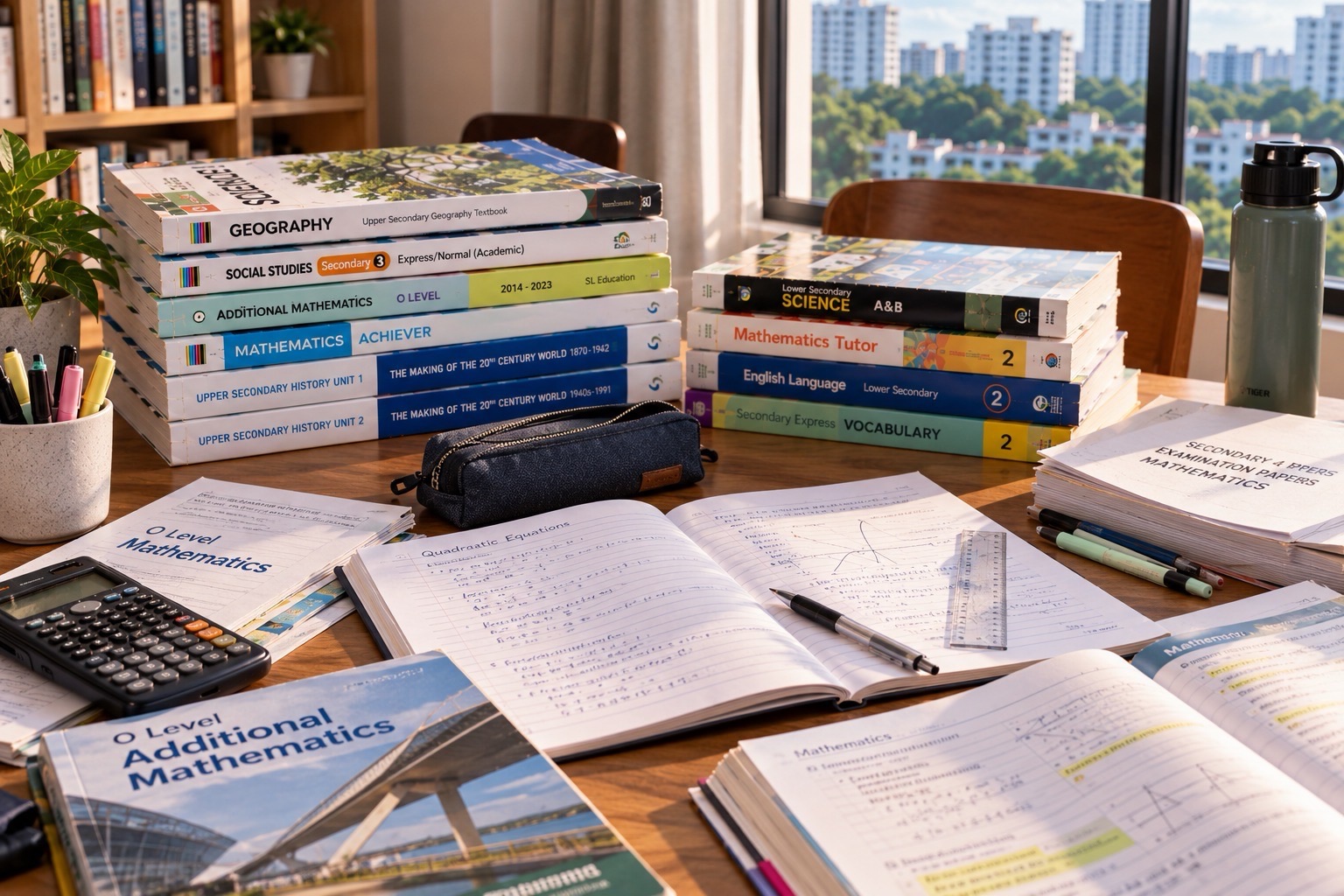
Optimisation in Additional Mathematics means finding the greatest or least permitted value of a quantity under clearly stated conditions. The arithmetic alone does not finish the problem: a student must define the variable, build the correct function, identify its permitted domain, locate candidate extremes and check whether those candidates really solve the question. This skill connects algebra, graph reasoning and calculus.
Both 2027 Singapore–Cambridge Secondary Education Certificate (SEC) G2 Additional Mathematics K232 and G3 Additional Mathematics K341 cover quadratic maximum and minimum values using completing the square and calculus applications to maxima and minima. Punggol students use the national syllabuses; any particular school’s subject combinations, pacing or eligibility remain separate decisions.
This guide answers a parent’s immediate questions before detailed explanation, then develops original worked examples, clear constraints, wrong-line diagnoses, a six-week teaching cycle and authoritative links. The Clementi benchmark is preserved: meaning first, method second, speed later, and independently checked learning rather than a promise of examination grades.
FAST FACTS: Optimisation = objective + variable + constraints + valid candidates + verification. Quadratic maxima/minima can use completed squares; calculus uses stationary points and derivative tests. Always compare boundaries of a restricted domain. Both 2027 K232 G2 and K341 G3 list maxima/minima applications. All physical examples here are hypothetical.
Choose the next relevant A-Math explanation
Use the official K232 or K341 topic that matches the student. These linked Punggol guides cover different decisions: gradient, rate of change, signed area, integration and constrained optimisation.
Find the right optimisation decision
- What optimisation means: a decision, not just a derivative
- What K232 and K341 actually require
- Lower-secondary algebra is the prerequisite
- The fastest quadratic route: complete the square
- A parabola has a vertex but the model has a domain
- Differentiation locates stationary candidates
- The second derivative is a useful but limited test
- First derivative signs tell the direction of change
- Local and absolute extremes are different
- An optimum outside the permitted interval must be rejected
- Rectangles with a fixed perimeter
- A three-sided fence has a different constraint
- A cut-corner box as a richer model
- A quadratic objective can describe a cost score
- Not every objective has an interior stationary point
- Cubic optimisation requires careful classification
- A context can turn a mathematical minimum into a choice
- Rounding an optimum can break a practical constraint
- Rates of change and optimisation are connected but not identical
- The role of dimensional checks
- A six-week Clementi-style optimisation learning sequence
- 54 original worked examples
- Parent FAQ
- Official primary sources
What optimisation means: a decision, not just a derivative
An optimum is the best allowable value according to a stated objective. The objective could be maximum area, minimum cost, greatest model height or least time. Real problems also include constraints: lengths cannot be negative, budgets have upper limits, and a model may apply only over a specified time interval.
The simplest distinction is between a mathematical extreme over all real numbers and a feasible extreme over a smaller set. A quadratic can attain its vertex at x=5 while a design problem only allows 1≤x≤4. Reporting the unrestricted vertex would not answer that design decision.
Before differentiation, ask three questions: what is being optimised, what may vary and what values are allowed? The answers determine which equation should be formed and whether a stationary point, boundary or both must be checked.
What K232 and K341 actually require
Both 2027 official SEAB Additional Mathematics syllabuses list maximum/minimum values of a quadratic using completing the square in algebra A1. Both also include stationary turning points, the second-derivative test, and calculus maxima/minima applications under C1. These are named curriculum outcomes, not invented requirements specific to Punggol.
The G3 K341 calculus syllabus additionally names derivatives of trigonometric, exponential and logarithmic functions, together with other applications. A G2 K232 student should prioritise the function forms and applications in K232. A more advanced-looking worksheet is not evidence that the topic is compulsory at the student’s registered subject level.
Schools may introduce modelling and differentiation in their own sequences. The official syllabus sets the national scope; the school teaches the particular cohort. An external tutor should map each intervention to the student’s code, not claim that all Additional Mathematics students must follow identical content.
Lower-secondary algebra is the prerequisite
Optimisation becomes fragile if the student cannot expand, factorise, substitute or interpret an inequality. The simple function A(x)=x(10−x) requires understanding both a product of lengths and a quadratic. Expanding gives 10x−x², which can then be differentiated or rewritten in completed-square form.
Negative signs create recurring errors: −(x−5)² is not the same as (x−5)². The first opens downward and may have a maximum, while the second opens upward and may have a minimum. Evaluating one test input detects an incorrect expansion.
Before new calculus, have the learner complete a factorisation, a graph sign question and a straight-line gradient. This reveals whether an error comes from the optimisation idea or from an earlier algebraic operation.
The fastest quadratic route: complete the square
For f(x)=x²−6x+13, complete the square to get (x−3)²+4. Since a real square is nonnegative, the minimum is four at x=3. This conclusion follows directly from the expression and does not need differentiation.
For g(x)=−2x²+8x−3, write −2(x−2)²+5. The negative coefficient means the squared contribution can only lower the output, so the maximum is five at x=2. The sign gives the direction of the extremum.
Ask the student to expand the completed form back into the original and state the x-value as well as the extreme y-value. A common incomplete answer is to give only ‘minimum four’ when coordinates or the parameter value were requested.
A parabola has a vertex but the model has a domain
A quadratic is defined for all real x, but the model using it may not be. If a rectangle has side lengths x and 10−x metres, then both must be positive, so 0<x<10. The formula A(x)=x(10−x) is algebraically defined outside that interval, but negative lengths make no sense in the geometry story.
The vertex at x=5 is inside the permitted domain and gives a maximum of 25 square metres. Its physical interpretation is a square of side five metres under the stated fixed-perimeter assumption. The mathematical story is complete only after checking the domain.
Ask the child to explain why x=−1 is not a valid rectangle side even though A(−1) can be calculated. This tests whether the learner distinguishes a polynomial from the actual situation being modelled.
Differentiation locates stationary candidates
For f(x)=x²−6x+13, f′(x)=2x−6. Setting f′=0 gives x=3, and f(3)=4. Since f″(x)=2>0, the stationary point is a minimum. The derivative method agrees with completing the square.
The derivative equation is a necessary way of locating many smooth interior extreme candidates, not a guarantee that every derivative-zero point is a maximum or minimum. Nor does it replace evaluating the original function at a stationary input.
Teach the sequence model → permissible domain → derivative → candidate x → original function value → classification. A pupil who stops after writing f′(x)=0 has not completed an optimisation task.
The second derivative is a useful but limited test
At a stationary point, f″(a)>0 indicates a local minimum and f″(a)<0 indicates a local maximum under the usual differentiability conditions. When f″(a)=0, this particular test is inconclusive. A sign chart or another mathematical argument is needed.
For f(x)=x⁴ at zero, both f′ and f″ are zero, yet the origin is a minimum because x⁴≥0. For f(x)=−x⁴, the origin is a maximum, while f(x)=x³ has a stationary inflexion, not an extreme.
These three examples show why a pupil should not assign a category from f″=0 alone. A strong tutor asks what the function does on either side and uses that behaviour to justify the result.
First derivative signs tell the direction of change
For f(x)=x²−4x+3, f′(x)=2x−4. It is negative when x<2 and positive when x>2. The function decreases before x=2 and increases after it. Thus the stationary point at x=2 is a minimum.
For a maximum the typical sign switch goes from positive to negative. A stationary derivative may also fail to switch sign, as with f=x³ at zero; there the curve is increasing on both sides.
A sign chart should state the relevant intervals and the conclusion in words. It helps the student see why the derivative determines local behaviour rather than treating differentiation as an unexplained numerical trick.
Local and absolute extremes are different
A local maximum is greater than nearby values, whereas an absolute maximum is at least as great as every permitted value in the domain. On a closed interval, endpoints can beat an interior stationary point or supply the only optimum if the function has no stationary point there.
For f(x)=x²−4x+3 on 0≤x≤3, the interior minimum is f(2)=−1. Endpoint values are f(0)=3 and f(3)=0, so the absolute maximum on that interval is three at x=0. A student who checks only the stationary point misses the requested maximum.
Write a short candidate table with each permitted stationary x and each required boundary input. Then compare actual values. This is a robust method for constrained problems, not just a final-minute precaution.
An optimum outside the permitted interval must be rejected
Take A(x)=x(10−x), a rectangle area model with unrestricted vertex x=5. Suppose a design problem adds the constraint 1≤x≤4. Then x=5 is infeasible. The function increases on that restricted interval, so its maximum is A(4)=24.
The minimum in the same closed interval is A(1)=9. A student who reports maximum 25 has completed the unconstrained mathematics but not the actual design question. The initial modelling step is the first mistaken decision.
Change the allowed interval while keeping the quadratic fixed. If the learner can explain how the optimum changes without repeating the entire derivation, the meaning of constraints has become more secure.
Rectangles with a fixed perimeter
Suppose a hypothetical rectangular garden has perimeter twenty metres. Then x+y=10 for positive sides x and y, so y=10−x and A=xy=x(10−x). The maximum is 25 square metres at x=y=5.
Using calculus, A′=10−2x=0 gives x=5 and A″=−2<0 confirms a local maximum; with the domain 0<x<10 and area tending to zero at the boundaries, it is the global maximum in this model.
This result is a mathematical design illustration, not a measured layout from a Punggol park. It shows how geometry supplies a constraint and algebra or calculus identifies the best permitted dimensions.
A three-sided fence has a different constraint
Suppose a fictional rectangular space sits against a wall, so only three sides need fencing and twenty metres of fence are available. Let the two equal side lengths perpendicular to the wall be x, and the remaining fenced width y=20−2x. The area is A=x(20−2x).
Differentiating A′=20−4x, so its stationary maximum occurs at x=5, y=10 and area 50 square metres. This differs from the four-sided perimeter example because the constraint is different, not because calculus has changed.
An exam learner should draw and label the fenced sides before constructing the function. If they mistakenly write 2x+2y=20, they are solving a different design problem.
A cut-corner box as a richer model
Imagine a square card 12 cm by 12 cm. Equal squares of side x are removed from each corner and the edges folded upward to make an open-top box. The resulting base dimensions are 12−2x by 12−2x and height x, giving volume V=x(12−2x)² cm³.
For a real box with positive dimensions, 0<x<6. Differentiating produces V′=(12−2x)(12−6x). The interior stationary candidate is x=2, where the volume is 2×8²=128 cm³. As x approaches the domain boundaries, the volume tends to zero, so 128 cm³ is the maximum in this model.
The value x=6 is not an admissible positive-volume box, even though it makes the derivative factor zero. This problem reveals whether a student checks both the derivative and the physical meaning of the candidate.
A quadratic objective can describe a cost score
Consider the explicitly fictional cost score C(x)=x²−8x+19 for x within an allowed interval containing four. Completing the square gives C=(x−4)²+3, with minimum three at x=4.
If the model is a monetary cost, the units and meaning of x must be defined before calling three dollars or any other real price. Without those definitions, the result is a dimensionless mathematical score and should be described that way.
Teach students to state both the computed minimum and the assumption linking symbols to reality. Exact algebra is not proof that an actual Punggol service has such a price structure.
Not every objective has an interior stationary point
Take f(x)=3x+2 on the closed interval 1≤x≤5. Its derivative is three, never zero, but a maximum and minimum still exist on the interval. The minimum is f(1)=5 and the maximum is f(5)=17.
A student who says there is no maximum because the derivative never equals zero has confused an interior stationary condition with the complete optimisation question. Endpoints control this linear example.
Start the practice with easy functions such as straight lines before using complex cubics. It exposes a general principle without overloading algebra.
Cubic optimisation requires careful classification
For f(x)=x³−6x²+9x+1, the derivative is 3(x−1)(x−3), giving stationary inputs one and three. The original function has values f(1)=5 and f(3)=1.
The second derivative is f″=6x−12. It is negative at one, indicating a local maximum (1,5), and positive at three, indicating a local minimum (3,1). These are local classifications on the unrestricted cubic, which has no absolute maximum or minimum over all real x.
The child must distinguish a local extrema conclusion from an absolute claim. A cubic extends without bound in both directions, so its local peak is not the greatest output over all real inputs.
A context can turn a mathematical minimum into a choice
Suppose an invented total operational score is C(x)=x²+16/x for x>0. The reciprocal introduces a domain restriction and makes the cost large as x approaches zero from above. Differentiating yields C′=2x−16/x².
Setting C′=0 gives 2x³=16, so x=2. The second derivative 2+32/x³ is positive on x>0, so the function has a minimum C(2)=4+8=12. The model’s conditions make this a meaningful mathematical optimum.
This calculation does not describe any actual business’s costs. The aim is to connect a denominator restriction, a derivative, a feasible candidate and an interpreted objective in one problem.
Rounding an optimum can break a practical constraint
Some applications require a whole number of objects or journeys, even when a calculus model produces a fractional stationary input. A mathematical optimum at x=4.6 may not be directly usable if x must be an integer. The correct response is to compare nearby permitted integers and respect all constraints.
A student should not automatically round up or down without checking. For a maximum or minimum objective, calculate the values at the feasible integer candidates and select the one that best satisfies the question.
This is a general modelling principle, not a claim that a specific Punggol transport or pricing system uses the fictional model. The lesson is careful interpretation after algebra.
Rates of change and optimisation are connected but not identical
Derivative f′(x) tells how a quantity changes locally. The condition f′=0 can locate a stationary candidate for optimisation, but connected-rates questions may instead request a derivative with respect to time, such as dA/dt, without asking for any maximum.
For a fictional circle area A=πr² and radius growth dr/dt=0.1 metres per minute, the area rate at r=3 is 0.6π square metres per minute. That result is a rate, not a maximum area. The output type differs even though differentiation appears in both.
Ask the student whether the question requests ‘how fast now’ or ‘best possible value’. A tutor who trains rule selection this way develops understanding that transfers across calculus chapters.
The role of dimensional checks
When maximising the area of a rectangle, the objective has square units; when finding a perimeter, it has length units; when finding a volume, cubic units. A candidate answer with the wrong units may reveal that the wrong quantity was optimised.
In the 12 cm card example the volume is 128 cm³, not 128 cm². The dimensions 8 cm by 8 cm by 2 cm verify the cubic unit. Writing only ‘128’ leaves the physical interpretation unclear.
Parents can ask what each variable represents and whether the final unit matches the requested quantity. This simple habit often catches a modelling mistake before it becomes a long incorrect derivative.
A six-week Clementi-style optimisation learning sequence
Week one checks expansion, quadratic forms and simple domains. Week two compares completing the square with differentiation. Week three practises first and second derivatives and sign changes. Week four introduces constrained intervals and endpoint comparisons. Week five forms objectives from geometry or careful fictional situations. Week six mixes tasks without identifying which method should be used.
Each session should inspect the first invalid transformation: a negative sign, missing perimeter factor, unrestricted stationary candidate or misunderstood unit. A small-group teacher may compare two strategies, but each learner must still solve an unseen version independently.
The parent’s evidence record can be brief: baseline problem, specific misconception, corrected explanation, fresh unprompted problem and delayed retrieval date. This is stronger than claiming a certain number of practice pages guarantees any SEC grade.
54 original worked optimisation checks with constraints and errors
These original mathematical examples are not reproduced SEC exam questions or measurements from actual Punggol buildings, parks or services. The tasks move from prerequisite algebra through G2/G3 optimisation reasoning. The student should explain what is being optimised and whether the reported input is permitted.
1. Quadratic completing square
Task: Find minimum of x²−6x+13.
Worked result: (x−3)²+4 has minimum four at x=3.
First wrong step and independent verification: Check x=2 and four give five.
Transfer test: change one constraint, coefficient or feasible interval, solve again without a topic heading and explain why the new optimum is admissible.
2. Downward quadratic
Task: Maximise −2x²+8x−3.
Worked result: −2(x−2)²+5 gives maximum five at x=2.
First wrong step and independent verification: The negative coefficient means downward opening.
Transfer test: change one constraint, coefficient or feasible interval, solve again without a topic heading and explain why the new optimum is admissible.
3. Basic square
Task: Minimum of (x−3)²+2.
Worked result: Two at x=3.
First wrong step and independent verification: Square cannot be negative.
Transfer test: change one constraint, coefficient or feasible interval, solve again without a topic heading and explain why the new optimum is admissible.
4. Negative square
Task: Maximum of −(x+2)²+5.
Worked result: Five at x=−2.
First wrong step and independent verification: Do not call it a minimum.
Transfer test: change one constraint, coefficient or feasible interval, solve again without a topic heading and explain why the new optimum is admissible.
5. Stationary point
Task: For f=x²−6x+13, find f′=0.
Worked result: 2x−6=0 gives x=3.
First wrong step and independent verification: Substitute for full point.
Transfer test: change one constraint, coefficient or feasible interval, solve again without a topic heading and explain why the new optimum is admissible.
6. Second derivative
Task: Classify f at x=3.
Worked result: f″=2>0: minimum.
First wrong step and independent verification: Relate to completed square.
Transfer test: change one constraint, coefficient or feasible interval, solve again without a topic heading and explain why the new optimum is admissible.
7. Product constraint
Task: x+y=12, maximise xy for nonnegative x,y.
Worked result: x=y=6 gives product 36.
First wrong step and independent verification: Use x(12−x), a downward quadratic.
Transfer test: change one constraint, coefficient or feasible interval, solve again without a topic heading and explain why the new optimum is admissible.
8. Closed interval minimum
Task: f=x²−4x+3 on [0,3].
Worked result: Minimum −1 at x=2.
First wrong step and independent verification: Compare both endpoints too.
Transfer test: change one constraint, coefficient or feasible interval, solve again without a topic heading and explain why the new optimum is admissible.
9. Closed interval maximum
Task: Same f on [0,3].
Worked result: Maximum three at x=0.
First wrong step and independent verification: f(3)=0; no larger stationary value.
Transfer test: change one constraint, coefficient or feasible interval, solve again without a topic heading and explain why the new optimum is admissible.
10. Unconstrained garden
Task: A=x(10−x), 0≤x≤10.
Worked result: Maximum 25 at x=5.
First wrong step and independent verification: Area is nonnegative on interval.
Transfer test: change one constraint, coefficient or feasible interval, solve again without a topic heading and explain why the new optimum is admissible.
11. Restricted garden
Task: Same A, 1≤x≤4.
Worked result: Maximum 24 at x=4.
First wrong step and independent verification: Vertex x=5 is forbidden.
Transfer test: change one constraint, coefficient or feasible interval, solve again without a topic heading and explain why the new optimum is admissible.
12. Restricted garden minimum
Task: Same A, 1≤x≤4.
Worked result: Minimum nine at x=1.
First wrong step and independent verification: Compare endpoints.
Transfer test: change one constraint, coefficient or feasible interval, solve again without a topic heading and explain why the new optimum is admissible.
13. Perimeter geometry
Task: Rectangle perimeter 20, sides x and y.
Worked result: y=10−x.
First wrong step and independent verification: Both lengths must be positive.
Transfer test: change one constraint, coefficient or feasible interval, solve again without a topic heading and explain why the new optimum is admissible.
14. Perimeter optimum
Task: Same rectangle.
Worked result: Maximum area 25 with sides 5 and 5.
First wrong step and independent verification: Confirm units square metres if sides are metres.
Transfer test: change one constraint, coefficient or feasible interval, solve again without a topic heading and explain why the new optimum is admissible.
15. Three-sided fence
Task: Length y=20−2x.
Worked result: Area 20x−2x².
First wrong step and independent verification: Only three sides use fence.
Transfer test: change one constraint, coefficient or feasible interval, solve again without a topic heading and explain why the new optimum is admissible.
16. Fence maximum
Task: A=20x−2x².
Worked result: Maximum 50 at x=5, y=10.
First wrong step and independent verification: Different constraint from four sides.
Transfer test: change one constraint, coefficient or feasible interval, solve again without a topic heading and explain why the new optimum is admissible.
17. Card box volume
Task: 12 cm square card, cut corners x.
Worked result: V=x(12−2x)².
First wrong step and independent verification: Positive dimensions require 0<x<6.
Transfer test: change one constraint, coefficient or feasible interval, solve again without a topic heading and explain why the new optimum is admissible.
18. Box derivative
Task: Differentiate x(12−2x)².
Worked result: (12−2x)(12−6x).
First wrong step and independent verification: Use product/chain rule.
Transfer test: change one constraint, coefficient or feasible interval, solve again without a topic heading and explain why the new optimum is admissible.
19. Box maximum
Task: Find optimal x for open-top box.
Worked result: x=2, volume 128 cm³.
First wrong step and independent verification: x=6 is degenerate boundary, not valid box.
Transfer test: change one constraint, coefficient or feasible interval, solve again without a topic heading and explain why the new optimum is admissible.
20. Cost score
Task: Minimise x²−8x+19.
Worked result: Three at x=4.
First wrong step and independent verification: State whether costs have units.
Transfer test: change one constraint, coefficient or feasible interval, solve again without a topic heading and explain why the new optimum is admissible.
21. Linear objective
Task: f=3x+2 on [1,5].
Worked result: Minimum five; maximum seventeen.
First wrong step and independent verification: No interior stationary point necessary.
Transfer test: change one constraint, coefficient or feasible interval, solve again without a topic heading and explain why the new optimum is admissible.
22. Cubic stationary
Task: f=x³−6x²+9x+1.
Worked result: Stationary x=1 and x=3.
First wrong step and independent verification: f′=3(x−1)(x−3).
Transfer test: change one constraint, coefficient or feasible interval, solve again without a topic heading and explain why the new optimum is admissible.
23. Cubic local max
Task: Same cubic at x=1.
Worked result: f(1)=5, f″(1)=−6: local maximum.
First wrong step and independent verification: Not absolute over all real numbers.
Transfer test: change one constraint, coefficient or feasible interval, solve again without a topic heading and explain why the new optimum is admissible.
24. Cubic local min
Task: Same cubic at x=3.
Worked result: f(3)=1, f″(3)=6: local minimum.
First wrong step and independent verification: Not absolute over all real numbers.
Transfer test: change one constraint, coefficient or feasible interval, solve again without a topic heading and explain why the new optimum is admissible.
25. Stationary inflexion
Task: f=x³ at zero.
Worked result: Neither maximum nor minimum.
First wrong step and independent verification: Derivative 3x² does not change sign.
Transfer test: change one constraint, coefficient or feasible interval, solve again without a topic heading and explain why the new optimum is admissible.
26. Zero second derivative, minimum
Task: f=x⁴ at zero.
Worked result: Minimum zero.
First wrong step and independent verification: f″(0)=0 is inconclusive, but x⁴≥0.
Transfer test: change one constraint, coefficient or feasible interval, solve again without a topic heading and explain why the new optimum is admissible.
27. Zero second derivative, maximum
Task: f=−x⁴ at zero.
Worked result: Maximum zero.
First wrong step and independent verification: f″(0)=0 is inconclusive, but −x⁴≤0.
Transfer test: change one constraint, coefficient or feasible interval, solve again without a topic heading and explain why the new optimum is admissible.
28. Restricted stationary choice
Task: For f=(x−5)² on [0,4], minimise.
Worked result: At x=4, value one.
First wrong step and independent verification: Unrestricted vertex x=5 is outside interval.
Transfer test: change one constraint, coefficient or feasible interval, solve again without a topic heading and explain why the new optimum is admissible.
29. Stationary at boundary
Task: For f=x² on [0,3], minimum?
Worked result: Zero at x=0.
First wrong step and independent verification: Boundary can be optimum even if derivative zero there.
Transfer test: change one constraint, coefficient or feasible interval, solve again without a topic heading and explain why the new optimum is admissible.
30. Monotonic slope
Task: f=3x+2, f′=3.
Worked result: Increasing on all real x.
First wrong step and independent verification: The derivative is never zero.
Transfer test: change one constraint, coefficient or feasible interval, solve again without a topic heading and explain why the new optimum is admissible.
31. A negative maximum
Task: f=−x²−1 over reals.
Worked result: Maximum −1 at x=0.
First wrong step and independent verification: A maximum need not be positive.
Transfer test: change one constraint, coefficient or feasible interval, solve again without a topic heading and explain why the new optimum is admissible.
32. The constant score
Task: f=5 on [0,2].
Worked result: Every point is both a maximum and a minimum value five.
First wrong step and independent verification: Derivative zero alone does not isolate one unique point.
Transfer test: change one constraint, coefficient or feasible interval, solve again without a topic heading and explain why the new optimum is admissible.
33. Cost with reciprocal
Task: Minimise x²+16/x for x>0.
Worked result: x=2 gives minimum twelve.
First wrong step and independent verification: Derivative 2x−16/x² vanishes at x2.
Transfer test: change one constraint, coefficient or feasible interval, solve again without a topic heading and explain why the new optimum is admissible.
34. Reciprocal domain
Task: Why x>0 in cost example?
Worked result: The model stipulates positive x; x=0 is also undefined.
First wrong step and independent verification: Check no forbidden division.
Transfer test: change one constraint, coefficient or feasible interval, solve again without a topic heading and explain why the new optimum is admissible.
35. Bounding via quadratic
Task: Maximise x−x² on [0,1].
Worked result: At x=1/2, value 1/4.
First wrong step and independent verification: Complete square or differentiate.
Transfer test: change one constraint, coefficient or feasible interval, solve again without a topic heading and explain why the new optimum is admissible.
36. Reinterpret units
Task: Box volume answer 128?
Worked result: 128 cm³.
First wrong step and independent verification: Volume units cubic.
Transfer test: change one constraint, coefficient or feasible interval, solve again without a topic heading and explain why the new optimum is admissible.
37. Rate not maximum
Task: A=πr², dr/dt=0.1, r=3.
Worked result: dA/dt=0.6π m²/min.
First wrong step and independent verification: A rate is not an extremum.
Transfer test: change one constraint, coefficient or feasible interval, solve again without a topic heading and explain why the new optimum is admissible.
38. Quadratic plateau error
Task: A child sets f′=0 then calls it a maximum.
Worked result: Classification needs derivative sign, second derivative or other reasoning.
First wrong step and independent verification: Do not infer nature from zero slope alone.
Transfer test: change one constraint, coefficient or feasible interval, solve again without a topic heading and explain why the new optimum is admissible.
39. Maximum in time
Task: h(t)=−t²+6t+2 on [0,5].
Worked result: Maximum eleven at t=3.
First wrong step and independent verification: Endpoints give two and seven.
Transfer test: change one constraint, coefficient or feasible interval, solve again without a topic heading and explain why the new optimum is admissible.
40. Minimum in time
Task: Same h(t) on [0,5].
Worked result: Minimum two at t=0.
First wrong step and independent verification: Compare stationary and endpoints.
Transfer test: change one constraint, coefficient or feasible interval, solve again without a topic heading and explain why the new optimum is admissible.
41. Endpoint equals candidate
Task: f=x²−4x+3 on [0,3].
Worked result: f(3)=0; f(0)=3; f(2)=−1.
First wrong step and independent verification: The largest is three at x=0.
Transfer test: change one constraint, coefficient or feasible interval, solve again without a topic heading and explain why the new optimum is admissible.
42. Multiple local extrema
Task: f=x⁴−4x².
Worked result: Local max zero at x=0 and minima −4 at ±√2.
First wrong step and independent verification: It has no absolute maximum on all reals.
Transfer test: change one constraint, coefficient or feasible interval, solve again without a topic heading and explain why the new optimum is admissible.
43. Fractional stationary input
Task: Hypothetical optimum x=4.6, x must be integer.
Worked result: Compare feasible x=4 and 5 and any additional constraints.
First wrong step and independent verification: Do not round without evaluating objective.
Transfer test: change one constraint, coefficient or feasible interval, solve again without a topic heading and explain why the new optimum is admissible.
44. Unknown coefficient
Task: f=x²−2kx+9 for real k.
Worked result: The minimum is 9−k² at x=k.
First wrong step and independent verification: Complete square (x−k)²+9−k².
Transfer test: change one constraint, coefficient or feasible interval, solve again without a topic heading and explain why the new optimum is admissible.
45. Always positive parameter
Task: f=x²−4x+k positive for all x.
Worked result: k>4.
First wrong step and independent verification: At k=4, f(2)=0.
Transfer test: change one constraint, coefficient or feasible interval, solve again without a topic heading and explain why the new optimum is admissible.
46. Nonnegative parameter
Task: Same f nonnegative for all x.
Worked result: k≥4.
First wrong step and independent verification: Boundary equality now permitted.
Transfer test: change one constraint, coefficient or feasible interval, solve again without a topic heading and explain why the new optimum is admissible.
47. Global vs local
Task: A cubic has a local maximum and goes to +∞ as x→+∞.
Worked result: The local maximum is not an absolute maximum.
First wrong step and independent verification: Domain governs comparison.
Transfer test: change one constraint, coefficient or feasible interval, solve again without a topic heading and explain why the new optimum is admissible.
48. Two-variable to one
Task: x+y=12, xy objective.
Worked result: Replace y with 12−x, then optimise x(12−x).
First wrong step and independent verification: Use constraint to reduce variables.
Transfer test: change one constraint, coefficient or feasible interval, solve again without a topic heading and explain why the new optimum is admissible.
49. Unspecified context
Task: A minimum ‘cost’ of three without units.
Worked result: Report three units of the defined model, not a real dollar price.
First wrong step and independent verification: Avoid invented Punggol charges.
Transfer test: change one constraint, coefficient or feasible interval, solve again without a topic heading and explain why the new optimum is admissible.
50. Quadratic endpoints
Task: f=(x−2)² on [3,5].
Worked result: Min one at x=3, max nine at x=5.
First wrong step and independent verification: Vertex x2 not permitted.
Transfer test: change one constraint, coefficient or feasible interval, solve again without a topic heading and explain why the new optimum is admissible.
51. Negative line
Task: f=−2x+3 on [0,4].
Worked result: Maximum three at zero, minimum −5 at four.
First wrong step and independent verification: Derivative negative throughout.
Transfer test: change one constraint, coefficient or feasible interval, solve again without a topic heading and explain why the new optimum is admissible.
52. Constant radius constraint
Task: r>0 for cylinder model.
Worked result: Only positive radii are physically meaningful.
First wrong step and independent verification: Domain belongs to modelling before calculus.
Transfer test: change one constraint, coefficient or feasible interval, solve again without a topic heading and explain why the new optimum is admissible.
53. Output form
Task: Asked ‘coordinates of optimum’ for f=x²−6x+13.
Worked result: (3,4), not just x=3 or minimum 4.
First wrong step and independent verification: Read command before working.
Transfer test: change one constraint, coefficient or feasible interval, solve again without a topic heading and explain why the new optimum is admissible.
54. Check via completing square
Task: Minimum of x²−6x+13.
Worked result: Four at three by both derivative and square methods.
First wrong step and independent verification: Independent method agreement adds confidence.
Transfer test: change one constraint, coefficient or feasible interval, solve again without a topic heading and explain why the new optimum is admissible.
Frequently asked parent questions
Are maxima and minima in both K232 and K341?
Yes. Both 2027 SEC A-Math levels include quadratic extrema and differentiation applications.
Does setting f′=0 prove a maximum?
No. It locates a stationary candidate that must be classified and checked against the permitted domain.
What is the second derivative test?
At a suitable stationary point, f″>0 indicates local minimum, f″<0 local maximum, and f″=0 is inconclusive.
What if the optimum lies outside the allowed domain?
Reject that candidate and compare the objective at valid interior candidates and relevant boundaries.
When is completing the square better than differentiating?
For a quadratic, completing the square often reveals the extreme value immediately and provides an independent check.
Must every optimum be a stationary point?
No. Constrained intervals may have their extrema at endpoints, and some objectives may be constant or nondifferentiable.
Should negative lengths be allowed in a geometry optimisation?
Not when the variable represents a physical length; define the feasible domain first.
Does a cost score automatically represent Singapore dollars?
No. Units and model assumptions must be explicitly stated.
Does a correct number prove a good model?
No. Real data, constraints and justification are needed before a model is applied to a physical or economic decision.
Is the 12 cm card box a measured Punggol example?
No. It is an invented educational construction used to teach geometry and calculus.
Can a G2 student study G3 optimization examples?
Suitable optional extension is possible, but compulsory work should match the actual registered K232 syllabus.
What is the best parental test of progress?
Ask the student to show a chosen variable, feasible domain, objective, candidate calculation and independent verification on a fresh problem.
Primary SEAB references and Punggol companion articles
Reviewed on 18 October 2026. Official syllabus outcomes come from SEAB’s 2027 K232 and K341 documents. The scenarios are original teaching illustrations, not real-world engineering designs or a guarantee of future examination questions. Check individual school offering and subject eligibility directly.
- SEAB 2027 K232 G2 Additional Mathematics PDF
- SEAB 2027 K341 G3 Additional Mathematics PDF
- SEAB official 2027 G2 subject listing
- SEAB official 2027 G3 subject listing
- Punggol A-Math Tangents, Normals and Stationary Points
- Punggol A-Math Connected Rates and Units
- Punggol A-Math Modelling with Waterway Examples
- Punggol Additional Mathematics Primary to University hub
- Immutable Clementi standard reference
Series: Understanding the Additional Mathematics Education System of Punggol. Use this article after the tangent and stationary-point guide for constrained decisions; return to the pathway hub for Primary-to-University education routes.


