
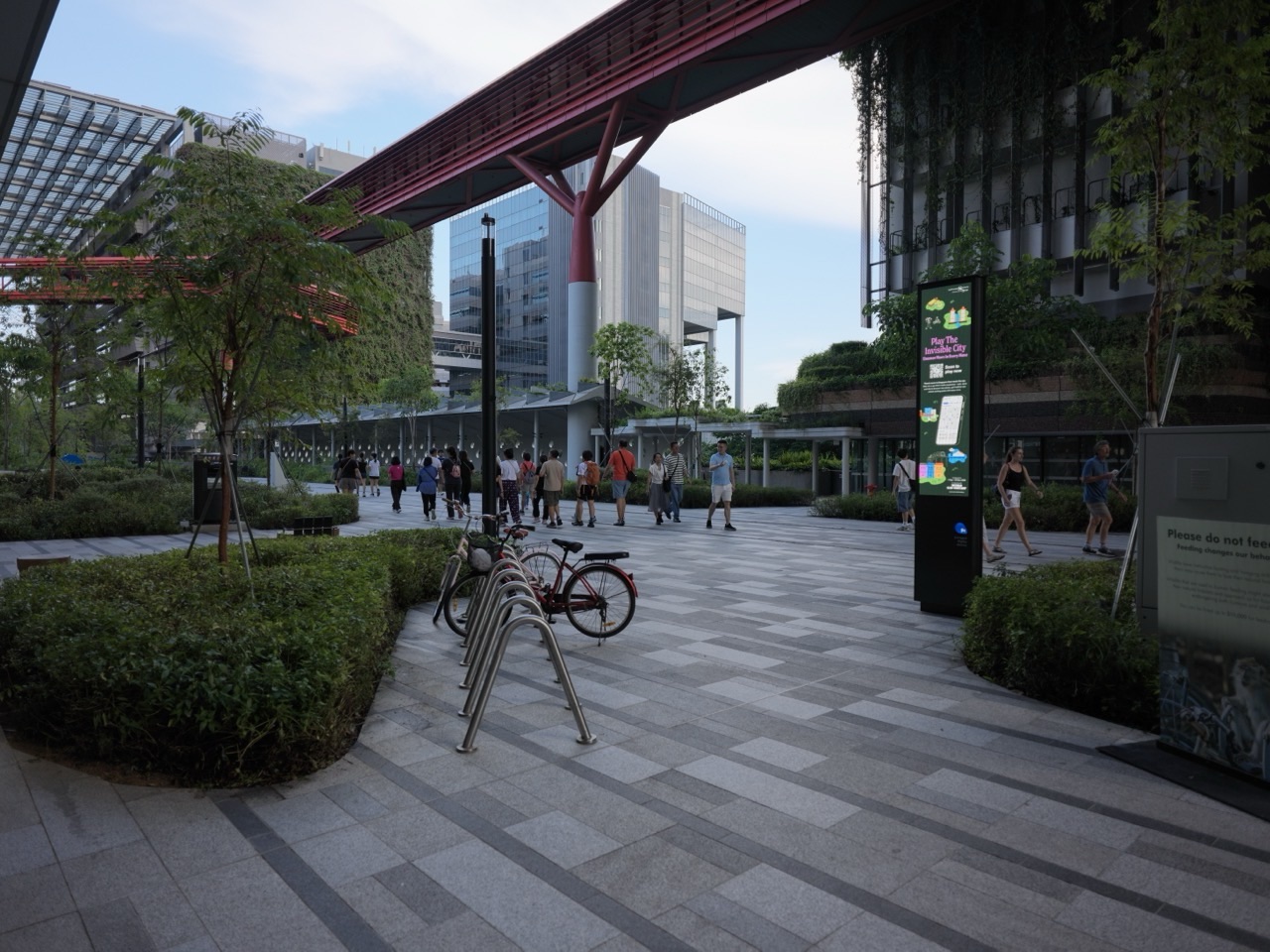
Walking the Punggol Heritage Trail is one of the most thoughtful free things to do in Punggol during the school holidays: a shady stretch of old Punggol Road, kept with its original rises and dips, running right through the brand-new Punggol Digital District.
Among the trees stands an old-style bus stop, waiting for a bus that will never come, while the glass towers of the Digital District rise behind it.
This is idea #27 in eduKate Punggol’s Top 100 Things to Do in Punggol During the School Holidays. Here you will find what is open on the trail and what is not, the trees, stories and signboards to look for, a gentle morning plan, ideas for every age, and how to pair the walk with Punggol’s library for a rainy-day “past and future” double bill.
The point is not to walk a long way.
It is to stand in one place and see two Punggols at once.
Children who have only known the new town are often amazed that, not so long ago, this was a road through kampongs, farms and coastal forest.
This idea is perfect for families who want to:
- enjoy a free, shady walk close to the MRT;
- show children how Punggol used to be;
- spot old trees, rare coastal plants and butterflies;
- combine a little history with a little nature;
- see the Punggol Digital District from the ground; or
- start a “then and now” project for the holidays.
Quick look
- Best for: all ages; especially Primary 3 to Secondary 4
- Time needed: 1 to 2 hours, plus lunch nearby
- Cost: free
- Best time: before 10am, or after 5pm on a dry evening
- Nearest station: Punggol Coast MRT (NE18); Teck Lee LRT (PW2) also serves the district
- Rain plan: Punggol Coast Mall nearby, or Punggol Stories at Punggol Regional Library
See all 100 school-holiday ideas · Chat with eduKate Punggol on WhatsApp · Visit eduKate Punggol on Facebook
The Punggol Heritage Trail Is Bigger Than It First Appears
At first, it looks like a pleasant path through some trees between new buildings.
Look more closely.
NParks describes the Punggol Heritage Trail as a 2.75-hectare park within the Punggol Digital District, with over 1 kilometre of walking trails. The first 400 metres, from Punggol North Avenue to Campus Boulevard, opened on 23 August 2025. Instead of flattening the land, the trail keeps the original undulating terrain of old Punggol Road, along with its coastal forest habitat and much of its existing greenery.
So when your child walks up and down its gentle slopes, they are walking the shape of a road their grandparents might have travelled.
Three named tracks wind through it: the Orchard Track, the Cascading Track and the Barringtonia Track, which is named after the Barringtonia trees planted along it.
Old road. New district. Same ground.
That is the magic of this place, and it is what makes it more than a walk.
The Hidden Lesson in a Heritage Walk
Stand at the recreated bus stop and ask your child: “What is different between this bus stop and the one near our block?”
You will hear some lovely observations. “It looks older.” “It’s in the trees.” “There’s no screen with bus times.”
Then ask the harder question: “Why would anyone build an old-looking bus stop in a brand-new district?”
Now the child has to reason. Maybe so we remember. Maybe so people can imagine what it was like. Maybe because the old road was here first.
That is the quiet skill underneath a heritage walk: comparing then and now, and asking why. It is the same thinking children use when they compare two characters, two sources or two sets of results in Science. And it gives them a reason to care about a place, which is where real learning starts.
Why Punggol Families Love the Punggol Heritage Trail
Some heritage outings feel like museums, all glass cases and quiet voices. This one feels like a walk in the woods with a story attached.
It is also close to the MRT, open around the clock and free, which makes it easy to slip into an ordinary holiday morning.
The joys of the Punggol Heritage Trail
- It is free and NParks lists it as open 24 hours
- The trees give welcome shade compared with the open promenade
- A recreated old-style bus stop makes a perfect photo and storytelling corner
- Signboards tell the stories of Kampong Punggol, the private zoos and the pig-farming district
- Conserved trees include Sea Almond and Common Pulai, some at least half a century old
- New plantings include rare coastal trees, some listed as Endangered or Critically Endangered
- It sits beside Punggol Coast Mall and its hawker centre for an easy lunch
- It pairs beautifully with the library’s Punggol Stories exhibition on a rainy afternoon
Best of all, it makes history feel close, because it is.
What You’ll Find on the Trail
Here is what to look for, based on the NParks Heritage Trail page, NParks’ opening announcement and our own Punggol Heritage Trail Guide.
The recreated bus stop
NParks describes a recreated bus stop designed to look like Singapore’s old bus stops. It is the trail’s storytelling corner, with interpretive panels nearby. Take a photo, then take a moment.
The heritage signboards
Panels supported by the National Heritage Board tell of the area’s past as Kampong Punggol, private zoos and the former pig-farming district. NHB’s history of Punggol records, for example, that Punggol Zoo was established in 1928 by William Lawrence Soma Basapa, and that in December 1974 the government set aside 620 acres in Punggol for commercial pig farming, with the last 22 farms stopping operations in November 1989. Ask children to find three panels and remember one fact from each.
The old trees and the new ones
NParks names Sea Almond and Common Pulai among the conserved trees, and invites visitors to spot Rambutan or Durian trees, which NParks says may have been planted by early Punggol settlers. New plantings include Pianggu and Small-leafed Oil-fruit, and NParks’ opening announcement lists coastal trees such as Common Putat (Critically Endangered) and Dungun, Nipis Kulit, Red Teruntum and White Teruntum (Endangered). Our site has short guides to several, such as Common Putat.
Butterflies and birds
NParks mentions the Common Tiger butterfly, with vivid orange wings and strongly marked black veins, and the Oriental Magpie Robin, known for its melodious song. Walk quietly and listen.
The playground and the Backwoods Trail
When the trail opened, NParks said an Adventure Playground inspired by “Pick Up Sticks” and a Backwoods Trail inspired by “Snakes & Ladders” were due by the end of 2025. Family guides such as Little Day Out have since reported them open, but they are not mentioned on NParks’ current park page, so check on arrival. Younger children may need help on log features.
What is not open
Phase 2, a further stretch with conserved mangroves and a link towards Punggol Jetty, is expected by NParks to be completed by the end of 2026, but we cannot promise it for the holidays. Punggol Point Park, at the far end of the planned route, is closed for upgrading until the end of 2027, so please do not plan to continue there.
How to Plan a Brilliant Heritage Trail Morning
A short walk, done well, beats a long one done grumpily.
1. Check the air and the weather
October 2026 brought unhealthy haze readings to Singapore. Check haze.gov.sg before you go, and save the walk for a clearer day if readings are high.
2. Read one story the night before
Pick one heritage topic, such as the old zoo or Kampong Punggol, and read a little about it together. Our article on Old Punggol Road is a good start.
3. Make a “then and now” card
Two columns: “Old Punggol” and “New Punggol”. Children add one thing to each column at every stop.
4. Wear proper shoes
Our guide notes that slopes and logs are fun but uneven. Covered shoes make everything easier.
5. Plan your exits and lunch
Punggol Coast MRT and Punggol Coast Mall are close by. Decide where you will finish, so lunch is the reward.
6. Pack repellent
It is a real forest edge, so insect repellent and water are essential.
A Sample Holiday Day, Hour by Hour
Here is a gentle weekday plan that ends indoors before the afternoon showers.
8.30am: Breakfast and the story
Over breakfast, read one short heritage story and hand out the “then and now” card.
9.15am: Ride to Punggol Coast
Take the North East Line to Punggol Coast. Tap in by 9.45am on a weekday and LTA’s free morning scheme makes the first rail trip free.
9.30am: Onto the trail
Walk the open stretch slowly. Find the bus stop, three signboards and one old tree.
10.30am: Nature pause
Sit somewhere shady, listen for birds and look for butterflies. Younger children can try the playground if it is open.
11.15am: Early lunch
Head to Punggol Coast Hawker Centre for an early lunch, before the weekday office crowd.
12.30pm: Past meets future
If it is raining, or you want more, ride to Punggol station and walk to One Punggol for the library’s free Punggol Stories exhibition, with its Memory Map of old Punggol on Level 4.
Afternoon: Draw it
At home, children draw the bus stop, or write three sentences about “Punggol then and now”.
Three Ways to Enjoy It
The same trail can be a treasure hunt, a project or a quiet think.
For little explorers (Primary 1–3)
Keep it short: the bus stop, one tree, one butterfly. Ask, “What did people wait for at bus stops long ago?” If the Backwoods Trail is open, counting its numbered sections is a fun game. Preschool siblings can come along in a stroller on the smoother paths, with a lift over any steps or mounds.
For big kids (Primary 4–6)
Give them the signboard mission: three panels, three facts, one question each. Ask them to find a tree listed as Endangered and explain what that word means. Primary 6 pupils who have just finished the PSLE often enjoy a calm, story-rich morning like this.
For teens (Secondary 1–4)
Try a photo pair: one photo of the old road’s bends and one of the Digital District’s towers, each with a one-line caption. Then talk about why planners kept the old road’s shape inside a new district. Teens can also research one heritage topic in more depth, using NHB’s history of Punggol.
The Learning Bridge: Vocabulary and Science Without the Worksheet
A heritage trail is full of rich words and real living things. Keep the links modest.
- Vocabulary: “heritage”, “conserve”, “recreate”, “undulating” and “endangered” all appear naturally on this walk. Ask children to use one in a sentence about what they saw. Precise words like these make compositions come alive.
- Science: Primary Science asks children to observe and compare living things. Spotting differences between a Sea Almond leaf and a Common Pulai leaf, or noticing which plants grow in shade, is exactly that kind of observation, and the idea of endangered species links to caring for our environment.
- English and Social Studies: writing a short “then and now” recount practises past and present tenses, and primary Social Studies looks at how Singapore and its communities have changed over time.
Keep it gentle and curious. If you would like to see how we build vocabulary step by step, our page on vocabulary in education explains our approach.
Little Hiccups and How to Dodge Them
Most trail troubles are small and easy to prevent.
Haze days
When readings on haze.gov.sg are high, swap the trail for the indoor Punggol Stories exhibition. Our Punggol Haze Indoor Activity Planner has more ideas.
Rain and lightning
The year-end holidays fall in the Northeast Monsoon season, when thundery showers often arrive in the afternoon. Trees and shelters are not safe places in a thunderstorm. Check the MSS lightning page and head indoors at the first rumble.
Heat and mosquitoes
The canopy helps, but it is still warm. Go early, drink water and use repellent. On very hot days, check the heat stress advisory.
Uneven ground
The rises and dips are part of the heritage, but they can trip little feet. NParks says the trail is wheelchair accessible but recommends that wheelchair users be aided, and notes that stepping stones and grass mounds are not wheelchair-friendly.
Toilets
NParks does not list toilets on the trail. Plan a stop at Punggol Coast MRT or the mall before you set off.
Fenced works
Parts of the district are still being built. Stay on open paths and never enter fenced areas.
What a Great Day Looks Like
You will know the walk worked when your child:
- can describe the old bus stop and guess why it was recreated;
- remembers at least one fact about the zoo, the kampong or the farms;
- points out an old tree and a new one;
- uses a new word, such as “heritage” or “undulating”, correctly;
- fills both columns of the “then and now” card; and
- asks, “What did Punggol look like when you were little?”
That last question, asked of a grandparent, may lead to the best story of the holidays.
When to Go
According to MOE, the 2026 year-end school holidays for MOE primary and secondary schools run from Saturday 21 November to Thursday 31 December 2026. The trail is open 24 hours, so any day works, but holiday weekday mornings are calmest. Looking ahead, MOE’s 2027 calendar lists the breaks as 13 to 21 March, 29 May to 27 June, 4 to 12 September and from 20 November 2027.
Our guide recommends mornings before 10am and evenings after 5pm as the most comfortable. In the Northeast Monsoon, which usually arrives around the end of November, mornings are the safer choice because storms often build in the afternoon.
Getting There from Around Punggol
NParks names Punggol Coast MRT (NE18) as the nearest station, and TheSmartLocal describes the trail as about a five-minute walk away. Teck Lee LRT (PW2) also serves the Digital District, linked by Campus Boulevard, which JTC describes as pedestrianised. Bus 84W stops at Punggol Coast Station; check a live journey planner. If you drive, NParks says the nearest parking is at Punggol Coast Mall, with fees.
Location: Punggol Heritage Trail, between Punggol North Avenue and Campus Boulevard, Punggol Digital District
Nearest MRT/LRT: Punggol Coast MRT (NE18); Teck Lee LRT (PW2)
Entry: free, open 24 hours
Quick Details
Activity: a self-guided heritage and nature walk along the open stretch of the Punggol Heritage Trail
Where: Punggol Heritage Trail, Punggol Digital District
Best ages: all ages; especially Primary 3 to Secondary 4
Cost: free
Time needed: 1 to 2 hours
Booking: none needed
Accessibility: NParks lists it as wheelchair accessible with assistance recommended; stepping stones and grass mounds are not wheelchair-friendly
Status checked: October 2026, NParks park page (open 24 hours; Phase 2 expected by end 2026, not confirmed for the holidays)
What to Bring
- Water bottles for everyone
- Insect repellent
- Covered shoes with a good grip
- Hats and sunscreen for the open stretches
- The “then and now” card and a pencil
- A phone or camera for the bus-stop photo
- A light umbrella or raincoat
- A small bag for rubbish
Frequently Asked Questions
Is the Punggol Heritage Trail free?
Yes. It is free, and NParks lists it as open 24 hours.
How long is the open section?
The first 400 metres, from Punggol North Avenue to Campus Boulevard, opened on 23 August 2025. NParks says the park has over 1 kilometre of walking trails.
Is Phase 2 open?
NParks expects Phase 2 to be completed by the end of 2026, but it was not open at the time of checking, so do not rely on it for the holidays.
Can we walk on to Punggol Point Park?
No. Punggol Point Park is closed for upgrading from 11 August 2026, with works expected to finish on 31 December 2027.
Is there a playground?
Family guides report an Adventure Playground and a Backwoods Trail, but NParks’ current page does not list them. Check on arrival.
Is it suitable for wheelchairs and strollers?
NParks says it is wheelchair accessible, but recommends assistance because of the undulating terrain. Our Heritage Trail for seniors guide suggests a gentler visit.
Where can we eat afterwards?
Punggol Coast Hawker Centre and Punggol Coast Mall are close by.
Helpful Reading for Punggol Families
- Top 100 Things to Do in Punggol During the School Holidays
- Punggol School Holiday Guide: A Week-by-Week Plan for the Year-End Break
- Punggol Heritage Trail Guide
- SIT Punggol Campus Guide
- Punggol Heritage Trail Trees: A Beginner Nature Walk
- Punggol Heritage Trail Photography: The Bus Stop
- Old Punggol Road: Why a Future Town Still Needs Memory
- Vocabulary in Education at eduKate Punggol
- NParks: Punggol Heritage Trail
- NHB Roots: History of Punggol
The Punggol Heritage Trail for Punggol Families
A new town still needs its old roads.
A bus stop becomes a time machine.
A tree becomes a witness.
A signboard becomes a story.
For little ones, the trail is a gentle hunt for butterflies and bus stops.
For big kids, it is a history mission with real clues.
For teens, it is a lesson in how a city chooses what to keep.
And for parents, it is a chance to show children that the place they call home has roots far deeper than the newest tower.
Plan the Rest of Your School Holidays
Browse the full Top 100 Things to Do in Punggol During the School Holidays for more ideas. If the trail has your children thinking about where everything is, idea #28 invites them to make a Punggol map of their own.
And if a calm, small-group learning block is also on your holiday list, eduKate Punggol teaches English, Mathematics and Science in classes of three. Come find out more.
Book a consultation · Chat on WhatsApp
eduKate Punggol
Small-group English, Mathematics and Science
Primary and Secondary
By appointment · +65 8823 1234
Properly taught kids shine a bright light into the future.
← Previous: #26 Autonomous shuttle ride · All 100 ideas · Next: #28 Make a Punggol map →
Checked October 2026. Opening hours, prices, programmes and closures change, so please confirm with the official source before you go.


