
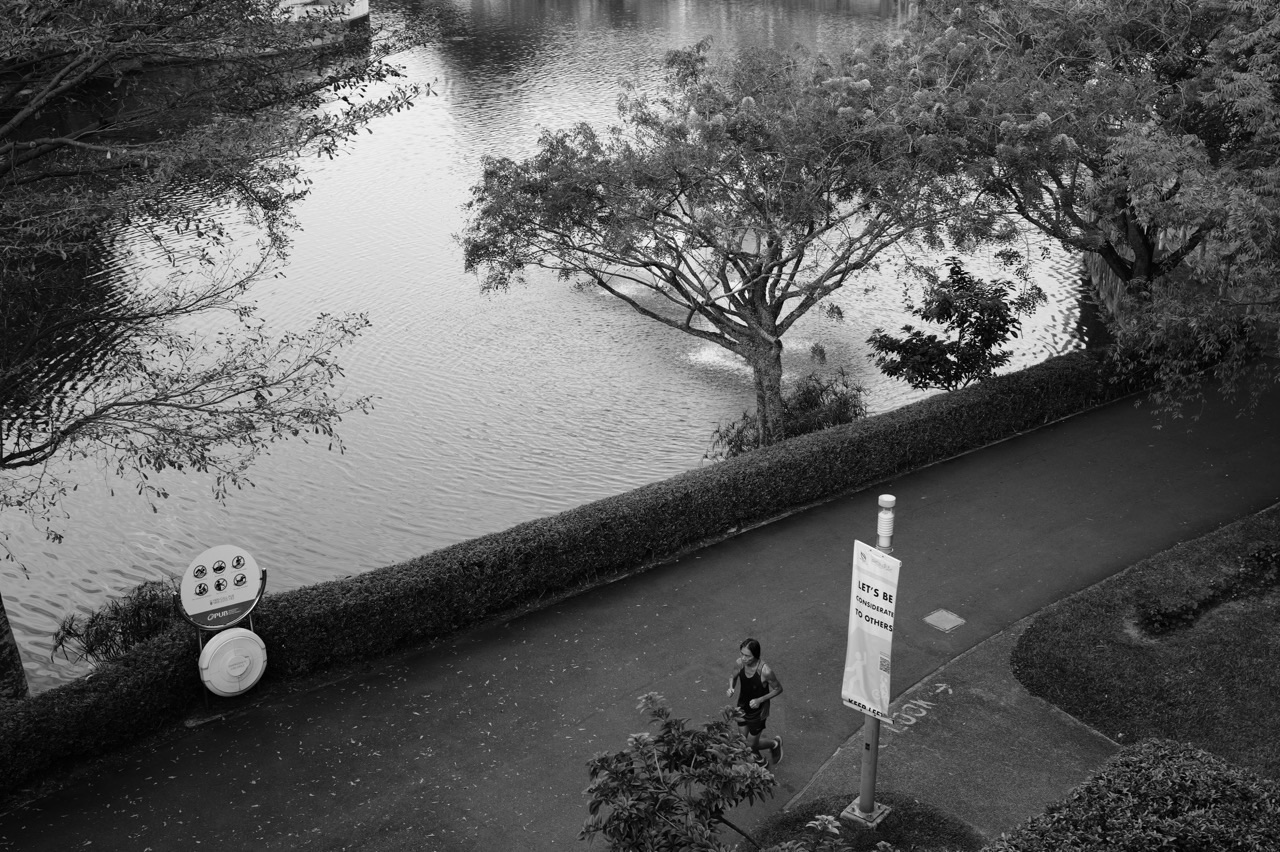
Two-check rule: for a Punggol outdoor activity, review NEA’s one-hour PM2.5 for haze and MSS’s WBGT heat stress map for heat. These are different measurements, and a safe-looking value in one does not cancel the risk shown by the other. This guide provides practical decisions for running, cycling, children and outdoor work.

Quick answer: check heat and haze separately before outdoor exercise
Punggol residents planning a run, cycle, school sports session or long walk need two environmental checks, not one. NEA’s one-hour PM2.5 indicates immediate fine-particle exposure; Singapore’s Meteorological Service (MSS) publishes heat-stress information based on Wet-Bulb Globe Temperature (WBGT), which captures temperature, humidity, solar radiation and wind. An ordinary air-temperature reading cannot stand in for either measure. Check both official pages, apply the relevant health guidance and respect any individual medical or institutional restriction.
A cooler waterfront breeze is not proof of cleaner air, while a comparatively clear skyline cannot guarantee that a hot afternoon is safe for hard exercise. You may need to reduce or postpone activity for haze, heat, or both. When either advisory recommends a more cautious option, do not use the better-looking reading for the other hazard as an excuse to push ahead. This guide explains the difference without inventing a new government ‘haze-plus-heat score’.
Two measurements, two separate problems
PM2.5 refers to fine particulate pollution, commonly monitored during smoke haze. The one-hour concentration is expressed in micrograms per cubic metre. WBGT is expressed in degrees Celsius and estimates environmental heat stress from several weather conditions rather than merely the dry-bulb temperature on a weather app. MSS reports WBGT as a 15-minute average, typically updated every 15 minutes. It is not the same as Singapore’s ordinary weather temperature.
Imagine a cyclist preparing to ride from Punggol Waterway Park toward Coney Island. They see a relatively normal PM2.5 band but an elevated heat-stress reading for their area. A two-hour daytime ride may still need major adjustment because of heat. Conversely, mild heat does not remove fine-particle exposure concerns when haze has worsened. A sound decision needs the current context for both.
What the 2026 heat-stress categories mean
NEA’s January 2026 public heat-stress advisory defines Low as WBGT below 31°C, Moderate as 31°C up to but below 33°C, and High as 33°C or higher. At Moderate it recommends reducing prolonged outdoor activities, taking regular indoor or shaded breaks, drinking more fluids and watching for symptoms. At High it advises minimising prolonged outdoor activities, taking more frequent or longer breaks and cooling actively where appropriate.
These categories apply to prolonged outdoor activities under direct sun exposure for the general population. They are not a guarantee that a short journey at Low is without risk, or a substitute for sport-specific and workplace safety protocols. Schools follow school guidance; outdoor workers and competitive athletes have sectoral rules. People with chronic conditions, pregnant women, older adults, young children and those recently recovered from illness need additional caution.
What the one-hour PM2.5 bands mean
Singapore’s current MOH public advice uses Normal (0–55 µg/m³), Elevated (56–150), High (151–250) and Very High (251 or above) for the one-hour PM2.5. At Elevated, healthy people are advised to reduce strenuous outdoor activity and vulnerable people avoid strenuous activity. At High, healthy people avoid strenuous outdoor activity while vulnerable groups avoid outdoor activity. At Very High, healthy people minimise outdoor activities and vulnerable groups avoid them.
This does not mean an individual with symptoms should continue merely because a public band is Normal. It also does not mean all schools or facilities have an identical closure policy. The 24-hour PSI forecast remains useful for planning the next day. The number 150 on a PM2.5 screen is not a temperature; the number 33 on a WBGT map is not a pollution index.
How to make a combined decision without inventing a combined index
Read the actual guidance for each measurement and identify the planned activity: short transit, a thirty-minute gentle walk, hard intervals, an outdoor shift or a school sport. Then consider age and health status. If the haze guidance would prohibit or minimise the activity, a reassuring heat reading cannot rescue it. If the heat advisory would discourage a long outdoor session, relatively cleaner air does not remove the heat risk. Follow the relevant more protective action.
For example, moderate heat stress plus Elevated PM2.5 is not a mathematically defined ‘Level 5 warning’. Rather, heat calls for reduced duration, rest and hydration, while smoke calls for reduced exertion and exposure according to personal vulnerability. The best practical plan may be a suitable indoor activity, not a complex calculation. Avoid inventing a clearance from adding or averaging incompatible units.
Why Punggol’s waterfront can feel cooler without solving haze
The waterway, reservoirs and coastal promenade can feel breezy. Breeze can make a person more comfortable by helping heat exchange, but it can also transport regional smoke. A waterfront is not a certified clean-air bubble. Shade may lower heat stress from direct sunlight, yet it generally does not filter fine smoke particles from the air a person breathes.
A Punggol family choosing between an exposed bridge and a shaded path should recognise that shade helps manage sun exposure but not necessarily haze. If official air quality is poor, the route itself might be unsuitable even when well shaded. If the air is acceptable but WBGT is high, moving to a cooler or indoor setting may address heat. Know which environmental problem you are actually solving.
Running: intensity matters more than a beautiful route
A runner can turn an enjoyable Waterway Park loop into strenuous exertion with fast intervals or a long pace test. MOH distinguishes strenuous activity because higher effort involves greater breathing. The heat-stress advisory separately considers prolonged activity under sun exposure, making the same run potentially uncomfortable for two independent reasons. Do not rely on the apparently peaceful water surface when deciding whether to complete a workout.
A practical alternative is to reschedule a hard session, shorten an appropriate easier session when advice permits, or use a suitable indoor exercise space. A person who has been ill should not use a ‘good’ WBGT number as medical clearance. The Punggol exercise restart article gives more detail on resuming gradual movement after haze, while this page identifies the two weather and air dimensions to check before departure.
Cycling and wind chill illusions
Cyclists may feel cool while moving even under significant heat stress because airflow affects comfort. That does not mean they cannot become dehydrated or overheated. It also does not mean the air is free of haze. Long cycling routes can create extended outdoor exposure, especially when someone rides toward the coast and then has a similarly long journey home.
Plan a sensible return route before starting. Avoid setting up a situation where the person must complete a distant loop regardless of deteriorating readings or symptoms. If the outing is discretionary, postponement is often straightforward. Do not replace a cancelled ride with a punishment-style high-intensity indoor circuit; the reason for changing the activity is to protect health, not prove endurance.
What about a quick school or work commute?
MSS notes that its general heat-stress advisory is intended for prolonged outdoor activity, rather than transient movement outside where exertion is low. Likewise, MOH’s haze guidance is differentiated by intensity, duration and personal vulnerability. A short direct walk from Punggol MRT to a destination is not automatically equivalent to an hour of high-effort sport. Nevertheless, serious symptoms or individual medical instructions may call for more caution.
If a parent can use a direct and safe transfer instead of a longer detour carrying heavy bags, that may be useful. Avoid sprinting to finish a commute more quickly: increased exertion and road-safety risks may defeat the purpose. A shaded bridge helps with sun, but do not label it a filtered air corridor. Combine realistic route planning with the latest official advice.
Children, older adults and pregnant people
Singapore’s heat-stress guidance identifies children and infants, older persons, pregnant women, people who are ill or recently recovered, and people with chronic conditions as groups needing greater care. MOH’s haze guidance likewise treats vulnerable groups more cautiously. A family should consider each member individually rather than decide that the fittest parent can speak for everyone. Children may not describe heat stress or breathing discomfort reliably.
Caregivers can plan shorter journeys, appropriate rest, cool surroundings and access to fluids. If someone has breathing difficulty, chest pain, confusion or other concerning symptoms, seek timely medical assistance rather than experimenting with activity levels. Neither a WBGT map nor the one-hour PM2.5 can diagnose a person. Prescribed asthma and other medication plans should not be changed by family guesswork.
Heat exhaustion is not the same as haze irritation
Heat-related illness occurs when the body struggles to cool itself; signs can include excessive sweating, fatigue, dizziness, headache, nausea and weakness. Haze may irritate the eyes, nose and throat, aggravate respiratory symptoms or affect people with underlying heart or lung disease. The two problems may occur together, and symptoms can overlap with many other causes. Do not assume that a person who feels unwell after a run only needs water or only needs to avoid smoke.
Move the person away from exertion and into an appropriate safer environment, follow emergency first-aid guidance and seek prompt care when symptoms are serious or do not improve. Suspected heat stroke is a medical emergency. A person with chest pain or unusual difficulty breathing needs urgent attention too. This article is for planning, not for differential diagnosis in an acute situation.
Why hydration cannot remove inhaled smoke particles
Water is important for heat management, and MOH notes it may help relieve some dryness or throat discomfort during haze. Drinking more does not filter smoke particles from the surrounding air or make a long outdoor session safe in a High PM2.5 band. Similarly, a portable air cleaner does not supply drinking water or protect somebody from direct sun outdoors.
Different risks need different interventions. For heat, activity modification, shade, cooling and fluids may be relevant. For haze, reduce unnecessary outdoor exposure and use a suitable indoor environment. If both advisories indicate concern, plan for both. There is no single bottle, supplement, face covering or gadget that can make an unsuitable outing safe against every hazard.
Masks and hot-weather comfort
N95 masks may reduce inhalation of fine particles when appropriately selected and fitted, but wearing a tight respirator can increase breathing resistance and discomfort, especially in heat. MOH does not generally recommend N95 masks for ordinary short school and work commutes, and advises vulnerable groups to avoid or minimise outdoor exposure at relevant bands. A respirator is not an alternative to following the physical-activity guidance.
People who experience breathing difficulty with a mask or have significant heart or lung conditions may need individual advice. Coaches should not issue blanket directions to make children play hard sport while masked simply because the next tournament is approaching. A voluntary indoor change or postponement is often simpler. Mask decisions and hydration should not be improvised at the last minute in extreme heat.
School PE, CCAs and youth sports
MOE schools can alter PE and outdoor activity under their own haze and heat safety measures. A parent should check the school’s current message through its authorised channel rather than interpret a heat stress map as an independent school-closure announcement. A youth football coach must also consider any applicable sport-specific protocol; FAS issued updated haze guidance in October 2026 with youth restrictions that differ from the professional match tier.
If an outdoor activity changes, children can practise game understanding, teamwork, reading or light suitable movement in a well-managed environment. An indoor alternative is not automatically safe for full-effort training if it is hot, crowded or poorly ventilated. The school’s and programme operator’s actual instructions matter. Parents should communicate medical needs confidentially and clearly.
Outdoor workers and delivery riders around Punggol
Workers who spend long shifts on exposed pavements, landscaping sites, delivery routes, transport facilities or waterfront maintenance tasks face cumulative exposure that casual park visitors may not. MOM’s haze guidance expects employers to assess outdoor tasks and use appropriate controls. Heat-stress management is an additional occupational duty; sector-specific plans may be more detailed than the general public WBGT advisory.
A delivery rider cannot simply be told to wear an N95 and keep going at the same pace without an assessment of exertion, heat, breaks and medical factors. Employers should apply their applicable guidelines, provide sensible work arrangements and respond to symptoms. The public may choose to shorten an optional walk, but staff often need organisational support to adjust necessary duties. Good local wellbeing accounts for this difference.
How to read an ordinary forecast
A typical weather forecast gives daytime temperature, rainfall chance and wind but may not include WBGT. The numerical temperature is not interchangeable with WBGT because humidity and solar exposure matter. MSS provides a dedicated heat-stress map and learning page; its WBGT is based on a 15-minute average from relevant stations. NEA publishes haze readings by air-quality region on a different cadence.
Check the data timestamps and locations. A heat station near a busy built-up area may differ from the conditions on a specific shaded footpath. An NEA regional PM2.5 band cannot tell you the exact pollutant concentration at your front door. Both datasets support public decisions, but neither is a personal medical measurement or a precise microclimate guarantee.
A practical 4-case decision table
Case one: Normal PM2.5, Low heat stress—ordinary activities may be considered under normal health and safety rules. Case two: Elevated PM2.5, Low heat stress—follow the PM2.5 exercise restrictions, especially for vulnerable people. Case three: Normal PM2.5, High heat stress—minimise prolonged outdoor activities and manage heat exposure. Case four: High PM2.5 and High heat stress—both independent advisories point toward substantial restriction of optional outdoor activities.
These cases explain logic, not a new official combination table. They do not cover every medical or sport-specific circumstance. A healthy adult, a preschool child and someone with chronic obstructive pulmonary disease may require different decisions. The purpose is to avoid choosing the more reassuring of two numbers and ignoring the other hazard. When in doubt, use the option that reduces optional outdoor exposure and strain.
Punggol Waterway Park: plan a return route first
Visitors often begin a waterfront outing with a lovely view but no thought to how far they will travel before returning home. On a hot or hazy day, choose a modest activity with a reliable exit point rather than a long loop that forces continued exposure. Identify the nearest realistic transport connection, drinking-water opportunities and places to rest. Do not rely on a public footbridge for filtered air or on a shop being open without checking.
If the air or heat stress becomes less suitable, leave the outdoor environment safely. Trying to race back quickly is not necessarily helpful because it increases exertion. If you plan a family excursion, agree on an indoor Plan B in advance. The Punggol indoor activity planner gives practical alternatives.
What about an evening or early-morning run?
The heat-stress advisory explains that WBGT can be lower when there is no direct sun, and Moderate or High heat stress occurs more often during late morning and afternoon. Early or late sessions may change heat conditions, but they do not guarantee low haze PM2.5. Air pollution can fluctuate independently with regional winds and weather. Do not choose a 6am jog solely because yesterday’s skyline was clear at dawn.
Likewise, exercising after dark has ordinary route and personal safety considerations. A poorly lit connector, isolated park path or closed nature area is not an ideal fallback. The better approach is to check current conditions near departure, use a familiar safe route if guidance permits, and accept that a rest day can be sensible when either environmental reading is unfavourable.
Worked scenario: a Punggol runner and a family cycling plan
Imagine a parent planned a 90-minute midday ride with a teenager along the Punggol Waterway. The NEA one-hour PM2.5 is Normal, but the MSS map shows High WBGT. The parent chooses to postpone the long exposed outing and spend time in a suitable indoor space. The clean-air reading did not cancel the heat concern. A few days later, the WBGT is Low but the PM2.5 band is High; the parent again avoids strenuous outdoor cycling.
Neither scenario implies a specific reading was recorded at Punggol at the time this article was written. The examples demonstrate how one hazard cannot cancel another. An optimistic family still has choices—reading, indoor games, safe appropriate exercise and rescheduling the route when both conditions are more suitable.
Common myths about haze and heat
Myth one: if the waterway feels breezy it must be low in PM2.5. Myth two: a low PSI forecast means no heat stress. Myth three: an air-temperature reading of 32°C means the WBGT is 32°C. Myth four: drinking enough water neutralises haze. Myth five: a mask makes a hard outdoor workout safe in both poor air and high heat. Myth six: the MOH general public table replaces occupational or school-specific procedures.
All six confuse variables, risk groups or responsible authorities. Better decisions separate fine-particle pollution, environmental heat stress, personal health, actual route and institutional obligations. Reading two different maps is not unnecessary complication; it answers two genuinely different questions about the body and the environment.
Frequently asked questions
What is WBGT? Wet-Bulb Globe Temperature, combining temperature, humidity, wind and radiation. Does WBGT equal air temperature? No. When is WBGT High in Singapore’s 2026 public advisory? At 33°C or more. Which PM2.5 reading governs a run now? NEA’s latest one-hour PM2.5 with MOH’s advice. Is the 24-hour PSI a temperature? No. Can I use just the better of the two numbers? No.
Does shade remove haze? Not reliably. Does a coastal breeze prevent heat stress? No guarantee. Do children use the same risk assumptions as healthy adults? Vulnerable groups require extra care. Should a coach switch straight to hard indoor exercise? Not automatically. Which authorities publish the data? NEA for haze and MSS for WBGT; sector operators and clinicians provide additional rules and individual advice.
A better Punggol outdoor day starts with two questions
Haze and tropical heat need not eliminate exercise and family fun from Punggol. They do require people to recognise different environmental constraints. The waterway is still beautiful, but beauty does not certify air quality; the shaded path is still helpful, but shade does not measure smoke. Both facts can be true at once.
Use the current official readings, protect vulnerable people, choose a realistic level of exertion, and be ready to reschedule. The purpose is not to become anxious about two graphs. It is to make the right decision early, enjoy normal life when conditions permit, and avoid unnecessary exposure when they do not.
Quick comparison: two environmental measures
| Question | PM2.5 and haze | WBGT and heat |
|---|---|---|
| What does it describe? | Concentration of fine airborne particles | Heat stress involving temperature, humidity, wind and sunlight |
| Units | µg/m³ | °C |
| Immediate information | NEA one-hour PM2.5 | MSS 15-minute-averaged WBGT |
| Better day to exercise? | Follow MOH’s health-group and exertion advice | Follow public heat-stress advice, with sectoral guidance when relevant |
| Can shade solve it? | Not reliably | Can reduce solar heat load, but follow advice |
Related Punggol guides
For current air readings, use Punggol Haze Check. Related reading: Punggol Heat Stress and Outdoor Exercise; quiet indoor exercise on haze days; team sports; Punggol outdoor activities; outdoor work; eduKateSG’s Punggol master hub.
Official references and editorial note
Reviewed 17 October 2026. Official sources: MSS current heat-stress measurements; MSS explanation of WBGT and heat risk; NEA January 2026 WBGT public advisory; NEA haze readings; MOH haze health advice; SportSG haze management. Example readings are hypothetical and are not live Punggol conditions or medical advice.


