
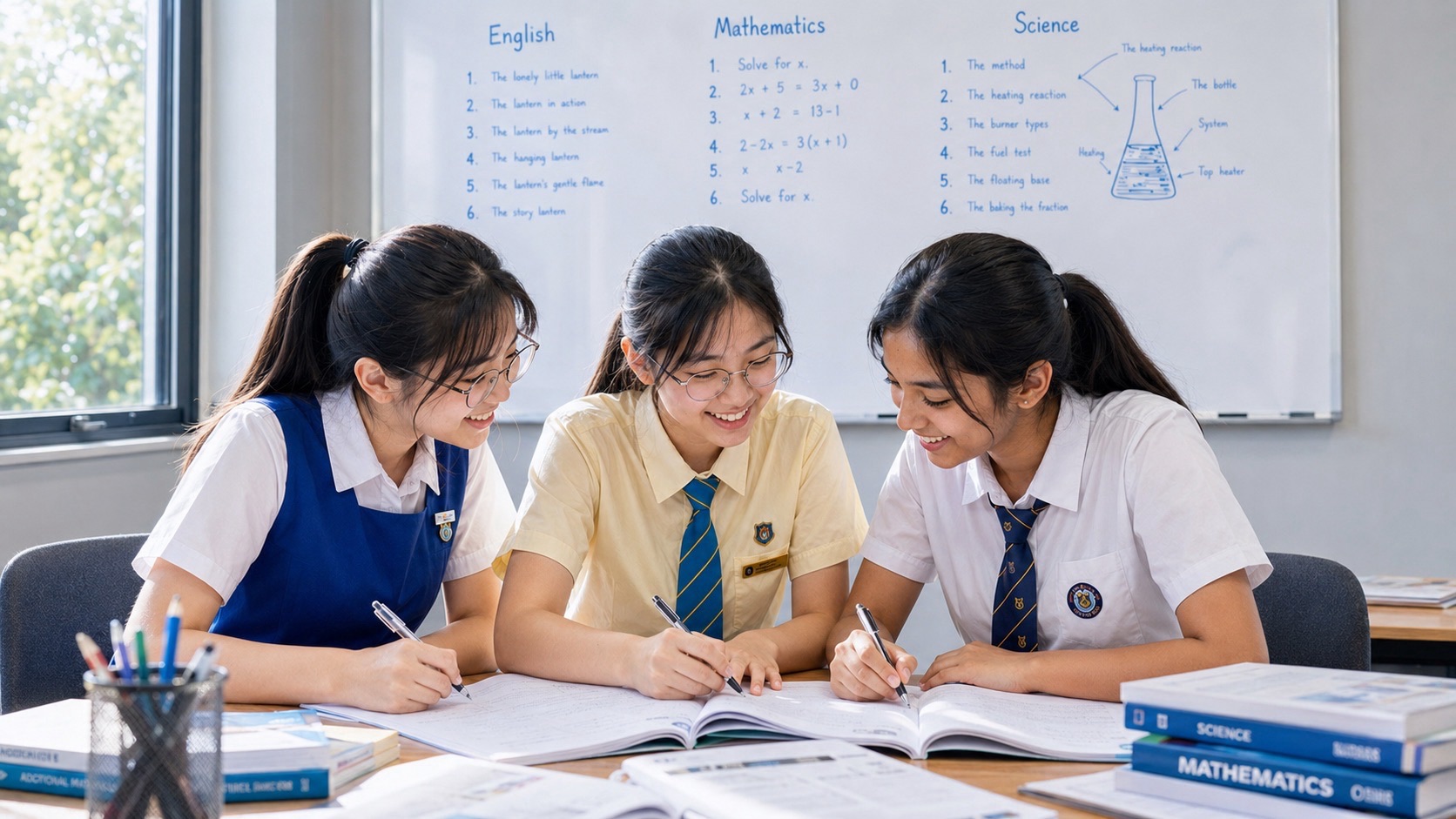
Revision techniques for students in Punggol matter because “study harder” is not a method. Students can spend hours rereading notes, highlighting pages, rewriting summaries and still discover during a test that the knowledge will not come back when they need it. Good revision is not measured by how long the book stayed open. It is measured by whether knowledge can be retrieved, selected, applied and checked under increasingly realistic conditions.
That is the core aim of Punggol education through revision techniques: help students convert what they have learned into durable, retrievable and usable knowledge through active recall, spacing, mixed practice, error repair and timed application. Revision should not be a final emergency phase before examinations. It should be a repeated process of finding what is weak, strengthening it and checking whether the improvement survives later.
The Core Aim in One Sentence
Revision is the process of making important knowledge easier to retrieve, apply and control when support is removed.
The student is not trying merely to see the material again. The student is trying to make the material available on demand.
Did You Know? Rereading Can Feel Better Than It Works
Rereading is comfortable because the page looks familiar.
That familiarity can be mistaken for mastery.
A stronger test is to close the book and ask: What can I produce now? What can I explain? What can I solve?
Revision becomes much more accurate when students distinguish recognition from retrieval.
The Seven Jobs of Effective Revision
1. Diagnose
Before revising everything, identify what is actually weak.
- Which topics are repeatedly forgotten?
- Which question types cause marks to disappear?
- Which mistakes return after correction?
- Which parts are slow under time pressure?
- Which ideas can be recognised but not explained?
Diagnosis protects time.
2. Retrieve
Students should practise bringing knowledge out of memory without looking.
This may include flashcards, blank-page recall, short quizzes, oral explanation or writing key points from memory.
See The Core Aim of Punggol Education | Active Recall.
3. Space
Revision should return to important knowledge across time.
One long session can create short-term familiarity. Repeated returns create stronger retention.
See The Core Aim of Punggol Education | Spaced Repetition.
4. Mix
Once separate methods are stable, students should mix related topics so they must decide which method applies.
See The Core Aim of Punggol Education | Interleaving.
5. Repair
Repeated errors should become revision targets.
Correcting one question is not enough if the underlying mistake survives.
6. Apply
Students need to use knowledge in unfamiliar or mixed questions.
Revision should eventually resemble the kind of thinking required in assessment.
7. Simulate
Timed sections and full-paper practice test whether revision still works when the clock, question order and pressure are real.
Revision Is Not the Same as Relearning Everything
Students often panic because the syllabus looks enormous.
A better revision system separates three categories:
- Secure — can retrieve and apply independently.
- Fragile — understands but forgets or hesitates.
- Missing — knowledge or method is not yet properly learned.
Secure material needs maintenance. Fragile material needs revision. Missing material needs teaching or relearning first.
Revision and Study Skills
Revision is one part of a wider study system.
Students also need attention control, note-taking, planning, feedback and self-monitoring.
See The Core Aim of Punggol Education | Study Skills.
Revision and Homework
Homework often provides the evidence that tells students what to revise.
If homework reveals repeated weakness, the next revision block should target that weakness rather than starting randomly somewhere else.
See The Core Aim of Punggol Education | Homework.
Revision and Feedback
Feedback identifies what to repair.
Revision turns that feedback into changed performance.
See The Core Aim of Punggol Education | Feedback.
Revision and Self-Reflection
Students should review not only what they revised, but whether the method worked.
See The Core Aim of Punggol Education | Self-Reflection.
Revision in Primary School
Primary revision should be short, concrete and regular.
Useful techniques include:
- oral recall of key facts;
- short vocabulary checks;
- mental Mathematics practice;
- one corrected Science explanation;
- reading aloud with a clear target;
- small mixed question sets.
Young students benefit from returning to material often rather than waiting for one large revision week.
Revision During PSLE Years
Primary 5 and Primary 6 students need more deliberate revision because the volume of examinable material grows.
A useful PSLE revision structure is:
- diagnose with school or practice evidence;
- repair weak foundations;
- retrieve important knowledge;
- mix question types;
- practise timed sections;
- review repeated errors;
- protect sleep and recovery.
Revision should become more selective as the exam approaches. Students should spend more time on high-value weaknesses and less time on material that is already secure.
Revision in Secondary School
Secondary revision becomes harder because students manage more subjects and more abstract content.
They need a system that answers:
- What matters most?
- What is weak?
- What method suits this subject?
- How often should I return?
- When should I switch from topical work to mixed work?
- When should I start timed practice?
A revision plan should therefore be adaptive rather than identical across every subject.
The Revision Mistake: Starting With the Notes
Students often begin revision by opening notes because that feels natural.
A stronger sequence is often:
- try to retrieve first;
- check what was missed;
- study only the missing part;
- retrieve again.
This prevents time being spent rereading what was already known.
The Other Revision Mistake: Revising Only Favourite Subjects
Students naturally spend more time on subjects that feel easier or more rewarding.
A useful revision timetable should be evidence-driven, not mood-driven.
The weakest high-value areas often deserve first claim on limited revision time.
The Traffic-Light Revision System
Students can classify topics:
- Green — can retrieve and apply independently.
- Amber — partial knowledge, slow recall or inconsistent accuracy.
- Red — missing, confused or repeatedly wrong.
The colours are not labels of intelligence. They are scheduling signals.
Red needs repair. Amber needs retrieval and practice. Green needs occasional maintenance.
The Revision Priority Formula
A useful way to prioritise is to combine:
- Importance — how likely or central is the topic?
- Weakness — how unstable is performance?
- Recoverability — can improvement happen with focused practice?
High-importance, high-weakness topics with realistic recovery potential usually deserve early attention.
Active Recall
Active recall is one of the strongest revision habits because it tests memory directly.
Students can use:
- flashcards;
- blank-page recall;
- question-and-answer lists;
- teach-back;
- closed-book definitions;
- short self-quizzes.
The important part is attempting before looking.
Spaced Revision
Revision should return after time has passed.
A simple pattern might be:
- same day — brief review;
- two or three days later — retrieval;
- one week later — mixed recall;
- later again — exam-style application.
The exact interval can vary. The principle is that memory should be asked to reconstruct after some forgetting has begun.
Interleaved Revision
Blocked revision is useful when a skill is new.
Mixed revision becomes useful later because the student must discriminate between methods.
For example, a Mathematics revision set might mix algebra, ratio and geometry. The challenge is not only executing the method but choosing it.
Revision Notes
Good revision notes are compressed, not copied.
A useful revision page might contain:
- core concept;
- key formula or structure;
- common error;
- one worked example;
- one retrieval question;
- one link to a related topic.
See The Core Aim of Punggol Education | Note-Taking Skills.
One-Page Compression
After learning a topic, ask the student to compress it onto one page.
Then close the page and reconstruct as much as possible from memory.
Compression identifies structure. Reconstruction tests retention.
The Error Log
An error log prevents mistakes from disappearing after correction.
Useful columns include:
- question or topic;
- error type;
- why it happened;
- correct principle;
- retest date;
- result after retest.
The log is most useful when repeated patterns become visible.
Revision and Deliberate Practice
Once a weak area is diagnosed, revision can become deliberate practice.
See The Core Aim of Punggol Education | Deliberate Practice.
Revision and Self-Explanation
Students should occasionally explain why a method works rather than merely reproduce it.
This deepens understanding and helps transfer.
See The Core Aim of Punggol Education | Self-Explanation.
Revision and Memory Retention
Revision succeeds when knowledge stays available after time passes.
See The Core Aim of Punggol Education | Memory and Retention.
Revision and Focus
Revision quality falls when attention is fragmented.
A focused twenty-five-minute retrieval block can be more useful than an hour of distracted rereading.
See The Core Aim of Punggol Education | Focus and Concentration.
Revision and Time Management
Students need to distribute revision across subjects without allowing one topic to consume the week.
See The Core Aim of Punggol Education | Time Management.
Revision in Mathematics
Mathematics revision should move through stages:
- concept repair;
- topical questions;
- mixed questions;
- timed sets;
- full-paper application.
Students should track whether errors come from concept, method selection, algebra, arithmetic, timing or checking.
See How to Study Mathematics Effectively and Revise for Tests.
Revision in English
English revision should not become memorising model essays.
Students can revise:
- vocabulary through retrieval and use;
- comprehension through question-type practice;
- writing through planning and paragraph revision;
- oral through recorded responses;
- grammar through error patterns.
See How to Revise English and Remember What You Learn.
Revision in Science
Science revision needs both knowledge and explanation.
Students should retrieve definitions, diagrams and processes, then practise applying those ideas to data, experiments and unfamiliar contexts.
Revision in Humanities
Humanities revision should combine factual recall with argument, evidence and source interpretation.
A useful History example is History Revision Notes, Active Recall and Spaced Repetition.
Revision and Timed Practice
Timed work should enter after the student has enough knowledge to make the timing meaningful.
Timing too early can simply rehearse weak methods under pressure.
A strong progression is:
- untimed accuracy;
- light timing;
- timed section;
- mixed timed set;
- full-paper simulation.
Revision and Exam Anxiety
A good revision system reduces anxiety because it replaces vague fear with evidence.
Students can say: “I have retrieved this topic three times, completed mixed questions and tested it under time.”
See The Core Aim of Punggol Education | Exam Anxiety.
Revision and Exam Preparation
Revision strengthens the underlying knowledge. Exam preparation adds pacing, question strategy, checking and simulation.
See The Core Aim of Punggol Education | Exam Preparation.
The Revision Timeline
A simple long-range revision sequence is:
- Far from the exam — build foundations and repair gaps.
- Several weeks out — active recall and topical practice.
- Closer in — mixed practice and repeated retrieval.
- Final stretch — timed sections and full-paper simulation.
- Last days — maintain, review key errors and protect sleep.
This prevents the entire syllabus from becoming a last-week emergency.
The Weekly Revision Cycle
A useful weekly cycle can be:
- Monday — retrieve one older topic.
- Tuesday — repair a current weakness.
- Wednesday — short mixed practice.
- Thursday — revisit an earlier error.
- Friday — light recall or rest depending on workload.
- Weekend — one longer application or timed set.
The exact schedule should fit school and CCA demands. The important principle is repeated return.
The 30-Minute Revision Block
A compact revision block might look like:
- 5 minutes — retrieve from memory.
- 10 minutes — check and repair missing knowledge.
- 10 minutes — apply through questions.
- 5 minutes — record errors and next retest.
This is far stronger than thirty minutes of passive rereading.
The Revision Stop Rule
Students should know when to stop revising a topic heavily.
Possible exit conditions include:
- accurate retrieval after a delay;
- stable performance in mixed questions;
- successful timed application;
- no repeated error across two retests.
Then the topic moves into maintenance while attention shifts to a weaker area.
Revision in the Age of AI
AI can generate quizzes, explanations, flashcards and alternative examples.
The strongest use is to support active revision, not replace it.
A useful AI workflow is:
- retrieve first without AI;
- ask AI to generate questions on the weak area;
- attempt independently;
- use AI to explain one specific gap;
- close the tool;
- retest later without assistance.
See The Core Aim of Punggol Education | AI Literacy.
The AI Revision Trap
Students can spend an hour asking AI for summaries and feel productive while retrieving almost nothing themselves.
The test is simple: close the tool and produce the knowledge.
How Parents Can Support Revision
- Ask what the current revision target is.
- Encourage retrieval before rereading.
- Help protect a realistic weekly schedule.
- Avoid demanding equal time for every topic.
- Ask what repeated errors are showing.
- Protect sleep near exams.
- Focus on evidence of readiness rather than repeated reassurance.
Parents do not need to supervise every revision session. They can help protect the system.
How Tutors Can Improve Revision
- Use diagnostics before assigning revision.
- Prioritise high-value weaknesses.
- Build retrieval into lessons.
- Return to topics after a delay.
- Mix question types.
- Use error logs.
- Introduce timing progressively.
- Define exit conditions.
At eduKatePunggol, revision should make the student more independent and more accurate about what they know, not simply busier before the exam.
What Progress Looks Like
Revision progress is visible when students:
- remember more after a delay;
- need fewer prompts;
- retrieve faster;
- make fewer repeated errors;
- choose methods more accurately;
- perform better in mixed questions;
- manage timed work more calmly;
- know what still needs revision;
- spend less time on already-secure material;
- transfer knowledge into unfamiliar contexts.
A Simple Revision Routine
- Diagnose — what is weak?
- Retrieve — what can I produce without notes?
- Check — what was missing or wrong?
- Repair — relearn only what needs repair.
- Apply — use the idea in questions.
- Space — return later.
- Mix — combine with other topics.
- Simulate — test under realistic conditions.
- Exit — move to maintenance when stable.
Frequently Asked Questions
What are the best revision techniques for students?
Strong revision techniques include active recall, spaced practice, mixed practice, error logs, self-explanation, targeted repair and timed application.
Is rereading useful for revision?
It can help when a topic is genuinely unclear, but it should usually be followed by closed-book retrieval so students know whether the knowledge can actually be produced.
How early should students start revising?
Revision works best when it is distributed across the term rather than saved entirely for the final week. Short returns to older material build more durable memory.
How should students revise multiple subjects?
Use evidence to prioritise weak, high-value areas and rotate subjects across the week. Do not give every topic equal time automatically.
Can AI help with revision?
Yes. AI can generate practice questions and explanations, but students should retrieve and attempt independently before using assistance.
What is the strongest sign that revision is working?
The student can retrieve knowledge after a delay, apply it in mixed or unfamiliar questions and perform with less support under realistic conditions.
Useful Routes for Punggol Families
- eduKatePunggol home — local education, tuition, parent, student and pathway routes.
- The Core Aim of Punggol Education | Active Recall.
- The Core Aim of Punggol Education | Spaced Repetition.
- The Core Aim of Punggol Education | Interleaving.
- The Core Aim of Punggol Education | Deliberate Practice.
- The Core Aim of Punggol Education | Exam Preparation.
- How to Study Mathematics Effectively and Revise for Tests.
- How to Revise English and Remember What You Learn.
- Punggol Atlas.
The Best Revision Makes Knowledge Available When the Book Is Closed
Revision is successful when familiarity becomes retrieval, retrieval becomes application and application survives pressure.
That is the core aim of Punggol education through revision techniques: help students strengthen the right knowledge at the right time until it can be recalled, selected and used independently when the exam paper is in front of them.
Properly taught kids shine a bright light into the future.


