
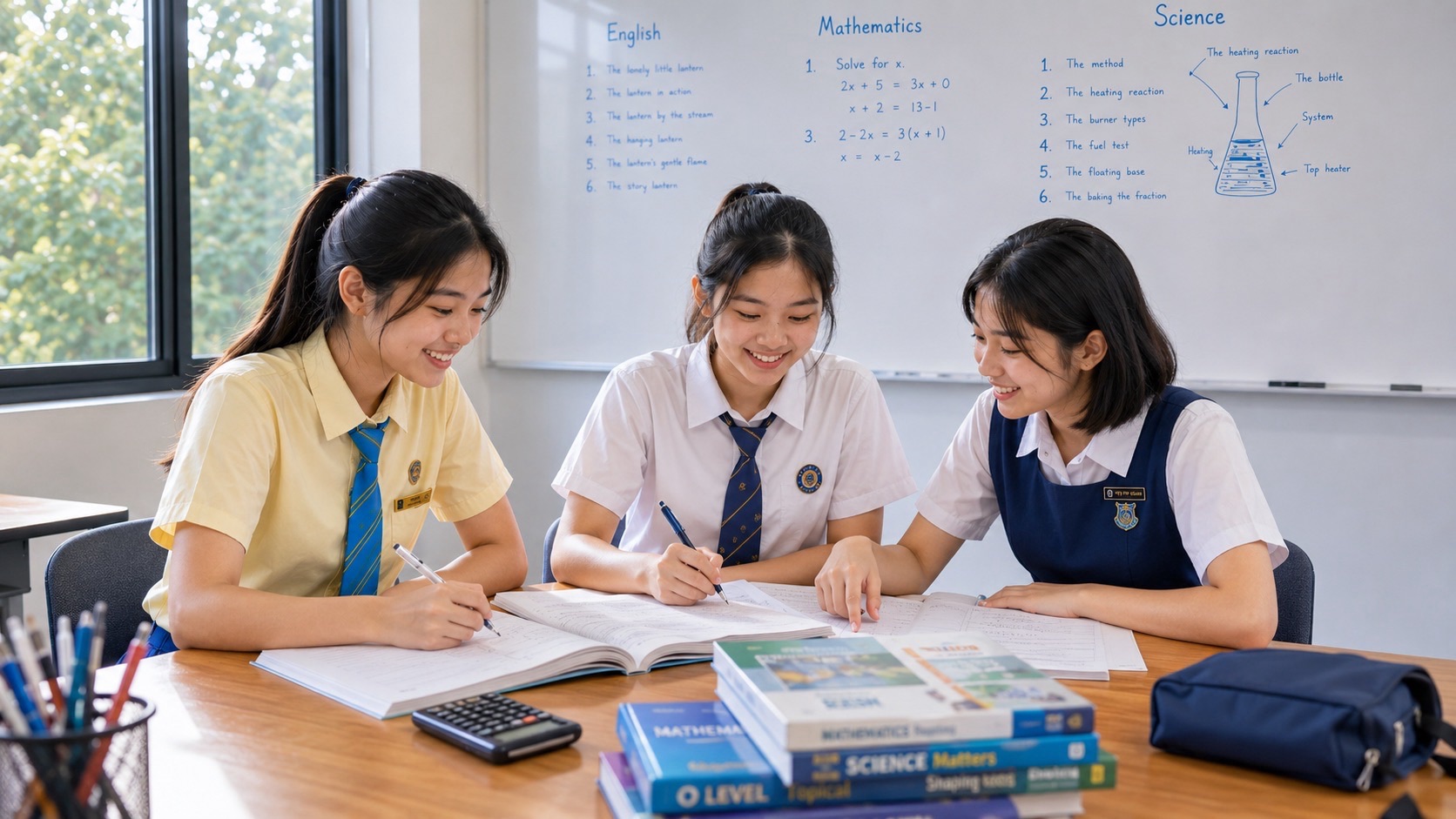
Active recall for students in Punggol is one of the simplest ways to make revision more honest. Instead of looking at notes until the page feels familiar, the student closes the source and tries to produce the knowledge from memory. That small change turns studying from recognition into retrieval — and retrieval is much closer to what examinations, oral responses, problem solving and real life actually require.
That is the core aim of Punggol education through active recall: help students practise bringing knowledge back without immediate support, then use the gaps revealed by that attempt to decide what needs repair. Active recall is not a trick for memorising more facts. It is a way to make learning visible.
The Core Aim in One Sentence
Active recall asks the student to retrieve before looking.
That one principle changes the quality of revision because the learner can no longer confuse familiarity with mastery. If the answer appears only when the notes are open, the knowledge is not yet reliably available.
Did You Know? Recognition Can Feel Like Mastery
A student may read a textbook paragraph and think, “I know this.” They may highlight it, reread it and feel increasingly confident.
Then the book closes and the explanation disappears.
This happens because recognition is easier than recall. Seeing the answer can make the material feel known even when the learner cannot generate it independently.
Active recall removes that illusion.
What Active Recall Actually Looks Like
Active recall can be very simple.
- Cover the answer and say it aloud.
- Close the book and write the main ideas from memory.
- Use flashcards properly: answer before flipping.
- Turn headings into questions.
- Complete a short closed-book quiz.
- Explain a concept to another person without notes.
- Solve a question without looking at the worked example.
- Write a formula, definition or process from memory, then check.
The common feature is retrieval before feedback.
The Three-Step Active Recall Loop
1. Retrieve
Try to produce the answer without help.
This may feel slow or uncomfortable. That difficulty is useful because it shows what the memory can actually do.
2. Check
Compare the response with a reliable source.
Do not merely mark right or wrong. Identify what was missing, distorted or confused.
3. Repair
Correct the gap, then retrieve again later.
The learning happens not only when the student remembers correctly, but also when a failed retrieval is followed by accurate feedback and another attempt.
Active Recall and Learning How to Learn
Active recall is one tool inside a much larger learning system.
The article The Core Aim of Punggol Education | Learning How to Learn explains how attention, encoding, retrieval, feedback, application and reflection work together.
Active recall is especially powerful because it connects retrieval with diagnosis: the student discovers what is actually available from memory.
Active Recall and Self-Regulated Learning
Self-regulated learners need evidence about what they know.
Active recall provides that evidence. A student can then decide whether to review, move on, seek help or change strategy.
See The Core Aim of Punggol Education | Self-Regulated Learning.
Active Recall and Metacognition
Metacognition asks, “What do I know, what do I not know and how confident should I be?”
Active recall improves that calibration because it replaces feeling with performance.
A student may feel 90% confident before testing and discover that only half the ideas can be retrieved accurately. That surprise is educationally valuable.
See The Core Aim of Punggol Education | Metacognition.
Active Recall Is Not Just Flashcards
Flashcards are one format, not the method itself.
Students can use active recall for complex learning too:
- Explain a Science mechanism from memory.
- Reconstruct an English essay plan.
- Write the steps of a Mathematics method without looking.
- List the causes and consequences of a historical event.
- Draw and label a process from memory.
- Summarise a chapter on a blank page.
- Answer oral questions without notes.
The important thing is that the learner generates the response before seeing the answer.
Active Recall in Primary School
Primary students can start with short, low-pressure retrieval.
- Three spelling words from memory.
- One multiplication fact family.
- Three facts from a Science topic.
- Retell the main events of a story.
- Explain yesterday’s lesson to a parent.
- Answer five questions without opening the workbook.
The sessions should be short enough that retrieval feels like normal learning rather than punishment.
Active Recall During PSLE
PSLE preparation often becomes overloaded with worksheets. Active recall helps students distinguish practice volume from actual memory strength.
A useful Primary 6 routine is:
- retrieve key concepts first;
- check gaps;
- repair only what is weak;
- complete selected application questions;
- return to the concept later without warning.
This can make revision more efficient because students stop spending equal time on material that is already secure.
Active Recall in Secondary School
Secondary students can use retrieval across increasingly specialised subjects.
For Science, retrieve definitions, mechanisms, relationships and diagrams. For Mathematics, retrieve formulas, method triggers and prerequisite rules. For English, retrieve vocabulary, structures, evidence patterns and planning frameworks. For Humanities, retrieve concepts, examples and argument structures.
The student learns that memory is not separate from reasoning. Reliable retrieval frees working memory for higher-level thinking.
Active Recall in Science
Science is a natural fit because students need both knowledge and application.
A strong Science retrieval routine may ask:
- What is the definition?
- What causes the effect?
- What variables matter?
- Can I draw the process?
- What evidence would support this explanation?
- What changes if one condition changes?
For a subject-specific route, see The Core Aim of Punggol Science Tuition | Science Retrieval Practice.
Active Recall in Mathematics
Mathematics students sometimes say, “There is nothing to memorise; you just practise.” In reality, effective problem solving depends on reliable retrieval of foundational knowledge.
Students need quick access to formulas, algebraic rules, number facts, definitions, standard relationships and method cues.
But recall should be connected to use. After retrieving a formula, solve a question that requires deciding whether the formula applies.
Active Recall in English
English active recall is not about memorising model essays word for word.
Students can retrieve:
- vocabulary and collocations;
- grammar rules;
- text structures;
- oral response frameworks;
- composition planning questions;
- evidence from a passage;
- key ideas from a reading.
Then they use the recalled material in new sentences, passages and prompts.
The Active Recall Mistake: Testing Before Understanding
Retrieval is not a substitute for explanation.
If the student genuinely does not understand a concept, repeated testing can become frustrating and shallow. First build enough understanding that the knowledge has something meaningful to attach to.
A useful sequence is: understand → retrieve → apply → check → repair.
The Other Active Recall Mistake: Turning Everything Into Tiny Cards
Flashcards are excellent for compact information, but not every idea should be atomised.
Students also need whole explanations, connected concepts and multi-step reasoning. A card asking for one definition should eventually connect to questions asking why the concept matters and how it works in context.
The Difficulty Sweet Spot
Retrieval should be effortful enough to require memory but not so impossible that every attempt fails.
If almost every card is instant, spacing may be too short or the material too easy. If almost every question is impossible, the student may need more explanation, smaller chunks or an earlier review.
The useful zone is where recall succeeds often enough to reinforce learning while still revealing real gaps.
Active Recall and Spaced Practice
Active recall becomes even more useful when combined with spacing.
Instead of retrieving the same answer ten times in one sitting, students revisit it after some delay. The slight forgetting makes the next retrieval harder — and that can strengthen long-term retention.
This is why a short review today, another later in the week and another later again can outperform one exhausting cram session.
Active Recall and Interleaving
Once a student can retrieve individual methods, mixed practice helps with selection.
In a mixed Mathematics set, for example, the learner must decide which method applies. In Science, mixed questions require the student to identify which concept explains the evidence.
Retrieval gives access to the knowledge; interleaving trains choice.
Active Recall and Feedback
Retrieval without checking can strengthen errors.
Every active recall session needs a reliable feedback source:
- school notes;
- teacher feedback;
- textbook;
- answer key;
- trusted reference;
- tutor review.
The shorter the distance between error and accurate repair, the less chance the wrong version has to become familiar.
The Blank-Page Method
One of the simplest retrieval methods requires only paper.
- Choose a topic.
- Close all notes.
- Write or draw everything remembered.
- Mark areas of uncertainty.
- Open the source.
- Correct in a different section.
- Close the source again.
- Reconstruct the corrected version.
This works especially well for connected topics because it reveals not only missing facts, but missing relationships.
The Teach-Back Method
Students can also retrieve by teaching the idea aloud.
The rule is simple: explain the concept as though the listener knows less than you. If the explanation becomes vague, circular or dependent on looking at notes, the gap has been located.
The local article Teach-Back at Home — If a Child Can Explain It, the Learning Is Becoming Their Own develops this useful family routine.
The Question-Generation Method
A strong student can create retrieval questions after learning a topic.
This has two benefits: generating the question requires understanding what matters, and answering it later creates retrieval practice.
Useful question types include:
- definition;
- why;
- compare;
- example;
- counterexample;
- apply;
- predict;
- explain the error.
Active Recall and Exam Preparation
Examinations are retrieval environments.
The notes are absent, the clock is running and the student has to recognise the task, retrieve relevant knowledge and execute.
Revision should therefore gradually become more like the performance environment. Closed-book recall, mixed practice and timed application all prepare the student for independent retrieval.
The eduKatePunggol guide How to Study for Exams at Home places retrieval inside the larger training system.
Active Recall and Confidence
Real confidence grows from evidence.
A student who can repeatedly retrieve the material from memory has better grounds for confidence than one who simply feels familiar with the notes.
This also helps reduce vague anxiety because the learner can identify exactly what is secure and what still needs work.
Active Recall in the Age of AI
AI can make retrieval either stronger or weaker.
It weakens retrieval when students ask for answers immediately. It strengthens retrieval when AI is used to generate quizzes, provide feedback after an attempt or create new examples after the student has answered independently.
A good AI-assisted retrieval routine is:
- ask for questions only;
- answer without help;
- submit the response for feedback;
- verify important feedback;
- retry missed ideas later;
- close the tool and test again independently.
See The Core Aim of Punggol Education | AI Literacy.
How Parents Can Use Active Recall at Home
- Ask one question before opening the notes.
- Let the child struggle briefly before giving the answer.
- Ask for an explanation rather than “Did you study?”
- Keep retrieval short and regular.
- Do not turn every missed answer into a lecture.
- Return to missed items later.
- Celebrate accurate self-correction.
The goal is not to become the family quizmaster. It is to help the child experience retrieval as a normal part of learning.
How Tutors Can Use Active Recall
- Begin lessons with short retrieval from the previous session.
- Ask students to reconstruct methods before seeing examples.
- Use cumulative questions.
- Delay hints briefly.
- Require explanation of corrected answers.
- Return to the same concept after a gap.
- Mix retrieval with application.
At eduKatePunggol, active recall is most useful when it helps tutors see whether knowledge has transferred from supported learning into independent performance.
What Progress Looks Like
Active recall progress is visible when students:
- close notes before testing themselves;
- retrieve more accurately across time;
- identify gaps earlier;
- need fewer prompts;
- explain concepts more fluently;
- use recalled knowledge in new questions;
- become less dependent on model answers;
- space review rather than cram;
- correct weak memories deliberately;
- show better calibration between confidence and actual performance.
A Simple Active Recall Routine
- Learn — understand the material first.
- Close — remove the source.
- Retrieve — produce the answer.
- Check — compare with the standard.
- Repair — correct the gap.
- Apply — use the knowledge in a question.
- Space — return later.
- Retest — confirm that the learning survived.
Frequently Asked Questions
What is active recall?
Active recall is a study method in which students deliberately retrieve information from memory before checking the answer.
Is active recall better than rereading?
Rereading can help initial understanding, but active recall provides a stronger test of whether knowledge is actually available without the source present.
How can students use active recall?
Use flashcards, closed-book questions, blank-page recall, teach-back, oral quizzing or independent practice before looking at notes or solutions.
Does active recall work for Mathematics?
Yes. Students can retrieve formulas, definitions, rules and method cues, then immediately apply them in problems so recall is connected to reasoning.
How often should students use active recall?
Short, repeated sessions spaced over time are generally more useful than trying to retrieve everything in one long sitting. Frequency should depend on difficulty and how well the material is retained.
What is the strongest sign active recall is working?
The student can retrieve the knowledge accurately after a delay and use it in an unfamiliar question without needing the original notes.
Useful Routes for Punggol Families
- eduKatePunggol home — local education, tuition, parent, student and pathway routes.
- The Core Aim of Punggol Education | Learning How to Learn.
- The Core Aim of Punggol Education | Self-Regulated Learning.
- The Core Aim of Punggol Education | Metacognition.
- The Core Aim of Punggol Education | Study Skills.
- The Core Aim of Punggol Science Tuition | Science Retrieval Practice.
- How to Study Science Effectively With Active Recall, Spaced Practice and Interleaving.
- Punggol Atlas.
The Best Revision Makes Memory Prove Itself
Students do not need to guess whether they know something. They can test it.
That is the core aim of Punggol education through active recall: move revision from looking at knowledge to producing knowledge — then use every retrieval attempt as evidence for what to strengthen next.
Properly taught kids shine a bright light into the future.


