
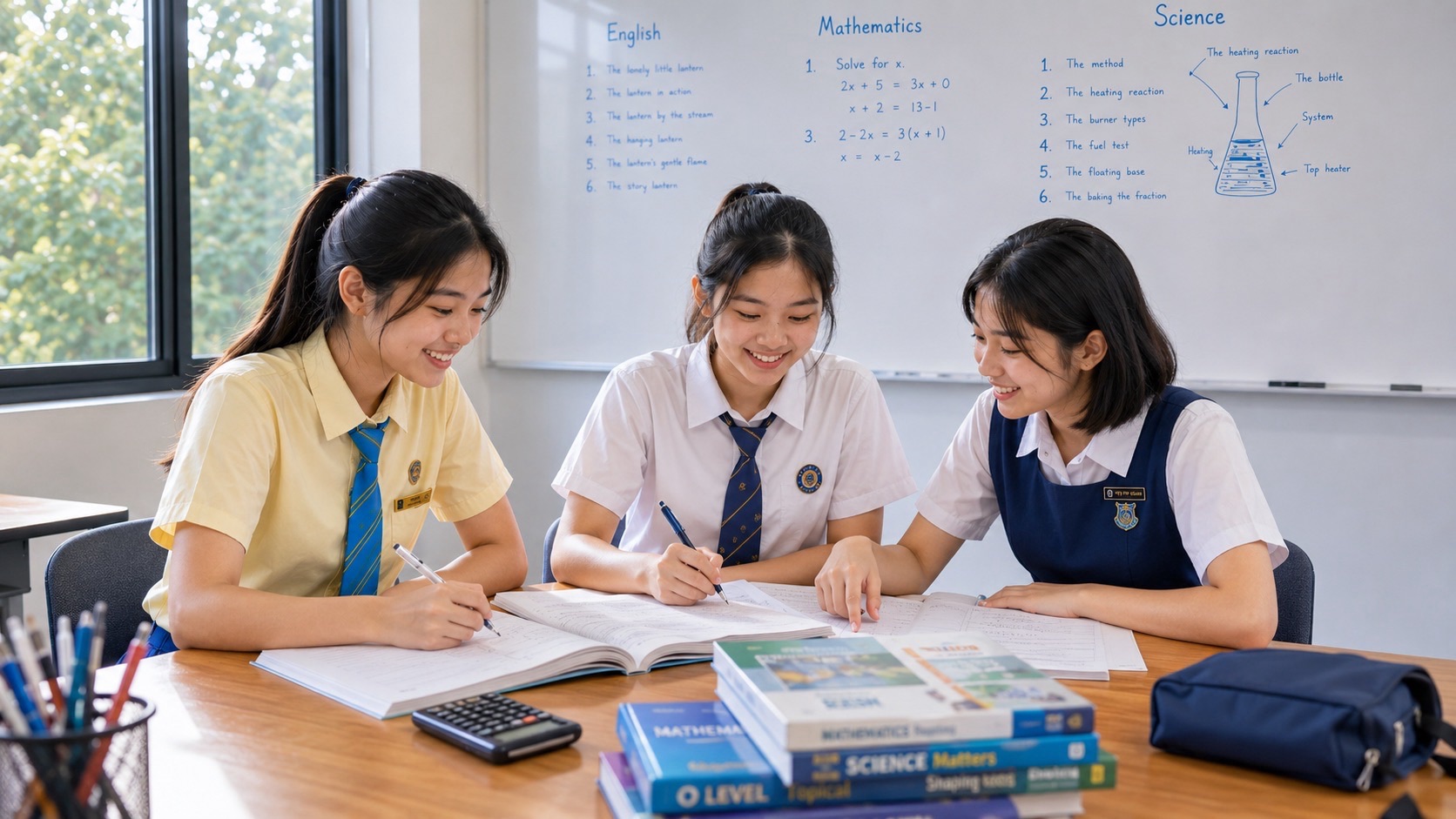
Memory and retention for students in Punggol matter because school is cumulative. A child cannot keep rebuilding every topic from zero each time it returns. Multiplication supports fractions. Vocabulary supports comprehension. Algebra supports functions. Scientific concepts return in more complex forms. Writing structures, grammar and background knowledge all become raw material for later thinking. When earlier learning disappears too quickly, every new topic becomes heavier than it needs to be.
That is the core aim of Punggol education through memory and retention: help students encode important knowledge clearly, retrieve it repeatedly, revisit it across time and connect it to new learning so useful knowledge remains available when it is needed. Memory is not the opposite of understanding. Strong understanding and strong memory support one another.
The Core Aim in One Sentence
Retention means learning survives long enough to support future thinking, not merely today’s worksheet.
A student who remembers enough foundational knowledge can use working memory for harder reasoning. A student who has forgotten the basics must spend mental effort reconstructing them while also trying to solve the new problem.
Did You Know? Understanding Today Does Not Guarantee Recall Next Month
Students often leave a lesson thinking, “I understand it.” That may be true.
But understanding at the end of a lesson and retrieving knowledge after a delay are different tests.
The educational goal is therefore not only immediate comprehension. It is durable learning.
The Five Jobs of Memory in Learning
1. Encoding
Encoding is the process of getting new information into memory in a meaningful form.
Students encode better when they connect new ideas to prior knowledge, explain meaning, compare examples and notice relationships rather than merely copy words.
2. Consolidation
Learning needs time to stabilise.
Rest and sleep matter because the brain is not simply “off” when students stop studying. Recovery supports the processes that help learning become more durable.
The eduKatePunggol article English Education Systems and Sleep explores how rest, fatigue and consolidation interact with learning performance.
3. Retrieval
Knowledge becomes useful when the student can bring it back without immediate support.
This is why active recall is central to memory. Retrieval tests whether the knowledge is genuinely available.
4. Reconstruction
Memory is not a perfect recording. Students rebuild knowledge from stored pieces, cues and relationships.
That means explanations, diagrams, examples and conceptual connections matter because they give the learner more routes back to the idea.
5. Transfer
The strongest memory is not only remembered. It is usable.
Students need to retrieve knowledge in new contexts, combine it with other ideas and recognise when it applies.
Memory Is Not Just Memorisation
Memorisation often refers to deliberately learning facts, formulas, vocabulary or sequences. Memory is broader.
Students need memory for:
- facts;
- concepts;
- procedures;
- vocabulary;
- examples;
- patterns;
- strategies;
- relationships between ideas.
A student cannot reason with knowledge that is completely unavailable.
Understanding and Memory Work Together
There is a common false choice between “understanding” and “memorising”. In real learning, the two reinforce each other.
Understanding gives memory structure. Memory gives understanding something stable to work with.
For example, a student who understands why a Science process happens is more likely to remember the sequence meaningfully. A student who remembers the core terms can then follow a more advanced explanation without constantly stopping to reconstruct vocabulary.
Memory and Active Recall
Active recall is one of the strongest practical tools for checking retention.
The student closes the source and tries to retrieve before looking.
- write the definition;
- draw the process;
- explain the concept aloud;
- solve the question;
- reconstruct the formula;
- list the key arguments.
Then the learner checks, repairs and later retrieves again.
See The Core Aim of Punggol Education | Active Recall.
Memory and Spaced Repetition
Memory weakens over time when knowledge is not revisited.
Spaced repetition deliberately brings important material back after delays so the student has to reconstruct it again.
The article The Core Aim of Punggol Education | Spaced Repetition develops this rhythm of return.
Memory and Interleaving
Interleaving helps students retrieve and select knowledge under mixed conditions.
Instead of receiving repeated cues from one chapter, the learner must decide which method or concept applies.
See The Core Aim of Punggol Education | Interleaving.
The Retention Problem: Same-Day Familiarity
Students often judge learning immediately after practice.
They solve five similar questions correctly and conclude that the topic is mastered. But immediate success may depend on short-term memory, recent cues or the fact that the method has not changed.
A better mastery test includes delay.
Can the student still perform tomorrow? Next week? In a mixed paper? In a differently worded question?
The Retention Test
A topic deserves to be called secure when the student can:
- retrieve the key knowledge after a delay;
- explain it without the original notes;
- apply it in a new form;
- distinguish it from similar concepts;
- recover after a small error;
- use it while attention is divided by a larger problem.
Retention therefore has both a time dimension and a transfer dimension.
Memory in Primary School
Primary-school memory should be built through meaning, repetition and regular return.
- number facts;
- spelling;
- vocabulary;
- grammar patterns;
- Science concepts;
- reading knowledge;
- problem-solving structures.
Young students benefit from short, frequent review more than rare marathon sessions.
The strongest habit is simple: learn something, use it, return to it later and connect it to something new.
Memory During PSLE
PSLE preparation depends heavily on retention because students must keep a large body of Primary-school learning available at once.
A useful Primary 6 memory system includes:
- active recall for key facts and concepts;
- spaced review across weeks;
- mixed questions across topics;
- error logs for repeated failures;
- cumulative practice;
- sleep and recovery;
- targeted repair instead of endless repetition.
The aim is to reduce the amount of knowledge that has to be relearned from scratch near the examination.
Memory in Secondary School
Secondary school increases both the amount and abstraction of knowledge.
Students need to retain earlier algebra while learning new functions, earlier Science concepts while building more complex mechanisms, and prior vocabulary while reading increasingly demanding texts.
The cost of forgetting compounds because new topics assume old ones.
Memory in Mathematics
Mathematics memory includes more than formulas.
Students need ready access to:
- number facts;
- algebraic conventions;
- definitions;
- standard relationships;
- common transformations;
- problem structures;
- method cues.
When basic knowledge becomes automatic enough, the student has more mental room for multi-step reasoning.
The article Why Your Child Forgets Maths After a Week — Build Retention, Not Same-Day Familiarity develops this subject-specific problem.
Memory in Science
Science retention requires both factual recall and conceptual connection.
Students need to remember terms, processes, variables, relationships and causal mechanisms — then apply them to unfamiliar observations.
A strong Science memory routine moves from definition → explanation → diagram → application → delayed retrieval.
Memory in English
English memory supports vocabulary, grammar, reading comprehension and writing.
Vocabulary especially needs repeated encounters in different contexts. A word remembered only as a flashcard definition may still fail to appear during composition.
The student should see, retrieve, say, write and later reuse important language.
The eduKatePunggol article English Education Systems and Memory explores encoding, retrieval, forgetting and reconstruction in language learning.
Memory and Background Knowledge
Background knowledge makes new learning easier because the student has more existing ideas to connect with.
A student who knows more about ecosystems understands a new environmental passage faster. A student with broad vocabulary can interpret more precise explanations. A student who remembers fractions can access ratio more easily.
Memory therefore compounds: stored knowledge becomes infrastructure for future knowledge.
The Memory Mistake: Copying Notes
Copying can help organise information, but it does not automatically produce retention.
A student can copy an entire page accurately while thinking very little about meaning.
A stronger note routine is:
- read;
- close the source;
- write the main ideas from memory;
- reopen;
- correct;
- condense;
- retrieve later.
The note becomes a tool for reconstruction rather than transcription.
The Other Memory Mistake: Memorising Without Meaning
Students sometimes memorise words or steps that they do not understand.
This can work briefly and then collapse when the question changes.
Strong memory should attach facts to meaning, examples, causes, structures and use cases wherever possible.
Chunking
Students often remember better when information is organised into meaningful chunks.
Instead of memorising ten unrelated points, group them into three larger ideas with internal structure.
Chunking reduces the number of separate items working memory has to manage and helps the learner reconstruct details from the larger pattern.
Dual Representation
Some ideas become easier to retain when represented in more than one useful way.
Students can combine:
- words and diagrams;
- equations and graphs;
- definitions and examples;
- timelines and explanations;
- process descriptions and labelled drawings.
The goal is not decorative note-making. It is creating multiple meaningful access routes to the same idea.
Elaboration
Elaboration means connecting new knowledge to what the student already knows.
Useful prompts include:
- Why is this true?
- What does this remind me of?
- What is an example?
- What is a non-example?
- How is this different from a similar idea?
- Where would I use this?
These connections can make retrieval more flexible because the memory is not stored as one isolated sentence.
Memory and Sleep
Students sometimes trade sleep for additional revision hours.
That trade can backfire when fatigue reduces attention, encoding, emotional regulation and later performance.
The goal is not to choose sleep instead of study. It is to organise study early enough that sleep can remain part of the learning system.
See Sleep and Recovery for Exams.
Memory and Student Wellbeing
Chronic overload can make retention harder because students have less attention and recovery capacity.
A good retention system often reduces stress by distributing review across time rather than forcing repeated relearning before every test.
See The Core Aim of Punggol Education | Student Wellbeing.
Memory and Self-Regulated Learning
A self-regulated learner tracks which knowledge is secure and which is fragile.
The student can then allocate review according to evidence instead of revising everything equally.
See The Core Aim of Punggol Education | Self-Regulated Learning.
Memory in the Age of AI
AI makes external information retrieval extremely fast. That does not make human memory irrelevant.
Students still need internal knowledge to:
- understand the question;
- notice when an AI answer is implausible;
- ask better follow-up questions;
- connect new information to prior knowledge;
- reason without constant interruption;
- perform in closed-book assessments;
- retain enough context to make good judgments.
AI reduces the cost of looking things up. It does not remove the value of having a well-stocked mind.
The External-Memory Trap
Students can become dependent on notes, search engines or AI if every uncertainty triggers immediate lookup.
A healthier sequence is:
- try to retrieve;
- state what is known;
- identify the gap;
- look up only the missing piece;
- close the source;
- reconstruct again.
This lets external tools support internal memory instead of replacing it.
A Simple Memory Cycle
- Understand — make meaning first.
- Connect — link to prior knowledge.
- Retrieve — close the source and produce.
- Check — compare with a reliable standard.
- Repair — correct the gap.
- Space — return after a delay.
- Mix — use with other topics.
- Apply — transfer into a new problem.
This cycle works across Primary and Secondary subjects.
How Parents Can Support Memory and Retention
- Ask children to explain without notes.
- Bring old learning back casually.
- Help schedule short spaced reviews.
- Avoid treating forgetting as laziness.
- Encourage correction after failed recall.
- Protect sleep.
- Ask what will be reviewed next week, not only tonight.
- Praise retained learning rather than hours spent.
Parents can make memory more durable by normalising repeated return instead of expecting one exposure to be enough.
How Tutors Can Build Retention
- Start with retrieval from earlier lessons.
- Bring repaired errors back later.
- Mix old and new material.
- Ask for explanation before showing the model answer.
- Track which concepts decay quickly.
- Use cumulative quizzes.
- Check whether performance survives without prompts.
- Reduce support as retention strengthens.
At eduKatePunggol, learning is strongest when a concept remains available between lessons and still works when the tutor is not present.
What Progress Looks Like
Memory and retention progress is visible when students:
- remember older topics with less relearning;
- retrieve key knowledge after delays;
- use earlier knowledge in new topics;
- need fewer prompts;
- retain corrections;
- show stronger cumulative performance;
- can explain concepts without the source open;
- maintain vocabulary and formulas over time;
- use spaced review naturally;
- distinguish immediate familiarity from durable mastery.
A Simple Retention Check
- Can I explain it without notes?
- Can I still do it tomorrow?
- Can I still do it next week?
- Can I distinguish it from similar ideas?
- Can I use it in a new question?
- Can I recover if I forget one part?
If several answers are no, the topic may be familiar but not yet durable.
Frequently Asked Questions
How can students improve memory and retention?
Use meaningful encoding, active recall, spaced repetition, mixed practice, feedback, sleep and repeated application rather than relying mainly on rereading.
Why do students forget after studying?
Forgetting is normal. Retention weakens when material is not retrieved, connected or revisited across time. Same-day understanding does not guarantee long-term recall.
Is memorisation bad for learning?
No. Memorisation is useful when students need reliable access to facts, vocabulary, formulas or procedures. It becomes weak when memorised material is not understood or cannot be applied.
Does sleep affect memory?
Yes. Adequate rest supports attention, learning and memory-related processes. Chronic sleep loss can also reduce the quality of study and performance.
How are active recall and spaced repetition related to memory?
Active recall strengthens retrieval by asking students to produce knowledge before looking. Spaced repetition schedules those retrieval attempts across time so learning becomes more durable.
What is the strongest sign of retention?
The student can retrieve and apply the knowledge accurately after a meaningful delay without having to relearn it from the beginning.
Useful Routes for Punggol Families
- eduKatePunggol home — local education, tuition, parent, student and pathway routes.
- The Core Aim of Punggol Education | Active Recall.
- The Core Aim of Punggol Education | Spaced Repetition.
- The Core Aim of Punggol Education | Interleaving.
- The Core Aim of Punggol Education | Learning How to Learn.
- English Education Systems and Memory.
- Why Your Child Forgets Maths After a Week.
- Sleep and Recovery for Exams.
- Punggol Atlas.
The Best Memory Is Knowledge That Stays Available for the Next Problem
Education should not force students to relearn the same foundations every time a new chapter begins.
That is the core aim of Punggol education through memory and retention: build knowledge strongly enough that it survives time, supports new learning and remains available when students need to think, explain, solve and create.
Properly taught kids shine a bright light into the future.


