Your Primary 5 child remembers the triangle-area formula but chooses a sloping side as the height. Start by naming the base, then finding the perpendicular distance from the opposite vertex to the line containing that base. A Punggol Mathematics tutor can show why those two lengths belong together, so the child selects the measurements before multiplying them.
Primary 5 Mathematics tuition in Punggol should make base and corresponding height a relationship, rather than two numbers taken from anywhere on the diagram. A triangle can be rotated, and its relevant height can run horizontally or fall outside the triangle. What matters is the right angle with the chosen base line, not which segment looks upright on the page.
When choosing a Primary 5 Maths tutor or Mathematics tutorials in Punggol, bring the full diagram and original working. Ask the tutor to check the chosen pair, explain the perpendicular condition and use a fresh orientation independently. This guide includes a labelled illustration and worked examples to help parents understand that teaching task without introducing trigonometry or measuring an unscaled worksheet picture.
eduKate Punggol · Primary Mathematics · Parent questions
Find your next learning step
Start with the question closest to your family, or read the full guide in order.
Chapter index
Choose the pair · Chapters 1–3
See the illustration · Chapters 4–7
Match the height · Chapters 8–11
Check the quantity · Chapters 12–15
Review and continue · Chapters 16–22
A triangle has three sides, and any side can be chosen as a base for its area calculation. Each choice has a corresponding perpendicular height. The base is therefore not automatically the side drawn at the bottom of the page. The tutor should establish which side is being used before discussing its height.
Name the side through its endpoints, such as AB. Then identify the opposite vertex, C. The corresponding height is the perpendicular distance from C to the line containing AB. This definition gives the student an action they can follow in a differently oriented diagram.
If the child picks the bottom side and the longest other side, ask why those lengths form a pair. Their availability on the page is not enough. A valid area calculation needs the base length and its corresponding perpendicular height. An unrelated side length does not become a height because it is labelled.
Preserve the original selection. It can show whether the student knows the formula but misidentifies the measurements, or understands the pair but makes an arithmetic error. Those are different next teaching steps. More multiplication practice will not establish the perpendicular relationship.
A precise parent note might say: “Uses half times base times a labelled sloping side; does not check the right angle.” That gives the tutor a focused task. “Cannot do triangle area” hides the useful formula knowledge the child may already possess and makes the repair less specific.
CHAPTER 2 OF 22 · Choose the pair
2. Perpendicular Describes a Right-Angle Relationship
Perpendicular lines meet at a right angle. For the chosen base, the corresponding height runs from the opposite vertex to the base line at that angle. The relationship remains true when the drawing is rotated. Upright and horizontal describe the page; perpendicular describes the geometry.
A small right-angle marker can make the relationship visible. Ask the child which two lines form the marked angle. The height must meet the chosen base line, not simply some other segment in the figure. The tutor should connect the marker with the actual base-height pair.
If no right-angle mark is supplied, use the wording and given properties to establish the relationship. A right-angled triangle may have two sides explicitly perpendicular. Another diagram may label a perpendicular distance. Do not infer a right angle solely because two lines look close to vertical and horizontal in an illustration.
Parents can ask, “What tells us these lengths meet at a right angle?” That question directs attention to evidence. It should not become a demand to justify every familiar property with advanced Mathematics. The tutor can explain the relevant given condition at the child's current level.
For independent review, change the orientation of a clear diagram while preserving its geometry. Ask the student to identify the chosen base and corresponding height again. If they rely on page direction, the selection may change incorrectly. The fresh orientation reveals that uncertainty more directly than another identically positioned triangle.
CHAPTER 3 OF 22 · Choose the pair
3. A Sloping Side Can Be a Height in a Different Valid Pair
A segment's appearance does not decide its role. In a right-angled triangle, one leg can be the base and the other perpendicular leg its height. Rotating that triangle can make either leg look sloping on the page without changing their right-angle relationship.
The correct caution is therefore not that every sloping side is forbidden. It is that the selected height must be perpendicular to the selected base. A labelled side may be useful as a base, as a corresponding height in a right-angled pair, or as a perimeter length. Its job depends on the relationship being used.
This distinction prevents another brittle shortcut. A child who learns “never use a sloping side” may reject a valid perpendicular leg after the diagram is rotated. Teach the right-angle condition instead. The student can then use evidence rather than a visual category that changes with page orientation.
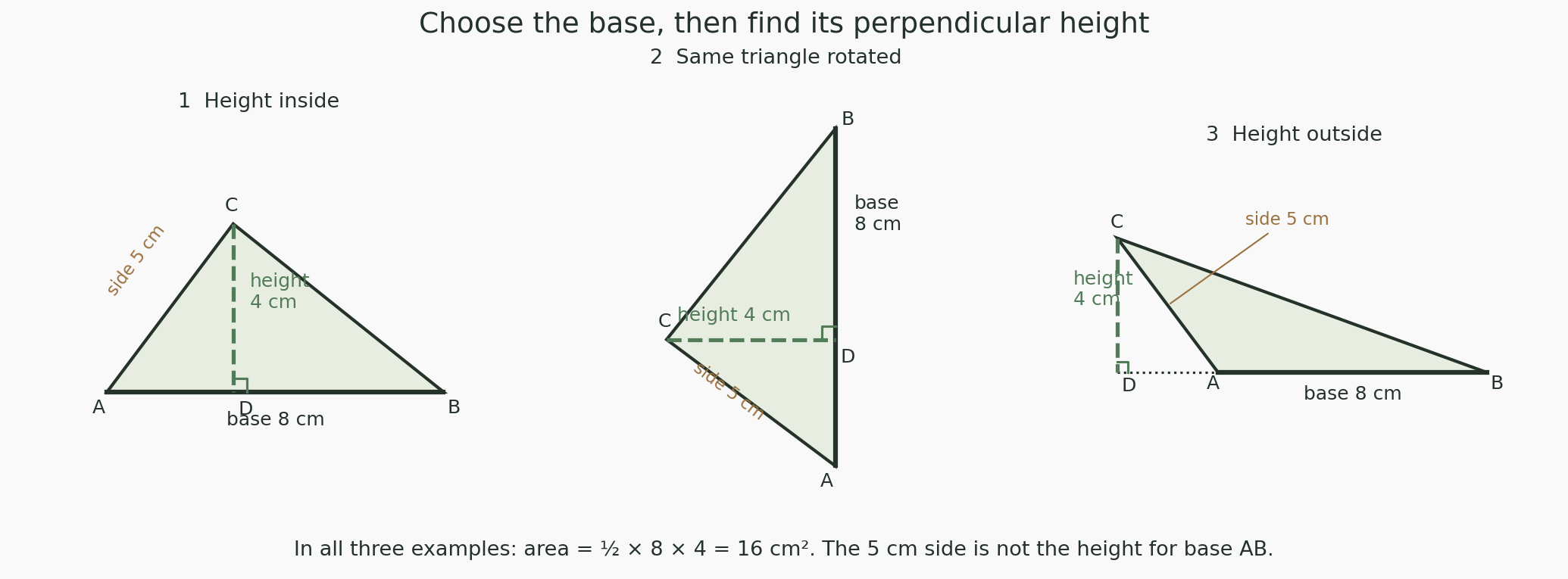
In the illustration used in this guide, side AC is five centimetres and is not perpendicular to base AB. The corresponding height CD is four centimetres. Those roles belong to this chosen pair. They do not claim that a five-centimetre side could never be a base in a different calculation.
Ask the child to explain the actual selection in words. “AB is my base, and CD meets its line at a right angle” is a useful account. A memorised statement that green lines are heights would not transfer to an uncoloured school diagram. Labels and properties should carry the meaning.
CHAPTER 4 OF 22 · See the illustration
4. Use the Labelled Illustration to Compare Three Orientations
The illustration below shows three examples. In each, AB is the chosen eight-centimetre base and CD is the four-centimetre perpendicular height. Side AC is five centimetres. The middle example rotates the first triangle, while the last shows a different triangle with the height outside it.

In the first example, the height falls inside the triangle and meets the horizontal base. In the rotated example, the base runs vertically and its height runs horizontally. The right angle still connects them. Rotation changes how the pair appears on the page, not the measured area.
In the external-height example, D lies beyond A on the line containing AB. The height CD still begins at the opposite vertex C and meets that line perpendicularly. The extension helps locate the height; it does not increase the chosen base AB beyond its eight-centimetre length.
All three area calculations use one half multiplied by eight multiplied by four, giving sixteen square centimetres. Multiplying eight by the five-centimetre side instead would use a length that is not the corresponding height for base AB. The illustration makes that selection error visible before arithmetic begins.
Ask the child to point to AB, C, CD and the right-angle marker in each example. Then remove the illustration for a fresh diagram. The pointing task is guided recognition; the later independent selection should establish whether the relationship is available without colour or a familiar orientation.
CHAPTER 5 OF 22 · See the illustration
5. Worked Example: The Labelled Side Is Not the Height
Consider a triangle with chosen base AB of eight centimetres. The perpendicular from C to the base line has length four centimetres. Another side, AC, is labelled five centimetres and is not perpendicular to AB. Find the area using the supplied base-height pair.
The area is one half times eight times four, which equals sixteen square centimetres. The eight measures the chosen base, and the four measures the corresponding perpendicular height. Their roles justify the multiplication. The half accounts for the triangle's area relationship.
A child may compute one half times eight times five and obtain twenty. The arithmetic is correct for those selected values, but the five-centimetre side does not satisfy the height condition. The tutor should preserve the successful computation while repairing measurement selection.
Ask what evidence makes four the corresponding height. The diagram or wording supplies its perpendicular relationship with the AB line. Ask what would be needed to use AC as a base instead. A corresponding perpendicular height to the AC line would be required; the student cannot keep an unrelated four automatically.
For transfer, use a different suitable triangle with base ten centimetres and corresponding height six, plus an unrelated labelled side. The area is thirty square centimetres. Let the student select the valid pair before calculating. A correct result after an adult circles the two measurements provides guided evidence, which should be recorded separately from independent selection.
CHAPTER 6 OF 22 · See the illustration
6. Why the Formula Uses Half the Base-Height Product
The base-height product describes the area of a related parallelogram, and a diagonal divides a parallelogram into two congruent triangles. Each triangle therefore has half that area. A suitable cut-and-rearrange or duplicated-triangle representation can help make the relationship visible without advanced calculation.
The perpendicular height measures the separation of the relevant parallel base lines in the related parallelogram. A sloping side is not that separation unless it is perpendicular to the base. This connection explains why multiplying the base by any convenient side length does not generally produce the triangle's area.
Use a clear representation appropriate to current learning. A rectangle divided diagonally is a straightforward starting case. Then connect the same area relationship with a suitably shown parallelogram or a shifted triangle. The tutor should avoid implying that every arbitrary sloping-side product describes a rectangle containing the triangle exactly.
A learner who memorises the half may still select the wrong height. A learner who selects the pair correctly may forget the half. Those are separate errors. The explanation should establish both the measurement relationship and the triangle-area factor, then check each in fresh work.
Parents can ask what the explanation is intended to repair. If the concern is measurement selection, use the formula's meaning to support that choice. Do not turn a focused height lesson into a long proof exercise that overwhelms the original task. The student needs enough reasoning to understand why the chosen pair works and use it again.
Rotating a triangle changes its orientation while preserving its lengths and angles. The area of that same triangle remains unchanged. If a valid base-height pair is rotated with the figure, the base and height still meet the required perpendicular relationship.
The middle illustration makes this concrete. AB becomes vertical, while CD becomes horizontal. Their lengths remain eight and four centimetres. The area calculation still gives sixteen square centimetres. A rule that height must be vertical on the page would fail this unchanged triangle.
Ask the child to trace the chosen base before finding the height. This action can reduce reliance on a familiar bottom-side layout. The opposite vertex and perpendicular connection provide a stable route through the rotated diagram.
Do not require the student to rotate the physical page every time. Turning the page can be a useful temporary support, but the goal is recognising the relationship in the given orientation. Record whether that support was used and check another diagram with less assistance when appropriate.
For a fresh independent example, show a triangle whose base is tilted and whose perpendicular height is clearly supplied. Keep the numbers simple. The tutor should observe selection before computation. If the student identifies the valid pair but multiplies inaccurately, preserve the geometry success and address the numerical step separately.
CHAPTER 8 OF 22 · Match the height
8. An External Height Still Measures the Perpendicular Distance
For some triangles and chosen bases, the perpendicular from the opposite vertex meets the base line outside the side segment. The height is then drawn to an extension of that line. It still measures the required perpendicular distance and can be used in the area formula.
The external-height illustration uses AB as the eight-centimetre base. D lies beyond A, and CD is the four-centimetre perpendicular. The line through AB is extended to locate D. The chosen base length remains AB, not the longer distance from D to B.
A child may include the extension in the base calculation because it lies along the same line. Ask which side was chosen as the base and where its endpoints are. The extension is a construction for locating height; it is not automatically part of the triangle's base segment.
Another student may reject CD because it lies outside the shaded triangle. The tutor should return to the definition: perpendicular distance from the opposite vertex to the line containing the chosen base. The line, not only the interior region, establishes where the perpendicular can meet.
Use an explicit labelled example before removing support. The student should be able to explain both why the external height is valid and why the extension does not change AB's length. A fresh diagram with different labels can then check whether those two decisions transfer independently.
In a right-angled triangle, the two legs meeting at the right angle form a valid base-height pair. If those legs measure six and eight centimetres, the area is one half times six times eight, or 24 square centimetres. Either leg can serve as the chosen base with the other as its corresponding height.
The hypotenuse is the side opposite the right angle. Its length is not automatically the height for either leg. A student may choose it because it is the longest labelled side. The tutor should point to the right-angle relationship that identifies the valid pair.
This explanation does not require calculating a missing side using Pythagoras. Use the supplied perpendicular lengths and the child's current learning boundary. The focused task is selecting base and corresponding height from given information, not introducing a secondary-school method unnecessarily.
Rotate the right-angled triangle in a fresh example. The two perpendicular legs may now look sloping. Ask which segments meet at the marked right angle. This checks whether the child follows geometry evidence rather than an instruction to avoid sloping sides altogether.
A valid answer should label square units. The six and eight are lengths in centimetres; their area relationship produces square centimetres. If the student selects and computes correctly but writes a length unit, that final communication needs repair. Keep the successful pair selection visible in the report.
CHAPTER 10 OF 22 · Match the height
10. A Different Base Needs Its Own Corresponding Height
Choosing another side as a base is mathematically possible, but its height must correspond to that side. The perpendicular distance to AB cannot automatically be paired with AC. A diagram may supply several heights, and each needs a clear connection with its chosen base.
For a triangle with area twelve square centimetres, a six-centimetre base has a corresponding height of four centimetres. If another side is eight centimetres, its corresponding height is three centimetres. Both products give the same area after multiplying by one half. The lengths change together as valid pairs.
A child who combines the six-centimetre base with the three-centimetre height obtains nine square centimetres, which uses measurements from different pairs. The arithmetic is not the first issue. The tutor should label which perpendicular belongs to which base line.
These numerical relationships illustrate pairing; the actual worksheet diagram must provide or justify the measurements being used. Do not infer an unlabelled height from how long a segment looks. A correct area formula does not authorise invented measurement data.
For independent review, offer a clear diagram with two valid pairs and ask the student to choose one and explain it. Then check the second pair where suitable. Agreement in area can confirm the pairing when both sets of measurements are genuinely supplied. The tutor should preserve the student's chosen valid route rather than insist on one particular base without a reason.
If the area and chosen base are supplied, the corresponding height can be found from the same relationship. With area 24 square centimetres and base eight centimetres, doubling the area gives 48, and dividing by eight gives a height of six centimetres.
Explain what the result represents. Six is the perpendicular distance to the eight-centimetre base line. It is not automatically a sloping side length or the vertical dimension of the whole drawing. The equation determines the corresponding height for that selected base.
A student may divide the area by the base and obtain three, forgetting the factor of one half. The tutor can reconnect the calculation with the formula: the base-height product is twice the triangle's area. This repairs the relationship rather than supplies an unexplained instruction to multiply by two.
Check by returning to the area. One half times eight times six equals 24 square centimetres. Then verify that the requested unknown is indeed the corresponding height. A numerical check cannot establish that a labelled sloping side is the same segment unless the geometry supplies that connection.
For a fresh task, use area thirty square centimetres and base ten centimetres. The corresponding height is six. Keep the earlier solution out of view and ask the child to name the unknown before calculating. Record any prompt about doubling area so that independence is assessed honestly.
Two triangles can have equal area when they share the same base length and the same corresponding perpendicular height. Their sloping side lengths or vertex positions along a parallel line may differ. The base-height relationship, rather than their overall appearance, determines the equality.
Imagine a fixed eight-centimetre base and opposite vertices on a line parallel to it four centimetres away. Each triangle has area sixteen square centimetres. Moving the vertex along that parallel line changes the sloping sides but preserves the perpendicular height.
This is a useful contrast for a child who chooses the longest side as height. The longest-looking side may change while the area remains fixed. The tutor should show the parallel-line separation clearly and connect it with the chosen base, rather than ask the learner to guess equal areas from the drawings.
A question about area comparison may therefore be solved through the shared relationship without calculating every unrelated length. The child should explain which base and height are equal. If the diagram does not supply that evidence, the equality should not be assumed from appearance alone.
For independent review, use a clearly labelled pair and ask what measurements matter. Keep the task appropriate to current schoolwork. The purpose is to strengthen height meaning and a useful comparison, not to expand a focused repair into every possible triangle theorem.
Perimeter measures the boundary length, so it uses the triangle's side lengths. Area measures the enclosed region and can use a chosen base with its corresponding perpendicular height. A side that is unnecessary for one area calculation may be essential to the perimeter calculation.
This distinction explains why a worksheet might label a five-centimetre sloping side even when a four-centimetre height is supplied for area. The extra label does not automatically mean every number should be multiplied together. Read the requested quantity and choose the relevant relationships.
A child may add the three side lengths and call the result area. Another may multiply a base and side because those are the prominent boundary labels. The tutor should connect each measurement with the quantity it describes before reviewing formulas.
Units help make the distinction visible. A perimeter answer uses centimetres for centimetre side lengths. An area answer uses square centimetres. The unit alone does not prove that the calculation is correct, but it can reveal whether the final quantity has been interpreted coherently.
A small contrast set can use the same labelled triangle and ask separately for perimeter and area where all needed data are supplied. The student should select relevant measurements for each. If the area height is missing, do not use an unrelated side merely to make the exercise solvable. State the missing information and choose a complete example for practice.
CHAPTER 14 OF 22 · Check the quantity
14. Do Not Measure an Unscaled Diagram to Supply a Missing Height
A diagram may not be drawn to scale. Its appearance can help show relationships, but measuring a screen or printed segment does not establish a missing mathematical length unless the task explicitly asks for measurement under suitable conditions. Use the given labels and properties.
Resizing, photographing or printing can alter displayed lengths. Even a carefully drawn figure should be interpreted according to its instructions. The tutor should ask which measurement is supplied and which relationship justifies the chosen height, rather than rely on a ruler applied to an unscaled exercise.
A student who estimates a height from appearance may obtain a plausible area that does not follow from the information. Preserve that response and explain the difference between a geometric relationship and a physical measurement task. Both can be useful learning activities, but they have different rules.
Bring the complete diagram to tuition. A cropped photo may omit the right-angle marker or label that supplies the height. The tutor should establish whether the information is actually missing before describing the student's choice as a misunderstanding. Practical source quality can affect interpretation.
The existing PSLE answer-key disagreement guide provides a wider checking route when the supplied information and key cannot be reconciled. For this focused geometry concern, identify the valid pair from evidence and seek clarification if the required relationship remains genuinely unspecified.
CHAPTER 15 OF 22 · Check the quantity
15. Compatible Units Come Before Multiplication
The base and height should use compatible length units before the area calculation. If the base is two metres and the corresponding height is fifty centimetres, convert fifty centimetres to half a metre or two metres to two hundred centimetres. The selected route determines the area unit.
Using metres, one half times two times one half gives one half square metre. Using centimetres, one half times two hundred times fifty gives five thousand square centimetres. These describe the same area, because one square metre contains ten thousand square centimetres.
A child who multiplies two by fifty and labels the result square metres has combined different units without accounting for their scale. The tutor should preserve any correct perpendicular selection and repair the unit conversion separately. Do not describe the error as a height-selection failure if the geometry was understood.
Use such conversions where they fit current schoolwork and the child's readiness. If the original concern is choosing the height, begin with matching units and simple values. Introduce a conversion demand deliberately after the pair relationship is secure, so a new difficulty does not hide the earlier progress.
For a fresh suitable example, use a one-metre base and a forty-centimetre perpendicular height. In centimetres, the area is one half times one hundred times forty, giving two thousand square centimetres. Ask the student to state the chosen units before multiplying and label the final quantity clearly.
A fast formula calculation with the wrong height remains wrong for the question. Begin by observing which measurements the child selects and why. The tutor can teach a short routine: name the base, locate the opposite vertex, identify the perpendicular to its line and read the corresponding length.
The routine should be explained through geometry, not imposed as four phrases to recite. Let the child point to the actual segments and right-angle evidence. Then connect the pair with the formula. This gives each action a purpose and makes the first uncertain link visible.
Guided practice can use colour or labels, followed by an uncoloured fresh diagram. Record which support remains necessary. A child who succeeds only after the tutor highlights the height has completed a guided step, which can lead towards independence but does not yet show unprompted selection.
Once selection is secure, calculation fluency and concise recording can receive attention. The tutor should preserve the geometry success while addressing arithmetic or units. Increasing speed before the measurement relationship is understood may simply make the wrong selection more automatic.
Parents can ask what the next lesson will check. A fresh rotated or external-height diagram with manageable numbers is a meaningful test of this concern. A harder multiplication on the same familiar triangle is less informative about whether the child understands corresponding height.
A focused set can include an internal height, a rotated triangle, an external height and a right-angled triangle. Keep the given evidence clear. Ask the child to identify the base-height pair before calculating, then explain one selection briefly.
Include an unrelated labelled side in a suitable example. The student should not use every available number merely because it appears on the page. The tutor can ask which condition makes a measurement relevant. This tests selection while preserving the same area relationship.
A contrast can also include two different base-height pairs in one triangle, where both are explicitly supplied. The student should keep each pair together. Do not introduce multiple heights without labels and then blame the child for guessing which one belongs to which side.
Remove the worked model during independent practice. If the parent says “use the dashed line,” record that cue. A later unprompted example can check whether the student recognises the perpendicular relationship rather than the visual style of the teaching diagram.
Finish the agreed set without extending it automatically. If the same selection error remains, preserve the original attempt for the tutor. The parent should not have to produce a successful-looking page by circling every valid pair. A visible unresolved decision is useful evidence for the next focused lesson.
A useful tutor report distinguishes measurement selection, formula use, arithmetic and units. For example: “Remembered the formula; initially selected the sloping side; identified the perpendicular height after a diagram explanation; then selected the pair in a fresh rotated triangle independently.” That describes the learning change.
If the external-height case still requires support, name it. The next lesson can explain the base-line extension and verify that its added segment does not become part of the chosen base length. A general comment that triangles need more work gives the parent less useful guidance.
Ask for a small home action that reinforces the same decision. It might be one fresh labelled diagram with the child identifying the pair before computing. Keep new unit conversions or missing-height calculations deliberate. Do not add every geometry topic at once and then assume the original repair failed.
Protect successful knowledge. A student who selects the valid pair but forgets the half has a different issue from one who computes perfectly with an unrelated side. The tutor should preserve what is secure and identify the specific next step.
Ask what outcome will close the focused practice. Look for independent selection across suitable orientations, a clear reason for the perpendicular pair and a correctly labelled area. Once those become dependable, return the skill to ordinary revision and connect it with current Primary 5 learning.
CHAPTER 19 OF 22 · Review and continue
19. Worked Example: Two Smaller Triangles Share the Same Height
Consider a triangle ABC with base AB of ten centimetres and corresponding perpendicular height six centimetres. Point P lies on AB, with AP four centimetres and PB six centimetres. Joining C to P divides the triangle into two smaller triangles. Find their areas using the supplied common base line.
Triangle ACP has base AP of four centimetres. Its opposite vertex is C, whose perpendicular distance to the line through AP is six centimetres, because AP lies on the same AB line. Its area is one half times four times six, or twelve square centimetres.
Triangle PCB has base PB of six centimetres. Its opposite vertex is also C, and the corresponding perpendicular distance to the same line is six centimetres. Its area is eighteen square centimetres. The areas add to thirty, matching one half times ten times six for the full triangle.
The joining segment CP is not automatically the corresponding height for either chosen base. Its role here is to divide the region. Unless it is supplied as perpendicular to AB, the student should not substitute its length for the common six-centimetre height. The tutor should connect each smaller base with the same base line.
This example is useful when a child assumes every interior line is a height. An interior segment can be a dividing side, while a different perpendicular supplies the area height. Ask which condition establishes the right angle before calculating. The position inside the triangle alone does not settle its role.
For independent transfer, use a twelve-centimetre base divided into lengths five and seven, with common perpendicular height four. The smaller areas are ten and fourteen square centimetres, totalling 24. Ask the student to identify the shared height and explain why the base parts keep the same reference line.
CHAPTER 20 OF 22 · Review and continue
20. Separate Geometry Selection From Arithmetic Repair
Suppose a child correctly chooses base eight and height four but writes half times eight times four as twelve. Their measurement selection is secure in that attempt. The tutor should inspect the arithmetic rather than repeat the whole explanation of perpendicular height. A correct pair can be preserved while the computation is repaired.
Another student calculates twenty accurately from half times eight times five. Here the computation fits the chosen values, but the five is an unrelated side for base AB. The next lesson should repair the pairing. These two wrong answers have different causes, so the home task should differ too.
A third learner obtains sixteen but labels it centimetres. The calculation and selection may be successful, while the unit communication needs correction to square centimetres. Ask what quantity area measures and connect the unit with a region. Do not erase evidence of successful geometry because the final label needs repair.
A brief report can state all four actions: selected the pair, used the half factor, computed the product and labelled square units. The tutor can identify the first uncertain action and check it freshly. That keeps progress precise and makes the next teaching task easier for the parent to support.
The final independent question should be suitable for that task. Use simple numbers when testing geometry selection, and a known valid pair when testing computation. Combine demands when the separate links are dependable. The child can then experience a completed correction, with each successful connection carried into current schoolwork.
Must the base be at the bottom of the triangle?
Any side can be chosen as a base, with its own corresponding perpendicular height. Page orientation does not determine the pair. Ask the child to name the chosen side and find the perpendicular from the opposite vertex to its line. The measurements must belong to that same relationship.
Can the height be outside the triangle?
Yes. The perpendicular can meet an extension of the chosen base line. The height still measures the distance from the opposite vertex to that line. The extension helps locate it but does not automatically enlarge the selected base segment. Use labels to keep those roles clear.
Is a sloping side always wrong as a height?
No. A rotated right-angled triangle can have perpendicular legs that both look sloping on the page. The relevant question is whether the selected height is perpendicular to the chosen base. In the guide's illustration, the five-centimetre side is not the corresponding height for AB.
What if my child knows the formula but gets the answer wrong?
Check selection, the half factor, arithmetic and units separately. Preserve the successful parts. A tutor should locate the first mismatch and teach that connection. A fresh orientation tests height meaning more directly than repeating calculations on the same familiar diagram.
Should we introduce trigonometry to find the height?
This focused Primary 5 task uses supplied lengths and perpendicular relationships. There is no need to introduce a secondary-school method to repair selection from a suitable diagram. Follow the child's current schoolwork and tutor assessment when deciding any extension.
What should I bring to a Punggol Mathematics tutor?
Bring the complete diagram, wording, original selected lengths and any school feedback. Note whether an adult highlighted the height or supplied a formula. The tutor can distinguish independent selection from supported work and choose a fresh check that addresses the actual concern.
CHAPTER 22 OF 22 · Review and continue
22. Let the Right-Angle Relationship Guide the Formula
Choose the base, identify the opposite vertex and find the corresponding perpendicular distance to the base line. Keep the pair together through rotation, external-height cases and unit conversion. Then apply the triangle-area relationship and label the result in square units.
Continue to Primary 5 Mathematics Tuition at eduKatePunggol for the level route. If the family is managing a timetable change, the Primary 5 and Primary 6 lesson-clash guide addresses that separate practical decision.
The child should leave knowing why the selected measurements work, rather than only remembering which numbers an adult circled. Parents gain a clear way to ask about progress, and the tutor gains a useful independent check. Triangle area can then become a relationship the student recognises across diagrams, with the formula recording a choice they understand.