
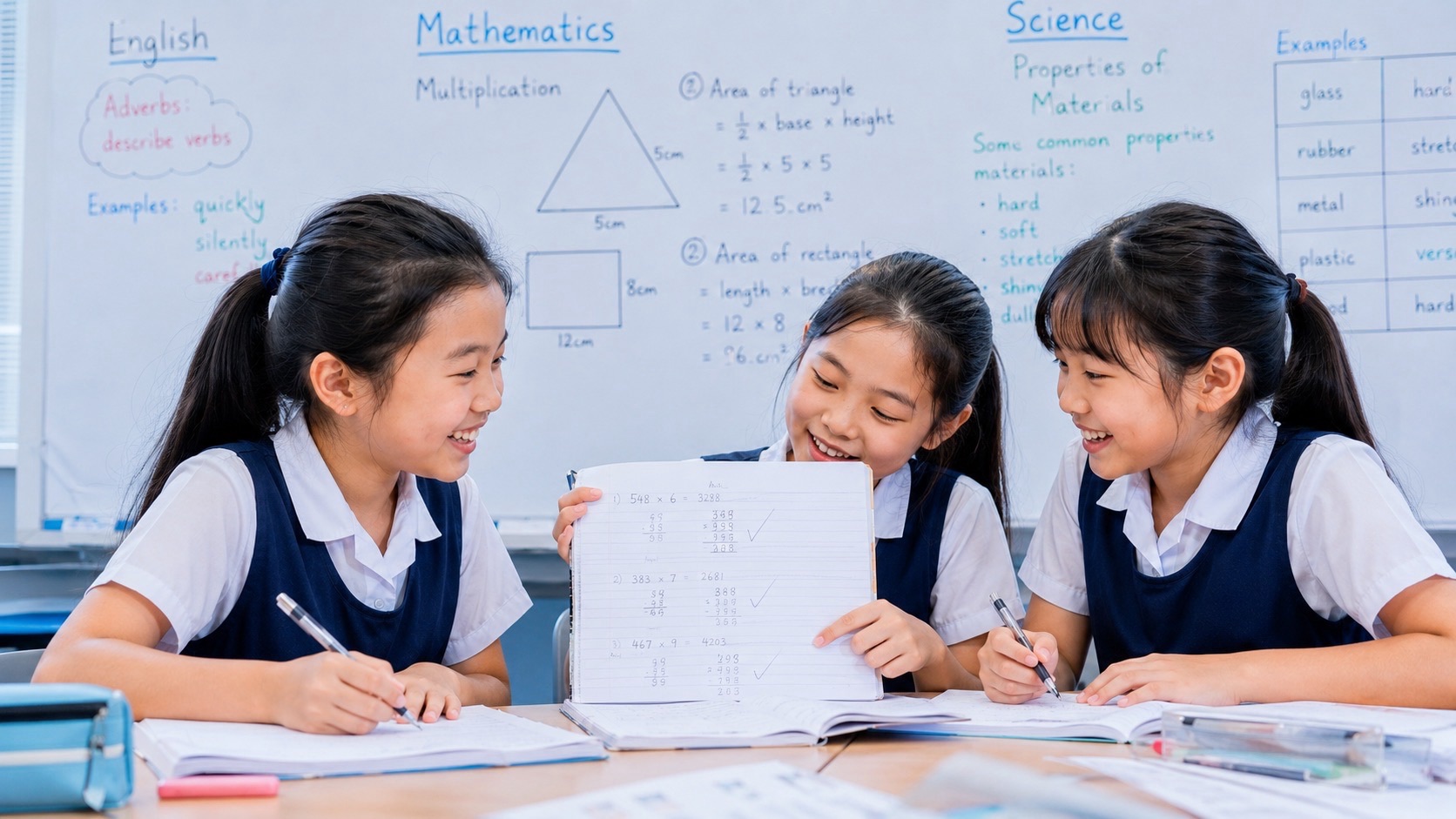
Your child divides correctly, finds a remainder and then chooses the wrong final answer in a PSLE Maths word problem. Start by asking what the question counts: complete groups, leftover objects, containers needed for everything, or an amount that can be divided into fractional units. A Punggol PSLE Mathematics tutor can connect the quotient and remainder with that target, so a correct calculation becomes a correct response to the story.
PSLE Mathematics tuition in Punggol should teach remainder interpretation as part of reading and checking. Forty-three objects packed eight per full box produce five complete boxes and three objects left. If every object must be stored and a partially filled box is allowed, six boxes are needed. The same division supports different answers because the requested quantity changes.
When choosing a PSLE Maths tutor or Mathematics tutorials in Punggol, bring the complete instruction and original working. Ask the tutor to preserve correct division, identify the final decision and check a fresh contrast independently. This guide uses illustrative examples to explain that process; actual examination preparation should follow the applicable subject, current official information and school guidance.
eduKate Punggol · Primary Mathematics · Parent questions
Find your next learning step
Start with the question closest to your family, or read the full guide in order.
Chapter index
Name the target · Chapters 1–3
Choose the interpretation · Chapters 4–7
Check the boundary · Chapters 8–11
Keep units and stages clear · Chapters 12–15
Review independently · Chapters 16–22
- Keep Remainder Interpretation Separate from Examination Promises
- Plan a Small Contrast Set
- Ask the Tutor for a Precise Progress Report
- Worked Example: Buying Whole Packs Leaves Unused Capacity
- Keep the Stages Separate in the Final Review
- Frequently Asked Parent Questions
- Let the Question Decide What the Remainder Means
For whole-number division with a positive whole-number divisor, the dividend equals divisor multiplied by whole-number quotient, plus remainder. The remainder is nonnegative and smaller than the divisor. With 43 divided by eight, the quotient is five and remainder three because five groups of eight use forty, leaving three.
That statement accounts for the entire starting amount. Eight multiplied by five plus three equals 43. The quotient records complete groups under the relevant interpretation, and the remainder records what has not entered those groups. Neither should be discarded before reading the question's target.
A child may compute the quotient and remainder accurately yet be unsure what each counts. Ask them to label the divisor, quotient and remainder within the story. If eight describes objects per box, five describes complete boxes and three describes leftover objects. The units differ.
The tutor should preserve that successful computation while teaching the final interpretation. Calling the whole attempt wrong can obscure what the child already understands. A focused correction might be: “Division is correct; the question asks for enough boxes for all objects, so the remaining three need another permitted box.”
A useful check begins with the relationship itself. If the recorded remainder is eight or more when dividing by eight, another complete group can be made. If the reconstructed total does not equal 43, inspect the division. Only after that numerical relationship is secure should the final context decision be assessed.
A word problem may ask for full boxes, leftover objects, minimum containers or an equal share. These targets are different. The tutor should ask the child to read the final sentence and state the requested quantity before deciding how to use the remainder.
For complete boxes, the quotient counts the full groups that meet the stated group size. For leftover objects, the remainder gives the requested amount. For containers sufficient to hold everything, a nonzero remainder may require an additional container if a partial one is allowed. For a divisible measure, the remainder may contribute a fraction of a unit.
Do not teach a universal “always round up” rule for every remainder. It would fail a question about how many full packs can be made. Nor should the learner always round down, because that can leave some objects unaccounted for in a minimum-container task.
Labels make the decision visible. “Five full boxes” differs from “six boxes needed.” A final number without a label gives less evidence of interpretation. A short quantity sentence is usually enough to connect the calculation with the story.
Parents can ask, “What would this answer allow us to do?” If five boxes each hold eight objects, they store only forty of the 43. If the question requires all objects stored, the proposed five-box answer fails that condition. This practical check explains the decision without supplying a general rounding shortcut.
Consider an illustrative question: 43 cards are packed into complete packs of eight cards. How many complete packs can be made? Five complete packs use forty cards. Three remain, but they do not make another eight-card pack. The requested answer is five complete packs.
Write 43 ÷ 8 as five remainder three, then label both parts. The quotient counts complete packs; the remainder counts cards. The question asks for the first quantity. A student who answers six has counted a partial group as complete, contrary to the stated pack size.
Check the boundary. Five packs need forty cards, which are available. Six complete packs need 48 cards, which exceed the available 43. That comparison verifies the greatest possible number of full packs. It gives the child a reason for retaining the quotient without increasing it.
A drawing can show five eight-card groups and three separate cards. Keep the labels clear. The separate cards are not a sixth complete pack. A tutor should connect the representation with the word complete rather than rely solely on the visual arrangement.
For independent transfer, use 58 cards and complete packs of nine. Six packs use 54 cards and four remain. Seven complete packs would require 63. Ask the child to label the answer and explain why the remainder does not create another full pack. Preserve any adult prompt so the next review can assess independence accurately.
CHAPTER 4 OF 22 · Choose the interpretation
4. Worked Example: Find the Leftover Objects
Use the same original quantities, but change the final question. Forty-three cards are packed eight in each complete pack. How many cards remain after making as many complete packs as possible? The division still gives five remainder three. The requested answer is now three cards.
The calculation has not changed, but the target has. Five is the complete-pack count, while three is the leftover-card count. A child who writes five may have followed the division procedure correctly and selected the wrong part of its result. The tutor should teach that final quantity decision.
Check by subtracting the cards used. Five packs contain forty cards. Forty-three minus forty leaves three. The quotient-remainder relationship and the subtraction check agree. Ask the student what the three measures and where those cards appear in the representation.
Do not hide the target in a trick. State the changed question clearly and let the child read it. The aim is to observe whether the student selects the requested quantity, not to surprise them after an adult has silently changed the instruction.
For a fresh contrast, use 58 cards in nine-card complete packs and ask for the leftovers. Four cards remain. Then ask separately for complete packs, which is six. A student who distinguishes these quantities independently has evidence of target interpretation beyond memorising one final answer from the original example.
Now ask: 43 cards must be stored in boxes that hold at most eight cards each. Boxes may be partly filled. What is the minimum number of boxes needed? Five boxes hold forty cards, leaving three without storage. One more permitted box can hold those three, so six boxes are needed.
The conditions matter. The capacity is at most eight, every card must be stored and partial filling is allowed. Those conditions justify using another box. If the exercise asks for complete eight-card packs instead, the answer is different. The tutor should connect the choice with the actual wording.
Check both candidate counts. Five boxes provide insufficient capacity. Six boxes provide capacity for 48 cards, which is enough for 43. Because five fail and six succeed, six is the minimum under the stated identical-box condition. The extra capacity does not mean extra cards must be invented.
A child may write five remainder three as the final answer to a box-count question. That statement describes the division but does not yet answer the minimum-container target. Ask what happens to the remaining three cards and whether another box is permitted. The next step becomes visible.
For transfer, store 58 cards in boxes holding at most nine, with partial filling allowed. Six boxes hold 54, so seven are needed. Ask the student to verify that six fail and seven succeed. This boundary check is stronger evidence than repeating “round up” without explaining the capacity condition.
CHAPTER 6 OF 22 · Choose the interpretation
6. A Fraction Can Be Appropriate for Divisible Quantities
Some quantities can be divided into fractional units. If 43 litres of water are shared equally among eight containers, the amount per container is five and three eighths litres, assuming suitable capacity and that all water is distributed equally. The remainder three litres is shared among the eight receiving containers.
The whole-number quotient contributes five litres to each container. Eight such shares use forty litres. The remaining three litres contribute three eighths of a litre to each. The exact total per container is therefore five and three eighths litres.
A decimal form is 5.375 litres. This describes the same quantity. Follow the actual question's requested form or rounding instruction if one is supplied. Do not apply a whole-container rule to the amount each container receives; the answer measures litres per container, not the number of containers needed.
For whole objects that cannot be split under the stated conditions, a fractional object may be inappropriate. The story decides whether splitting is allowed. A tutor should explain that boundary rather than suggest that decimals are always wrong or always more precise in every practical problem.
A fresh contrast can use 29 metres of ribbon shared equally into four lengths, giving seven and one quarter metres each. Then compare a question about complete four-metre pieces cut from 29 metres, which gives seven pieces and one metre remaining under the stated no-loss simplification. The same numerical division has different quantity roles.
CHAPTER 7 OF 22 · Choose the interpretation
7. A Calculator Decimal Still Needs Interpretation
A calculator may display 5.375 for 43 divided by eight. In a minimum-box question, 5.375 boxes does not provide a whole-number count of identical boxes. In an equal-water-share question, 5.375 litres per container can be meaningful. The display does not decide which answer the story requires.
Ask the child to label the calculator result before changing it. What is being measured? Does the question count indivisible containers or a divisible quantity? Which instruction governs the final form? This keeps context interpretation separate from accurate input and calculation.
Rounding to the nearest whole number is not the same as finding sufficient capacity. The nearest whole number to 5.375 is five, but five eight-card boxes cannot hold 43 cards. The minimum-container condition requires six. A general rounding routine would answer a different question.
Similarly, rounding a full-pack count up would create a pack without enough cards. Use the capacity or complete-group check. The tutor should teach the condition that justifies the final integer rather than call every adjustment rounding without specifying its purpose.
For independent practice, let the student inspect a decimal and the exact original story. They should decide whether a fraction, quotient, remainder or additional container is required. Keep calculator use appropriate to the actual learning task and applicable assessment conditions. This guide does not prescribe a calculator for every example or promise examination marks for a particular presentation.
CHAPTER 8 OF 22 · Check the boundary
8. Check the Remainder Is Smaller Than the Group Size
A remainder smaller than the divisor shows that no further complete group can be formed. In 43 divided by eight, three is smaller than eight. If a student records four remainder eleven, another eight can be taken from the eleven, giving five remainder three.
The reconstruction four times eight plus eleven still equals 43, but it is not the completed standard whole-number quotient-and-remainder form because eleven contains another full group. The tutor should distinguish total accounting from the requirement that all possible complete groups have been counted.
Use an object model or a short subtraction to show the additional group. Eleven leftover cards contain eight for another complete pack and three still left. The corrected quotient increases by one while the remainder decreases by eight. The total remains unchanged.
A child may need this numerical repair before the context decision can be judged. If the division form is incomplete, asking them to choose minimum containers from it can hide the earlier computation problem. Preserve the sequence: verify the quotient-remainder relationship, then interpret the requested quantity.
For a fresh numerical check, inspect a proposed result of five remainder thirteen for 58 divided by nine. Five groups use 45 and thirteen remain. One more group of nine leaves four, so the completed form is six remainder four. Ask the student to account for the whole total and the remainder bound.
CHAPTER 9 OF 22 · Check the boundary
9. Exact Division Does Not Need an Extra Container
If the total divides exactly by the capacity, no leftover objects require another container. Forty objects stored eight per box need five boxes. Five boxes have exactly the required capacity, and no remainder remains. Adding one automatically would make the answer unnecessarily large.
This is another reason to teach the condition rather than a blanket “divide and add one” routine. An additional container is needed for the nonzero leftover amount in a suitable all-objects-storage question. When the remainder is zero, the quotient already provides enough containers.
Check the candidate capacity. Five times eight equals forty, which meets the total. Four boxes hold only 32 and fail. The minimum is therefore five. The same boundary reasoning works without a remainder and helps the student see why the final decision depends on the result.
A small contrast set can include forty and 43 objects with the same eight-object capacity. Ask the child to explain why the minimum container count changes. Keep the target identical so that the remainder's role is the main changed feature.
Parents should preserve an unnecessary extra-container response as evidence. The learner may have remembered a routine from a previous worked example without checking whether it applies. The tutor can repair that condition selection and ask for another exact-division case independently, rather than assign a full new division programme.
CHAPTER 10 OF 22 · Check the boundary
10. Minimum Containers and Maximum Complete Groups Are Different Boundaries
A minimum-container question asks for the smallest count whose total capacity is enough. A maximum-full-group question asks for the largest count whose full-group requirement does not exceed the available amount. Their boundary checks point in different directions.
With 43 and capacity eight, five containers fail to hold everything and six succeed. For complete eight-card packs, five can be made and six cannot. The same adjacent counts appear, but the task decides which is selected. The tutor should make that comparison explicit.
A child who uses one rule for both may find their answers change unpredictably across worksheets. Explain the purpose of each boundary. Enough space for all items requires no unaccounted leftovers; complete packs require every pack to meet the group size. Both are reasonable mathematical demands, but they are different.
Labels such as minimum and maximum should be connected with these conditions. Memorising a word-to-operation shortcut is less reliable than testing a candidate count. Ask what makes one candidate fail and the next succeed, or one succeed and the next fail.
For a fresh review, use 67 objects and groups or containers of ten. Six full groups can be made, seven containers are needed to store all objects if partial filling is allowed, and seven objects remain after making six full groups. Ask the student to state each requested quantity before giving its answer.
A minimum-container solution assumes the stated containers can be used in the permitted way. If a question says each box must contain exactly eight objects, a partially filled sixth box may not be allowed. The student cannot silently treat exactly as at most merely to produce an integer answer.
Read whether the task asks for full packs, storage boxes or boxes that meet a specified condition. Bring the complete wording to the tutor. A cropped instruction may omit the sentence that distinguishes the targets. The answer should follow the supplied condition, not the everyday association an adult has with the word box.
If the question genuinely lacks enough information, state what needs clarification. Does every object need to be included? Are partial groups allowed? Are containers identical? These questions may determine the final count. The tutor should avoid inventing an assumption solely because it matches the key.
A conditional explanation can still help. “If partial filling is allowed and all objects must be stored, six boxes suffice” makes the dependency clear. It is different from claiming six is established by an incomplete prompt. The student can learn to separate supplied information from an added illustration.
Parents should keep this discussion proportionate. Preserve the evidence and seek clarification from the school or publisher where appropriate. Meanwhile, use an unambiguous example to practise the underlying relationship. One uncertain practice item need not occupy the entire evening or become a dispute about the child's overall ability.
CHAPTER 12 OF 22 · Keep units and stages clear
12. Cutting Problems Need a Clear Simplification
A cutting story may ask how many complete pieces can be obtained from a given length. In a simplified exercise with no cutting loss, 29 metres of ribbon cut into four-metre pieces yields seven complete pieces and one metre remaining. Seven times four plus one accounts for 29.
Real cutting can involve waste, joins or measurement tolerances, but those should not be invented in a mathematical illustration that excludes them. Conversely, if the question states a loss for each cut, that condition changes the accounting and must be included. The tutor should read the actual assumptions.
The quotient counts pieces, while the remainder measures metres. A child who labels the remainder as one piece changes the unit. Ask how long the leftover segment is and whether it meets the required four-metre length. It does not create another complete piece.
If the task asks for equal lengths shared among four recipients, the same 29 divided by four gives seven and one quarter metres each. That is a different grouping condition. Compare the two stories using clear labels: fixed piece length versus fixed number of equal shares.
For independent transfer, use 38 metres and five-metre complete pieces under a no-loss simplification. Seven pieces use 35 metres, leaving three. Ask the child to check the units and the complete-piece condition. This review tests interpretation while keeping the calculation suitable and understandable.
CHAPTER 13 OF 22 · Keep units and stages clear
13. Units Should Be Compatible Before Division
A total length in metres and a piece length in centimetres must be expressed in compatible units before finding a piece count. If a two-metre ribbon is cut into thirty-centimetre complete pieces with no loss, the total is two hundred centimetres. Six pieces use 180 centimetres, leaving twenty.
Dividing the bare two by thirty would combine different units without accounting for their scale. The tutor should connect the conversion with the measured quantities, then perform the division. An incorrect piece count may begin with unit selection rather than remainder interpretation.
The remainder's unit follows the chosen total unit. In the centimetre calculation, twenty means twenty centimetres left, not twenty metres or twenty pieces. If the final answer requires metres, convert the leftover measure explicitly. The complete-piece count itself is a count and does not carry a length unit.
Ask the child to write the total and group size with labels before computing. This small step can reveal whether the conversion is being selected independently. If an adult supplies two hundred centimetres, record that support and arrange a fresh unit check later.
For a new example, use three metres and forty-centimetre complete pieces. Three hundred centimetres divided by forty gives seven complete pieces with twenty centimetres remaining. Eight full pieces would need 320 centimetres. The boundary check connects the unit conversion, quotient and remainder with the original length.
CHAPTER 14 OF 22 · Keep units and stages clear
14. A Table Can Keep the Possible Answers Separate
A compact comparison can record total, group size, complete groups, leftover amount and minimum containers where permitted. These columns describe related quantities with different units. The tutor should use the table to clarify the target, not as another form the child fills without interpreting the story.
For 43 objects and an eight-object size, the complete-group count is five, leftover objects are three and sufficient containers are six if partial filling is allowed. The entries should be labelled. A table makes it easier to see why the same division does not always produce the same final answer.
Ask the student to select the relevant column from the final question. They should explain why that quantity answers the target. This is a useful independent decision after guided teaching. If the adult points to the column first, the student has less opportunity to show selection.
Do not require every problem to be solved through a full table once the distinction is secure. A concise calculation and quantity sentence may be enough for suitable work. The representation should support the child's observed need and can be reduced when the relationship becomes dependable.
A tutor report can then state the specific improvement: the student now distinguishes full groups from sufficient containers without a cue. That is more informative than describing the whole topic as better because several final numbers matched a key. The parent should know which decision became independent and which, if any, still needs support.
CHAPTER 15 OF 22 · Keep units and stages clear
15. Use an Answer Check That Tests the Target
For full packs, test whether the selected count can be made and whether one more complete pack would exceed the total. For sufficient containers, test whether the selected count holds everything and whether one fewer fails. For leftovers, reconstruct the used amount and subtract it from the total.
For an equal share of a divisible measure, multiply the proposed share by the number of recipients to recover the total. Eight containers receiving five and three eighths litres each account for 43 litres. The check preserves the unit and equality condition.
These checks have different purposes. Repeating the same division may confirm arithmetic while leaving the target mismatch untouched. Ask the child what condition the check is testing. A result that passes the wrong check can still answer a different question.
If a check fails, preserve successful earlier work and locate the first mismatch. The child may have correct division but choose the wrong count, or they may have an incomplete remainder form. The tutor should repair the demonstrated issue rather than rewrite every part automatically.
Parents can use one short question during review: “Does this answer meet what the question requires?” Ask the student to show the relevant candidate test. The question should invite a reason, not simply signal that the adult dislikes the result. A clear condition check helps the child trust a verified answer and understand a necessary correction.
CHAPTER 16 OF 22 · Review independently
16. Keep Remainder Interpretation Separate from Examination Promises
A mathematically justified solution should communicate the requested quantity clearly. Actual marks depend on the assessment's instructions and relevant expectations. A practice key does not by itself establish an examination marking scheme. The tutor can explain validity and presentation without guaranteeing a particular mark outcome.
For current official information, families can begin with SEAB's PSLE page and the formats examined in 2026. Confirm the applicable Mathematics subject with the school. This guide's numerical stories are illustrations of checking, rather than reproductions of official examination questions.
Use the child's actual paper to discuss a specific marked response. The teacher can clarify the task and feedback. The tutor can help the student understand why a remainder should be interpreted in a particular way and practise the relevant decision independently. Keep those roles connected with the evidence available.
Avoid telling a child that a decimal is always unacceptable or that any explanation will automatically earn full credit. The correct form depends on the requested quantity and instructions. A fractional litre can be meaningful where a fractional box count is not. The teaching should make that distinction clear.
The existing PSLE answer-key disagreement guide provides a wider route for preserving work and seeking clarification. This focused remainder article should help the child explain the final decision and verify that it fits the actual conditions.
A useful set can keep the same division while changing the target. Ask for complete packs, leftover objects and minimum storage containers under explicit conditions. The child should select the relevant interpretation from each final sentence, then label the answer.
Add one exact-division case so that an extra container is not always required. Add a suitable divisible-measure share where a fraction is meaningful. These contrasts test condition selection more directly than a page in which every problem expects the same adjustment.
Keep the numbers manageable during the first review. If the learner is still uncertain about interpretation, difficult arithmetic can obscure the decision. Once the target distinction is secure, the tutor can broaden the numerical demand deliberately. Record which part the student handled independently.
Remove the earlier worked solution from view. A child who sees a table with the selected answers may match the new question visually without reading its conditions. If an adult provides a hint, record it and arrange a later check with less support.
The activity should have a clear finish. When the child has completed the agreed contrast, note the result and stop. If the same uncertainty remains, bring the original attempt to the tutor. A parent does not need to generate independence by supplying every final decision across another full paper.
CHAPTER 18 OF 22 · Review independently
18. Ask the Tutor for a Precise Progress Report
A useful report identifies the calculation skill and interpretation separately. “Division gave the correct quotient and remainder; initially rounded every result to the nearest integer; then used capacity checks to distinguish full packs from sufficient boxes” describes the teaching change.
State the support still needed. The student may select the correct target after a prompt to read minimum, or they may need help converting units before division. Those are different next steps. A clear report prevents the family from practising the wrong action at home.
Ask for one fresh independent check and its conditions. The child should know what the answer counts, interpret the remainder appropriately and test the result against the story. A final correct number with an adult-supplied target is a guided success, which should be recorded honestly.
The tutor should also protect successful knowledge. If the child computes accurately, preserve that strength while repairing the final decision. If interpretation is secure but division has an arithmetic error, prescribe relevant numerical practice. The same low score can conceal different learning tasks.
Ask when the focused remainder practice can close. Once suitable fresh work shows independent target selection and verification, return the skill to ordinary revision. Any remaining issue should be named specifically. This gives the child a visible sense that a correction can be completed rather than become a permanent label about their Mathematics.
CHAPTER 19 OF 22 · Review independently
19. Worked Example: Buying Whole Packs Leaves Unused Capacity
Suppose 57 students each need one identical card. Cards are sold only in packs of ten, and each pack costs seven dollars. Find the minimum number of packs to buy, their total cost and the number of unused cards. These are three related quantities, but none should be substituted for another.
Fifty-seven divided by ten gives five remainder seven. Five packs contain fifty cards, which are insufficient for all students. Six packs contain sixty cards, so six are needed. The cost is six times seven dollars, or 42 dollars. After 57 cards are distributed, three cards remain unused.
The division remainder seven is not the number of unused cards after buying six packs. It describes the students still needing cards after fifty have been supplied from five packs. The unused three describes the surplus after purchasing sixty cards. The two quantities refer to different stages.
A child may answer seven unused cards because that number appears as the remainder. Preserve the correct division and label its meaning. Then account for the actual purchased total. Sixty minus 57 gives the unused amount. This repairs the stage and quantity connection without restarting division facts.
Check all three targets. Five packs fail to supply every student, six succeed, the cost follows the required whole-pack count and 57 distributed plus three unused account for sixty purchased. These checks make the chain traceable. The price is illustrative and does not represent a current shop offer.
For independent transfer, use 46 students, packs of eight and five dollars per pack. Five packs supply forty and are insufficient, so six packs are needed. Their total cost is thirty dollars, and two of the 48 purchased cards remain unused. The division remainder six describes the shortfall after five packs, not the final surplus.
CHAPTER 20 OF 22 · Review independently
20. Keep the Stages Separate in the Final Review
A useful review names the quantity at each stage: available amount, full groups formed, shortfall or leftovers, containers purchased and unused capacity. Not every story uses every stage. The child should select only the stages supported by the question, then answer the requested target.
The tutor can ask why two leftover-looking numbers differ. In the 57-student example, seven is the shortfall after five packs and three is the surplus after six. Their sum equals one pack's ten-card capacity because moving from five packs to six crosses the total needed. That relationship can provide another meaningful check.
Avoid treating the larger remainder as proof that the child made an arithmetic error. They may have computed it correctly and interpreted it at the wrong stage. Ask what the number measures before revising the calculation. The answer should identify which part of the solution deserves teaching.
Parents can preserve this distinction in a brief note: “Correct remainder, but used it as unused cards after purchase.” The next lesson can contrast shortfall and surplus with a fresh set of quantities. A clear target and stage record is more useful than a general instruction to read carefully or check again.
A useful final check asks the child to name the unit of the remainder before choosing an answer. Objects left, metres left and litres still to be shared have different roles. That label can reveal the interpretation even when the division is numerically correct.
Should my child always round up after division?
No. A sufficient-container question with nonzero leftovers may require another permitted container, while a complete-pack question uses the full-group count. An equal share of a divisible measure may use a fraction. Read the target and conditions, then perform a check that tests them.
What if the quotient and remainder are correct but the answer is wrong?
Preserve the division and inspect what the result counts. The child may select complete groups when the question asks for leftovers or sufficient capacity. Ask the tutor to teach that final decision and verify it on a fresh contrast, rather than restart all division work.
Why does rounding to the nearest whole number fail for boxes?
Nearest-value rounding answers an approximation question. Minimum sufficient boxes require enough capacity for every object. With 43 objects and eight per box, five is nearer to 5.375 but holds only forty. Six meets the storage condition. The purpose of the adjustment determines the answer.
Can a remainder become a fraction?
For a suitable divisible quantity shared equally, it can contribute a fraction of the per-recipient unit. Forty-three litres shared among eight containers gives five and three eighths litres each. Whole-object stories may impose different restrictions. The tutor should connect the form with the actual quantity and instructions.
How much extra practice is useful?
Use enough focused contrast to check the decision, with a fresh independent attempt and clear support record. More volume is not automatically more informative. Ask what the set tests and what result will allow it to close. Keep the home task proportionate to the identified issue.
What should I bring to a Punggol PSLE Mathematics tutor?
Bring the full question, original division working, units, requested target and any instruction about complete groups or capacity. Note prompts and calculator use where relevant. The tutor can distinguish computation, unit conversion, remainder interpretation and presentation, then choose the first necessary repair.
CHAPTER 22 OF 22 · Review independently
22. Let the Question Decide What the Remainder Means
Verify the division relationship, name the requested quantity and apply the stated conditions. Complete groups, leftovers, sufficient containers and divisible equal shares use the same calculation differently. A clear label and a relevant boundary or reconstruction check can finish the solution.
Continue to Punggol PSLE Mathematics Tutor and Primary 6 Mathematics Tuition at eduKatePunggol for the appropriate learning routes. Current schoolwork can help set the immediate practice boundary.
The child should leave knowing what the quotient counts, what the remainder measures and why the final answer meets the story. Parents gain a focused way to discuss progress, and the tutor gains a clear independent check. A remainder can then become useful information in the solution rather than a number to discard or adjust automatically.


