
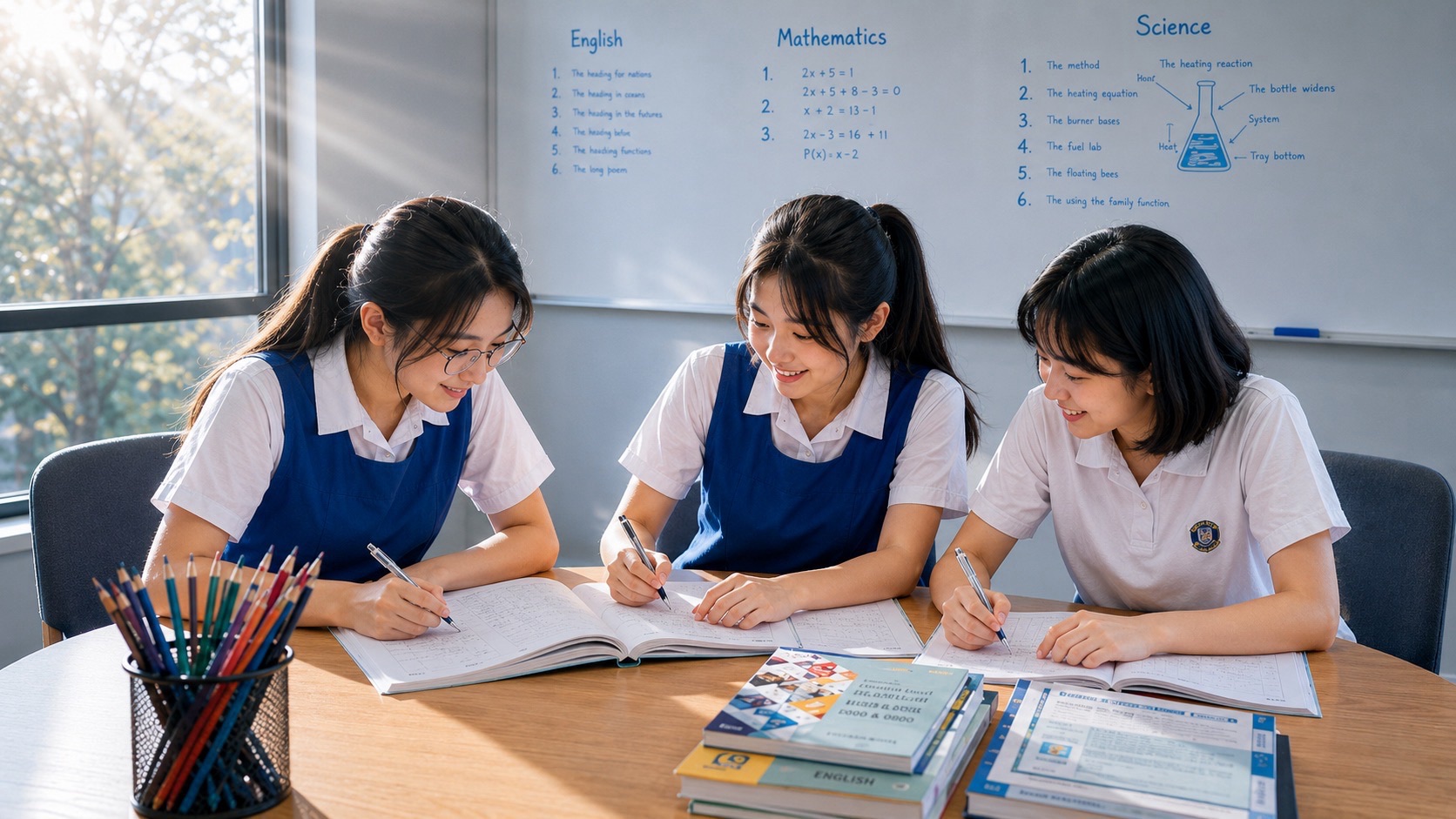
Inside a 3-Student Secondary 3 G3 English SEC Tutorial in Punggol | 90-Minute Lesson Anatomy
A Secondary 3 G3 English class in 2026 is a runway into the first 2027 Singapore-Cambridge Secondary Education Certificate cohort. That makes the lesson more than a generic “O-Level prep” class. A current Sec 3 student becomes Sec 4 in 2027, when G3 English Language is coded K300. The teaching should therefore strengthen the English system that must survive the final year: argument, situational writing, comprehension evidence, summary, oral interaction, listening, vocabulary, grammar, timing and independent revision.
This page has a precise purpose: show what happens inside a three-student Sec 3 G3 English tutorial. It is intentionally different from our Sec 3 SEC-runway guide. That page explains what the year must achieve. This page explains the machinery of the 90-minute class—how three scripts are compared, how argument is challenged, how summary reasoning is exposed, how oral answers are stress-tested, how cues are faded and how the student is pushed toward Sec 4 independence.
The current eduKate Punggol model is three students for 1.5 hours. G3 is a subject level under Full Subject-Based Banding, not a renamed Express stream. The school controls subject-level offering and progression. Tuition can build capability but cannot guarantee a subject-level move or a national-examination grade.

Why the Sec 3 lesson is different from the Sec 2 lesson
Sec 2 is consolidation. Sec 3 is conversion: the learner’s English must increasingly operate under Upper-Secondary task complexity and national-exam-style constraints while there is still time to repair the underlying system.
| Sec 2 capability | Sec 3 development | Inside-the-class consequence |
|---|---|---|
| Can support a paragraph | Can sustain an argument across several paragraphs | Three thesis routes and evidence chains can be compared |
| Can infer from evidence | Can distinguish purpose, effect, tone and stronger/weaker inference | Tutor asks students to defend the answer boundary |
| Can paraphrase sentences | Can compress information accurately in summary | Students compare what can be removed without losing meaning |
| Can give an oral viewpoint | Can adapt under follow-up and qualification | Peers challenge one another’s positions |
| Can edit with cues | Can self-edit more strategically | Tutor stops identifying every error first |
| Can do short timed work | Can condition components without sacrificing quality | Timed transfer becomes more deliberate |
The key question becomes: Can the student run the method when the tutor, the topic label and the unlimited time are all removed?
The exact 90-minute Sec 3 lesson anatomy
| Time | Lesson job | Evidence the tutor is collecting |
|---|---|---|
| 0–10 min | Retrieval and re-entry | What survives from earlier corrections without prompts? |
| 10–25 min | School / test / writing-script diagnosis | Where did the student’s process first become unreliable? |
| 25–45 min | Repair one high-leverage Upper-Secondary capability | Can the learner reconstruct the method? |
| 45–60 min | Three-script / three-position comparison | What do alternative routes reveal? |
| 60–75 min | Changed-context transfer | Does the repair survive a fresh task? |
| 75–85 min | Timed or interactive component test | Does quality survive pressure and fewer cues? |
| 85–90 min | Handoff and next diagnostic priority | What can the student now operate alone? |
The exact minutes can shift. The core architecture should not: retrieve → diagnose → repair → compare → transfer → pressure-test → hand back.
0–10 minutes: retrieval protects the runway
Sec 3 has too much new work for old learning to disappear quietly. The class should regularly retrieve previous vocabulary, grammar, summary decisions and writing corrections.
- Reconstruct an earlier thesis without looking.
- Explain why one summary paraphrase preserved meaning better than another.
- Correct a recurring grammar pattern in a fresh sentence.
- Use older vocabulary in a new argumentative context.
- Answer an oral follow-up on a topic discussed weeks earlier.
Retrieval tells the tutor whether a prior “good lesson” became durable learning.
10–25 minutes: marked scripts show where the runway is leaking
A recent school script is especially valuable in Sec 3 because it reflects the learner’s performance under real school expectations.
| Visible problem | Deeper diagnostic question |
|---|---|
| Argumentative essay feels thin | Is the claim weak, the evidence generic or the explanation incomplete? |
| Situational writing loses task relevance | Was audience, purpose, role or required information misread? |
| Summary loses content | Was scope wrong, a core point omitted or paraphrase distorted? |
| Comprehension answers are vague | Is the problem evidence location, question-type recognition or expression? |
| Oral response sounds rehearsed | Can the student adapt to a different follow-up? |
| Timed quality collapses | Did time leak in reading, planning, drafting, summary or checking? |
The lesson should not begin with “today we are doing comprehension” if the evidence says the highest-value problem is elsewhere.
Argument: compare three routes, not one model essay
Argumentative and discursive writing becomes more useful when the class compares the logic beneath the language.
Give all three students the same question and ask for a thesis plus one paragraph. Then compare:
- Which thesis is specific enough to organise the essay?
- Which reason actually supports the claim?
- Which example is relevant rather than merely interesting?
- Which explanation shows why the example matters?
- Which paragraph needs qualification?
- Which sentence can be removed because it repeats the claim?
A useful paragraph architecture can be:
- Claim.
- Reason.
- Evidence or example.
- Explanation.
- Connection to the task.
- Qualification where appropriate.
This is not a rigid template. It is a way to see whether the paragraph is doing enough logical work.
Situational writing: three students can expose three different task readings
Situational writing is a communication problem under constraints. Before anyone drafts, each student can state:
- Who am I writing as?
- Who is the audience?
- What outcome is required?
- Which information must be used?
- What tone fits?
- What order makes the message easiest to follow?
If the three students interpret the role differently, the tutor can resolve the task before anyone writes 400 words on the wrong premise.
Comprehension: the class should compare evidence boundaries
At Upper Secondary, a comprehension answer can sound intelligent and still be too broad. The class should learn to distinguish:
- what the passage states,
- what the passage implies,
- what the reader knows from outside the passage,
- and what the question actually asks.
One student can defend an answer; another can challenge whether the evidence is strong enough. The tutor then asks what wording would stay within the evidence.
Summary: three versions reveal information loss
Summary is one of the best three-way comparison tasks because different students remove different information.
- Define the scope.
- Identify relevant points.
- Separate core meaning from examples.
- Paraphrase accurately.
- Combine compatible points.
- Check whether any cause-effect relationship was lost.
- Check the word limit and grammar.
When three summaries are placed side by side, the tutor can show where one is concise but incomplete, one is accurate but wordy, and one changes the meaning during paraphrase.
Vocabulary: Upper-Secondary precision, not ornament
Sec 3 vocabulary should help students discriminate ideas more precisely.
The class can compare:
- important / significant / crucial,
- problem / issue / dilemma,
- show / demonstrate / reveal,
- change / adjust / transform.
The tutor asks what changes in intensity, implication, collocation or register. Students then use the word only if it improves the sentence. “Advanced” vocabulary that damages accuracy is not an upgrade.
Grammar and editing: reduce tutor highlighting
By Sec 3, grammar work should increasingly be embedded in original writing. A student should learn to identify high-risk error families such as tense shifts, subject-verb agreement, fragments, run-ons, pronoun reference, prepositions, collocations and unnecessarily complex sentences.
The tutor can progress from:
- highlighting the exact error,
- highlighting only the sentence,
- telling the student the error family,
- telling the student how many errors exist,
- giving no cue and asking for a risk-based edit.
That is cue fading applied to editing.
Oral interaction: challenge the position, not the student
Three students create a natural spoken-interaction environment. One can take a position, one can question the reasoning and one can observe whether the answer became more precise after challenge.
- Position.
- Reason.
- Example or evidence.
- Connection.
- Response to follow-up.
- Qualification or alternative perspective.
The tutor should reward adaptation, not memorised length.
Cue fading: Sec 3 should become increasingly self-operated
| Support level | Tutor action | Student responsibility |
|---|---|---|
| Model | Show the reasoning explicitly | Explain why each step exists |
| Guided | Ask discriminating questions | Choose the next move |
| Light cue | Give one prompt only if required | Run the process |
| Independent | Observe silently | Complete and self-check |
| SEC-style transfer | Change task surface and add realistic time | Recognise, adapt and execute |
If the student can only succeed when the tutor announces “this is an inference question” or “use PEEL here”, the method is not yet independent.
Timed transfer: pressure should reveal the next repair
Sec 3 is the right year to condition components progressively, but a timed task is useful only if the result changes the next lesson.
- a timed essay plan,
- a short situational-writing section,
- a comprehension block,
- a summary task,
- an oral preparation window,
- or a mixed editing set.
Afterwards, ask where quality changed. Did the student misread, over-plan, over-write, lose evidence discipline, paraphrase too slowly or fail to check? The clock identifies an execution problem; the diagnosis explains it.
Three hypothetical Sec 3 G3 students in one tutorial
These are hypothetical profiles, not testimonials.
| Student | Pattern | Priority | Possible class task |
|---|---|---|---|
| A | Strong language, thin argument | Evidence and explanation | Compare three paragraphs for logical load |
| B | Strong writing, weak summary | Scope and compression | Compare three summaries for information loss |
| C | Strong untimed, weak school exams | Execution | Timed component + time-leak diagnosis |
They can share one 90-minute class because the common material generates different diagnostic work.
What progress should look like before Sec 4
- Arguments are supported rather than asserted.
- Situational writing adapts to audience and purpose.
- Comprehension answers stay within the evidence.
- Summary becomes shorter without losing required information.
- Vocabulary becomes precise rather than decorative.
- Repeated grammar errors shrink in original work.
- Oral responses adapt under follow-up.
- Timed component quality approaches untimed quality.
- The learner can diagnose more of their own errors.
- The tutor can remove more cues without performance collapsing.
What parents can ask after a Sec 3 tutorial
- Which script or task did you diagnose today?
- What was the first meaningful error?
- What principle repaired it?
- Did you use the repair on a different question?
- What will you retrieve next week?
- What can you now do without the tutor?
These questions make the lesson’s logic visible without requiring the parent to reteach English.
What not to do in a three-student Sec 3 G3 English tutorial
- Do not describe the 2026 Sec 3 cohort as though its final certificate is still simply O-Level.
- Do not promise that success is inevitable.
- Do not pre-teach simply to advertise being “ahead of school”.
- Do not force a fixed four-week cycle on every student.
- Do not promise a mini-mock every cycle or parent update schedule unless actually offered.
- Do not expose proprietary internal methods as a sales device.
- Do not teach summary as synonym replacement.
- Do not make vocabulary a rare-word contest.
- Do not promise A1, fixed mark gains or subject-level movement.
Frequently asked questions
What national-exam framework applies to a current 2026 Sec 3 student?
This cohort reaches Sec 4 in 2027, when the Singapore-Cambridge Secondary Education Certificate begins. SEAB lists G3 English Language as K300.
Does every lesson cover writing, comprehension, summary, oral and listening?
No. The class keeps the whole English system active across time while allocating more lesson attention to the current high-value bottleneck.
Will all three students receive the same task?
They may share a core text or prompt while receiving different cue levels, correction priorities and transfer tasks.
How much timed practice should Sec 3 students do?
There is no universal frequency. Timed components are useful when the underlying method is stable enough for the result to reveal an execution problem rather than basic misunderstanding.
Can tuition guarantee a G3 English result?
No. Tuition can strengthen capability and examination execution. Final results depend on the learner and actual assessment, while subject-level progression remains school-controlled.
Related Sec 3 English routes
- Secondary 3 G3 English | Build the 2027 SEC K300 Runway
- Secondary 3 English Tuition | General Guide
- Secondary English Time-Management Diagnosis
- Secondary English Vocabulary Learning System
The Sec 3 small-group end condition
A strong Sec 3 G3 tutorial should leave the learner increasingly able to build arguments, adapt to audience, constrain comprehension answers to evidence, compress information accurately, respond orally under challenge and preserve quality under time.
Most importantly, the learner should require less tutor intervention as the 2027 SEC K300 year approaches.





