
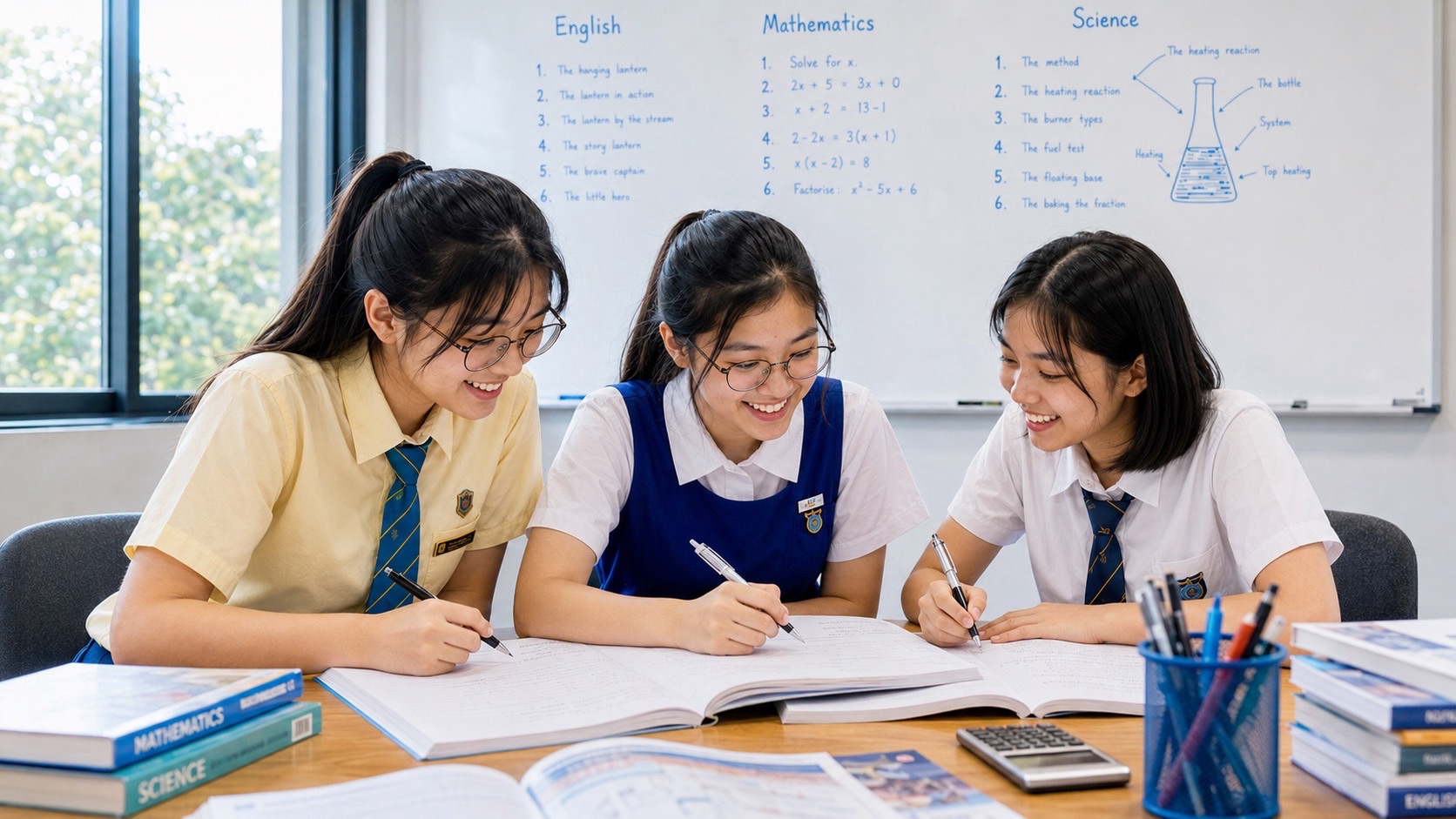
Punggol English tuition becomes especially important in the secondary years because English is no longer only a language subject with familiar Primary-school routines. Families searching for Secondary English tuition, English tuition for secondary students, Sec 1 English tuition or a Secondary English tuition centre in Singapore are usually asking a deeper question too: what should actually become stronger as the student moves from Secondary 1 toward the final national examination?
The core aim of Secondary English tuition is independent language control. A student should gradually become able to understand unfamiliar texts, identify evidence, infer meaning, write for different purposes and audiences, speak with precision, listen for structure, use grammar and vocabulary deliberately, manage time, recover from uncertainty and perform without needing a tutor to translate every task into smaller instructions.
That target matters because Secondary English expands in two directions at once. The language becomes more demanding, and the student is expected to become more independent. Reading grows denser. Writing grows longer. Vocabulary becomes more abstract. Questions require more explanation. Spoken responses need stronger organisation. Examination tasks increasingly reward judgement rather than simple recall.
At eduKatePunggol, this article owns the target state of Secondary English tuition: what good tuition should ultimately produce. The detailed lesson owners—continuous writing, comprehension, summary, oral, editing, vocabulary, listening and level-specific pages—remain separate so parents can move from the big picture to the exact skill without several pages repeating the same job.
Open the Punggol English Article Index
The Core Aim: Make English Transfer Across Unfamiliar Tasks
Secondary English can look deceptively simple when lessons are organised by topic. One week may focus on comprehension. Another may focus on situational writing. Another may be grammar, summary, oral, vocabulary or listening.
The student, however, does not experience these as truly separate systems.
A comprehension answer may fail because the vocabulary is weak. A situational-writing response may fail because the student misreads the audience. An oral answer may sound thin because the learner cannot retrieve examples quickly. A summary may lose marks because the student understands the passage but cannot paraphrase concisely. A composition may drift because the student cannot hold purpose and structure in working memory while writing sentences.
Good Secondary English tuition therefore connects the pieces.
The learner should become increasingly able to:
- read a fresh text without panic;
- distinguish what the text says from what it implies;
- locate evidence and explain why it matters;
- recognise purpose, audience and context;
- adjust register and tone;
- write clear, relevant paragraphs;
- select and organise ideas under time limits;
- paraphrase without changing the meaning;
- use vocabulary with precision rather than display;
- edit recurring grammar problems independently;
- speak in an organised way without memorising a script;
- listen for key information and structure;
- recover when a question is unfamiliar; and
- carry successful strategies from one task into another.
Transfer is the important word. If the student can only perform when the worksheet resembles last week’s worksheet, the learning is still fragile. If the student can recognise the same principle inside a different text, prompt or question, the skill is becoming durable.
A More Important Transition Than It First Appears
Secondary English is not simply Primary English with harder vocabulary.
The transition changes what students are expected to do with language.
In Primary school, a student may succeed through strong foundational reading, familiar comprehension routines, grammar knowledge, vocabulary, composition structures and oral practice. Those foundations remain valuable. The Secondary learner, however, must begin dealing more explicitly with abstraction, interpretation, evidence, purpose, register, argument, multimodal information and sustained writing.
This can surprise students who previously felt comfortable in English.
A learner may read fluently but struggle to explain language effect. Another may speak confidently but write loosely. Another may know many words but use them without sensitivity to register. Another may score well on grammar exercises while still producing sentence-level errors in a timed composition.
The problem is not necessarily that the student “became bad at English”.
The job changed.
A strong Secondary English tutor makes that change visible. Instead of treating every lower mark as one general weakness, the tutor asks which new demand is not yet under control.
For the dedicated starting point, see Secondary 1 English Tuition in Punggol.
The Hidden Secondary English Problem: Language Knowledge Must Become Judgement
One of the biggest shifts in Secondary English is from knowing language to making decisions with language.
A student may know that “however” signals contrast. The harder task is deciding whether the ideas actually contrast and whether “however” is the best connector in that sentence.
A student may know what “reluctant” means. The harder task is deciding whether it accurately describes the character’s attitude in this context.
A student may know that an answer needs evidence. The harder task is deciding which evidence is sufficient and how to connect it to the inference.
A student may know how to write a formal email. The harder task is adjusting the details, tone and organisation when the purpose changes.
This is where Secondary English becomes intellectually interesting.
The learner is no longer only collecting rules. The learner is choosing among possibilities.
Tuition should therefore create many small judgement calls:
- Which detail matters most?
- What can safely be inferred?
- What would be an overclaim?
- Which word best matches the degree of certainty?
- What does this reader need to know?
- What can be removed without losing meaning?
- Which sentence should come first?
- What tone suits this purpose?
- Is the evidence relevant enough?
- Is this interpretation supported by the text or merely possible?
When students become better at these decisions, improvement spreads across several components at once.
What Secondary English Tuition Actually Teaches
Secondary English tuition works best when it develops a connected set of language capabilities rather than a pile of unrelated tricks.
1. Reading comprehension
Students learn to follow ideas across paragraphs, distinguish main points from supporting details, identify text relationships, interpret vocabulary in context, recognise tone, make inferences and justify conclusions with evidence.
2. Language for effect
The learner moves beyond naming a device. The real task is to explain how a word, image, contrast, sentence pattern or structural choice shapes meaning and influences the reader.
3. Continuous writing
Students learn to interpret prompts, generate and select ideas, build a coherent structure, control paragraphs, sustain voice, use evidence or examples where appropriate, and revise the piece for meaning as well as accuracy.
4. Situational writing
Purpose, audience and context become central. Students learn to select relevant information, use the appropriate format, manage register and make every paragraph serve the intended action.
5. Summary writing
Summary requires selection, compression, paraphrase and meaning control. Students must identify what belongs, remove repetition, preserve the original meaning and work within the word limit.
6. Grammar and editing
Grammar is taught as a resource for meaning. Editing then tests whether the learner can detect and repair errors under pressure rather than only recognise a rule during isolated practice.
7. Vocabulary
Students build precision, collocation, register, nuance, word families and retrieval. The aim is not to collect impressive words but to choose language that fits the exact job.
8. Oral communication
Students learn to organise spoken responses, develop ideas, support viewpoints, respond to follow-up questions and speak with enough fluency that thinking remains visible.
9. Listening
Listening develops attention to sequence, purpose, emphasis, detail, distractors and note-taking. It also strengthens the ability to hold meaning in working memory while the information continues moving.
10. Metacognition
The student learns to plan, monitor, notice confusion, change strategy, check evidence and review the final response. This is what makes English learning increasingly self-correcting.
The dedicated Secondary hub is Secondary English Tuition in Punggol.
Why a 3-Student Secondary English Class Can Matter
English errors are often hidden inside plausible work.
A Mathematics answer may be visibly wrong. In English, an answer can sound fluent and still be unsupported. A paragraph can be grammatically clean and still miss the purpose. A summary can be elegant and still include the wrong points. A student can speak confidently and still avoid answering the actual question.
This is one reason a very small group can be useful.
The tutor can observe how each student reaches the answer, not only whether the answer looks acceptable.
- Each student can explain evidence choices aloud.
- Writing can be inspected while it is being produced.
- Oral responses can be repeated with reduced prompting.
- Vocabulary choices can be challenged in context.
- Recurring sentence patterns can be identified.
- Students can compare different valid interpretations.
- Feedback can be personalised without removing peer learning.
- Fresh transfer tasks can reveal whether the skill is independent.
The useful peer effect is not competition for the “best answer”. It is exposure to alternative reasoning. One student may notice evidence another missed. Another may choose a cleaner paragraph structure. Another may explain the same inference more precisely.
For the separate class-format decision, see 3-Pax Small Group vs 1-to-1 vs Large Class.
Our First-Principles Secondary English Method
1. Diagnose the first unstable link
A lower English score can come from very different causes: weak vocabulary, shallow reading, poor evidence selection, sentence instability, weak planning, careless task interpretation, slow writing, weak oral retrieval or poor time control.
The first job is to name the bottleneck accurately.
2. Rebuild meaning before technique
If the student does not understand the passage, teaching a polished answer frame will only hide the problem. If the learner has no argument, adding sophisticated connectors will not create one.
Meaning comes first. Technique organises and expresses it.
3. Fence the task
Students identify the boundaries of a question: what is being asked, what evidence is allowed, which part of the text matters, what audience is implied, what the word limit is and what would count as drifting away from the task.
4. Make thinking visible
Students explain why they chose an answer, why another answer is weaker, what a phrase implies, why a paragraph belongs where it does and what they would change after rereading.
The tutor cannot repair reasoning that remains invisible.
5. Move from model to principle
Models are analysed for the decisions behind them. Students should leave knowing why the response works, not merely which sentence to copy.
6. Practise with reduced support
The tutor gradually removes prompts. A skill that only appears during guided practice has not yet become dependable.
7. Retrieve and interleave
Earlier skills return inside later work. Vocabulary reappears in comprehension. Grammar reappears in writing. Evidence reappears in oral discussion. Summary forces the student to combine comprehension, paraphrase and concision.
8. Check transfer on an unfamiliar task
The final test is not whether the learner can repeat the taught example. It is whether the learner can recognise the same principle when the surface changes.
What Happens During a 90-Minute Secondary English Lesson
Each lesson changes with the learner and the school calendar, but a stable lesson rhythm helps students know how to work.
Warm-up retrieval
Students recall a previously taught idea: a vocabulary distinction, editing pattern, inference move, paragraph structure, oral-response frame or summary technique.
Text or task encounter
The learner meets a fresh passage, prompt, visual text, listening task or writing problem. The new material prevents the lesson from becoming rehearsal of a memorised answer.
Concept instruction
The tutor teaches one central mechanism clearly. This may be inference, evidence sufficiency, language effect, paragraph focus, register, paraphrase or a recurring grammar relationship.
Guided practice
Students attempt selected questions while the tutor checks the reasoning process. Prompts are used strategically rather than continuously.
Independent application
The learner completes a fresh item without step-by-step help. This is where understanding becomes visible.
Error classification
Mistakes are grouped by source: task reading, vocabulary, evidence, reasoning, structure, grammar, expression, timing or checking. The aim is to identify a pattern the student can recognise next time.
Transfer check
A short final task asks the learner to use the same principle in a slightly different context.
This rhythm is deliberately simple: retrieve, understand, practise, apply, diagnose and transfer.
Three Secondary English Pathways
The repair pathway
This student may have entered Secondary school with weak reading fluency, limited vocabulary, unstable grammar or low confidence. School work feels dense and slow. The learner may leave blanks, copy phrases from the passage without understanding them or avoid writing because every sentence feels risky.
The priority is to stop further drift.
We rebuild the earliest weak links while keeping the student connected to current school work. The aim is not to retreat indefinitely into easier material. It is to restore enough foundation for the learner to re-enter the current curriculum with control.
The stabilisation pathway
This student is usually passing but inconsistent. One comprehension passage goes well; another collapses. Writing may be strong on familiar topics and weak on unfamiliar ones. Grammar errors appear mainly under time pressure. Oral responses depend heavily on the prompt.
The priority is reliability.
Students practise across varied texts, retrieve earlier strategies and learn a repeatable checking system. Marks become steadier when successful behaviour becomes portable.
The extension pathway
This student already performs strongly and needs deeper challenge.
Extension may involve competing interpretations, more subtle language effect, denser non-fiction, stronger argument, counterexamples, more precise vocabulary, sophisticated register control, tighter synthesis and faster movement from evidence to judgement.
The goal is not to make English more decorative.
It is to make thinking more precise.
Secondary English Under Full Subject-Based Banding
Singapore’s current secondary system gives the English-tuition conversation a useful new frame.
Full Subject-Based Banding has been fully implemented in secondary schools since 2024. Students can offer subjects at G1, G2 and G3 subject levels, and the national examination transition moves to the Singapore-Cambridge Secondary Education Certificate from 2027.
That means “Secondary English tuition” should not be treated as one generic worksheet programme.
The tutor needs to know:
- the student’s current English subject level;
- the school’s current topics and assessment schedule;
- the learner’s reading and vocabulary base;
- how independently the student can write and revise;
- which examination components are already stable;
- which demands are still new; and
- whether the student needs repair, stabilisation or extension.
SEAB’s current 2027 school-candidate pages list English Language as K100 at G1, K200 at G2 and K300 at G3. The G3 page also shows 1184 as the reference code for 2026 and earlier. This is useful context for families because the labels are changing while the deeper language abilities remain continuous: comprehension, writing, listening, speaking, vocabulary, grammar, evidence and control.
Official references: MOE Full Subject-Based Banding and SEC announcement, SEAB 2027 G1 syllabuses, SEAB 2027 G2 syllabuses and SEAB 2027 G3 syllabuses.
Secondary 1: Build the Bridge Before the Gap Widens
Secondary 1 is a transition year, and English often reveals the transition more slowly than Mathematics.
A student may continue scoring reasonably for several months while hidden weaknesses begin accumulating. The learner reads the passage but does not notice how paragraphs relate. Vocabulary is understood approximately rather than precisely. Writing sounds fluent but ideas are loosely organised. Oral responses rely on personal experience without enough explanation.
The best Secondary 1 support therefore does not wait for a dramatic failure.
It teaches the student how Secondary English works.
- Annotation becomes purposeful rather than decorative.
- Vocabulary is tied to context and nuance.
- Evidence is separated from inference.
- Paragraphs carry one controlled unit of development.
- Grammar moves from exercise knowledge into writing.
- Oral answers gain structure and support.
- Students begin using short checking routines independently.
A good Secondary 1 year makes Secondary 2 less surprising.
Secondary 2: Consolidate Before Upper Secondary Accelerates
Secondary 2 is often underestimated because the final national examination still feels far away.
In practice, it is an excellent year for consolidation.
Students have enough Secondary experience for patterns to become visible, but there is still time to repair them without every lesson feeling exam-driven.
Useful Secondary 2 priorities include:
- stronger reading stamina;
- more exact inference and evidence;
- greater vocabulary precision;
- more reliable sentence control;
- clearer paragraph architecture;
- greater independence in planning and revising; and
- more stable performance across unfamiliar topics.
The student should arrive at upper secondary with a language system, not merely a collection of lower-secondary worksheets.
Secondary 3: Turn Knowledge Into Exam-Shaped Control
Secondary 3 is where time pressure and examination specificity begin to matter more.
The learner still needs broad English development, but that development now has to survive the shapes of actual papers and school assessments.
A student may understand a comprehension passage yet write answers too slowly. Another may have strong ideas for continuous writing but fail to control relevance. Another may know grammar well but lose editing marks because the error pattern is not recognised quickly enough.
This is where tuition begins calibrating performance:
- How much explanation is enough?
- How much evidence is necessary?
- How long should planning take?
- Which questions deserve more time?
- What should be checked first?
- When should the student move on?
Exam technique is useful when it sits on top of language ability. It is fragile when it tries to replace language ability.
Secondary 4: Make Ability Survive the Clock
By Secondary 4, the question becomes less “Can the student do this with enough time?” and more “Can the student do this accurately, independently and repeatedly under examination conditions?”
Final-year English tuition should therefore become more selective.
There is little value in rushing through endless full papers if the same bottleneck keeps repeating. A better cycle is to use examination evidence to find the pattern, repair it in a smaller task, then return to timed performance.
For example:
- weak inference → short evidence-and-inference drills → fresh comprehension;
- slow summary → point selection and compression drills → timed summary;
- writing drift → relevance and paragraph planning → timed continuous writing;
- oral hesitation → idea retrieval and example building → timed spoken response;
- editing misses → error-pattern retrieval → timed editing section.
This keeps the final year diagnostic rather than merely busy.
Reading Comprehension: Evidence Before Guesswork
Secondary comprehension improves when students stop treating answers as something hidden in the tutor’s head.
The passage provides constraints.
Students learn to ask:
- Which part of the text is relevant?
- What does it state directly?
- What can reasonably be inferred?
- Which word or phrase creates that implication?
- What alternative interpretation is possible?
- What makes one interpretation stronger than another?
This makes comprehension more rigorous and less mysterious.
The series companion is The Core Aim of Punggol English Tuition | Reading Comprehension.
Writing: Purpose Before Decoration
Secondary writing becomes stronger when students understand that different tasks have different jobs.
A narrative is not an argumentative essay wearing dialogue. A formal email is not a composition with “Dear Sir/Madam” added at the top. A speech is not a report with rhetorical questions sprinkled through it.
Students need to control:
- purpose;
- audience;
- context;
- content selection;
- organisation;
- register;
- tone;
- paragraph development;
- sentence control; and
- revision.
The useful question is not “How do I make this sound more advanced?”
It is “What does this reader need this text to do?”
For the detailed Secondary writing route, see Secondary Continuous Writing — Ideas, Structure, Voice and SEC Exam Control.
Summary Writing: Selection Is the First Skill
Students sometimes approach summary as a shortening exercise.
The deeper skill is selection.
Before paraphrasing anything, the learner must know which ideas answer the summary task. A beautifully paraphrased irrelevant point remains irrelevant.
Then the student must preserve meaning while compressing language.
This requires:
- accurate comprehension;
- point selection;
- distinguishing essential from optional detail;
- paraphrase;
- sentence economy;
- cohesion; and
- word-limit control.
The dedicated owner is Secondary Summary Writing — Selection, Paraphrase, Word Limit and G3 SEC Control.
Vocabulary and Grammar: The Hidden Infrastructure
Vocabulary and grammar rarely receive the glory when a student writes an excellent essay or gives a strong oral response.
They are still doing much of the work.
Vocabulary allows the learner to discriminate between ideas: annoyed, resentful, reluctant, doubtful, sceptical and indifferent are not interchangeable. Grammar allows the learner to express time, condition, cause, contrast, emphasis, reference and logical relationships accurately.
The problem comes when these resources are taught only as lists and exercises.
Students should repeatedly move between knowledge and use:
- learn the word → notice it in reading → retrieve it in speaking → use it in writing;
- learn the grammar relationship → recognise it in a sentence → edit it → use it under time pressure.
This is how passive knowledge becomes operational English.
How We Reduce “Careless” English Mistakes
“Careless” is often an unsatisfactory diagnosis because it hides several different problems.
Task-reading errors
The learner misses a command word, scope, audience or required detail. Repair requires deliberate task fencing before answering.
Evidence errors
The answer sounds reasonable but is weakly supported. Repair requires returning to the exact phrase, line or relationship that justifies the inference.
Reference errors
Pronouns or references become unclear. Repair requires checking what each word points back to.
Grammar-pattern errors
The same tense, agreement or sentence-boundary problem appears repeatedly. Repair requires targeted retrieval and then immediate use in real writing.
Vocabulary errors
The student chooses a word that is approximately right but wrong in collocation, nuance or register. Repair requires alternatives and contrast, not merely a dictionary definition.
Time-pressure errors
The learner knows what to do but cannot finish reliably. Repair requires smaller timed components before another full paper.
Checking errors
The student rereads everything but notices nothing. Repair requires a narrow checklist: task fit, evidence, sentence boundaries, tense, reference, spelling or whatever the learner’s actual pattern shows.
Once the category is clear, “careless” becomes teachable.
Teaching Ahead Without Turning English Into an Arms Race
Teaching ahead can be useful in Secondary English when it reduces surprise.
A Secondary 1 student can encounter audience, register and evidence before those ideas become heavily assessed. A Secondary 2 student can practise denser non-fiction and stronger paragraph reasoning before upper-secondary demands accelerate. A Secondary 3 student can begin calibrating timed performance before the final year becomes crowded.
The purpose is not to race through every future paper.
It is to create familiarity with the kind of thinking that future tasks will require.
Teaching ahead becomes counterproductive when it skips over weak foundations. A student who cannot distinguish evidence from inference does not need harder inference questions yet. A student who cannot control sentence boundaries does not need more sophisticated essay structures first.
Good progression is not always faster.
It is better sequenced.
What Progress Should Look Like
Secondary English progress should become visible in behaviour before it becomes dramatic in grades.
Parents and students may notice that the learner:
- starts unfamiliar tasks more calmly;
- reads the question before hunting for an answer;
- uses more precise evidence;
- distinguishes inference from quotation;
- explains language choices instead of only naming devices;
- plans writing more efficiently;
- maintains paragraph focus;
- uses vocabulary more naturally;
- catches recurring grammar errors;
- paraphrases with less distortion;
- speaks with stronger development;
- finishes more reliably under time pressure;
- asks more precise questions; and
- needs fewer tutor prompts to continue working.
The grade matters, but the pattern behind the grade matters too.
A single high score may reflect a familiar topic. A durable improvement appears across different texts, prompts and assessment conditions.
Responsible tuition should not promise an exact grade after a fixed number of lessons. Progress depends on the student’s starting point, reading habits, attendance, school load, practice, willingness to revise and time available before major assessments.
When Should Secondary English Tuition Start?
There is no universal month in which every student should begin tuition.
Support is more useful when there is evidence of a recurring gap.
Consider more structured support when a student:
- reads fluently but cannot explain answers;
- frequently quotes without interpreting;
- has weak vocabulary across several components;
- writes clearly only on familiar topics;
- understands grammar exercises but cannot edit own writing;
- produces summaries that are too long or distort meaning;
- speaks confidently but gives undeveloped answers;
- loses marks repeatedly for the same pattern;
- depends heavily on model answers;
- cannot finish papers despite knowing the content; or
- is beginning to avoid English because the subject feels unpredictable.
Early support is often quieter because fewer habits need to be dismantled. Later support can still work, but diagnosis becomes more important because there is less time for broad experimentation.
Class Details at eduKatePunggol
eduKatePunggol’s current English programme pages describe very small three-student classes with 1.5-hour lessons. The format is designed to make student thinking visible, allow frequent response opportunities and support targeted feedback.
Secondary students may need different proportions of reading, writing, vocabulary, grammar, oral, listening and examination calibration depending on their current level and the evidence from school work.
Current timetable, fees and available places should be confirmed when enquiring.
Read the Secondary English Tuition in Punggol programme guide
Ask about current English tuition at eduKatePunggol
What Parents Can Bring to a First Secondary English Consultation
The best diagnosis usually begins with ordinary evidence rather than a generic placement label.
- two recent English papers;
- one recent continuous-writing or situational-writing piece;
- teacher comments;
- one comprehension passage with the student’s answers;
- an editing or grammar section if sentence control is a concern;
- a recent oral or listening result if available; and
- the student’s own view of what feels hardest.
The student’s explanation matters because the same mark can come from different experiences.
“I ran out of time” is different from “I did not understand the passage.” “I knew the answer but could not explain it” is different from “I could not find any evidence.” “I had ideas but could not organise them” is different from “I did not know what the prompt meant.”
Precision at the diagnosis stage makes the teaching more efficient.
Frequently Asked Questions
Is Secondary English tuition mainly about examination technique?
No. Examination technique matters, especially in the upper-secondary years, but it should sit on top of language ability. Students still need reading, vocabulary, grammar, writing, listening, speaking and reasoning that can survive unfamiliar tasks.
My child was strong in Primary English. Why are Secondary results falling?
The job may have changed faster than the learner’s strategy. Secondary English demands more interpretation, evidence, abstraction, register control and independent judgement. A strong Primary foundation helps, but new skills still need to be built.
Should Secondary students memorise model essays?
Models are useful for analysing structure, language and decisions. Memorisation becomes risky when students force an old essay into a new prompt. The safer goal is to learn principles that can be adapted.
Is vocabulary the main key to better English?
Vocabulary is important, but it works inside a larger system. A student also needs comprehension, syntax, evidence, organisation, audience awareness, retrieval and revision. More words do not automatically create stronger thinking.
How often should a Secondary student write full essays?
Full writing is important, but not every weakness requires another full essay. Sometimes targeted paragraph work, planning, revision, sentence repair or timed micro-practice is more efficient before the learner returns to a complete task.
What is the best sign that tuition is working?
The learner becomes less dependent on the tutor when the material changes. More precise evidence, better self-correction, steadier writing, stronger time control and successful transfer across unfamiliar tasks are useful signs.
Does a G1, G2 or G3 student need a completely different English system?
The level of demand changes, but the underlying language system remains connected. All learners benefit from stronger comprehension, vocabulary, grammar, writing, listening, speaking and metacognition. The texts, task complexity, expected independence and examination requirements should be calibrated to the student’s subject level.
Should tuition follow the school’s exact topic order?
School timing matters, especially near assessments, but tuition also needs to protect the underlying foundation. A student who is struggling because of weak vocabulary or reading cannot be helped fully by following the next worksheet topic without repairing the cause.
Helpful Reading in the eduKate Ecosystem
- Punggol English Article Index
- Secondary English Tuition in Punggol
- Secondary 1 English Tuition in Punggol
- The Core Aim of Punggol English Tuition | Reading Comprehension
- The Core Aim of Punggol English Tuition | English Composition Tuition
- Secondary Continuous Writing
- Secondary Summary Writing
- Secondary Visual Text and Comprehension
- Secondary Oral
- The Core Aim of English Mastery | Reading Comprehension
- The Core Aim of English Mastery | Writing Skills
The Secondary English Principle
The best Secondary English tuition should gradually make the tutor less necessary.
At first, the tutor may need to slow the passage down, model an inference, question the evidence, help build a paragraph, classify an error or show the student where the answer drifted.
Over time, the learner should begin doing those things internally.
The student reads and notices. The student checks whether the evidence is enough. The student hears when a sentence is awkward. The student recognises when the paragraph has wandered. The student adjusts tone for the audience. The student chooses a better word because the first one is too vague. The student knows when to move on and when to revise.
That is the core aim of Punggol English tuition for Secondary students: not simply more practice, but more independent control over meaning, language and performance.
When that control becomes portable, English stops feeling like a set of tricks attached to separate papers.
It becomes one connected system the student knows how to use.


