
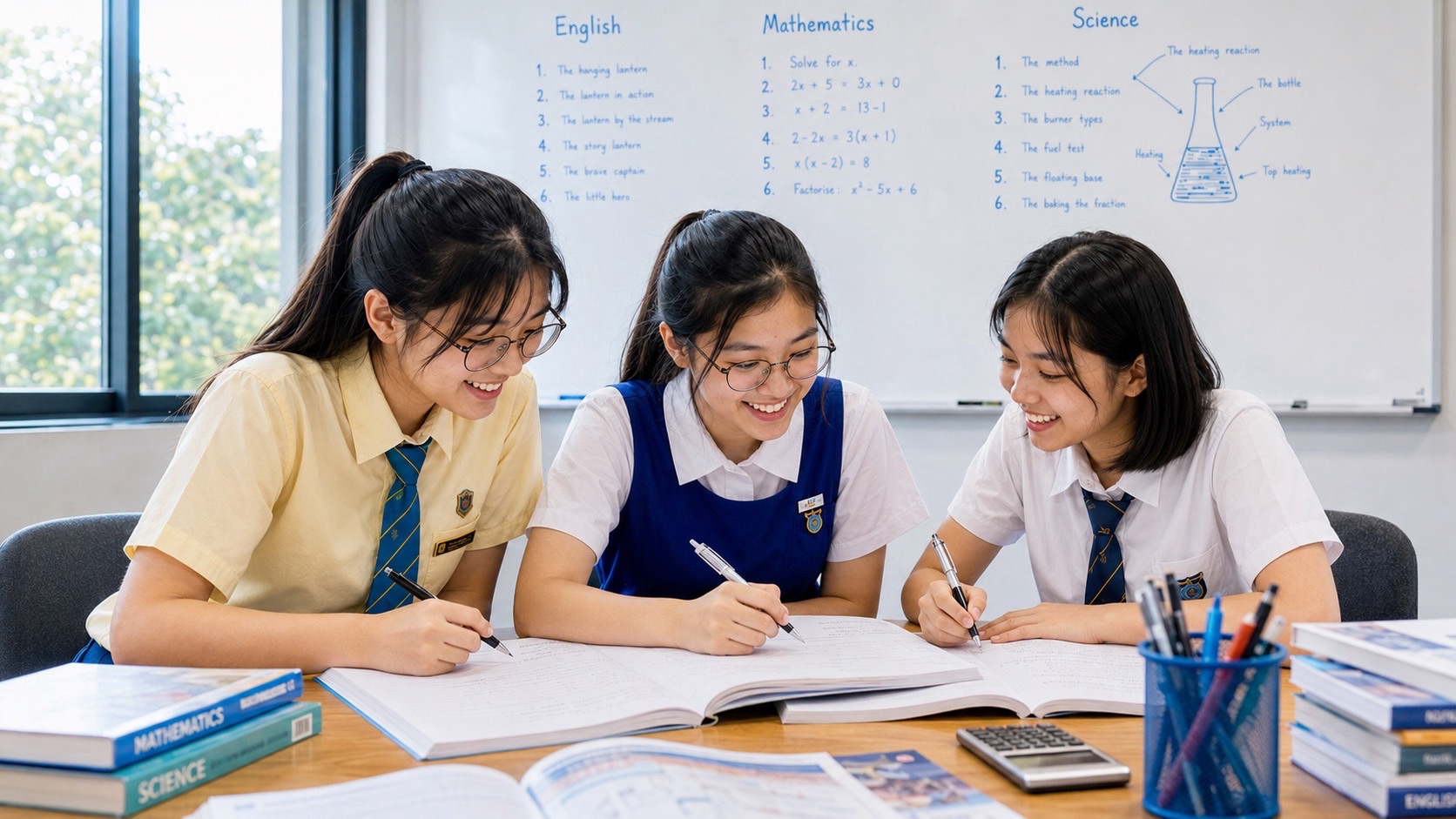
Punggol Science Tuition for students taking separate Physics, Chemistry and Biology should aim far beyond surviving a larger syllabus. Families searching for Pure Science Tuition usually need help with depth, subject separation, practical reasoning, calculations, precise scientific language and the much harder task of keeping several scientific models active at the same time.
The core aim of Pure Science tuition in Punggol is to help a student become fluent in three related but distinct scientific languages. Physics asks for relationships, quantities and representations. Chemistry asks students to move among observations, particles and symbols. Biology asks for systems, structures, processes and consequences. Strong tuition makes each subject clearer on its own while also showing how all three belong to one larger way of thinking: model the system, inspect the evidence, reason carefully and communicate precisely.
Pure Science Is Not Simply “More Content”
The first misconception to remove is that separate sciences are just Combined Science with extra chapters. Greater depth changes the learning task. Students are expected to hold more detailed models, use more specialised vocabulary, manage more quantitative work and explain mechanisms with greater precision.
This means a study method that worked at lower secondary may stop working. A student who relied on memorising summary notes can become overwhelmed because there are now too many details to store as disconnected facts. A student who avoided calculations may find Physics increasingly uncomfortable. A student who memorised Biology definitions without tracing processes can lose track when questions combine several steps.
Pure Science tuition therefore needs architecture. The learner must know what the central model is, which details belong around it, how the model appears in diagrams or equations, and how to retrieve it when a question does not announce the topic clearly.
The Core Aim: Three Subjects, One Scientific Operating System
Although Physics, Chemistry and Biology feel different, strong learners use a common operating system. They ask what the system contains, what changes, what remains controlled, what evidence is available, what model explains the pattern, what quantity or process matters and whether the final conclusion is supported.
This common system is valuable because it reduces cognitive overload. A student does not need a completely different brain for each subject. The same habits—retrieval, representation, evidence, transfer, checking—can be reused while the subject-specific tools change.
Pure Science tuition should therefore develop both layers: a shared scientific method and discipline-specific fluency.
Physics: Build Relationships Before Memorising Formulae
Physics becomes much easier when students see equations as relationships rather than passwords. A formula tells us how quantities are connected. It should be possible to explain that relationship in words, recognise it in a graph and decide whether the answer makes physical sense.
A useful Physics routine is: identify the system, draw or visualise the representation, name the relevant quantities, select the relationship, standardise units, calculate and sense-check. This routine creates a visible path from question to answer.
Students should also practise moving between representations. A motion graph, equation and verbal description may all express the same underlying behaviour. Tuition should ask learners to translate among them instead of treating them as separate topics.
Chemistry: Move Between What You See, What Particles Do and What Symbols Mean
Chemistry becomes confusing when students remain trapped at one level. An observation such as gas produced or colour changed belongs to the macroscopic level. Particle arrangements and collisions provide a microscopic model. Chemical formulae and equations represent the change symbolically.
Strong Chemistry tuition deliberately moves among all three. If the student balances an equation, ask what particles the symbols represent. If the student sees an experimental observation, ask what model could explain it. If a particle diagram changes, ask what observation might follow.
This creates chemistry that makes sense rather than chemistry that is memorised as code.
Biology: Trace Systems, Not Lists
Biology contains many terms, but the subject is not a vocabulary contest. Strong Biology students organise knowledge into systems: structure supports function, processes occur in sequences, substances move through pathways and changes in one component affect others.
A useful tuition question is, “What happens next?” If a condition changes, trace the consequences through the system. If a structure is damaged, predict which function is affected. If a concentration changes, consider the downstream effect.
These process chains make Biology more manageable because details are attached to causal structure instead of floating independently in memory.
Why Pure Science Students Often Feel Fine Until the First Major Mixed Test
During school lessons, topics are usually learned in order. Students know what chapter they are in, so method selection is easy. A major test removes that support. Questions jump between topics, and the learner must decide which model applies.
This is where hidden weakness appears. A student may know every topic in isolation but fail to retrieve the right one under mixed conditions. The problem is not always knowledge; it can be classification and switching.
Tuition should therefore introduce mixed retrieval before high-stakes exams. Ask students to identify the subject model before solving. Over time, the question cue itself should trigger the correct conceptual family.
The Pure Science Error Map
- Concept error: the underlying scientific model is incomplete or wrong.
- Selection error: the student knows the model but does not recognise that it applies.
- Representation error: a graph, equation, particle diagram, circuit or biological schematic is misread.
- Quantitative error: units, formula selection, rearrangement or substitution breaks down.
- Practical error: variables, measurement, reliability, precision or safety is mishandled.
- Language error: reasoning is correct but expressed too vaguely.
- Retrieval error: knowledge cannot be accessed after delay.
- Transfer error: the student succeeds only on familiar-looking questions.
- Checking error: the answer is not tested against physical, chemical or biological plausibility.
This map matters because “do more practice” is too vague. Different error categories require different repairs. Pure Science tuition should know which one it is targeting.
Lower Secondary Foundations Still Matter
Upper-secondary depth sits on lower-secondary habits. A student who never became comfortable with graph reading, units, variables or scientific explanation can carry those weaknesses into every Pure Science subject.
Tuition should not be embarrassed to repair an older skill. If unit conversion is unstable, fix it. If graph axes are misread, rebuild that routine. If the learner cannot distinguish observation from inference, revisit it. Advanced work is often blocked by a very ordinary foundation.
This is one reason the broad route at The Core Aim of Punggol Science Tuition | Secondary Science Tuition remains useful even for Pure Science families.
Pure Science Tuition Should Not Become Three Separate Worksheet Factories
A common failure mode is to turn Physics, Chemistry and Biology into three large piles of worksheets. Quantity increases, but the learner’s method does not.
Better tuition gives each task a purpose. One set may train graph interpretation. Another may repair electrolysis. A Biology set may train process explanation. A Physics set may focus on formula selection under mixed conditions. The student should know what capability is being built.
When practice has a purpose, review becomes meaningful. The tutor can ask whether the target skill improved rather than merely whether the pages were completed.
Pure Science Needs Stronger Retrieval Than Students Expect
There is simply more to remember. That does not mean the solution is endless rereading. Retrieval should become part of every week.
Short closed-book tasks work well: write the key equation, sketch a process, define a term, label a diagram, explain one mechanism, predict one outcome. Then check immediately. Older topics should continue appearing even while school moves forward.
The goal is not perfect recall of every sentence. The goal is fast access to the structures that allow the detail to be reconstructed.
One-Page Core Maps Help Manage Depth
Long notes are useful during learning, but final revision needs compression. A one-page core map can hold the model, key equations or processes, common representations, practical ideas and personal error risks.
The act of deciding what belongs on the page is itself learning. Students must separate central relationships from supporting detail. They begin to see the architecture of the topic.
A good map should trigger explanation. If it is merely a tiny-font copy of the textbook, it has missed the point.
Physics Calculation Fluency: Relationship → Units → Magnitude
Pure Physics students need calculations that are both accurate and meaningful. Formula recall is only the beginning. The student must recognise the relevant quantities, convert units when required and decide whether the result is plausible.
A reliable sequence is relationship first, calculator second. Write the equation. Identify the unknown. Convert units. Substitute clearly. Calculate. State the unit. Estimate whether the answer fits the situation.
This sequence makes mistakes visible and easier to correct. It also prevents calculator confidence from masking conceptual weakness.
Chemistry Calculations: Keep the Chemical Meaning Attached
Chemical calculations can become mechanical if students manipulate ratios without remembering what the quantities represent. Tuition should keep units, particles, equations and amounts connected.
When a calculation uses an equation, ask what the coefficients mean. When concentration is involved, ask what is being measured per unit volume. When masses or gas volumes are compared, keep the chemical relationship visible.
The strongest students can explain the calculation in words before pressing the calculator.
Biology Data Questions: Read the Evidence Before Recalling the Chapter
Biology questions increasingly use graphs, tables and experimental data. Students who rush to memory can miss what the evidence actually shows.
A better order is data first, model second. Describe the pattern, identify the relevant comparison, then use biological knowledge to explain it. This prevents the learner from forcing a memorised explanation onto evidence that does not support it.
The same habit strengthens practical reasoning and evaluation.
Practical Science: Design Is More Important Than Recipe Memory
Pure Science students often remember practical procedures but struggle when the apparatus or variables change. That is because recipe memory is context-bound.
Design reasoning begins from the question: what relationship is being tested, what should change, what should be measured, what must remain controlled, what precision is needed and what result would support the claim?
Once students understand why each step exists, unfamiliar practical questions become much easier to adapt to.
Reliability, Accuracy and Precision Must Be Separated
These terms are often memorised together and then used interchangeably. Tuition should make the distinction concrete.
Reliability concerns consistency and whether repeated measurements give a stable pattern. Accuracy concerns closeness to the true or accepted value. Precision concerns the fineness or repeatability of measurement. An experiment can be precise but inaccurate, or reliable yet systematically biased.
Students should diagnose which problem an improvement actually solves. Repetition cannot fix every weakness.
Practical Evaluation: Improvements Need a Matched Reason
“Repeat and average” is one of the most overused responses in school Science. It can help reduce the influence of random variation, but it does not repair an uncontrolled variable, low-resolution instrument or systematic error.
A stronger student identifies the flaw first, then proposes the improvement. The explanation should say how the improvement addresses that particular flaw.
This matched reasoning is far more transferable than memorising a list of generic improvements.
Pure Science Answering Skills: Precision Without Padding
Separate sciences often demand more detailed explanations, but detail should not become padding. The strongest answer states the relevant relationship, uses the correct mechanism and stops when the task is complete.
Students should learn to distinguish command words. Describe is not explain. State is not evaluate. Compare requires both sides. Suggest asks for a plausible scientific application.
Answer length should be controlled by the demand of the question, not anxiety.
How to Study Three Sciences Without Letting One Collapse
Students often have a favourite Science and one they quietly avoid. The favourite receives revision because it feels rewarding. The weaker subject becomes increasingly threatening.
A weekly plan should therefore protect all three. Use small retrieval blocks for each, then allocate deeper practice according to evidence. A strong subject may need maintenance while a weak subject receives repair.
Avoid the opposite mistake too: spending all time on the weak subject until the strong one decays. Pure Science is a portfolio, and portfolios need balance.
Subject Choice Should Follow Evidence, Not Prestige
Families sometimes treat Pure Science as an automatic status marker. A better decision considers school eligibility, the student’s strengths, interest, workload, post-secondary intentions and willingness to sustain the study habits required.
Taking separate sciences can be rewarding for students who enjoy deeper scientific thinking. But the route should fit the learner. More subjects or greater depth are useful only if the student can engage meaningfully.
Our broader comparison is at Combined Science or Physics, Chemistry & Biology? | 2027 SEC Parent Guide.
The 2027 SEC Transition: Check the Cohort, Then Keep the Learning Logic
Singapore’s transition to the Singapore-Cambridge Secondary Education Certificate changes examination labels and subject-level organisation for relevant cohorts. Families should check the current syllabus and subject level for the student rather than relying on older terminology alone.
The durable learning principles remain. Physics still requires relationships and representations. Chemistry still requires movement across observation, particle models and symbols. Biology still requires systems and processes. Practical reasoning, data interpretation, retrieval and transfer remain central.
Good tuition should be current without becoming dependent on a label that will change again.
Strong Pure Science Students Need Novelty, Not Just Volume
A strong learner should not be extended only by receiving more questions. Better extension increases novelty and reasoning.
Ask for competing explanations. Give imperfect data. Change the representation. Remove the obvious topic cue. Combine concepts. Ask the student to design an investigation or explain why a plausible answer is wrong.
This preserves curiosity and prepares the learner for the kinds of unfamiliar problems that distinguish deeper mastery.
When Marks Fall After Taking Pure Science
A drop in marks after moving into separate sciences does not automatically mean the student chose the wrong route. The increase in depth often exposes learning habits that were previously adequate.
First diagnose the mechanism. Is the student overwhelmed by volume? Weak in retrieval? Unable to manage calculations? Struggling with scientific language? Losing time? Avoiding one subject?
A targeted repair can change the trajectory. A global conclusion such as “I am not good at Science” usually hides a solvable problem.
A Weekly Pure Science Rhythm
- Short mixed retrieval from all three sciences.
- One current school priority for each subject.
- Targeted repair of the highest-value recurring error.
- Independent application without immediate hints.
- One changed-context transfer problem.
- Practical or data reasoning every week.
- A brief update to the error ledger.
- Spaced retest of a repaired weakness.
The exact proportions change across the term. Before assessments, mixed and timed work increases. After assessments, diagnosis and repair regain priority.
Past Papers: Separate Subject Readiness From Paper Familiarity
Students can become familiar with the look of papers without becoming stronger at the underlying Science. Past papers should therefore be analysed by error category, not just score.
A Physics paper may reveal unit instability. Chemistry may reveal equation-selection problems. Biology may reveal weak data explanation. These patterns should feed back into targeted practice.
Doing another paper before repairing the pattern can make revision feel busy without making it effective.
Time Management Across Three Subjects
Pure Science students face a workload challenge even before the examination. Schoolwork, practicals, tests and revision cycles overlap. Tuition should help the learner design a realistic system rather than adding another uncontrolled stream of work.
Protect sleep, school commitments and recovery. A student who studies until exhausted may increase hours while reducing learning quality. Efficient retrieval and targeted practice are often more sustainable than marathon rereading.
The Tutor Should Gradually Become Less Necessary
One of the best measures of Pure Science tuition is fading support. At first, the tutor may prompt: identify the model, read the axis, check the unit, state the observation, distinguish evidence from inference. Over time, those prompts should become internal.
If the learner succeeds only when the tutor gives the first clue, the tuition is still carrying too much of the thinking. Productive struggle is necessary.
The end goal is not a student who never asks for help. It is a student who knows what to try first and can use feedback to change the next attempt.
How Parents Can Support a Pure Science Student
Parents do not need to understand every topic. They can ask higher-level questions about the learning system.
- Which Science currently has the biggest recurring error?
- Which old topic did you retrieve this week?
- What practical skill are you working on?
- Which mistake has stopped recurring?
- Are you doing papers, or learning from papers?
- Which subject is being avoided because it feels uncomfortable?
- Is the weekly workload sustainable?
These questions keep the focus on evidence and process rather than constant grade pressure.
How the eduKate Science Ecosystem Connects
For the broad secondary route, use The Core Aim of Punggol Science Tuition | Secondary Science Tuition. For students considering or already taking Combined Science, see The Core Aim of Punggol Science Tuition | Combined Science Tuition.
Final-year students can also use The Core Aim of Punggol Science Tuition | O-Level Science Tuition. For the wider learning journey across disciplines, Journey of Learning Advanced Science in Punggol | How Physics, Chemistry and Biology Connect provides the bigger map.
Frequently Asked Questions
What is the main aim of Pure Science tuition?
To help the student manage depth across Physics, Chemistry and Biology through strong models, retrieval, practical reasoning, quantitative control, precise explanation and transfer to unfamiliar contexts.
Is Pure Science only for very strong students?
Not as a simple label. Suitability depends on school eligibility, current performance, interest, workload and future plans. A student should be able to sustain the deeper learning demand, not merely qualify for the route.
Should Pure Science students study all three subjects equally every week?
All three need maintenance, but time should be allocated according to current evidence. A weak subject may need more repair while stronger subjects receive shorter retrieval blocks.
Why do Pure Science marks sometimes fall suddenly?
Depth can expose old weaknesses in retrieval, graph reading, calculations, scientific language or time management. Diagnose the specific mechanism before concluding that the route is unsuitable.
Should tuition teach ahead?
Preview can help when foundations are secure, but it should not replace repair. The best sequence depends on school pace, student readiness and the assessment calendar.
How important are practical skills?
Very important. Practical reasoning appears both in hands-on work and written assessment through variables, data, measurement, reliability, precision and evaluation.
Is doing more past papers the best way to improve?
Only when papers are analysed and the identified weaknesses are repaired. Paper volume without correction often reproduces the same errors.
How can a strong Pure Science student be extended?
Use novel contexts, imperfect data, competing explanations, experimental design, deeper representation questions and cross-topic transfer rather than simply increasing worksheet volume.
How do we know tuition is building independence?
The student begins unfamiliar questions with fewer prompts, retrieves older knowledge, checks work independently and can explain why an error occurred and how to repair it.
The Secondary 3 Transition: Depth Arrives Before Students Feel Ready
For many students, the move into upper-secondary Pure Science is the moment when previous study habits are stress-tested. The class can move quickly because the school must cover more specialised material, while the student is also adjusting to other upper-secondary subjects, CCA commitments and a heavier assessment rhythm.
Tuition should therefore make the transition visible. The first objective is not to race ahead. It is to establish a stable operating rhythm: preview where useful, learn the model properly, practise representations, retrieve older work and identify errors early. Students who wait until the first major test to discover their weak system can spend the rest of the year catching up.
A good first term should answer four questions. Can the student keep Physics, Chemistry and Biology organised without confusing their representations? Can the learner retrieve earlier content after a few weeks? Can calculations and practical questions be completed independently? Can the weekly workload fit around school life without exhaustion?
Pure Science Needs Subject-Specific Study Blocks
Because the three sciences place different demands on memory and representation, a single generic revision routine is inefficient. A Physics block may begin with equations and diagrams, then move into calculation and graph interpretation. A Chemistry block may retrieve reaction families and particle models before calculations or practical questions. A Biology block may reconstruct a process map and then answer a data-based explanation.
The shared structure is still useful—retrieve, apply, check, classify, repair—but the contents of the retrieval differ. This makes revision feel more natural because each subject is practised in the form it is most often used.
Students should also rotate the starting subject. If Physics is always revised first when attention is strongest and Biology is always left until late evening, the timetable can accidentally create a performance gap.
The Difference Between “Hard Topic” and “Hard Representation”
Students frequently say a topic is difficult when the actual obstacle is the representation. A Physics chapter may feel confusing because the graph is unfamiliar. Chemistry may feel hard because symbolic equations are not connected to particles. Biology may feel overwhelming because a flow of processes has been memorised as prose rather than mapped visually.
Tutors should test the representation directly. Can the student explain the idea without the graph? Draw the process without the notes? Translate the equation into words? If the concept appears once the representation is changed, the repair should focus on representation fluency, not reteaching the entire chapter.
This distinction saves time and prevents the learner from developing a false belief that a whole subject is beyond them.
Interleaving Across Sciences: Learn to Change Scientific Gears
Pure Science students need to switch not only between topics but between ways of thinking. One question may require a Physics equation, the next a Chemistry particle model, the next a Biology process explanation. The student has to change gears quickly.
Cross-science interleaving can be introduced gently. A short mixed set might include one graph, one equation, one experimental-design question and one biological system explanation. Before solving, the learner states the discipline and model being used. This makes switching explicit.
Over time, the shift becomes automatic. The student no longer feels that every new question starts from zero.
Practical Skills Should Be Revisited in All Three Subjects
Students sometimes compartmentalise practical work into special weeks before a practical assessment. That is too late. Variables, measurement, reliability, precision, safety and evaluation are cross-cutting scientific habits.
Pure Science tuition can include one short practical-thinking task each week. Design a way to measure a relationship. Identify a control. Explain a measurement choice. Evaluate a limitation. Interpret an anomalous result. The context can rotate across Physics, Chemistry and Biology.
This rhythm keeps experimental reasoning alive and makes written practical questions less surprising.
The Role of Mathematics in Pure Science
Mathematics supports Pure Science but should not dominate it. Physics may require algebraic rearrangement, graphs and proportional reasoning. Chemistry uses ratios, concentration and quantitative relationships. Biology increasingly asks students to interpret rates, percentages and data.
If a mathematical skill repeatedly blocks the Science, repair it directly. A student who struggles to rearrange equations should practise the algebra separately enough to become fluent. A student who misreads scales needs graph work. A learner who confuses percentages needs a quick mathematical reset.
But after the mathematical repair, return immediately to the scientific meaning. A number is useful only when the student knows what it represents.
How to Prevent Three Error Logs From Becoming Three More Burdens
Pure Science students can easily accumulate too many revision systems. Separate notebooks, flashcards, formula books, practical notes and error logs can become another management problem.
A compact error ledger works better. Use one page or digital table with columns for subject, error category, correction rule, date retested and status. The goal is not to archive every mistake. It is to keep recurring patterns visible until they stop recurring.
- Physics — unit conversion — convert before substitution — retest Friday.
- Chemistry — mole ratio — read coefficient ratio before calculating — retest next week.
- Biology — compare question — mention both conditions — retest with unfamiliar graph.
This system makes cross-subject patterns visible too. If “did not read the axis” appears in Physics and Biology, the learner has a general representation problem rather than two unrelated topic problems.
Assessment Seasons Need a Different Rhythm From Learning Seasons
During ordinary weeks, tuition should allow slower model building and deliberate practice. Before weighted assessments, the balance can shift toward retrieval, mixed questions and timing. After the test, the rhythm should shift again toward diagnosis and repair.
Keeping every week in permanent exam mode can exhaust students and reduce curiosity. Keeping every week in slow learning mode can leave students unprepared for time pressure. A good programme changes gears with the calendar.
How to Decide Whether to Drop, Keep or Change a Science Combination
Sometimes families ask whether a student should continue with separate sciences when marks are weak. The decision deserves more evidence than one disappointing test.
Look at the pattern. Is the difficulty concentrated in one subject or all three? Is the student improving after targeted repair? Is the workload sustainable? Does the learner still have interest? Are future pathways likely to benefit from particular subjects? What does the school advise?
A route change can be sensible when it creates a better overall academic fit. But changing too quickly after an early setback may remove a subject the student could have learned successfully with a better system. Tuition can contribute evidence, but the decision should include school guidance and the student’s broader programme.
Strong Students Need Cross-Disciplinary Synthesis
For strong learners, one of the richest forms of extension is to connect the sciences without drifting beyond the purpose of the course. Energy links Physics, Chemistry and Biology. Diffusion appears in physical and biological systems. Electricity connects circuits, electrochemistry and biological signalling at different levels. Materials science sits at the boundary of structure and properties.
These links can make knowledge more memorable because the student sees that school subjects are different windows onto the same world. The connections should clarify core ideas, not bury the learner in university-level terminology.
A Pure Science Student’s Monthly Audit
Once a month, ask the learner to review the whole system rather than one test. Which subject has improved? Which error category remains? Which old topic is becoming inaccessible? Which practical skill has not been revisited? Which subject is consuming disproportionate time?
Then adjust the next month. This prevents a weak area from remaining invisible until examination season.
- One strongest topic in each science.
- One weakest recurring skill in each science.
- One cross-subject problem such as graphs or units.
- One repaired error that has stayed fixed.
- One practical skill to revisit.
- One study habit to simplify or remove.
The Long-Term Aim: Scientific Range Without Fragmentation
Pure Science gives students the opportunity to see the natural world at several scales. Physics models relationships and interactions. Chemistry models matter and transformation. Biology models living systems and regulation.
The educational win is not simply knowing more facts in three subjects. It is learning to move between scales without becoming fragmented: from force to energy, from particles to reactions, from molecules to cells, from cells to organisms, and from organisms to ecosystems.
A student who can make those moves has gained something larger than examination preparation. They have learned that complex systems can be understood by choosing a useful model, testing it against evidence and revising it when necessary.
A Final Pure Science Readiness Check
Before a major assessment, ask the student to complete one short mixed diagnostic in each science and then explain the route taken. In Physics, can the learner identify the model before selecting an equation? In Chemistry, can the learner connect observation, particles and symbols? In Biology, can the learner trace the system and use evidence rather than memory alone?
Then look across the three. Are the same cross-cutting weaknesses appearing—graphs, units, command words, practical design, time management? A shared weakness deserves priority because one repair can improve several subjects at once.
Finally, repeat a related diagnostic after a delay. Pure Science readiness is not demonstrated by one successful evening. It is demonstrated when the student can rebuild the method days or weeks later without heavy prompting.
What Success Looks Like Beyond the Next Test
The most encouraging sign is not that the student suddenly finds every topic easy. It is that difficulty becomes more manageable. The learner knows how to classify the problem, choose a representation, retrieve the relevant model and check the result.
That is scientific maturity in practical form. A difficult question becomes a task with steps instead of a wall. A low mark becomes evidence to analyse instead of a verdict. And three demanding sciences become a connected learning system rather than three unrelated burdens.
A Small Final Rule: Protect Breadth While Repairing Depth
When one Pure Science topic becomes difficult, students can spend all their revision time there and accidentally allow the other subjects to decay. A better system protects a small retrieval block for every science while giving extra time to the current weakness. Breadth keeps the whole portfolio alive; depth repairs the problem. That balance is especially important near examinations, when students need access to many topics at once rather than perfect knowledge of only the most recently revised chapter.
The Core Aim, in One Sentence
The core aim of Punggol Science Tuition for Pure Science is to help a student turn deeper Physics, Chemistry and Biology content into a coherent, retrievable and transferable scientific system that can be used independently under changing assessment conditions.
When that system is working, three sciences no longer feel like three mountains of notes. Physics becomes relationships that can be modelled. Chemistry becomes transformations that can be seen at several levels. Biology becomes systems whose consequences can be traced. The learner still has plenty to study, but now there is a structure strong enough to carry the detail.


