
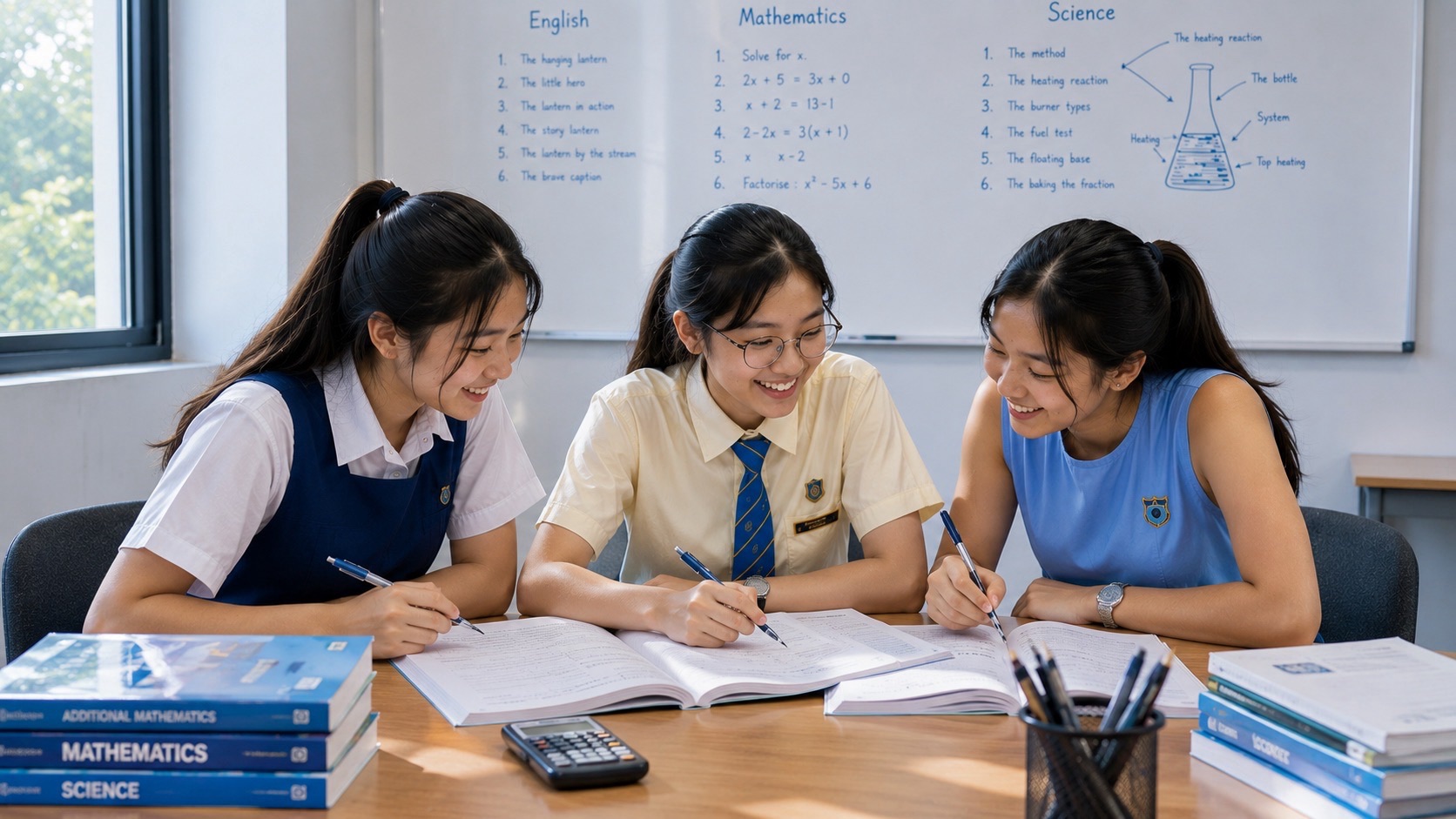
Punggol Science Tuition sits inside a much larger search landscape: Science Tuition Singapore. Families compare neighbourhood centres, online lessons, small groups, one-to-one tutoring, Primary Science, PSLE, Secondary Science, G1, G2, G3, Combined Science and separate Physics, Chemistry or Biology. The choices are wide, but the educational problem is surprisingly consistent: which programme actually helps this student understand, retain and use Science more independently?
The core aim of Science tuition in Singapore should therefore be bigger than examination drilling. Strong tuition aligns with the student’s current syllabus, diagnoses what is really going wrong, builds retrieval across the year, teaches practical and data reasoning, and improves transfer to unfamiliar questions. For Punggol families, the local advantage is convenience; the national standard remains the same: tuition should make scientific thinking stronger, not merely add another weekly class.
Explore related Science guides and choose your next reading step.
Science Tuition Singapore Is Not One Market
A Primary 3 child, a Primary 6 PSLE student and a Secondary 4 G3 Chemistry student are all searching under the same broad phrase, but they need completely different teaching.
The first step in comparing Science tuition in Singapore is therefore to identify the stage, subject level and specific learning need.
- Primary 3–4: build curiosity, vocabulary, diagrams and foundational reasoning.
- Primary 5: build cumulative retrieval and PSLE runway.
- Primary 6: integrate the whole Primary Science syllabus under exam conditions.
- Secondary 1–2: strengthen lower-secondary models, graphs, practical reasoning and subject-level fit.
- Secondary 3–4: manage Combined Science or separate sciences with cumulative retrieval and assessment control.
- SEC: align precisely to G1, G2 or G3 and the correct subject route.
The Core Aim: Match the Student Before Comparing the Brand
Families often compare tuition centres by name, fees, location or claims. Those factors matter, but fit matters first.
A strong programme should match the learner’s syllabus, current errors, pace, confidence and available study time.
A famous programme that does not fit the student may still be poor value.
Singapore Science Tuition Should Follow the Current Syllabus
Science education in Singapore changes over time, especially in secondary pathways.
For current cohorts, Full Subject-Based Banding and the Singapore-Cambridge Secondary Education Certificate mean that parents should understand the student’s actual G1, G2 or G3 Science route rather than relying on old whole-student stream labels.
See SEC Science Tuition.
Primary Science Tuition Singapore: Build the Model First
Primary Science should not become a keyword memorisation exercise.
Students need to observe, compare, explain, read diagrams and connect evidence to scientific ideas.
The broad route is Primary Science Tuition.
PSLE Science Tuition Singapore: Cumulative Control Matters
PSLE Science is cumulative and application-heavy.
Strong tuition should keep old topics retrievable, improve open-ended precision, train MCQ reasoning and develop paper control without turning the entire year into panic.
See PSLE Science Tuition.
Secondary Science Tuition Singapore: Representation Becomes More Important
Secondary students must increasingly move among words, graphs, tables, equations, particle models, circuits and biological systems.
Tuition should teach those representations as ways of expressing the same scientific model.
See Secondary Science Tuition.
Combined Science Tuition Singapore: Balance Two Disciplines
Combined Science students need to switch quickly between two scientific modes.
The weaker component should receive targeted repair while the stronger one remains maintained through retrieval.
Pure Science Tuition Singapore: Depth Needs Structure
Students taking separate sciences face a larger retrieval and representation load.
Strong tuition helps them organise Physics, Chemistry and Biology into coherent systems rather than three piles of notes.
See Pure Science Tuition.
Science Tuition Singapore Should Diagnose Before Teaching Ahead
Teaching ahead can help some students, but it is not automatically a sign of better tuition.
If graph reading, units, scientific language or retrieval are weak, moving faster can make the learning system more fragile.
Diagnosis should come before acceleration.
Class Size Changes the Learning Experience
Large classes can deliver explanations efficiently. Small groups can increase participation and feedback. One-to-one tutoring can become highly targeted.
The useful question is how much student thinking occurs in the chosen format.
See Small Group Science Tuition.
Science Tuition Fees in Singapore Should Be Compared Against Value
Fee alone does not describe the learning system.
Families should compare syllabus fit, tutor interaction, correction quality, retrieval, materials, travel and progress.
See Science Tuition Fees.
Location Still Matters
A long commute can consume energy, homework time and sleep.
For Punggol families, local tuition can create real educational value when the programme is also a good fit.
Online Science Tuition Can Be Effective When Students Stay Active
Online tuition can reduce travel and support continuity.
But the student must still answer, draw, calculate, annotate and work independently.
Science Tuition Singapore Should Build Retrieval
A student can understand a topic today and forget it next month.
Strong tuition should bring old topics back through spaced retrieval.
This is one of the most important differences between teaching and cumulative exam preparation.
Science Tuition Singapore Should Teach Practical Reasoning
Variables, measurements, controls, reliability and evaluation appear across school Science.
Practical skills should not be left until just before an assessment.
See Science Practical.
Science Tuition Singapore Should Teach Transfer
A student who succeeds only when a question resembles the worksheet has fragile mastery.
Strong tuition changes context, representation and wording while keeping the scientific relationship intact.
Transfer is the real test of learning.
Science Tuition Singapore Should Use Assessment as Evidence
A school test or mock paper should guide the next cycle of teaching.
Which errors are conceptual? Which are representation, retrieval, language or timing?
See Science Assessment.
The Tutor Should Become Less Necessary Over Time
The strongest outcome of tuition is not permanent dependency.
The student should internalise the tutor’s questions: read the axis, check the unit, identify the model, use the evidence, test the answer.
See Science Self-Study.
How Punggol Families Can Compare Singapore-Wide Options
- Is the programme aligned to the current syllabus?
- Does the class format allow enough student participation?
- How are recurring errors diagnosed and retested?
- Are old topics retrieved regularly?
- Are graphs, practicals and data taught explicitly?
- Does the programme fit the student’s actual level?
- Is travel or screen time sustainable?
- Is the student becoming more independent?
The Local Advantage of Punggol
Punggol families can compare national-quality teaching without ignoring local logistics.
Shorter travel can protect sleep, homework and family time. Local school knowledge can make scheduling and school-paper interpretation easier.
The advantage matters only when teaching quality remains strong.
How the eduKate Ecosystem Connects
For the local parent-facing hub, use Science Tuition in Punggol.
For the tutor relationship, see Science Tutor. For the centre-level system, see Science Tuition Centre.
Frequently Asked Questions
What should parents look for in Science tuition in Singapore?
Current syllabus alignment, good tutor fit, strong feedback, cumulative retrieval, practical reasoning, transfer and increasing independence.
Is Science tuition necessary for every student?
No. Some students can self-study effectively. Tuition adds value when expert diagnosis, feedback or structured practice solves a real problem.
Is small-group Science tuition better than large classes?
It can be when the smaller group produces more student thinking and individual feedback.
Should Science tuition teach ahead?
Only when foundations are secure and preview serves a clear purpose. Repairing current gaps often has higher value.
How do we know Science tuition is working?
Old topics remain accessible, repeated errors decrease, unfamiliar questions become more manageable and the student needs fewer hints.
The Core Aim, in One Sentence
The core aim of Science tuition in Singapore is to match the right student to the right level, teaching format and learning system so scientific understanding becomes durable, transferable and increasingly independent.
For Punggol families, the best Singapore Science tuition is not defined by distance from the city centre. It is defined by whether the student actually learns better.


