
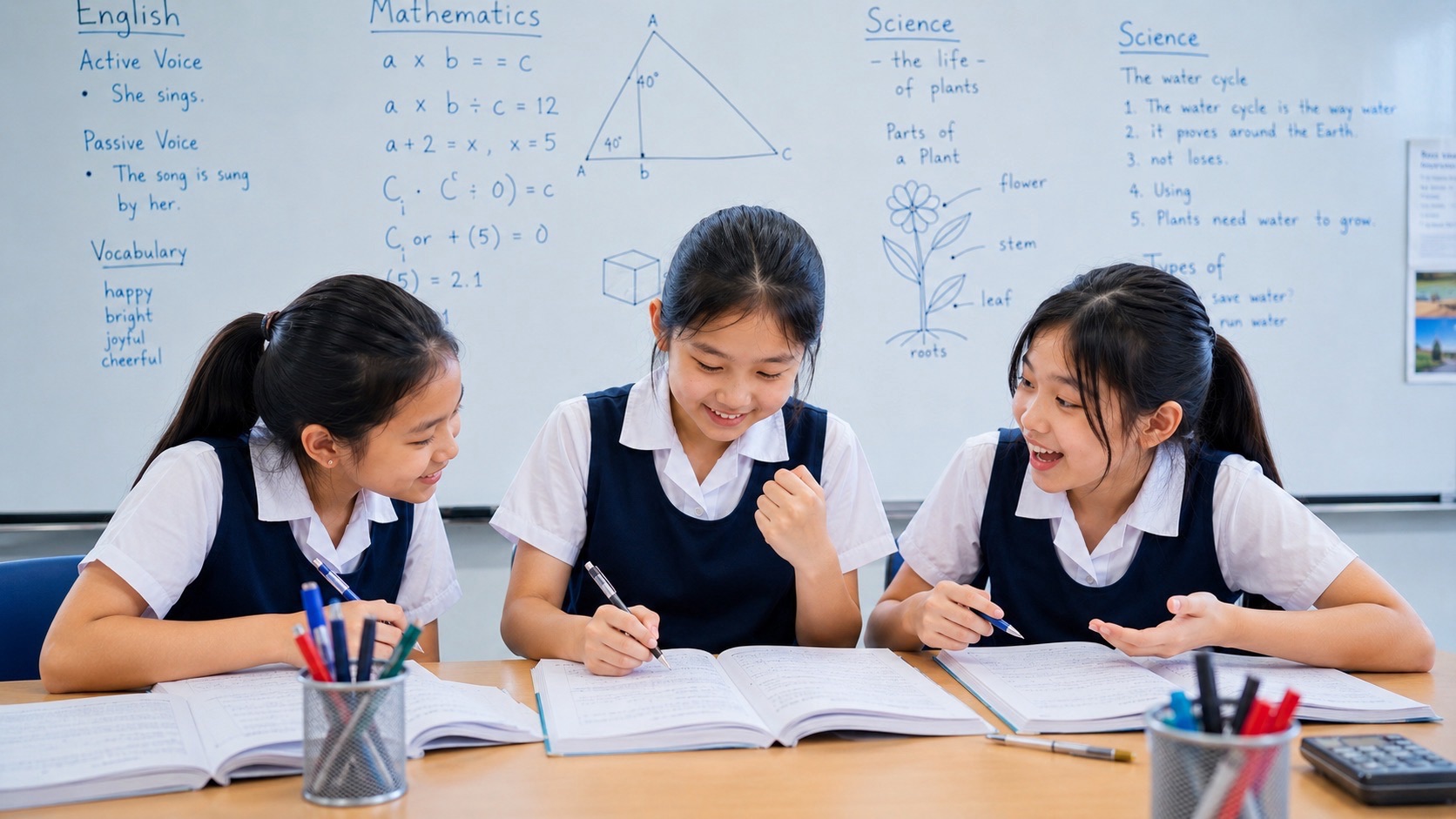
Punggol Science Tuition for primary-school learners should protect something precious while building something rigorous: curiosity must remain alive, while observation, vocabulary, evidence and explanation become increasingly precise. Parents searching for Primary Science Tuition are often not looking for a child who can memorise more pages. They are looking for a child who can understand what is happening, explain why it is happening and stay steady when the question looks different from the workbook example.
The core aim of Primary Science tuition in Punggol is therefore to build a scientific operating system before examination pressure takes over. That system begins with careful observation, grows into concept models, develops through comparison and inquiry, and eventually becomes the ability to read data, reason from evidence and communicate a clear answer. By Primary 6, this foundation supports PSLE Science. But its value begins much earlier, because strong Primary Science is really training in how to notice, ask, test, connect and explain.
Explore related Science guides and choose your next reading step.
Primary Science Should Begin With Wonder — Then Add Discipline
Young learners naturally ask scientific questions. Why does one object float while another sinks? Why does a shadow move? Why do some seeds grow while others do not? Why does a wet floor dry faster near a fan? These questions are not distractions from the syllabus. They are the doorway into it. Science becomes powerful when curiosity is joined to a disciplined way of finding answers.
The danger is that Science can slowly become a vocabulary subject. Students collect notes, highlight keywords and memorise model answers. They may score reasonably on familiar questions, yet the subject begins to feel like a list of phrases rather than a way of understanding the world. Tuition should reverse that drift. Every scientific term should connect to an observable phenomenon, a model, a relationship and a reason.
A child who understands evaporation should be able to recognise it in a tray of water, wet clothes, perspiration and a changed experimental setup. A child who understands forces should see pushes and pulls in many contexts, not only in the exact diagram from a worksheet. A child who understands plant transport should be able to reason from structure to function, not merely reproduce a sentence about roots, stems and leaves.
The Core Aim: Build a Learner Who Can Explain
A useful test of Primary Science learning is simple: can the child explain the idea without copying the notes? Not perfectly, not with adult sophistication, but clearly enough that the relationship is visible. Explanation reveals whether the child has connected the parts.
For example, if a student says, “The plant needs water,” that is a fact. If the student can explain how water is absorbed, transported and used in the plant’s processes, the knowledge is becoming connected. If the child can then reason about what happens when water availability changes, the concept is becoming transferable.
This is why explanation is at the centre of good tuition. It forces retrieval, exposes gaps, strengthens vocabulary and prepares the learner for open-ended questions. It also gives the tutor immediate evidence. A student who can select a correct MCQ option may still be uncertain. A student who can explain why the option is correct and why another is wrong is showing deeper control.
From Primary 3 to Primary 6: The Same Science, Growing in Depth
Primary Science is not four separate subjects called P3, P4, P5 and P6. It is a progression. Early learning introduces habits of observing, classifying, comparing and describing. Later learning asks students to connect systems, interpret evidence, use more precise language and handle questions that combine ideas.
In Primary 3 and Primary 4, tuition should protect foundations. The child needs clear meanings, concrete examples, simple representations and confidence in speaking scientifically. Overloading a younger learner with examination-style answer templates can produce surface fluency without understanding.
In Primary 5, the conceptual load rises. More ideas interact. Students need stronger retrieval because earlier topics remain relevant while new systems are introduced. It becomes especially important to distinguish similar concepts and to show how topics connect rather than treating each chapter as an island.
In Primary 6, the task becomes cumulative. The learner must retrieve older knowledge, interpret unfamiliar scenarios, write concise explanations and manage the full PSLE-style demand. The best Primary 6 preparation is easier when P3–P5 learning has produced connected models instead of a pile of remembered sentences.
A Concept Is Strong When It Survives a Changed Example
The central test of conceptual strength is not whether the student can answer the taught example. It is whether the same idea survives when the surface changes. This is called transfer.
Suppose a learner studies insulation using a cup wrapped in different materials. A weak understanding may remain attached to cups. A stronger understanding recognises the broader principle of reducing energy transfer and can reason about clothing, coolers, building materials or another unfamiliar setup. The object changes; the model remains.
Tuition should create this deliberately. Teach one clear example. Then vary one condition. Then vary the object. Then combine the idea with a second concept. Ask the child to identify what stayed the same scientifically. This helps the learner stop searching for visual similarity and start searching for conceptual structure.
Scientific Vocabulary: Precise Words With Real Meaning
Primary Science has a language of its own. Terms such as absorb, reflect, transparent, conductor, germination, respiration, reproduction, evaporation, condensation, force, energy and organism are not decorative. They compress precise ideas. But vocabulary becomes dangerous when students treat the word as the learning.
A student may memorise “condensation” and still confuse it with evaporation. The solution is not to repeat the definition twenty times. The solution is to connect the word to particle behaviour, temperature change, observable water droplets, everyday examples and a comparison with what condensation is not. Meaning needs a network.
We therefore teach vocabulary through contrast. What is the difference between melting and dissolving? Between mass and weight in the contexts the child encounters? Between a conductor and an electrical component? Between a habitat and a population? When similar terms are placed side by side, boundaries become clearer.
Students should also practise moving in both directions: from term to example, and from example back to term. If they can define a word but cannot recognise it in a new situation, the vocabulary is not yet functional.
Diagrams Are Thinking Tools
Science is full of things that are difficult to see directly: particles, forces, pathways, systems and invisible transfers. Diagrams make these ideas manageable. But students often treat diagrams as pictures to copy instead of representations to interpret.
Tuition should teach what a diagram is doing. Is it showing structure? Sequence? Direction? Relative position? A circuit connection? A life cycle? A transfer of matter or energy? The student should read labels, arrows, symbols and relationships before jumping to the question.
Drawing from memory can be especially powerful. Ask the child to sketch the route of water through a plant, a simple circuit, a food chain or the stages of a process. The missing arrow or misplaced part reveals more than a copied page of notes. A sketch externalises the student’s mental model, making correction possible.
Tables and Graphs: Science Is Often Hidden in the Representation
Many students say they “do not know the Science” when the real difficulty is reading data. They may compare the wrong values, ignore units or describe a trend that the graph does not show. The concept may be intact while the representation skill is weak.
We teach a fixed reading order: identify what is being measured, read the headings or axes, check the units, locate the relevant values, compare only what the question requires, and describe the pattern before explaining it. This slows the student down for a few seconds and often saves an entire answer.
Students should also learn the difference between describing data and explaining data. “The temperature increased from A to B” is a description. “It increased because…” requires a mechanism. Mixing these tasks produces answers that sound complete but miss the command word.
Inquiry: Teach Children How a Fair Comparison Works
Scientific inquiry is one of the most valuable parts of Primary Science because it teaches children how claims are connected to evidence. A fair test is not merely a list of variable names. It is a structure for making a comparison trustworthy.
The child should understand why one factor is changed, why another is measured, and why relevant conditions are kept the same. If two setups differ in several important ways, the result cannot be confidently attributed to one factor. This is the logic behind controlled variables.
Tuition should use simple verbal questions before formal labels. “What did the experimenter change on purpose?” “What was measured?” “What else should remain the same?” Once the logic is clear, the terms independent variable, dependent variable and controlled variables become easier to remember.
Then comes the harder skill: conclusions. A conclusion should answer the investigation question and stay within the evidence. Children need to learn that one experiment does not prove everything. Evidence has boundaries.
Observation Is Not the Same as Inference
Primary Science questions often require students to distinguish what can be directly observed from what is inferred. This difference is foundational. “The water level decreased” is an observation. “Water evaporated” is an inference based on scientific reasoning.
Strong students learn to keep those categories clear. They can identify what the data gives them and what their scientific model adds. This matters when evaluating experiments, interpreting photographs and writing explanations.
At home, parents can reinforce this gently. Ask, “What did you actually see?” and then, “What do you think caused it?” Those two questions build scientific discipline without turning dinner into a test.
Open-Ended Answers: Build the Chain, Not the Template
Open-ended questions are where many families begin looking for Primary Science tuition. The child may know the topic but write answers that are vague, incomplete or too general. The tempting response is to memorise model sentences. That can help with language exposure, but it should not become the method.
A stronger approach is to build the reasoning chain. What changed? What scientific process or property matters? What effect follows? If the question gives data, what evidence should be used? This produces answers that are adaptable rather than brittle.
A useful editing exercise is to underline the scientific nouns, circle the direction of change and draw an arrow between cause and effect. If the answer contains no clear relationship, it is probably descriptive rather than explanatory. If it contains many facts but no link to the question, it needs pruning.
Children also need permission to be concise. A precise two-sentence answer can be stronger than a paragraph full of loosely related facts. Tuition should teach enough, not excess.
MCQ: Correct Answers Still Need Reasons
Multiple-choice work is an excellent diagnostic tool when the tutor asks for reasoning. A child who chooses the correct option but cannot explain it may have guessed, recognised a familiar phrase or used partial elimination. That can hide a fragile concept.
We ask students to predict, justify and eliminate. Predict the likely answer before reading all options when possible. Justify the scientific principle. Eliminate wrong options for specific reasons. This makes misconceptions visible and turns every distractor into a teaching opportunity.
It also teaches intellectual honesty. “I got it right but I was not sure why” is valuable information. The aim is not to reward the appearance of certainty; it is to build real certainty where the evidence supports it.
Misconceptions Need to Be Replaced, Not Merely Corrected
Science misconceptions are sticky because they often feel intuitive. Children may think heavier objects always sink, larger objects are always heavier, plants “eat” soil, or a battery “stores current.” Simply marking these ideas wrong may not replace the mental model.
Effective repair has three steps. First, make the existing idea visible by asking the child to predict. Second, present evidence or a counterexample that creates useful tension. Third, rebuild the correct model and apply it in several contexts. The learner needs somewhere better for the idea to live.
This is why explanation and demonstration are powerful. The child should be able to say not only what the correct answer is, but why the old idea fails.
Memory: Retrieval Beats Re-Reading
Re-reading notes feels productive because the page becomes familiar. But familiarity is not the same as recall. In an assessment, the notes are closed. The student must retrieve the idea independently.
Primary learners benefit from short retrieval routines: five questions from older topics, one diagram from memory, one definition, one comparison and one transfer problem. These can take ten minutes and often reveal more than thirty minutes of passive review.
Spacing matters too. Revisiting a topic after a delay strengthens access. Tuition should therefore keep old Science alive while teaching new material. A child should not finish “Heat” in March and never touch it again until September.
Interleaving: Learn to Choose the Right Idea
When every worksheet is labelled by topic, the student already knows which concept to use. Real assessments are mixed. The learner has to identify the relevant model.
Interleaving means mixing different types of questions so the student practises selection. A forces question may sit beside a plant question, a graph question and an electrical circuit. The difficulty rises because the cue has been removed. That difficulty is useful once the foundations are strong enough.
The goal is not confusion. Early practice can be blocked by topic so the learner gains fluency. Later practice should become increasingly mixed. Teaching should move from support to independence.
A Small Group Should Make Every Learner Visible
Primary Science tuition in a small group works best when each child has frequent opportunities to think aloud, answer, draw and revise. The tutor should be able to notice the exact moment the reasoning goes wrong.
Three students can be an effective size because there is peer energy without much hiding space. One student’s explanation can become a comparison for another. Different methods can be discussed. Yet each child still needs individual checking; a group answer is not evidence that every learner understands.
The tutor should vary who answers first. Stronger students should not dominate. Quieter students should not be protected from productive thinking. The atmosphere should be calm enough that wrong predictions can be discussed without embarrassment. Science grows through revision.
Primary Science Progress Has Several Layers
Parents often look first at marks, understandably. But marks are a delayed and noisy indicator. We also look at how the student approaches work.
- Can the child explain concepts without reading?
- Can the child identify what a question is testing?
- Can the child use diagrams and data accurately?
- Are open-ended answers becoming more precise?
- Do old mistakes recur less often?
- Can older topics still be retrieved after several weeks?
- Can the student solve a changed-context question?
- Does the child check units, labels and evidence without being prompted?
- Can the learner describe why an answer was wrong and how to repair it?
When these behaviours improve, the learning system is getting stronger. Test scores usually become more stable when the mechanisms underneath them improve.
What a Productive Weekly Lesson Can Look Like
A productive lesson has rhythm. Begin with brief retrieval from earlier topics. Review one recurring error. Teach or consolidate the current concept. Use guided examples where the tutor can question the reasoning. Move to independent work. Finish with one or two transfer questions that look different from the lesson. Record what needs to return next week.
The lesson should not be a race to finish pages. Some days, a single misconception deserves twenty careful minutes because it affects many future questions. On another day, the student may be ready for a broad mixed set. The method should respond to evidence.
Homework should continue the same logic. If the lesson revealed weak graph reading, home practice should include graphs. If vocabulary is unstable, short retrieval may be more useful than another full paper. If the student is strong, extension should increase novelty and reasoning rather than simply increase quantity.
Parents Can Support Science Without Recreating School at Home
A parent’s best role is often environmental rather than instructional. Help the child keep a regular study rhythm, bring corrected work back to tuition, and create small moments of curiosity. You do not need to know every mark scheme.
- Ask the child to teach you one idea in two minutes.
- Ask what changed in an experiment and what was measured.
- Ask for one real-life example of the week’s concept.
- Ask the child to draw the idea instead of rereading it.
- Ask what mistake from last week has now been repaired.
- Ask which old topic still feels uncertain.
If an explanation becomes tense, stop. Home should not become another examination hall. The point is to make thinking visible, not to turn the parent into an assessor.
Science in Punggol: Use the Neighbourhood as a Context, Not a Gimmick
Punggol offers many ordinary contexts that can make Science tangible: waterways, rain, plants, shade, transport, building materials, wind, sound and changing light. These can prompt questions about systems and evidence. The educational value comes from the thinking, not from the location itself.
A child can compare surfaces in sunlight and shade, notice how leaves differ, observe water movement after rain or discuss why different materials are used in structures. The observation becomes scientific when the learner asks a testable question, identifies variables or connects the phenomenon to a model.
This local connection helps one important idea: Science is not something that only exists in a textbook. The textbook gives names and models to patterns that are already happening around the learner.
Preparing for PSLE Without Turning Primary Science Into PSLE From Day One
PSLE matters, but Primary Science education should not become an endless final-exam rehearsal from the first year of the subject. Younger students need conceptual richness, vocabulary, curiosity and inquiry habits. Examination precision can then grow on top of those foundations.
By Primary 5 and Primary 6, exam-style application becomes increasingly important. Yet even then, the best preparation is still conceptual. Past papers are useful because they expose how concepts are tested, not because students should memorise past answers.
Families nearing Primary 6 can use our dedicated route, The Core Aim of Punggol Science Tuition | PSLE Science Tuition, for a deeper look at cumulative retrieval, open-ended answers, inquiry and examination control.
How the eduKate Science Routes Connect
Families who want the broad local programme can begin at Science Tuition Punggol. The dedicated Primary route is Primary Science Tuition in Punggol. For children working specifically on independent retrieval, How to Self-Test Science at Home Without Looking at the Notes is a useful companion.
For learners who rely heavily on memorised model responses, see How to Learn From Science Model Answers and Mark Schemes Without Memorising Sentences. The purpose of the ecosystem is routing: once the difficulty is visible, the family can move to the most useful next explanation instead of reading everything.
Frequently Asked Questions
When should a child start Primary Science tuition?
There is no single correct age. Tuition is useful when it solves a real learning need: persistent concept gaps, weak explanations, difficulty with inquiry, repeated mistakes, low confidence or a desire for deeper extension. A child who is progressing well independently may not need additional tuition simply because peers have it.
Is Primary Science mainly about keywords?
No. Scientific terms matter, but the child must understand the relationship they describe. A correct keyword inside an incorrect explanation does not create understanding. Vocabulary should be taught with examples, diagrams, contrasts and application.
Why does my child understand verbally but lose marks in writing?
The learner may have an answer-construction problem rather than a concept problem. The child needs practice turning oral reasoning into concise scientific sentences that match the command word and include the necessary relationship.
Why can my child do topical worksheets but struggle in tests?
Topical practice tells the student which concept to use. Mixed assessments require concept selection. The learner may need more interleaved practice, retrieval of older topics and changed-context transfer questions.
Should tuition teach ahead of school?
Sometimes. Preview can reduce surprise and free school lessons for consolidation. But teaching ahead should not outrun weak foundations. The best decision depends on the student’s current evidence, school pace and assessment timeline.
How much Science practice is enough each week?
Enough to retrieve, apply and correct without turning practice into rushed volume. A smaller set that is carefully reviewed can be more useful than a large set that is completed mechanically. The student’s school load and current needs matter.
What should I look for in a Primary Science tutor?
Look for diagnosis, clear explanations, evidence of concept teaching, attention to inquiry and data, precise feedback on written answers, and a plan for retrieval and transfer. Ask how the tutor decides what to teach next when a child keeps making the same error.
Can strong students benefit from Primary Science tuition?
Yes, if extension changes the quality of thinking rather than simply adding harder worksheets. Strong learners benefit from novel contexts, deeper explanations, competing hypotheses, experimental design, data evaluation and connections across topics.
How do I know whether tuition is creating independence?
Watch the child’s next attempts. Does the learner begin with less prompting, explain more clearly, retrieve older knowledge and recover from unfamiliar questions? Independence should increase over time. If the student can succeed only while the tutor is beside them, the support has not yet completed its job.
What Changes From P3 to P6 — and What Should Stay Constant
Primary Science grows quickly across the middle and upper-primary years, but the best learning habits should remain recognisable throughout. The child should keep asking what was observed, what changed, what stayed the same, which scientific idea explains it and what evidence supports the conclusion. What changes is the depth of the model and the precision expected in the answer.
Primary 3: Build the habit of looking closely
At Primary 3, the priority is not speed. It is careful noticing. Students are learning how Science organises familiar experiences into categories, properties and relationships. Tuition should use concrete examples, simple diagrams and short explanations. The child should be encouraged to say what they see before being told what to think.
This is also the right stage to teach that a scientific word has a narrower meaning than everyday speech. “Transparent,” “absorb,” “force,” “life cycle” and similar terms should be connected to examples and non-examples. The learner needs semantic boundaries before examination language becomes demanding.
Primary 4: Connect ideas across representations
By Primary 4, students can handle more movement between words, diagrams, tables and simple experimental setups. Tuition should begin asking them to express the same idea in more than one form. Explain it in a sentence. Sketch it. Point to the relevant evidence. Compare two cases.
This multi-representation work prepares students for later questions because the exam rarely presents knowledge in only one familiar form. A child who understands a concept only as a paragraph of notes may struggle when the same idea appears inside a diagram.
Primary 5: Protect retrieval as content expands
Primary 5 often feels like a step up because new content arrives while older ideas remain examinable. Students can start forgetting earlier topics simply because attention has moved elsewhere. Tuition should deliberately bring old concepts back.
This is also a good stage to strengthen open-ended answer structure. The student should learn to connect condition, process and effect without becoming dependent on rigid templates. They should also meet more changed-context questions so that transfer grows before the PSLE year.
Primary 6: Integrate, switch and control
Primary 6 adds cumulative pressure. Now the learner has to identify which concept applies, retrieve it quickly, interpret the representation, build the answer and manage time. Tuition should gradually move from topic support toward mixed control while still repairing specific gaps when they appear.
The important continuity is this: a P6 student should still be doing what the P3 student began doing—observing, comparing, explaining and checking—only with a larger scientific toolkit and greater independence.
The Oral-to-Written Bridge: One of the Most Useful Primary Science Repairs
Many children can explain a Science idea in conversation but produce a weak written answer. This can frustrate parents because the child clearly “knows it.” The gap is real: oral language allows gestures, repetition and immediate clarification. Written answers must be precise without that support.
A useful tuition method is to capture the oral explanation first. Ask the student to say the answer naturally. Then identify the scientific relationship hidden inside the speech. Remove fillers. Replace vague pronouns with the correct object or variable. Add the necessary scientific term. Finally, compare the polished sentence with the original meaning.
This shows the child that good answer writing is not a separate mysterious skill. It is accurate scientific thinking edited into a form the reader can inspect. Over time, the editing moves inside the student’s head and the written answer becomes cleaner on the first attempt.
A Science Notebook Should Record Thinking, Not Copy the Textbook
Some learners spend large amounts of time making beautiful notes that are rarely used for retrieval. Notes can help, but the best notebook is a tool for thinking. It should make relationships visible.
- One-sentence concept summaries written from memory.
- Quick diagrams that show structure, direction or sequence.
- Common contrasts such as evaporation versus boiling or conductor versus insulator.
- A small list of recurring personal errors.
- Questions the student still cannot explain confidently.
- Examples of one concept appearing in different real-world situations.
- Corrections that include why the original idea failed.
The notebook should stay compact enough to revisit. If it becomes a second textbook, the learner may admire it instead of using it. A good Science notebook is alive: ideas are tested, corrected and condensed as understanding improves.
Safe Home Science: Observation Before Experiment
Parents often ask whether children should do experiments at home. Simple, safe investigations can be helpful, but elaborate demonstrations are not necessary. Observation is already scientific when it is structured.
A child can compare how quickly small amounts of water dry in different safe conditions, observe shadows at different times, classify household materials by visible properties, track seed growth or record how temperature changes in a safe container. The learning comes from asking a question, making a prediction, deciding what to observe and discussing what the evidence can support.
Safety should always come first. Avoid chemicals, heat, electrical mains, sharp tools or any activity that requires specialist supervision. Home Science should deepen curiosity, not imitate a laboratory beyond the family’s safe competence.
The Difference Between Practice and Overpractice
Practice is essential, but children can overpractice one narrow form until they become good at the worksheet rather than the Science. Repeating twenty near-identical questions may create speed without transfer.
A healthier sequence is: a few similar questions for initial fluency, then changed contexts, then mixed questions after a delay. If the student keeps succeeding, increase novelty rather than simply adding quantity. If errors appear, return to the model and diagnose them.
This protects motivation too. Children are more likely to remain engaged when practice feels purposeful and when they can see what new capability they are building.
Strong Students Need Better Questions, Not Just More Questions
A strong Primary Science student can become bored if extension means finishing the same kind of worksheet faster. Better extension changes the intellectual demand. Ask the student to predict before seeing results, compare two plausible explanations, design a fairer test, identify a limitation or transfer the concept to an unusual context.
Strong learners also benefit from explaining. Teaching a concept to another person exposes hidden assumptions. Ask the student to explain the idea to a younger sibling, parent or imaginary class, then answer a follow-up “why?” without notes.
Depth is not the same as racing into secondary-school content. Sometimes the richest extension is to stay with the same Primary concept and ask a more demanding question about evidence, mechanism or design.
A Term-by-Term Learning Rhythm
Primary Science tuition should breathe with the school year. Early in a term, the emphasis may be concept building and school alignment. Mid-term, retrieval and application increase. Before a weighted assessment, mixed practice and answer precision become more important. After the assessment, the programme should return to diagnosis rather than immediately rushing ahead.
School holidays are useful for selective repair. One child may need to rebuild a difficult concept. Another may need to consolidate older topics. A strong learner may benefit from a small preview of the next term. The holiday plan should be based on evidence, not a fixed rule that every child must “get ahead.”
How to Read a Returned Primary Science Paper
A returned paper contains more information than the total mark. Sort the errors. Were they concentrated in one topic? Were several answers scientifically correct but too vague? Did graph questions fail? Were MCQ errors caused by misconceptions? Did the child leave questions blank because of time?
Then find the repeated mechanism. If the same child loses marks across different topics because they do not compare both conditions, the problem is a comparison skill. If units are ignored across several data questions, that is a representation habit. Cross-topic patterns deserve priority because one repair can improve many future questions.
When a Child Says “I Don’t Get Science”
Broad statements usually hide a narrower difficulty. Ask which part feels hard. Remembering terms? Understanding diagrams? Writing answers? Experiments? Too many topics? A bad recent test? Once the difficulty is named, it becomes more manageable.
Tuition should avoid reinforcing a global identity such as “not a Science person.” Primary school is far too early for that label. A learner may simply need a different explanation, more retrieval, slower representation work or clearer feedback. Specific problems invite specific solutions.
The Parent–Tutor Feedback Loop
Parents benefit most from feedback that is concrete. “Doing better” is pleasant but vague. “The student now identifies variables reliably, but open-ended comparisons are still incomplete” helps everyone understand the next step.
Likewise, parents can give tutors useful context without micromanaging. Mention repeated homework frustration, a topic the child avoids, a change in school pace or a recent marked paper. These observations can sharpen diagnosis.
The goal is a triangle of evidence: school work, tuition work and the child’s independent behaviour. When all three improve, progress is more likely to be real and durable.
Primary Science Tuition Should Eventually Need Less Prompting
One of the clearest signs that tuition is working is that the tutor speaks less during independent practice. Early on, the student may need questions such as “What changed?” or “Which concept applies?” Later, the learner should ask those questions internally.
This transfer of control is the point. A tutor who always rescues the student quickly can make lessons feel successful while preserving dependence. Productive struggle, within a supportive environment, gives the learner time to retrieve and decide.
The end state is not a child who never needs help. It is a child who knows what to try before asking for help and who can use feedback to improve the next attempt.
The Core Aim, in One Sentence
The core aim of Punggol Science Tuition for Primary Science is to turn natural curiosity into disciplined scientific capability: observe carefully, build accurate concepts, use precise language, reason from evidence, transfer ideas to new contexts and explain independently.
When that happens, Primary Science becomes more than a subject to pass. The learner gains a way to think. A question becomes something to investigate. A diagram becomes a model to read. A mistake becomes evidence about what to repair. And a correct answer becomes more than a remembered sentence — it becomes the visible result of understanding.


