
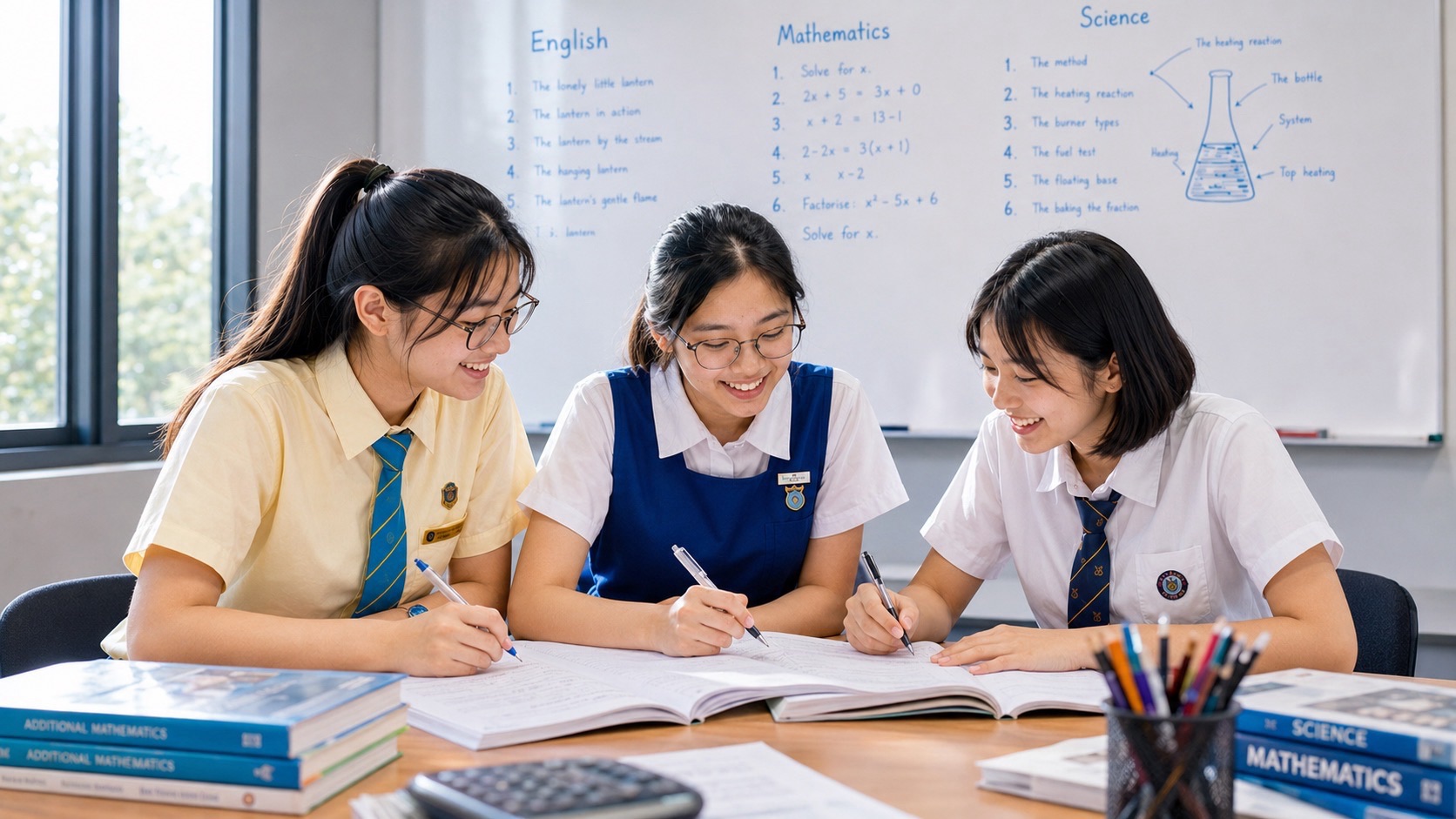
Punggol Science Tuition works better when students know what they are trying to become able to do. Families often think of Science learning goals as marks, grades or chapter completion, but those are outcomes. A useful learning goal is more specific: explain this concept without notes, interpret this graph accurately, design a fair test, write a complete causal answer, or solve a changed-context question independently.
The core aim of Science learning goals in Punggol tuition is to convert broad ambition into observable capability. A student who says “I want to improve Science” still needs a next move. A student who says “I want to compare two conditions accurately in open-ended answers” has a target that can be practised, checked and eventually retired when the skill becomes stable.
Explore related Science learning guides and choose your next reading step.
Marks Are Outcomes; Learning Goals Are Capabilities
A mark can tell a student where they ended up. A learning goal tells them what to build next.
This distinction matters because students cannot directly practise “get AL1” or “score 80.” They can practise retrieval, graph reading, practical reasoning, precise explanations and time control.
The Core Aim: Turn Ambition Into the Next Trainable Skill
- Too broad: “Improve Science.”
- Better: “Remember old topics for longer.”
- Better: “Read graph scales accurately.”
- Better: “Explain cause and effect without vague pronouns.”
- Better: “Identify independent and dependent variables correctly.”
The best goal is specific enough to change what the student does this week.
One Goal Should Have Observable Evidence
A good Science learning goal should answer: What would success look like?
For example, “I can redraw the circuit from memory and explain what changes when resistance increases” is stronger than “understand electricity better.”
Use Short-Term and Long-Term Goals Together
Long-term goals provide direction. Short-term goals create movement.
A Primary 6 student may want stronger PSLE Science overall, but this week’s goal could be improving graph interpretation. A Secondary 3 student may want stronger Physics, but the immediate target could be unit conversion.
Primary Science Goals Should Build Foundations
For Primary 3 and 4, useful goals include observation, vocabulary, comparison, diagrams and simple explanations.
The child should experience progress as growing scientific capability, not only test scores.
Primary 5 Goals Should Build Cumulative Control
Primary 5 is a good stage to add retrieval, mixed-topic practice and open-ended precision.
The learner should begin preparing for the cumulative demands of Primary 6 without turning the year into constant PSLE drilling.
Primary 6 Goals Should Integrate the Whole System
Useful Primary 6 goals include stable retrieval, stronger open-ended answers, accurate MCQ reasoning, graph interpretation and paper timing.
See Primary 6 Science Tuition.
Secondary Goals Should Match G1, G2 or G3
A learning goal must match the student’s actual course and syllabus depth.
Under Full Subject-Based Banding, the right target is not “do harder Science because harder is better.” It is “master the current course and build evidence for the next step.”
Subject Goals Should Be Different Across Physics, Chemistry and Biology
Physics goals may involve model selection, diagrams, units and calculations. Chemistry goals may involve observations, particles and equations. Biology goals may involve structure-function reasoning, processes and data.
One generic “Science goal” can hide these different needs.
Goals Should Come From Error Analysis
A student’s recurring errors provide excellent goal material.
If graph scale errors appear repeatedly, that becomes a learning goal. If open-ended answers omit mechanisms, that becomes another.
Goals Should Be Few Enough to Remember
A list of twelve goals is usually a wish list.
Choose one or two priorities at a time, especially for students who are already overloaded.
Once a goal stabilises, replace it with the next high-value target.
Strong Students Need Growth Goals, Not Just Score Goals
A high-performing student can still grow in transfer, precision, experimental design and critical evaluation.
These goals protect depth and curiosity even when school marks are already strong.
Struggling Students Need Achievable Goals
A student with many gaps should not be given the entire syllabus as one target.
Use smaller, meaningful goals that create visible success and rebuild momentum.
Learning Goals Should Include Independence
A powerful goal is not only “solve this question” but “solve it without the tutor’s first hint.”
Support should gradually fade as capability grows.
Retrieval Goals Are Easy to Measure
Examples include “recall five old concepts without notes” or “redraw this diagram after one week.”
See Science Retrieval Practice.
Application Goals Test Real Mastery
A student should eventually solve the concept in a changed context.
That is stronger evidence than success on repeated familiar questions.
See Science Application Questions.
Time Goals Should Focus on Process
Instead of “finish faster,” use a goal such as “release a stalled question after a sensible attempt and return later.”
This makes time management trainable.
Goals Should Be Reviewed Against Evidence
A goal is complete when the student can perform the skill repeatedly and independently, including after a delay or in a fresh context.
One lucky success is not enough.
A Simple Science Goal Template
- Skill: what will improve?
- Evidence: what will prove improvement?
- Practice: what will the student do?
- Retest: when will the skill be checked again?
- Exit rule: when is the goal stable enough to replace?
Parents Should Ask About the Current Goal
Instead of asking only “What did you score?” parents can ask “What Science skill are you working on this week?”
This keeps attention on the learning process.
Learning Goals and Progress Tracking Are One System
Goals define what should improve. Progress tracking shows whether it did.
See Science Progress Tracking.
Learning Goals and Feedback Are One System
Feedback should tell the student how close they are to the current goal and what next move matters most.
See Science Feedback.
Learning Goals and Study Planning Are One System
The weekly Science plan should contain tasks that serve the current goals.
See Science Study Plan.
Frequently Asked Questions
What is a good Science learning goal?
A specific capability that can be practised and observed, such as reading graph scales accurately or explaining a causal mechanism without notes.
How many Science goals should a student have?
Usually one or two major active priorities are easier to manage than a long list.
Should goals be based on marks?
Marks can guide priorities, but the goal itself should usually describe the skill that will improve those marks.
How do we know a learning goal is complete?
The student can perform the skill independently, repeatedly and in fresh contexts, including after a delay.
The Core Aim, in One Sentence
The core aim of Science learning goals in Punggol tuition is to turn “I want to improve” into a small number of trainable capabilities with clear evidence of success.
A strong goal gives the student something more useful than hope: a next move.


