
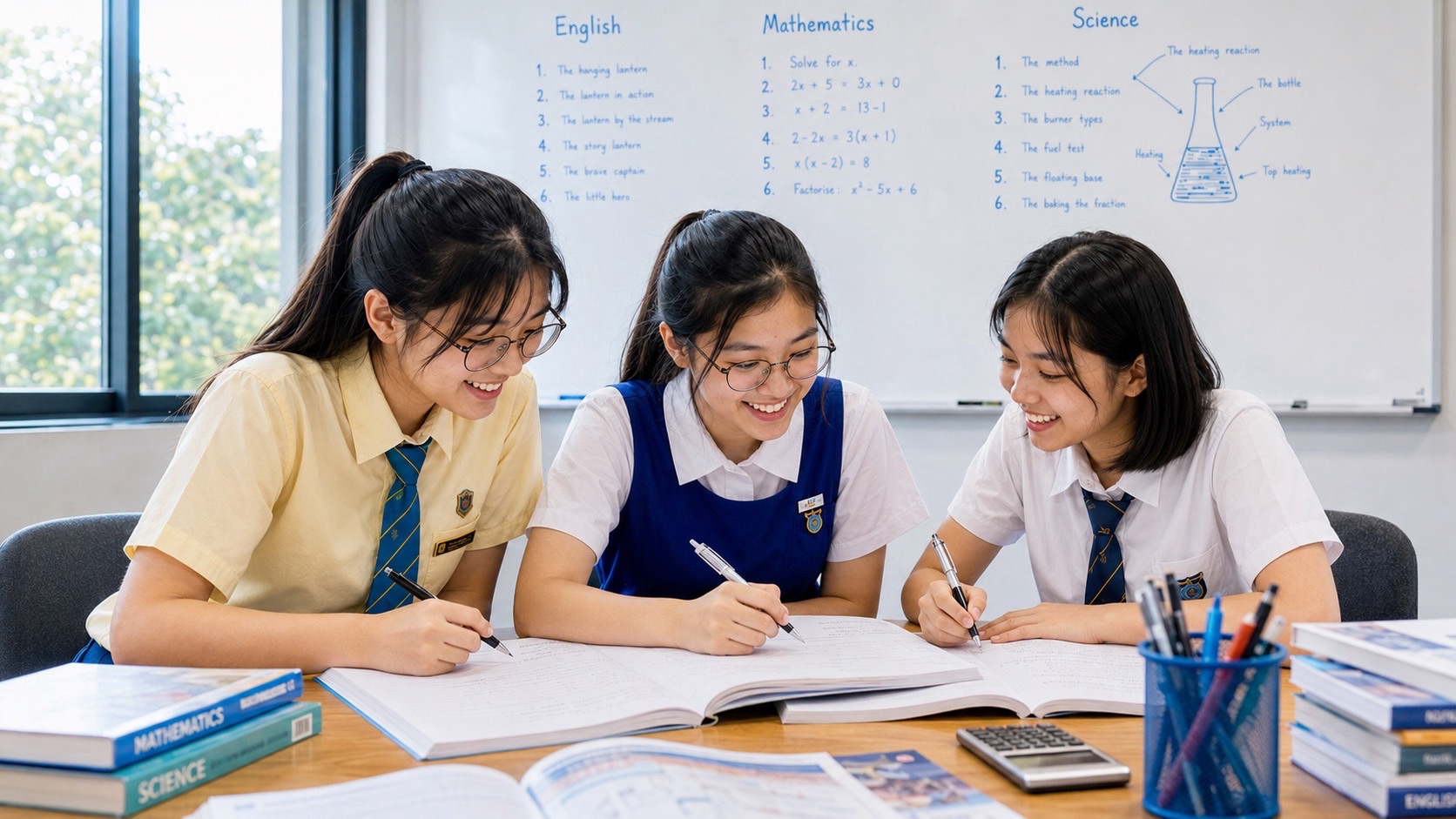
Secondary school education in Punggol is the stage where students move from being closely guided primary learners into young people who must manage subjects, teachers, assessments, CCAs, friendships, choices and increasingly independent study. For families searching for Punggol secondary schools, Full Subject-Based Banding, G1 G2 G3 subjects, Secondary 1 tuition or the new SEC pathway, the most useful question remains wonderfully simple: what is secondary education actually trying to build?
The core aim is not merely to survive four years and collect grades. It is to help a student develop deeper subject knowledge, stronger judgement, self-management and enough ownership of learning to make increasingly informed choices. Under Full Subject-Based Banding, fully implemented since 2024, students may offer subjects at G1, G2 or G3 levels according to strengths, interests and learning needs. From 2027, graduating students will sit the Singapore-Cambridge Secondary Education Certificate examinations at their respective subject levels.
The Core Aim in One Sentence
Secondary education should turn a supported learner into a young person who can manage complexity, build real subject capability and make better choices about what comes next.
This is why Secondary 1 is such an important transition. The student does not simply receive harder chapters. The whole operating environment changes: more teachers, more specialised subjects, more movement between classes, more homework decisions, more independent revision and more consequences for weak routines.
Secondary School Is Where Learning Becomes a Portfolio
In primary school, the timetable is broad but the learning experience is still relatively integrated. By secondary school, the student starts carrying a portfolio of subjects. Strengths can diverge sharply. A learner may be excellent in English and Humanities, steady in Science and less secure in Mathematics — or the reverse.
Full Subject-Based Banding makes that reality more visible. Posting Groups are used for entry into secondary school, while subjects can be offered at different G1, G2 or G3 levels where school criteria and readiness support it. The student is no longer best understood as one fixed academic label.
For Punggol families, this is a useful change in mindset: read the subject, not only the student’s overall label.
Five Capabilities Secondary Education Should Build
1. Subject depth
Secondary subjects develop their own language, methods and standards of evidence. English requires more controlled reading, writing, speaking and interpretation. Mathematics becomes increasingly algebraic and structural. Science develops more formal models, data reasoning and explanations. Humanities demand evidence, perspective and argument.
A student who relies only on memorised procedures will increasingly feel the floor move beneath them. Secondary education should help students understand the grammar of each subject: what counts as a good question, a good method, a good explanation and a good check.
2. Learning independence
A secondary student cannot wait for an adult to organise every page of revision. Independence develops through repeated transfer of responsibility:
- know what has been taught;
- know what is not secure;
- choose an appropriate way to practise;
- retrieve without looking too soon;
- check work against the question;
- return to weak areas after a delay;
- ask for help with enough precision that someone can actually help.
This does not mean adults disappear. Teachers, parents and tutors remain important. Their role gradually changes from constant director to coach, diagnostician and guide.
3. Self-management
Secondary school adds more moving parts. The student has to manage time, deadlines, CCA commitments, tests, group work, devices, friendships, sleep and the ordinary unpredictability of adolescence.
The educational aim is not a colour-coded planner for its own sake. It is the ability to notice competing demands, decide what matters next and act before urgency becomes crisis.
4. Judgment
As content becomes more complex, students need more than recall. They must compare evidence, recognise assumptions, evaluate sources, distinguish confidence from certainty and decide whether an answer is reasonable.
Judgment is also social. Secondary students are beginning to make choices about peers, digital life, values, identity and future pathways. Education should give them language and habits for thinking before acting.
5. Direction without premature closure
Secondary school introduces serious pathway decisions, but students are still developing. Good education helps them learn enough about themselves to choose sensibly without forcing a permanent identity too early.
A strong Mathematics student may discover design. A language-focused student may enjoy coding. A practical learner may thrive in applied settings. Direction should sharpen as evidence accumulates.
What Full Subject-Based Banding Changes
Full SBB has been fully implemented in secondary schools since 2024. Students learn in mixed form classes and may take a mix of subjects at G1, G2 and G3 levels based on their strengths, interests and learning needs, subject to school arrangements.
This matters educationally because it weakens the old idea that one stream label should describe the whole student. A learner can have a mixed subject profile, and subject levels can be adjusted at appropriate junctures.
The local guide Full SBB in Punggol Secondary Schools | G1, G2 & G3 in Practice explains the system for Punggol families.
From PSLE Score to Secondary-School Reality
PSLE helps determine the Secondary 1 starting route, but the real work begins after posting. Students still need to adapt to their school’s pace, teachers, subject combinations, programmes and expectations.
A child who was strong in primary school can wobble in Secondary 1 because the methods changed. Another child may flourish because greater subject specialisation finally matches their strengths. The first term is therefore not only about marks; it is a diagnostic window.
Three Secondary-School Pathways
The repair pathway
The student has carried an unstable foundation into secondary work. Fractions now damage algebra. Weak vocabulary now affects inference across English, Science and Humanities. Poor working habits create repeated losses under more demanding assessments.
The priority is to repair the first unstable point without reteaching everything. Precision matters.
The stabilisation pathway
The student can understand lessons but performance is inconsistent. The problem may be retrieval, pacing, organisation, exam technique or poor transfer between guided examples and independent questions. The aim is reliable execution.
The extension pathway
The student is coping well and needs depth: unfamiliar applications, stronger explanation, wider reading, multiple methods, projects and richer connections between subjects.
Extension is not a race to finish the syllabus. It is training the mind to operate with greater range.
A First-Principles Diagnostic for Secondary Students
When results fall, resist the urge to call the whole student “weak”. Ask where the chain broke.
- Did the student understand the concept?
- Could the student retrieve it without notes?
- Did the student recognise when to use it?
- Could the student execute accurately?
- Did the answer meet the subject’s standard of explanation?
- Was time managed well enough?
- Did stress or avoidance prevent the student from starting?
Different breaks need different repairs. More practice helps only when the practice is aimed at the real cause.
The New SEC Is a Certificate of Subjects and Levels
From 2027, the Singapore-Cambridge Secondary Education Certificate replaces the separate N- and O-Level certificates for graduating secondary students. Students sit the national examinations at the subject levels they offer.
For families, the important educational idea is continuity: build each subject to the strongest appropriate level, rather than reducing the student to one old stream identity. The student’s portfolio matters.
What Progress Should Look Like
Secondary-school progress may first appear as better control rather than dramatic grade jumps. Look for a student who:
- knows what homework and assessments are coming;
- can begin revision without waiting for an adult to design the whole plan;
- asks subject-specific questions;
- keeps clearer working and notes;
- retrieves older knowledge more reliably;
- can explain recurring errors;
- uses feedback on the next attempt;
- recovers after a poor result;
- makes pathway choices with reasons rather than labels.
Grades remain important evidence. The point is that stable grades are usually built by stable processes.
How Parents Can Help Without Running the Student’s Entire System
- Move from “Have you studied?” to “What is the next assessment and what evidence says you are ready?”
- Ask for one or two recurring error patterns instead of every individual mistake.
- Protect sleep and realistic routines.
- Use school communication and teacher feedback before assuming a child needs a different subject level.
- Let the student make some planning decisions and review the consequences.
- Keep pathway conversations open enough for new strengths to appear.
Parents are still important. The aim is to shift from constant supervision toward increasingly intelligent support.
When Tuition Helps in Secondary School
Tuition can be useful when a subject gap is compounding, school pace is difficult to manage, a student needs close diagnosis, assessment execution is unstable or extension would benefit from more deliberate challenge.
Tuition should not become a substitute for school attention or independent effort. Its best role is to make the learner more capable of succeeding in school and eventually less dependent on tuition.
At eduKatePunggol, the local small-group system uses observation, diagnosis, rebuilding, guided practice, independent application and review. The larger principle is simple: support should improve the student’s next unaided attempt.
Frequently Asked Questions
Are Express, Normal (Academic) and Normal (Technical) still the main streams for new Secondary 1 students?
No. Full Subject-Based Banding has been fully implemented since 2024. New Secondary 1 students are posted through Posting Groups, learn in mixed form classes and may take subjects at G1, G2 or G3 levels.
What do G1, G2 and G3 mean?
They are subject levels. “G” stands for General. They describe the level at which a particular subject is offered; they should not be used as a new fixed label for the whole student.
What happens to O-Levels and N-Levels?
From 2027, graduating students sit the Singapore-Cambridge Secondary Education Certificate examinations at their respective subject levels, replacing the separate N- and O-Level certificates.
Should Secondary 1 students start tuition immediately?
Not automatically. Some students adapt well through school support and good independent habits. Tuition becomes useful when there is a recurring problem, a foundation gap, a difficult transition or a clear extension need that is not being met.
How do I know whether a subject problem is serious?
Look for repetition: the same misconception, unfinished homework, widening avoidance, repeated test losses, inability to explain methods or a growing gap between guided work and independent work.
Useful Routes for Punggol Families
- eduKatePunggol home — local tuition, student, parent, education and pathway routes.
- Punggol Atlas — Punggol learning, schools, family and pathway knowledge routes.
- Full SBB in Punggol Secondary Schools | G1, G2 & G3 in Practice.
- How Tuition Works at eduKatePunggol.
- MOE Education Conversations — current direction on Full SBB, assessment and 21st-century competencies.
- MOE Full SBB and SEC announcements — current national transition information.
The Secondary-School Finish Line Is Independence With Direction
Secondary education is successful when the student knows more, can do more and increasingly understands how to decide what to do next. The teenager does not need to have life completely figured out. They do need a stronger learning engine, better judgment and enough self-knowledge to move into the next pathway with purpose.
That is the core aim of Punggol education at secondary school: build subject capability, independence and direction without reducing the student to one label.
Properly taught kids shine a bright light into the future.


