
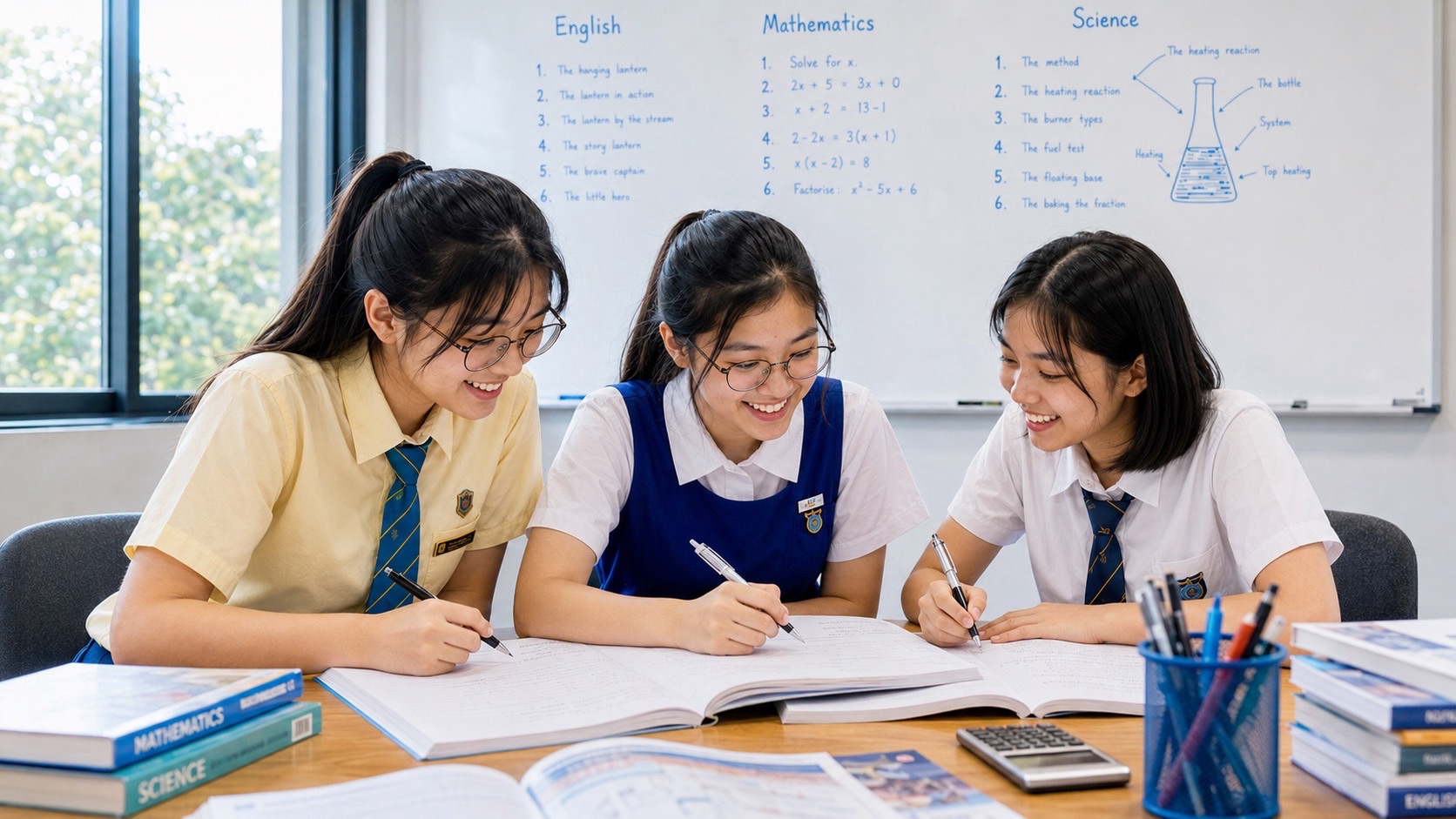
Science model answers help most when students study why the answer works, not when they memorise the sentence. In Punggol, a learner may copy a polished answer perfectly and still fail the next question because the context, evidence or command word changes. The useful skill is to extract the scientific concept, the evidence, the mechanism and the level of precision that earned the mark.
Parents searching for Science model answers, Science mark scheme, PSLE Science answers, Secondary Science worked answers or how to answer Science questions are usually trying to calibrate quality. That is useful. The danger begins when calibration turns into sentence memorisation.
This guide continues the Science Improvements In Punggol lane after How to Use Past-Year Science Papers Without Wasting Them. It also connects to How to Answer Science Questions and the main Science Tuition Punggol route.
What apex exam systems use model responses for
Cambridge International provides past papers, mark schemes and example candidate responses so students and teachers can understand exam requirements and see how different levels of performance relate to assessment objectives. The important idea is calibration: examples show what successful performance looks like.
A model response is therefore strongest when it answers four questions:
- What did the student notice?
- Which scientific concept was selected?
- How was the mechanism or reasoning expressed?
- What made the answer complete enough for the task?
Do not copy the sentence; copy the logic
A memorised sentence is tied to the conditions that produced it. Change the organism, apparatus, graph or variable and the same sentence may become wrong.
Instead, reduce a model answer to its logic:
- Evidence: what detail from the question is used?
- Concept: what scientific principle is required?
- Mechanism: how does the condition create the outcome?
- Precision: which words prevent ambiguity?
The model-answer decomposition method
- Read the question again before reading the answer.
- Underline the command word.
- Mark the evidence supplied in the question.
- Read the model answer once.
- Label each phrase as evidence, concept, mechanism or outcome.
- Close the answer.
- Rewrite the reasoning in your own words.
- Answer a fresh question using the same scientific relationship.
The final two steps are what convert imitation into learning.
Mark schemes are not essays
Students sometimes read a mark scheme as if every word must appear in their answer. Mark schemes are assessment tools. They may use compact language, alternatives and marking points designed for examiners rather than as prose a student should copy mechanically.
The learner should ask: what knowledge or relationship is the marking point protecting? Once that is understood, the answer can be written naturally while preserving scientific precision.
Use several acceptable answers when possible
When students see only one model answer, they may believe there is only one legal sentence. Showing two or three scientifically equivalent responses helps them separate essential meaning from optional wording.
Ask which parts are common across all acceptable answers. Those shared parts usually reveal the core concept and mechanism.
Compare a weak answer with a strong answer
Contrast is powerful. Place a partially correct response next to a stronger one and ask:
- What scientific idea is already present?
- What is missing?
- Is the missing part evidence, mechanism, precision or completeness?
- Which added phrase actually changes the scientific quality?
This is more educational than simply circling the better answer.
Primary 3–4: use short answer pairs
Younger students benefit from small contrasts. Show one vague answer and one precise answer. Ask which word makes the difference and why.
Do not overwhelm the child with long model-answer banks. The aim is to learn the relationship between question and answer.
Primary 5–6 and PSLE: learn answer architecture
Upper-Primary students should use model answers to learn how evidence, concepts and mechanisms are assembled. They should then reproduce the architecture under different conditions.
Use the Primary 5–6 and PSLE Science guide for the larger open-ended system.
Secondary G1, G2 and G3: calibrate depth and technical precision
Secondary responses increasingly require specialised vocabulary, data interpretation, calculations, practical evaluation and model-based explanation. A worked response can help students see how much detail a command word requires and where evidence enters the answer.
The cover-and-reconstruct test
After studying a model answer, cover it and reconstruct the reasoning from the question alone. If the student cannot do this, the model answer has not yet become usable knowledge.
Then vary one condition and ask how the answer must change. This is the fastest protection against sentence memorisation.
Use model answers to improve vocabulary carefully
Good model responses can reveal high-value technical words. Add those words to the student’s vocabulary system only if the learner can explain what each word contributes.
Use How to Learn Science Vocabulary and Write More Precise Answers for the full language routine.
Use model answers after an independent attempt
The student should usually attempt the question before seeing the worked response. Otherwise the model answer can make the problem appear easier than it was.
Attempt → compare → diagnose → rewrite → fresh retest is a stronger cycle than read → copy → move on.
A 15-minute model-answer drill
- Attempt one Science question independently.
- Compare with the model answer or marking points.
- Highlight the missing scientific relationship.
- Rewrite the answer without copying the sentence.
- Change one condition in the question.
- Answer the changed version from memory.
Common model-answer mistakes
- memorising exact sentences;
- reading the answer before attempting the question;
- copying technical words without understanding them;
- assuming one model response is the only acceptable wording;
- ignoring the command word;
- failing to practise a changed-context version;
- treating marking points as prose to reproduce verbatim.
When Science tuition in Punggol adds value
Students often struggle to identify why a model answer is stronger. A tutor can point to the exact missing mechanism, evidence link or vocabulary distinction.
In eduKate Punggol’s three-student Science tutorials, students can compare different valid explanations and then answer a fresh variant. The goal is to make the standard transferable rather than memorised.
Parents can review Science Tuition Punggol or the Science tuition sign-up route.
Conclusion
Model answers are mirrors, not scripts. Use them to see the required concept, evidence, mechanism and level of precision. Then close the model and prove the learning on a new question.
Explore the Punggol Science reading library for related guides.


