
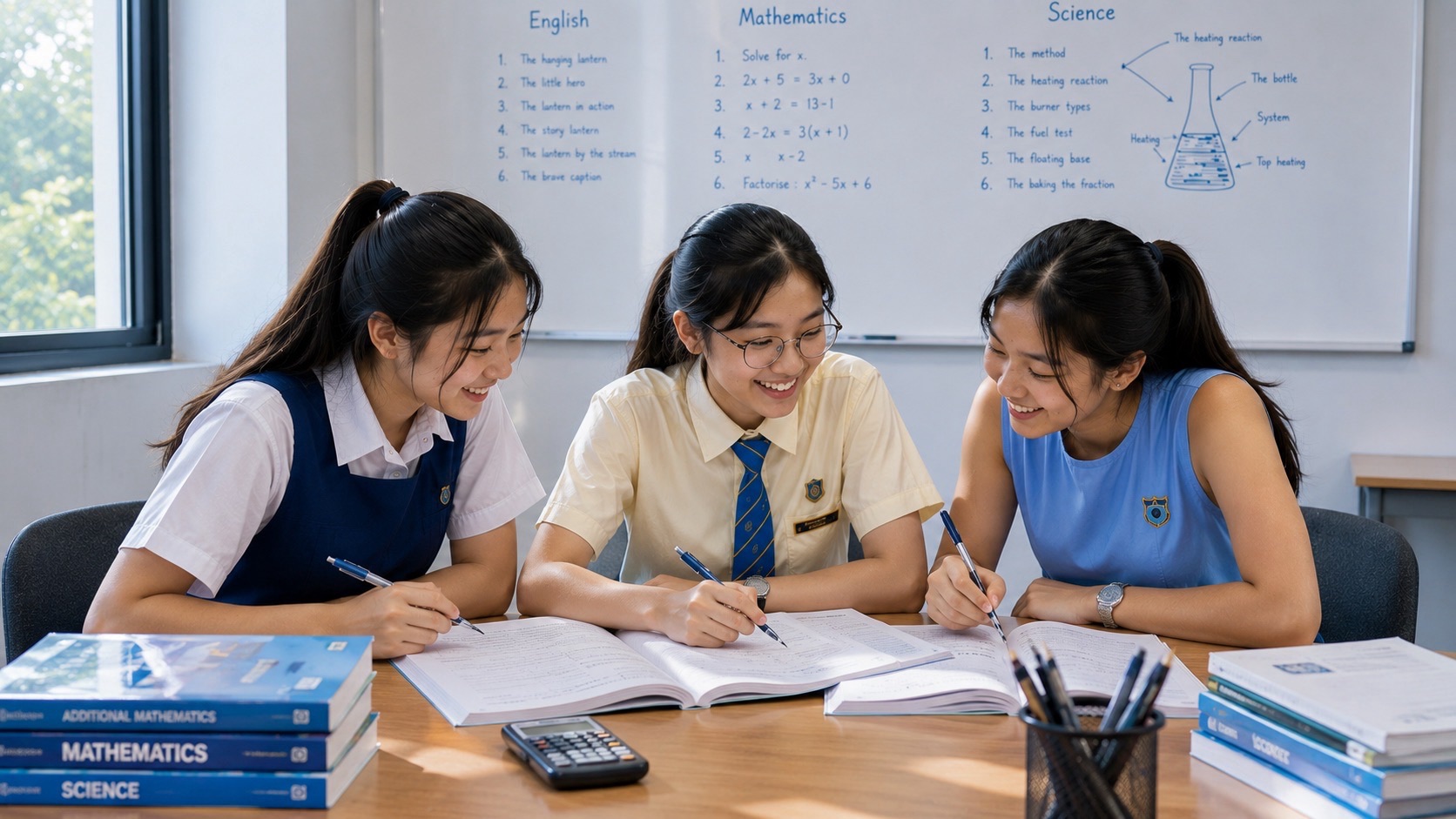
Independent learning in Punggol is one of the most important outcomes a student can build because every stage of education eventually asks the learner to carry more of the work themselves. Primary-school children begin with close adult guidance. PSLE students learn to revise across a wider body of knowledge. Secondary students juggle subjects, CCAs, deadlines and different levels of challenge. By the time young people move into post-secondary education, no parent or tutor can realistically sit beside them for every important decision.
That is the core aim of Punggol education through independent learning: teach students how to start, plan, retrieve, practise, check, ask for help, recover from mistakes and decide what to do next without needing an adult to direct every step. Independence does not mean “do everything alone”. It means support becomes something the learner can use intelligently instead of something they permanently depend on.
The Core Aim in One Sentence
Independent learning means the student can increasingly manage the learning process, not merely complete the learning task.
A child who finishes homework only because a parent sits beside them is completing work. A student who can identify the homework, begin it, notice where they are stuck, use available resources, ask a precise question and finish with a check is building independence.
Independent Learning Is Not the Same as Being Left Alone
One of the biggest misunderstandings is that independence means adults should withdraw quickly. That can turn support into abandonment.
Real independence is built through scaffolding: adults model the process, practise it together with the student, reduce help gradually and step back only when the learner can carry the next part.
The educational sequence is usually:
- I show you.
- We do it together.
- You do it with prompts.
- You do it while I observe.
- You do it independently.
- You explain what you did and why.
The final stage is important. A learner who can explain their process has a much better chance of reusing it later.
Why Independent Learning Matters So Much in Singapore Education
Singapore’s Desired Outcomes of Education include becoming a self-directed learner. That outcome is not separate from academic achievement. It is one of the mechanisms that make later achievement possible.
As students move through Primary school, PSLE, Full Subject-Based Banding, the SEC pathway and eventually post-secondary education, the amount of direct supervision naturally decreases. The learner must make more decisions about time, methods, revision and help-seeking.
Independent learning is therefore not an enrichment extra. It is part of the handover from childhood learning to adult learning.
The Six Capabilities of an Independent Learner
1. Starting
Many students know what to do once they begin but cannot begin without repeated prompting. Independent learners need an initiation routine.
A simple start looks like: identify the task, remove one distraction, place the needed materials on the desk and take the first visible action.
Starting is a skill. The article The Core Aim of Punggol Education | Student Motivation explains why motivation often follows action rather than arriving before it.
2. Planning
Independent learners can see beyond the next five minutes. They know what is due, which subjects need attention and what can wait.
This does not require complicated productivity software. A student can be highly independent with a school diary, calendar and a weekly priority list if they use them consistently.
The related article The Core Aim of Punggol Education | Time Management develops this planning layer.
3. Choosing a learning method
A mature learner does not respond to every problem with the same study method.
- Forgotten facts need retrieval.
- Weak retention needs spaced return.
- A conceptual gap needs explanation and examples.
- A recognition problem needs mixed practice.
- A recurring careless error needs a checking routine.
- A writing weakness needs drafting, feedback and rewriting.
This is why independent learning depends on study skills. The learner must know more than what to study; they must know how to study it.
4. Monitoring understanding
Students often confuse “I have seen this before” with “I can do this independently”. Independent learners test themselves.
They close the notes, explain the idea, solve a question, recreate the diagram or answer from memory. If the knowledge disappears when support disappears, the learner knows more work is needed.
5. Asking for help well
Independent students still ask for help. The difference is that the help request becomes more precise.
Instead of “I do not understand Maths,” an independent learner may say, “I can form the equation, but I do not understand why the sign changes in this step.” That question is easier to answer and teaches the student to diagnose their own thinking.
6. Reviewing and adapting
After the work, the learner asks: What worked? What did not? What should I change next time?
This is metacognition — thinking about one’s own learning. It turns each task into information for the next task.
Did You Know? Independence Can Be Measured by the Number of Hints Needed
One useful way to track independence is to observe how much support is required for the same type of task over time.
At first, the student may need the entire method demonstrated. Later, a short prompt is enough. Eventually, the student begins without help. The academic answer may look similar, but the educational achievement is very different.
This is why the eduKate teaching principle is simple: support should improve the next unaided attempt.
The Independent Learning Ladder
Independence develops in stages.
- Dependent — waits for instructions and reassurance.
- Prompted — can work after an adult identifies the next step.
- Guided — chooses some steps but needs regular checking.
- Supervised — works independently while an adult monitors from a distance.
- Independent — plans, executes and checks without routine intervention.
- Self-correcting — notices weaknesses, changes methods and seeks targeted help.
Students can be on different rungs in different subjects. A child may be fully independent in reading but still need guided support in Mathematics.
Independent Learning in Primary School
Primary-school independence begins with routines, not grand speeches about responsibility.
- Pack the school bag using a checklist.
- Read the homework instruction before asking for help.
- Begin with one familiar task independently.
- Check completed work against the question.
- Keep corrections understandable enough to revisit.
- Put materials back in a consistent place.
- Tell an adult what still feels difficult.
Parents should expect uneven progress. A child can manage independently for several days and then regress during a busy week. Independence is built by repeated handover, not one dramatic moment.
Independent Learning During PSLE
PSLE is often the first stage where students need to manage a substantial revision system across multiple subjects.
The learner needs to know:
- which topics are secure;
- which errors repeat;
- what to revise this week;
- when to return to older knowledge;
- how to use school papers and corrections;
- when to ask a teacher, parent or tutor for help;
- how to complete timed practice without an adult beside them.
A PSLE student who can do these things is developing a learning system that will make Secondary 1 significantly easier.
The companion article The Core Aim of Punggol Education | PSLE frames the examination as preparation for calm, accurate and increasingly independent performance.
Independent Learning in Secondary School
Secondary school raises the independence requirement sharply. More teachers mean fewer daily reminders. More subjects create more competing demands. CCAs consume fixed blocks of time. Full Subject-Based Banding can create different challenge profiles across different subjects.
Students need to move from “What homework do I have?” to “What is the state of my learning portfolio?”
That means asking:
- Which subject is becoming fragile?
- Which topic do I understand only when someone guides me?
- Which assessment is approaching?
- Which old knowledge has started fading?
- Which teacher feedback have I not acted on yet?
- Where do I need help before the gap widens?
This is the difference between task completion and self-directed learning.
Independent Learning Under Full Subject-Based Banding
Full Subject-Based Banding makes subject-specific independence especially important. Students may take subjects at different G1, G2 or G3 levels according to strengths, interests and learning needs, subject to school criteria and arrangements.
A learner may need highly structured support in one subject while being nearly self-directed in another. Adults should therefore avoid one global label such as “independent student” or “dependent student”. Independence is a portfolio too.
The Role of SLS and Digital Learning
Singapore’s Student Learning Space can support independent learning because students can access curriculum-aligned resources, complete assigned activities and revisit learning beyond the physical classroom.
But access to digital resources does not automatically create self-direction. A student still needs to choose when to use the resource, engage actively and check whether learning actually occurred.
The local article Punggol Education System | Student Learning Space (SLS) explores that digital learning infrastructure in the Punggol context.
Independent Learning in the Age of AI
AI makes independence both easier and more difficult.
It is easier because students can access explanations, examples, feedback and practice almost instantly. It is harder because the same technology can quietly replace the thinking the student needs to learn.
An independent learner uses AI as a tool, not a substitute for ownership.
- Try before asking.
- State the exact difficulty.
- Ask for explanation rather than only the answer.
- Check the output against trusted material.
- Retry the task without AI.
- Record what was learned, not merely what was generated.
The test is simple: after the tool is removed, is the student more capable than before?
Why Homework Completion Is Not Enough
A student can complete every worksheet while remaining dependent if every difficult step is supplied by an adult.
The educational question is not only “Was the task completed?” but also:
- Who decided how to begin?
- Who noticed the error?
- Who chose the method?
- Who decided when help was needed?
- Who checked the final answer?
- Who planned the next return?
The more of these decisions the learner can carry successfully, the more independent the learning has become.
The Cold Start Test
One of the cleanest ways to measure independence is the cold start: can the student begin a familiar type of work without the tutor or parent setting up the first step?
The eduKatePunggol article How Tuition Works | The Cold Start Test uses this idea to separate apparent understanding from genuine independent control.
If the student cannot start without a prompt, the support loop is not finished yet.
Independent Learning and Growth Mindset
Independent learning requires students to survive moments of uncertainty without immediately handing the problem back to an adult.
Growth mindset helps because the student can interpret confusion as temporary and repairable. Instead of “I cannot do this,” the learner asks, “What part do I not understand yet?”
See The Core Aim of Punggol Education | Growth Mindset.
Independent Learning and Critical Thinking
Self-direction without judgment can become efficient wrongness. Students also need to evaluate whether the method, source or conclusion deserves trust.
Critical thinking helps the learner ask:
- Does this explanation make sense?
- What evidence supports it?
- Is this source reliable?
- Is there another method?
- What assumption am I making?
- What would make me change my answer?
This is why independent learning and critical thinking belong together.
How Parents Can Build Independence Without Disappearing
The parent’s job changes over time from operator to coach.
- Ask the child to state the task before helping.
- Wait a little longer before giving the next step.
- Give one hint instead of the whole method.
- Ask the child to check their own work first.
- Let manageable consequences teach planning.
- Review the process afterwards instead of controlling every moment.
- Step back when the learner shows reliable control.
The hardest part is often adult restraint. Helping quickly feels kind, but too much rescue can quietly remove the exact decision the child needs to learn.
How Tutors Can Build Independence
Tutors should design lessons so support decreases as capability increases.
- Demonstrate the model once.
- Ask the student to explain the model.
- Guide a similar question.
- Give an independent question.
- Delay hints.
- Review the student’s own error analysis.
- Return to the skill later without announcing the method.
At eduKatePunggol, small-group tuition is valuable when the tutor can observe precisely how much support each learner needs and remove scaffolding at the right speed.
What Happens After Tuition Stops?
A powerful test of education is what happens after structured support ends.
Students may experience a short wobble because the environment changes. The goal is not perfection from the first week. The goal is that the learner has enough routines and self-monitoring to recover without immediately recreating the old dependency.
The article What Happens After Tuition Stops? explores the first term of independent learning, relapse checks and when help may be needed again.
What Progress Looks Like
Independent-learning progress is visible when a student:
- starts familiar work without prompting;
- knows what is due;
- can identify a specific weakness;
- chooses a study method that matches the problem;
- retrieves before checking notes;
- asks more precise questions;
- uses feedback on the next attempt;
- checks their own work;
- returns to older knowledge without being reminded every time;
- needs fewer hints from adults;
- can explain what they will do differently next time.
These changes are often more important than a temporary jump in marks because they make future improvement easier.
A Simple Independent-Learning Routine
- Define the target.
- Try from memory or first principles.
- Mark where the difficulty begins.
- Use one suitable resource.
- Retry without the resource.
- Check the answer.
- Record one lesson from the attempt.
- Schedule the next return.
This routine turns studying from consumption into active control.
Frequently Asked Questions
What is independent learning?
Independent learning is the ability to increasingly plan, carry out, monitor and improve one’s own learning. It includes knowing when and how to seek help rather than trying to do everything alone.
At what age should children become independent learners?
The process can begin in early primary school with simple routines and choices. Full independence develops gradually across many years and at different rates across subjects.
Should parents stop helping with homework?
No. Help should change form. Move from giving answers and directing every step toward prompting, questioning, reviewing and gradually transferring responsibility.
How do I know if my child is too dependent on tuition?
Look at what happens between lessons and when the tutor is absent. If the student cannot start familiar work, choose methods or correct known errors without the tutor, more deliberate independence training may be needed.
Can technology improve independent learning?
Yes, when it gives access to useful resources, feedback and practice. It becomes less helpful when it replaces planning, thinking or retrieval that the student needs to learn to do themselves.
What is the strongest sign of independent learning?
The student can identify what needs to be done next and begin without routine adult direction.
Useful Routes for Punggol Families
- eduKatePunggol home — local education, tuition, parent, student and pathway routes.
- The Core Aim of Punggol Education | Study Skills.
- The Core Aim of Punggol Education | Time Management.
- The Core Aim of Punggol Education | Student Motivation.
- The Core Aim of Punggol Education | Growth Mindset.
- How Tuition Works | The Cold Start Test.
- What Happens After Tuition Stops?.
- Punggol Atlas.
The Best Independent Learner Knows When to Work Alone and When to Ask
Independence is not isolation. Mature learners use teachers, tutors, parents, classmates, books, digital tools and AI when those resources help. The difference is that they increasingly understand why they are using the support and what they need to do after it is removed.
That is the core aim of Punggol education through independent learning: gradually transfer the control of learning from the adult to the learner, until the student can carry more of the planning, thinking, checking and next-step decisions themselves.
Properly taught kids shine a bright light into the future.


