
Quadratics are one of the first places where algebra, graphs and structure become impossible to separate. A quadratic equation can have two real roots, one repeated real root or no real roots. The discriminant tells us which case we are in before we solve the equation completely.
For Punggol students learning Advanced Mathematics, the discriminant is valuable because it teaches a deeper habit: sometimes a formula is not only for calculation. It can act as a sensor that tells us what kind of mathematical situation we are looking at.
Roots and graph intersections are the same story in two languages
If a quadratic function crosses the x-axis twice, the equation has two real roots. If it touches the axis once, there is a repeated root. If it does not meet the axis, there are no real roots.
This is why students should always connect the algebraic discriminant to the graphical picture.
The discriminant classifies before it calculates
- Positive discriminant: two distinct real roots.
- Zero discriminant: one repeated real root.
- Negative discriminant: no real roots.
The learner should understand what those three cases mean rather than memorise them as disconnected rules.
Parameter questions become much easier with the discriminant
When a coefficient contains a parameter, the discriminant can show when the graph crosses, touches or misses the axis. The parameter therefore controls the root structure.
This links directly to Parameter Thinking — One Symbol Can Control a Whole Family of Graphs.
Repeated roots are threshold cases
A repeated root is not just another answer type. It often marks the boundary between two behaviours. On one side, two real intersections exist. At the threshold, they merge. Beyond it, the real intersections disappear.
A reliable quadratic routine
- Write the quadratic in standard form.
- Identify the coefficients carefully.
- Decide whether you need exact roots or only root behaviour.
- Use factorisation, completing the square or the quadratic formula appropriately.
- Use the discriminant when classification or a parameter condition is required.
- Check the roots against the graph or original equation.
Why completing the square still matters
Completing the square reveals the turning-point structure of a quadratic. It connects symbolic form to graph shape and later helps with circle equations and optimisation thinking.
Punggol gives a visual way to think about intersections
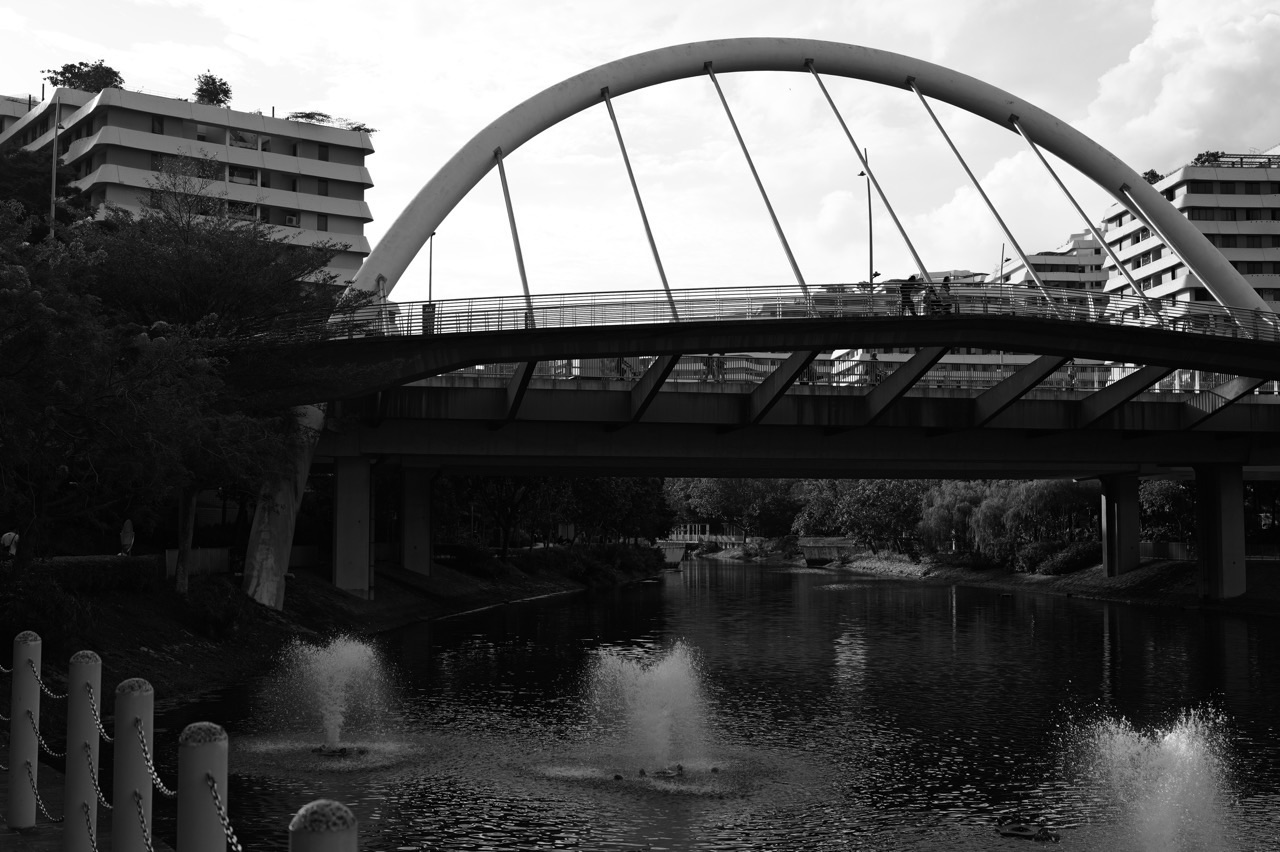
A bridge meeting a path or two routes joining at a node can remind students that intersection is a structural idea. A Punggol transport image works well here because quadratics also ask where one mathematical object meets another.
Continue the Punggol Advanced Mathematics journey
- Secondary 3 — Build One Connected Map
- Parameter Thinking — Families and Thresholds
- One Idea, Five Representations
Continue through the wider eduKate Punggol ecosystem
- Mathematics Tuition at eduKatePunggol
- Punggol Mathematics Reading Library
- Additional Mathematics Tuition in Punggol
- eduKatePunggol Atlas
The discriminant turns a quadratic from something to solve into something to understand. It tells students how many real roots exist, how a graph behaves and where important parameter thresholds lie.


