
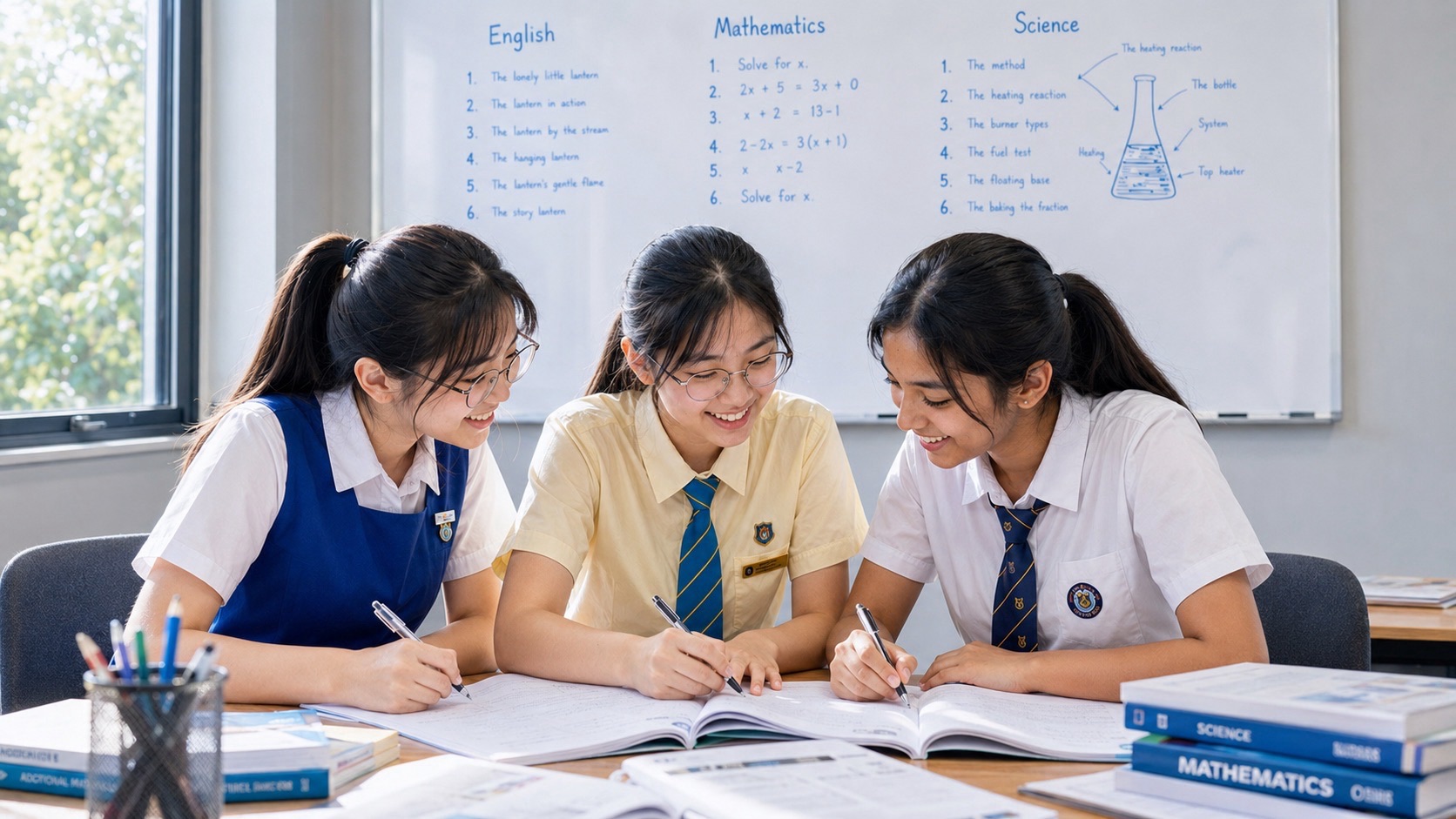
Secondary 2 Mathematics tuition in Punggol for the school-holiday period: protect retention, repair the few gaps that matter most and restart January without turning the entire break into another school term.
The year-end holiday has two jobs.
Students need real rest.
They also need enough contact with Mathematics that important Secondary 2 foundations do not disappear before Secondary 3 begins.
At eduKate Punggol, our premium 3-pax tutorials use a light but deliberate holiday bridge rather than a giant revision pile.
This article sits underneath the broader 12-Week Year-End Revision Runway and supports the main Punggol Secondary 2 Mathematics Tutor hub.
Class size is limited to three students. Lessons are about 1.5 hours weekly, with targeted repair, retrieval, mixed practice and carefully paced preview only when the student is ready.
Arrange a parent–student consultation with eduKate Singapore
Chat with eduKateSG on WhatsApp
Visit the eduKateSG Facebook page
Rest and Retention Are Not Opposites
A student does not need daily Mathematics throughout the holiday to preserve learning.
The goal is not constant workload. The goal is preventing complete disconnection from the high-value skills that will be needed again in January.
A good bridge can be short, spaced and selective.
This is especially useful for algebra, fractions, equations, graph reading and multi-step working because these skills sit underneath many upper-secondary topics.
The Holiday Risk Is Not Forgetting Everything
Students rarely forget an entire year.
What fades first is often access.
The learner remembers that a topic exists but takes too long to retrieve the first step. A method that was once fluent now needs an example. An old sign error returns because the checking habit has disappeared.
This is why retrieval matters.
We want the important pathways to remain easy to reopen.
A Simple Three-Lane Holiday Plan
Lane 1: Repair
Choose one or two high-connectivity weaknesses that still damage several topics.
Examples include negative signs, fractions inside algebra, equation balance or graph scale reading.
Lane 2: Retain
Use short mixed retrieval to keep secure Secondary 2 knowledge available.
The student should answer from memory before opening notes.
Lane 3: Preview
Only after the foundation is secure, introduce a small amount of upcoming Mathematics so January feels familiar rather than entirely new.
Preview is optional. Repair and retention come first.
Do Not Turn December Into Secondary 3
Acceleration can look impressive while hiding unfinished foundations.
If a student is still unstable with algebra, teaching far ahead may create two layers of confusion at once: old gaps and new content.
A better question is: What should this student carry cleanly into January?
For many learners, the answer is not “more chapters”. It is stronger command of the existing engine.
One Short Weekly Retrieval Set Can Be Powerful
Retrieval works best when the student attempts before reviewing.
A holiday set might contain:
- one signed-number or fraction question;
- one algebraic manipulation question;
- one equation;
- one graph or coordinate interpretation;
- one geometry or mensuration question;
- one ratio, percentage or application problem.
The set does not need to be long.
Its job is to keep several mathematical pathways awake.
Use the Error Log Once a Week, Not Every Day
The student does not need to stare constantly at old mistakes.
A brief weekly review can ask:
- Which error family was most common this year?
- What check catches it?
- Has it reappeared in holiday work?
- Can the student explain the corrected rule without looking?
This turns the error log into a maintenance tool rather than a punishment archive.
For a deeper look at recurring patterns, read Why Careless Mathematics Mistakes Keep Returning.
January Restart: Test Retrieval Before Teaching Ahead
In the final part of the holiday, we use a short restart diagnostic.
The purpose is not to grade the student.
It is to see which Secondary 2 foundations remain immediately available.
- Can the student start an equation without a model?
- Can algebra survive fractions and negative signs?
- Can a graph be read accurately?
- Can geometry units be controlled?
- Can mixed questions be classified independently?
Any important skill that has faded can be refreshed before school pace begins again.
How Much Holiday Mathematics Is Enough?
There is no universal number of hours.
A student with a narrow gap may need only short maintenance.
A learner with several connected weaknesses may benefit from a more structured bridge.
The important principle is proportionality.
Holiday work should be enough to preserve and repair, but not so heavy that the student begins January mentally exhausted.
Why a 3-Pax Class Works Well During the Holidays
Holiday needs vary sharply.
- One student may need algebra repair.
- One may need only retention.
- One may be ready for extension.
A small group allows the tutor to share common teaching while giving each learner different continuation work.
The tutor can also reduce the pace when rest is more important and increase challenge only when the student’s foundation is ready.
A 1.5-Hour Holiday Bridge Lesson
- Short mixed retrieval from Secondary 2.
- Review one recurring error family.
- Repair one high-connectivity weakness if needed.
- Complete a changed question to test transfer.
- Use one calm mixed set without chapter labels.
- Add a small preview only for students who are ready.
- Finish with a light continuation task rather than a large worksheet pile.
The holiday lesson should leave the student clearer, not overloaded.
What Progress Should Look Like by January
- Important Secondary 2 methods return quickly.
- The student needs fewer examples to start.
- Recurring error families stay reduced.
- Mixed questions feel familiar rather than alarming.
- Algebra remains stable after a break.
- The learner can explain what needs checking.
- January schoolwork begins as continuation rather than total restart.
The Holiday Bridge and the Secondary 3 Handoff
Secondary 3 increases the importance of stable algebra, representation and independent method selection.
The holiday bridge should therefore protect the capabilities that later learning assumes.
For the broader transition map, read Secondary 2 to Secondary 3 Maths — Algebra, Upper-Secondary Readiness and A-Math.
Full Subject-Based Banding: Prepare the Student’s Actual Next Course
Students may take Mathematics at G1, G2 or G3 subject levels.
Holiday work should therefore be aligned to the learner’s actual Mathematics level and school programme rather than to a generic “Secondary 3” worksheet pack.
The aim is readiness for the course the student is really taking.
When Should Parents Consider Holiday Tuition?
- Several Secondary 2 gaps remain unresolved.
- The student forgets methods quickly after a break.
- School papers show one recurring high-connectivity weakness.
- The family wants a calm structure without daily supervision.
- The learner is ready for a small amount of preview but needs careful pacing.
- January restarts have historically been difficult.
If the student already retains knowledge well, works independently and has a sensible self-study routine, additional holiday tuition may not be necessary.
Class Details
Format: Premium 3-pax small-group tutorials
Level: Secondary 2 Mathematics / Secondary 3 transition
Subject support: matched to the student’s current Mathematics subject level and school programme
Duration: 1.5 hours weekly
Location: 83 Punggol Central, Singapore 828761
Holiday approach:
- targeted repair;
- spaced retrieval;
- mixed practice;
- error-log review;
- transfer checks;
- light continuation work; and
- carefully paced preview where appropriate.
What Parents Can Bring to the Consultation
- recent year-end examination papers;
- weighted assessments;
- marked worksheets;
- teacher comments;
- examples of repeated Mathematics difficulty;
- information about the student’s next-year subject level if known.
These materials help us decide whether the holiday should be used mainly for repair, retention or extension.
Frequently Asked Questions
Should my child study Mathematics every day during the holiday?
Not necessarily. Short, spaced and purposeful retrieval can preserve learning without turning the holiday into another full school term.
Should we teach Secondary 3 topics early?
Only when the Secondary 2 foundation is ready. Preview can be useful, but unresolved gaps should not be buried under new content.
What if my child wants a complete break?
Real rest matters. A light bridge can be placed later in the holiday, especially nearer the January restart, rather than occupying the entire break.
How do we know what to revise?
Use several school papers and worksheets to identify recurring high-connectivity weaknesses rather than revising every chapter equally.
What is the best January outcome?
The student should retrieve important Secondary 2 methods quickly and enter Secondary 3 ready to learn forward rather than spend the first months rebuilding old foundations.
Helpful Reading for Punggol Parents
- Punggol Secondary 2 Mathematics Tutor | 3-Student Small-Group Tutorials
- 12-Week Year-End Revision Runway
- Turn School Test Papers Into a Repair Plan
- Why Careless Mathematics Mistakes Keep Returning
- Train Transfer for Unfamiliar Questions
- Secondary 2 to Secondary 3 Mathematics Transition
- Punggol Mathematics Article Index
Arrange a Parent–Student Consultation
Bring the year-end evidence. We can help decide whether the holiday needs repair, retention, light preview—or simply more rest with a small January restart plan.
Properly taught kids shine a bright light into the future.


