
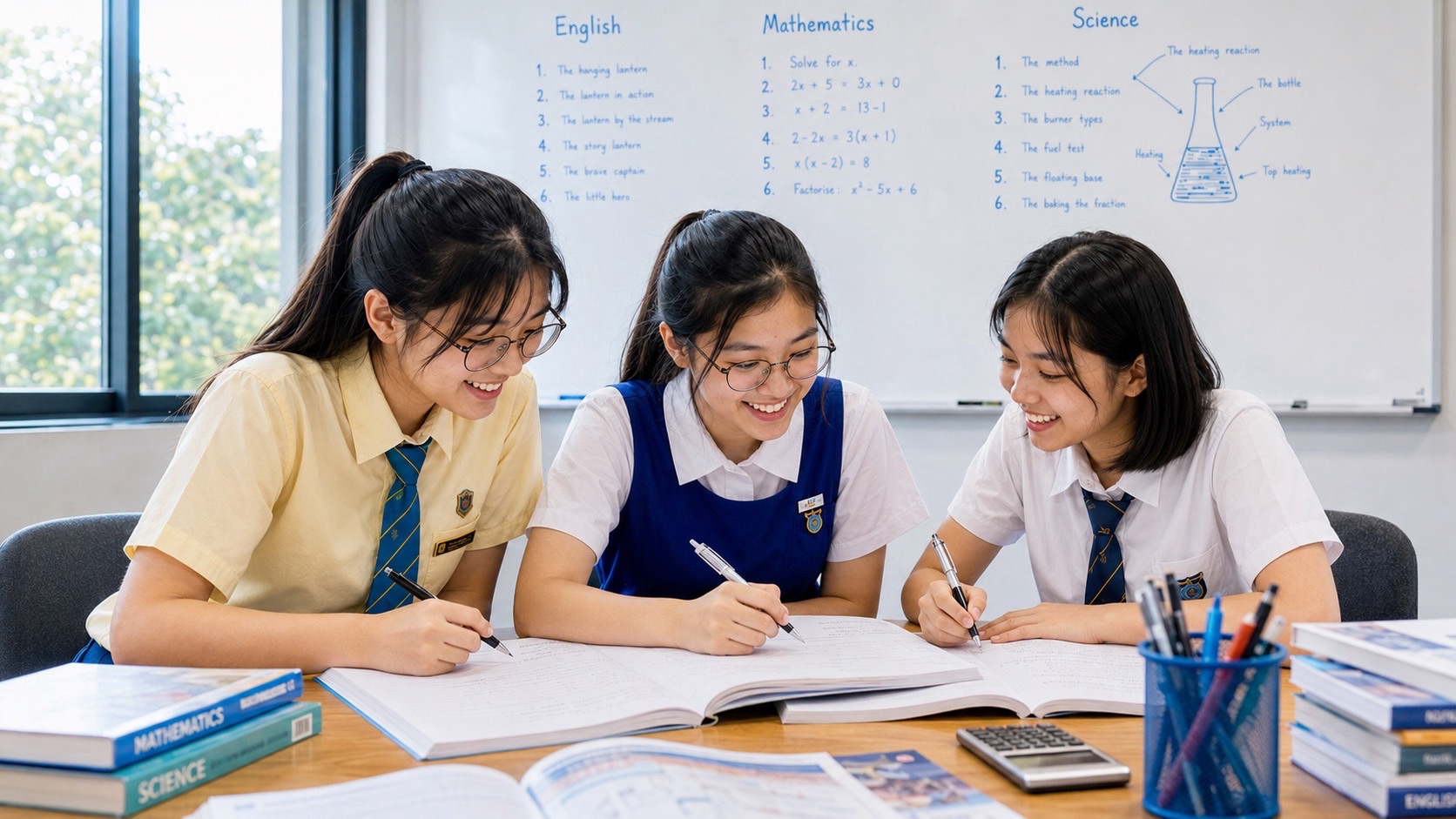
Secondary 2 Mathematics: find a topic to practise
Choose a worked topic, check the method and try a question. Use the main guide below to plan support before Secondary 3.
At eduKate Punggol, our Secondary 2 Mathematics tutorials are kept to three students, normally for about 90 minutes. The small group allows the tutor to inspect the actual working of each learner: what was understood, what was assumed, where the method changed direction, whether notation is clear and whether the same mistake has appeared before. Mathematics is easier to teach when the process remains visible.
This page is a focused commercial guide for parents evaluating a Secondary 2 Mathematics tutor in Punggol. It does not replace the newer level spine, and it does not promise a particular grade. Its job is to explain what useful tutoring should do in the consolidation year: diagnose, repair, stabilise, connect and prepare.
Secondary 2 is the consolidation year before upper secondary
Secondary 1 teaches the student how secondary Mathematics feels. Secondary 2 reveals whether the new habits have become reliable.
By now, the learner has seen more algebra, graphs, geometry, statistics and multi-step problems. The student may recognise familiar forms and know standard procedures. The risk is that familiarity can hide fragility. A method may work only when the question looks exactly like the example. Algebra may be accurate when the numbers are simple but collapse when fractions or negative signs are introduced. Geometry may be solved by visual guessing rather than properties.
Secondary 2 is therefore a good time to ask a more demanding question: can the student transfer the method? If the surface changes, does the structure remain visible? If a problem combines two topics, can the learner decide where to begin? If the first attempt is wrong, can the error be diagnosed rather than merely corrected?
Those are the habits that make upper-secondary Mathematics more manageable.
Full Subject-Based Banding: use the student’s actual course and work
Under Full Subject-Based Banding, students may take Mathematics at G1, G2 or G3 depending on their individual subject-level arrangements. Tuition should therefore begin from the actual level studied, the school’s current material and the student’s present performance.
The Ministry of Education explains the framework in its Full Subject-Based Banding guide. For a tutor, the central lesson is to avoid old stream assumptions and to diagnose Mathematics as a subject in its own right.
Two Secondary 2 learners at the same subject level can need different work. One may have strong number sense but weak algebraic representation. Another may be technically competent yet make repeated sign and unit errors. Another may understand every chapter separately but struggle when a question integrates ideas.
Class level and subject level tell us the broad demand. The written work tells us the teaching job.

The main Secondary 2 problem: students can recognise a method without owning it
A common pattern appears in homework. The student watches a teacher’s example, says the method makes sense and completes several similar questions correctly. Two weeks later, a new question uses the same mathematics in a different form and the learner cannot start.
This is not necessarily forgetting. It may be weak abstraction. The student has remembered the appearance of the example rather than the structure that made the method valid.
We therefore ask learners to name the mathematical relationship before calculating. What is invariant? What quantity changes? Which condition triggers this method? What makes this question similar to the earlier one even though the numbers, diagram or wording are different?
Variation is a central part of our practice. Five identical questions can create speed. A carefully varied set can create transfer.
Algebraic fluency: accuracy first, then economy
By Secondary 2, algebra should be becoming a working language. Students increasingly need to simplify, expand, factorise, substitute, solve and rearrange without using all of their attention on each small step.
Fluency, however, should not be confused with rushing. A student who compresses too many steps before the method is secure often produces invisible errors. We may temporarily require more explicit working so that sign changes, operations and substitutions can be inspected.
As accuracy improves, the working can become more economical. The goal is a method that is both clear and efficient.
We also teach students to check structure. After factorisation, can the expression be expanded back to the original? After solving an equation, can the value be substituted to verify it? These small inverse checks help learners become less dependent on external marking.
Fractions and algebra: a common hidden bottleneck
Students who were comfortable with numerical fractions may become unstable when letters are introduced. The visual familiarity disappears, but the underlying fraction laws have not changed.
We return to meaning. A fraction bar indicates division. Equivalent fractions preserve value. A common denominator is a representation choice, not a ritual. When students understand the numerical idea, the algebraic version becomes less arbitrary.
Weak fraction work can have large consequences because it later interacts with equations, ratio, algebraic manipulation and more advanced upper-secondary content. Secondary 2 is a good time to repair it properly.
Equations and inequalities: solve relationships, not recipes
Equation solving becomes more reliable when students understand balance, inverse operations and the role of the unknown. Memorised phrases may produce answers on standard forms, but understanding is needed when brackets, fractions or variables appear on both sides.
Inequalities add another layer because the solution describes a range rather than a single value. Students need to interpret the final statement, not simply manipulate symbols.
We teach the process in a way that makes later checking possible. What operation was undone? Why does the inequality behave differently under a negative multiplication or division? What does the solution mean on a number line or in the original context?
The more the student can explain, the less likely the method is to remain fragile.
Graphs: connect visual shape to numerical relationship
Graphs are a key bridge between algebra and visual reasoning. A student who sees graphs only as pictures may struggle to interpret gradient, intercept, rate or the relationship between variables. A student who sees only equations may miss the information carried by shape.
We move repeatedly between representations. What does this table become on a graph? How does changing a parameter change the line or curve? What information can be read directly? What needs calculation? What does a point represent in the original situation?
When students learn to translate among table, equation and graph, later coordinate and function work becomes more coherent.
Geometry: move from visual intuition to property-based reasoning
Secondary geometry is not solved by what the diagram looks like. The student must use stated facts and known properties.
We teach learners to mark diagrams, label what is known and distinguish given information from conclusions. If an angle is equal to another, why? Parallel lines, polygon properties, congruence, similarity or circle relationships may justify the step depending on the course and topic.
The habit of giving a reason is important because it trains mathematical communication. It also exposes whether the student actually knows the property being used.
Mensuration and units: the calculation is not complete until the quantity makes sense
Many avoidable marks disappear through units. Length, area and volume are not interchangeable, and conversions may need to be performed before a formula is applied.
We teach students to write units throughout the process rather than attach them at the end from memory. A square unit signals area; a cubic unit signals volume. The dimensions of a formula can become a checking tool.
Estimation also helps. If a calculated length is absurdly large or a probability exceeds one, the answer should trigger review. Mathematical maturity includes recognising when a result is impossible.
Ratio, proportion and rates: multiplicative thinking must remain strong
Some Secondary 2 students are comfortable with additive thinking but become less reliable when quantities relate multiplicatively. Ratio, percentage, rates and direct or inverse relationships require students to reason about how one quantity changes relative to another.
We use tables, diagrams and equations to make the relationship visible. The student learns to ask whether a change is additive, multiplicative or proportional. That distinction becomes useful far beyond one chapter.
Problems involving speed, scale, cost or percentage often reveal whether the learner can move between units and representations without losing the relationship.
Statistics and probability: interpret, do not only compute
Secondary Mathematics increasingly asks students to make sense of data. An average is a summary, not the data itself. A graph may emphasise or hide variation. Probability describes uncertainty within a model.
We ask students to interpret results in context. What does this mean? Which measure is more informative? Does the graph support the conclusion? Are the outcomes equally likely? What assumptions are being made?
This helps students recognise that Mathematics is not only about producing numbers. It is also about using numbers responsibly to reason.

Multi-step problems: protect the chain
Secondary 2 questions can require several linked decisions. The student may know every component skill yet lose the question because the chain is not organised.
We teach a planning pause. What is the target? Which information is relevant? Is an intermediate value needed? Can the problem be divided into stages? Which result should be kept exact until later?
Clear working becomes part of problem solving. The page should show the chain strongly enough that the student can return to it after an error.
When students learn to protect the chain, longer questions become less intimidating.
Why three students works for Secondary 2 Mathematics
At this stage, students are often independent enough to attempt difficult work but still benefit greatly from immediate diagnosis. A small class lets the tutor watch the attempt instead of receiving only the finished page.
If a student chooses an inefficient method, we can ask why before the method becomes habitual. If another learner reaches the answer through an elegant alternative route, the group can compare approaches. If the third learner needs a scaffold, the tutor can provide it without stopping the class.
Peer explanation is also powerful. A student who explains a method to another person often discovers whether the understanding is complete. The tutor can listen for gaps that are hidden by correct numerical answers.
A 90-minute Secondary 2 Mathematics lesson
- Retrieval. Revisit a previous topic or method without full prompts.
- Diagnostic task. Use a short problem to reveal the current weakness.
- Model structure. Show why the method works and where errors typically occur.
- Guided practice. Students attempt with immediate questioning and correction.
- Variation. Change the surface form so the learner must recognise the invariant.
- Integration. Combine the idea with another topic where appropriate.
- Independent transfer. Remove support and inspect the working.
- Record the next target. Add one useful error pattern or principle to the student’s review system.
Not every lesson needs every phase equally. The architecture follows the diagnosis.
Worked example 1: the student who completes textbook questions but freezes on a school test
A learner can factorise expressions accurately when the exercise title says “Factorisation”. In a mixed test, the student does not recognise that factorisation is the first step in solving a different-looking equation.
The repair is method recognition. We mix question types and ask the student to name the useful structure before solving. What form is present? Which transformation would make the problem simpler? Why?
The goal is to remove the chapter heading from the student’s mind. Real tests do not announce the method.
Worked example 2: the student who is always “careless”
A parent may hear the word careless repeatedly. We prefer to identify the actual family of errors. Does the student copy a number wrongly? Drop negative signs after expansion? Forget units? Round too early? Skip an intermediate line?
Once the pattern is named, the student can use a targeted checking routine. “Be careful” uses too much attention and gives no action. “Check the sign after every bracket expansion” is operational.
Carelessness often becomes smaller when it is converted into a specific process problem.
Worked example 3: the student who is slow because every question feels new
Some students take a long time not because calculation speed is poor, but because they re-invent the method each time. They have not built enough recognition.
We group problems by underlying structure and compare them. Which cues signal a proportion problem? Which graph features indicate a particular relationship? Which geometry properties are being invoked?
Recognition reduces cognitive load. Speed improves because the student spends less time deciding from scratch.
Worked example 4: the student whose confidence depends on getting everything right
A capable learner may avoid challenging questions because mistakes feel like evidence of weakness. That limits growth.
We use questions calibrated just beyond current comfort and treat errors diagnostically. The student must identify where the chain failed and repair it. Over time, difficulty becomes information rather than threat.
This mindset is especially useful before upper secondary, when unfamiliar problems become increasingly common.
Repair, stabilise, connect, stretch
Repair addresses missing foundations or unreliable methods.
Stabilise makes a skill repeatable across time and variation.
Connect helps the learner see how topics interact instead of living in separate chapters.
Stretch introduces greater complexity, transfer and time pressure when the foundation is ready.
Secondary 2 is particularly valuable for the connection stage. The student has enough material to see relationships but still has time before the final examination runway.
The Secondary 2 Mathematics mistake ledger
Useful error categories include: concept misunderstood, method not recognised, representation wrong, algebra manipulation, sign error, arithmetic error, unit conversion, formula choice, diagram assumption, rounding, incomplete reasoning and insufficient checking.
We track recurring categories rather than every individual question. The student should know the two or three most common leaks.
Over time, a good ledger becomes shorter because patterns are repaired. It is a learning tool, not an archive of failure.
Preparing for Secondary 3 without premature exam panic
Secondary 2 should prepare for upper secondary by strengthening the mathematical engine, not by turning the entire year into full-paper drilling.
By the end of the year, we want algebra to be more fluent, representation more flexible, working clearer and problem-solving more transferable. The student should be better able to decide how to start unfamiliar questions and to recognise repeated error patterns.
Those capabilities make later exam practice more productive because the student has methods worth timing.
Different schools introduce and sequence topics differently, so tuition should stay connected to the student’s actual course and school pace.
What progress looks like before the grade moves
Progress can appear as fewer repeated errors, better notation, shorter but clearer working, faster method recognition and greater willingness to attempt unfamiliar problems.
The student may begin checking answers without being told. The learner can explain why a method applies. Homework takes less time because fewer steps need to be rediscovered.
These behavioural changes are leading indicators. Grades are important but can fluctuate with paper difficulty. We want to see a stronger mathematical process underneath.
What parents can do at home
- Ask what type of mistake was repeated, not only how many marks were lost.
- Encourage correction before additional practice.
- Keep weekly revision steady enough that old topics do not disappear.
- Ask the child to explain one method aloud in plain language.
- Watch homework time. Unusually long work may reveal confusion rather than diligence.
- Protect rest. Tired students make more working-memory and sign errors.
Parents can support consistency without becoming the Mathematics tutor.
When tuition may not be necessary
If a Secondary 2 student is progressing well, uses school consultations effectively, corrects mistakes independently and can handle unfamiliar work without persistent confusion, additional tuition may not be necessary.
Tuition is more useful when the same weaknesses keep recurring, the learner understands only when guided, homework is becoming excessively slow, confidence is falling or there is a gap between effort and performance that school feedback has not resolved.
A clear learning job is the best reason to add a class.
How to choose a Secondary 2 Mathematics tutor in Punggol
- Does the tutor diagnose from working? The wrong answer alone is insufficient.
- How is transfer trained? Look for variation and mixed questions.
- How are old foundation gaps handled? Repair should support current work rather than create a separate remedial world.
- How does the tutor teach checking? Students need targeted routines, not only the instruction to be careful.
- What is the real class maximum? Our own model is three students.
- How is progress recognised? The tutor should be able to describe changes in method, independence and error patterns.
For a wider checklist, see How to Choose a Tutor in Punggol.
Where this page sits in the eduKate Punggol Mathematics system
This page owns the tutor-choice and service intent for Secondary 2. The newer canonical level page is Secondary 2 Mathematics Tuition. Wider Mathematics explanations and pathways sit elsewhere in the site and should remain the owners of those larger questions.
Parents can also explore What Is Mathematics Tuition? for the broader service concept and How Mathematics Works for a mechanism-led parent guide. Keeping this page focused prevents it from competing with those larger explanatory owners.
Frequently asked questions
How many students are in the class?
Our small-group Mathematics model is a maximum of three students.
How long is the lesson?
Lessons are normally around 90 minutes.
Do you teach G1, G2 and G3 Mathematics?
Teaching follows the student’s actual Mathematics subject level and school work under Full Subject-Based Banding.
Is Secondary 2 too early to prepare for upper secondary?
No, if preparation means strengthening algebra, representation, checking and problem-solving. We do not believe every Secondary 2 student needs premature full-paper drilling.
My child gets standard questions right but unfamiliar ones wrong. What is happening?
The issue may be transfer or method recognition. The student may know procedures without yet recognising the invariant structure across different-looking questions.
Can tuition guarantee a particular grade?
No. We can improve capability, method and practice quality. Outcomes also depend on the student, school demands, attendance and assessment conditions.
What should we bring for a first discussion?
Recent school papers, worksheets, teacher feedback and examples of questions the student cannot start or repeatedly gets wrong.
Where is eduKate Punggol?
83 Punggol Central, Singapore 828761. Classes and consultations are arranged directly.
The Secondary 2 objective: arrive at upper secondary with fewer fragile habits
Secondary 2 succeeds when the student stops relying on recognition alone and begins owning the mathematics. Algebra becomes more fluent. Graphs, equations and words can be translated into one another. Geometry is justified by properties. Units and signs are checked deliberately. Mixed questions feel less like surprises.
The year does not need to be dramatic. Quiet stability is powerful.
At eduKate Punggol, our three-student Secondary 2 Mathematics tutorial is built around that quiet work: find the weak link, repair it, vary the problem, connect the topic and verify independent transfer.
To discuss a student’s current Secondary 2 Mathematics work, WhatsApp eduKate Punggol at +65 8823 1234.
Curriculum context reviewed 16 September 2026. Families should use the latest MOE, SEAB and school information for current subject-level and assessment arrangements.
Secondary 2 Mathematics diagnostic matrix: the quiet problems worth fixing before upper secondary
Secondary 2 often produces fewer dramatic warning signs than Secondary 1 or Secondary 3. That can make weak habits harder to notice. A student may still pass comfortably while the underlying method becomes more fragile. The value of close tutoring is not to manufacture anxiety. It is to identify which patterns are likely to become expensive later and fix them while the calendar still has room.
Pattern 1: the student who knows every chapter separately
This learner can complete algebra when the worksheet says algebra, geometry when the worksheet says geometry and statistics when the worksheet says statistics. Mixed questions create a problem because the chapter label has been doing part of the thinking.
We respond with classification before calculation. The student looks at a mixed set and identifies the structure, useful representation and possible method without solving immediately. Then the questions are completed. This separates method recognition from execution and reveals whether the learner can choose independently.
Pattern 2: the student whose algebra becomes unstable when fractions appear
A learner may handle simple algebra fluently and then slow dramatically when algebraic fractions, negative coefficients or several operations appear together. The issue is often not the new chapter. It is the interaction between older number foundations and newer symbolic work.
We isolate the prerequisite just long enough to repair it. Fractions are revisited through the algebraic context rather than as an unrelated Primary-school exercise. The student then returns to the original problem and proves that the repaired movement now carries the larger method.
Pattern 3: the student who solves but does not check meaning
Some students produce a numerical answer and stop. Units are forgotten, impossible lengths are accepted and probabilities outside a valid range may go unnoticed. The learner has treated calculation as the entire task.
We build a final interpretation question into the method: What quantity have you found? What unit should it have? Is the magnitude plausible? Does the answer satisfy the original condition? Over time, checking becomes part of solving rather than a separate activity added when time remains.
Pattern 4: the student whose graph work is mechanical
A student may plot points accurately without understanding what the graph says. If asked to interpret gradient, compare relationships or connect the graph to an equation, the learner becomes uncertain.
We move between representations repeatedly. The student predicts the graph before plotting, describes what a point means and explains how a change in an equation would alter the visual form. This converts graphing from drawing into relationship reasoning.
Pattern 5: the learner who has become dependent on hints
The student appears successful during lessons because a teacher or tutor is always close enough to ask, “What should you do next?” At home or in a test, the same learner cannot start.
We deliberately fade support. First the tutor models. Then prompts become less specific. Next, the student must choose the first step independently. Finally, the same concept is retrieved later without warning. Independence is measured by what the learner can initiate without rescue.
Pattern 6: the strong student who needs less repetition and more variation
A capable learner can become bored by large quantities of standard questions. More pages may increase speed without increasing mathematical maturity.
We stretch through variation: reverse questions, missing-information problems, alternative representations, multi-topic combinations and explanation tasks. The learner is asked not only to get the answer but to compare methods and justify choices.
How Secondary 2 tutoring should use school papers
A returned paper is valuable because it contains evidence from a real assessment condition. We do not simply redo every wrong question. We sort the errors into families and look for recurring causes.
If four marks were lost through one sign pattern, that may deserve more attention than a single difficult geometry question. If several blanks come from not knowing how to start, method recognition may be the priority. If the student gets almost everything right untimed but leaves the final section incomplete, pacing may need to be trained.
The paper becomes a diagnostic map rather than a score to be filed away.
How to decide whether the student is ready to stretch
We do not stretch simply because a student has finished the easy worksheet. A skill is ready for stretch when the learner can retrieve it later, use it in a different form and explain the method with reasonable clarity.
Then complexity can rise. The question can combine topics. The wording can become less direct. Time can become tighter. The student can be asked to compare two valid solutions and decide which is more efficient.
This sequence protects understanding. Challenge should reveal stronger capability, not merely create a larger pile of errors.
Secondary 2 Mathematics and the upper-secondary handoff
The end of Secondary 2 should feel like a handoff rather than a cliff. The student does not need to know every future topic. The learner does need enough mathematical habits to absorb future complexity.
That means algebra is becoming fluent, working is readable, representations can be translated, units are treated seriously and unfamiliar problems are approached rather than avoided. The student knows that mistakes have categories and that correction is part of the learning process.
Those habits reduce the amount of basic repair required when Secondary 3 begins. They also make subject-level work under Full Subject-Based Banding easier to interpret because the student’s strengths and gaps are more visible.
Parent checklist: is the current Mathematics support enough?
- Can the student explain why recent marks were lost?
- Do corrections change later work or do the same errors repeat?
- Can the learner start mixed questions without a chapter heading?
- Is homework time reasonable for the amount of work?
- Can the student move between word problems, equations, graphs and diagrams?
- Does the learner check units and plausibility without being reminded every time?
- Is school support already sufficient for these needs?
If the student is already learning effectively, tuition may add little. If several answers above reveal a consistent gap between effort and control, close small-group teaching can be useful.
The Secondary 2 teaching principle
Do not wait for a dramatic collapse before paying attention, but do not treat every small mistake as a crisis either. Secondary 2 Mathematics is a good year for measured maintenance: repair the recurring gaps, stabilise the methods, connect the representations and stretch only what is ready.
Our three-student model is designed for that middle work. Every student remains visible enough for the tutor to see whether the problem is conceptual, procedural, representational or simply a matter of execution.
Find a Secondary 2 Mathematics guide
Open a topic or school-year stage, then choose the guide you need.
Number, fractions and accuracy · 5 guides
Algebra and equations · 12 guides
- Algebraic fractions and valid cancellation
- Algebraic identities, perfect squares and difference of squares
- Changing the subject of a formula
- Checking algebra by substitution and reverse operations
- Equivalent expressions
- Formula substitution with negative values, powers and units
- Linear inequalities, number lines and word problems
- Number patterns, sequences and nth-term thinking
- Quadratic equations and roots
- Simultaneous equations
- Simultaneous-equation word problems and forming two conditions
- Translating words into algebraic expressions
Graphs and functions · 4 guides
Ratio, rates and finance · 3 guides
Geometry, trigonometry and measurement · 8 guides
- Angle properties, parallel lines and polygon reasoning
- Circles, arc length and sector area
- Constructions and loci
- Right-triangle trigonometric ratios
- Scale drawings, maps and real-world length
- Surface area and volume of prisms and cylinders
- Three-figure bearings
- Translation, reflection, rotation and enlargement
Additional Secondary 2 guides
Core topics and methods · 17 guides
- Repair Algebra Before Secondary 3
- When Fractions Break Algebra
- Linear Graphs, Gradient and Coordinates
- Geometry, Mensuration and Diagram Reasoning
- Fraction Equations, Denominators and Cancellation
- Read Graph Scales, Coordinates and Intercepts Correctly
- Unit Conversion, Composite Figures and Formula Selection
- Ratio, Rate, Proportion and Percentage
- Data, Statistics, Graphs and Probability
- Linear Equations, Inequalities and the Balance Principle
- Expansion and Factorisation as Reverse Operations
- Indices, Powers, Roots and Standard Form
- Sets, Venn Diagrams and Set Notation
- How to Start Multi-Step Word Problems Without Guessing
- Similarity, Congruence and Scale Factors
- Pythagoras and Right-Triangle Reasoning
- Calculator Input Discipline and Number Sense
Planning, revision and lesson routine · 12 guides
- Turn School Test Papers Into a Repair Plan
- 12-Week Year-End Revision Runway
- Holiday Retention and the January Secondary 3 Restart
- What to Do Between Weekly Math Lessons
- From a Middle Grade Toward Distinction
- Returned Test Review — 48-Hour Correction and Retest
- Term 1 — January Baseline and Foundation Check
- Term 2 — Consolidate the First Semester
- Term 3 — Mixed Practice, Timing and Transfer
- Term 4 — Year-End Consolidation and Secondary 3 Handoff
- WA and Common Test — A One-Week Preparation Plan
- Catch Up After Missing School or Tuition Lessons
Repair, consistency and independence · 7 guides
Secondary 2 practice and mastery guides: Continue with school worksheets, assessment books or past papers, Mathematics homework taking too long, one weak topic damaging many others, and how to know a topic is truly mastered before Secondary 3.
Secondary 2 independence and placement guides: Continue with joining a 3-pax class mid-term, answer-key and model-solution dependence, G1, G2 and G3 Mathematics readiness, and going blank in tests and the restart routine. Use the student’s actual school Mathematics level and current evidence to decide the next useful step.
Secondary 2 parent evidence and execution-control guides: Continue with the parent progress review after 6–8 weeks, command words and question reading, copying question data correctly, and revision notes and formula-sheet dependence. Use the student’s actual school evidence to decide which process needs attention first.
Secondary 2 paper-execution guides: Continue with showing sufficient working, multi-part questions and carry-forward control, rough-work organisation, and paper time management, skip-and-return and checking. Use the student’s actual school papers to identify which execution process needs repair first.
Secondary 2 paper-control and correction guides: Continue with the first 15 minutes of a Mathematics paper, the last 10 minutes and final-pass checking, the weekly Mathematics error log, and how to stop changing correct answers without evidence. Use the student’s actual school papers to decide which control habit needs repair first.





