
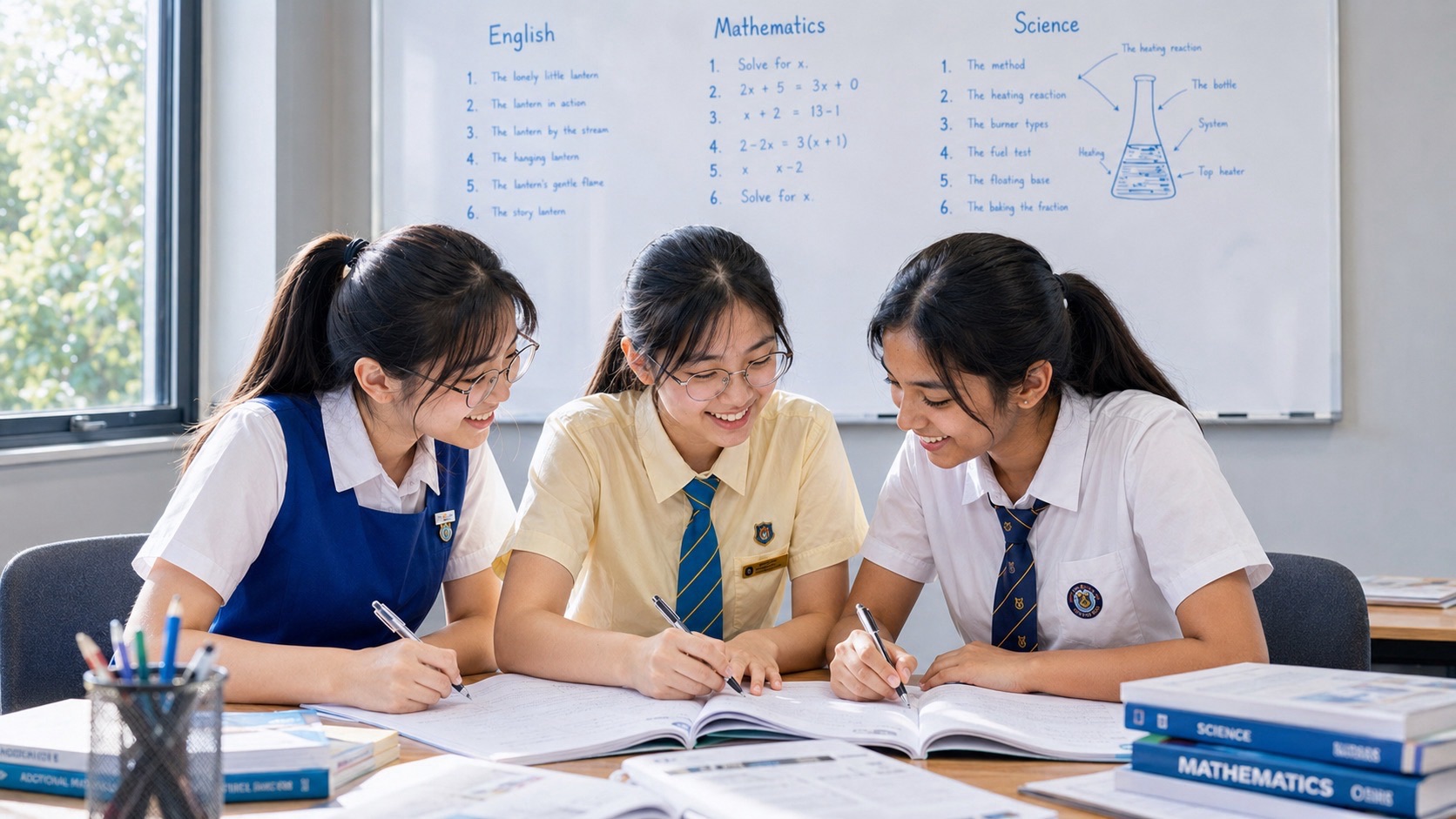
Secondary 2 to Secondary 3 Mathematics is one of the most important transitions in the secondary school years. Parents searching for Secondary 2 Math tuition in Punggol, Secondary 3 Math preparation, Sec 2 to Sec 3 Maths, upper secondary Mathematics tuition or A-Math readiness are usually seeing a shift from lower-secondary foundations into a stage where algebra, graphs, geometry, subject combinations and future SEC preparation begin to matter more sharply.
Secondary 2 should therefore end with more than a final grade. The student should know whether signed numbers, fractions, algebraic manipulation, equations, coordinates, graphs and geometric reasoning are stable enough for upper-secondary work. For some students, Secondary 3 may also introduce Additional Mathematics depending on their school, subject combination and subject level. The transition should be planned around readiness rather than treated as a January surprise.
At eduKatePunggol, Secondary Mathematics is taught in focused groups of up to three students in 1.5-hour lessons near Punggol MRT. The practical transition question is: what must be secure by the end of Secondary 2 so the student can learn Secondary 3 Mathematics instead of spending the year repairing Secondary 1 and 2?
The short answer: Secondary 2 should finish with symbolic control
Before Secondary 3, the student should be reasonably comfortable with:
- signed-number arithmetic;
- fractions and percentages;
- algebraic notation;
- expansion and basic factorisation at the relevant level;
- linear equations;
- coordinates and graphs;
- geometry and measurement;
- data and statistics;
- clear working and checking.
These are not isolated chapters. They are the infrastructure for upper-secondary Mathematics.
Why Secondary 3 feels different
Secondary 3 usually increases the amount of abstraction and the length of mathematical chains.
A student may need to:
- carry algebra across several lines;
- connect equations and graphs;
- use geometry properties more formally;
- manage more complex applications;
- retain older topics while new ones arrive.
The student who survived lower-secondary Mathematics through short-term memorisation often becomes more exposed here.
The first audit: signed numbers and fractions
Many algebra problems that appear to be “Secondary 3 algebra” are actually damaged by weak signed-number or fraction control.
Before moving into harder symbolic work, check whether the student can:
- add and subtract negative numbers;
- multiply and divide signed numbers;
- operate with fractions accurately;
- simplify without losing signs;
- estimate whether a numerical result makes sense.
The second audit: algebraic manipulation
Secondary 3 places more pressure on algebra.
The student should be able to distinguish:
- term;
- coefficient;
- expression;
- equation;
- identity;
- substitution;
- expansion;
- factorisation.
When these words are not conceptually stable, the student may follow a worked example without understanding what kind of object is being manipulated.
The third audit: equations and equality
Students who solve equations by memorising “move across and change the sign” often become fragile as equations become more complicated.
Before Secondary 3, the student should understand that valid transformations preserve equality.
This makes later algebra more coherent and reduces sign errors.
The fourth audit: graphs and coordinates
Upper-secondary Mathematics increasingly connects symbolic and graphical representations.
The student should be able to:
- read coordinates accurately;
- interpret axes and scales;
- connect tables of values to plotted points;
- understand what a graph represents rather than merely draw it.
The fifth audit: working discipline
Upper-secondary questions become harder to debug when working is compressed or disorganised.
The student should develop a habit of:
- one valid line leading to the next;
- clear substitutions;
- visible units where relevant;
- checking high-risk sign changes;
- keeping final answers connected to the question.
Secondary 2 is also the A-Math readiness checkpoint
Some students may be considering Additional Mathematics for upper secondary, depending on school offerings and subject combinations.
The right preparation is not to race through an A-Math textbook.
It is to strengthen algebraic foundations, symbolic fluency, graph interpretation and working discipline.
For a fuller decision guide, read Should My Child Take Additional Mathematics?.
Holiday preparation: repair first, preview second
The Secondary 2 year-end holiday is a useful transition window.
A sensible sequence is:
- review Secondary 2 papers;
- identify repeated weak prerequisites;
- repair signed numbers, fractions or algebra;
- retest after delay;
- preview a small amount of Secondary 3 work once the foundation is stable.
This creates readiness without turning the holiday into Term 1 in advance.
What a three-student transition class can see
- Does the student understand algebra or imitate procedures?
- Do sign errors repeat?
- Can the student start a mixed question without a chapter label?
- Can the student explain a graph?
- Can the student preserve a multi-line solution?
- Does the student recover after one difficult question?
These observations matter more than simply completing next year’s first chapter early.
Frequently asked questions about Secondary 2 to Secondary 3 Mathematics
Should my child start Secondary 3 Math during the year-end holiday?
A light preview can be useful after important Secondary 2 foundations are secure. Repair should come before acceleration.
What is the most important Secondary 2 skill before Secondary 3?
There is no single skill, but symbolic control—signed numbers, fractions, algebra and equations—has unusually high leverage because so much upper-secondary Mathematics depends on it.
Should Secondary 2 tuition focus on A-Math if the student may take it next year?
First strengthen the ordinary Mathematics prerequisites that A-Math will assume. A small preview can follow once those foundations are stable.
Mathematics Tuition in Punggol: Secondary 2 should end with a platform for Secondary 3
Secure number. Secure algebra. Secure equations. Secure graphs. Clean the working. Then add upper-secondary demand.
Families who want to discuss a Secondary 2 to Secondary 3 Mathematics transition plan can WhatsApp eduKatePunggol.
Continue through the Punggol Mathematics route
- Secondary 2 Mathematics Tuition at eduKatePunggol
- Secondary 3 Mathematics Tuition at eduKatePunggol
- Secondary 2 Mathematics in Punggol
- Secondary 3 Mathematics in Punggol
- A-Math Readiness Guide
Explore the Punggol Mathematics reading library for related guides.


