
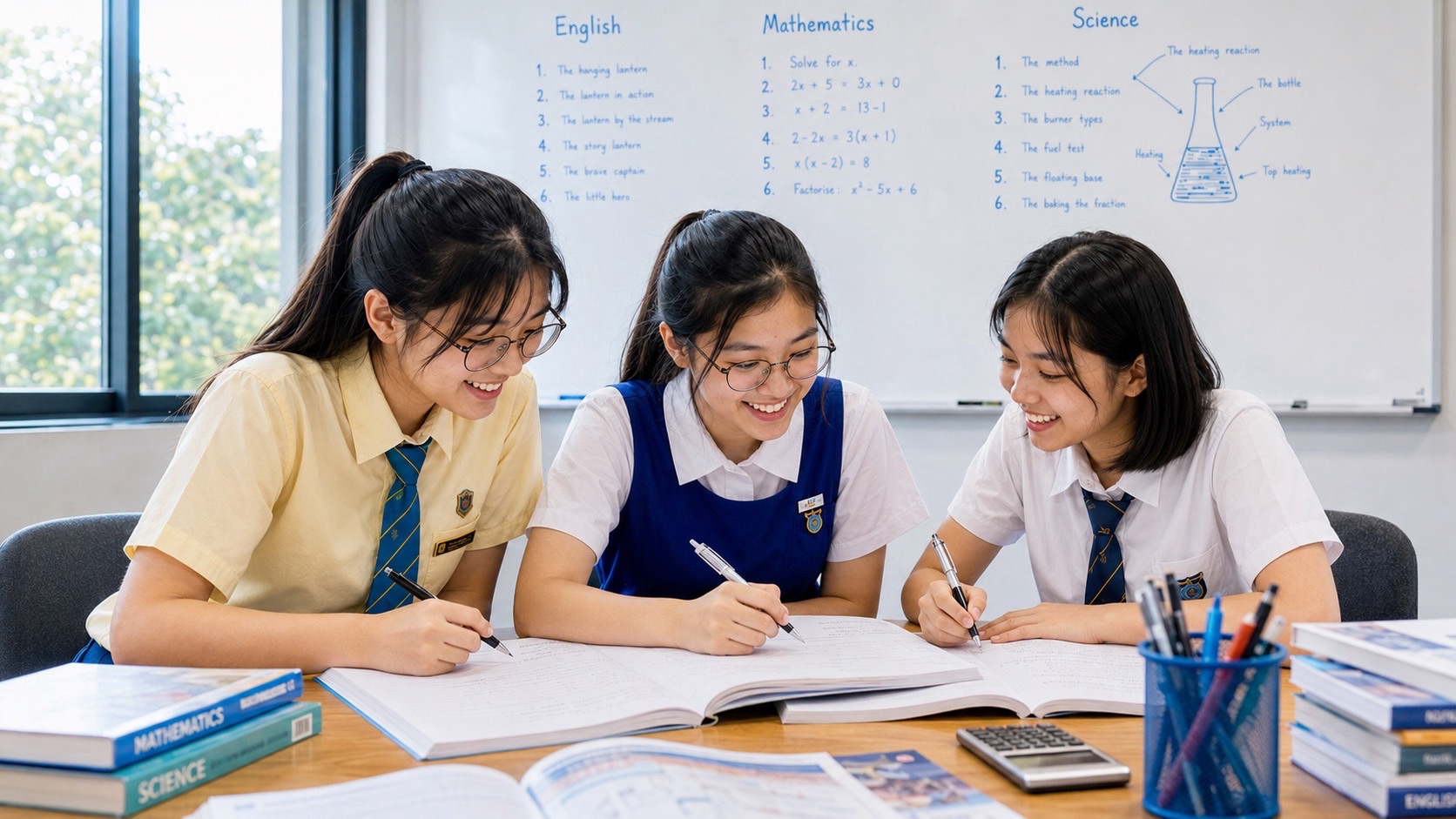
Secondary 2 Mathematics tuition in Punggol for students who can manipulate algebra after an expression is written, but struggle to translate written relationships into algebra in the first place.
This is a language problem inside Mathematics.
“Three more than x”, “three times x”, “three less than x” and “three less than twice x” look similar in English but produce different expressions.
At eduKate Punggol, our premium 3-pax tutorials teach students to identify the quantity, operation and order before simplifying.
This guide supports our main Punggol Secondary 2 Mathematics Tutor hub and extends our multi-step word-problem guide.
Class size is limited to three students. Lessons are normally around 90 minutes weekly, with language decoding, algebraic representation, checking and school-paper alignment.
Arrange a parent–student consultation with eduKate Singapore
Chat with eduKateSG on WhatsApp
Visit the eduKateSG Facebook page
An Expression Describes a Quantity
If x represents a number, “five more than x” is x + 5.
“Five times x” is 5x.
“Five less than x” is x − 5.
The words tell us both the operation and the order.
Worked Example 1: Order Matters
Translate “7 less than x” into algebra.
The starting quantity is x. We take 7 away from it:
x − 7.
The expression 7 − x means x less than 7, which is different.
Worked Example 2: Multiplication Before Addition
Translate “four more than three times x”.
Three times x is 3x.
Four more than that is 3x + 4.
The phrase does not mean 3(x + 4), which would multiply the added four as well.
Brackets Capture a Whole Quantity
Translate “five times the sum of x and 2”.
The whole sum x + 2 is multiplied by 5:
5(x + 2).
Without the brackets, 5x + 2 would describe “two more than five times x”.
Worked Example 3: Consecutive Integers
Let the first integer be n.
The next consecutive integer is n + 1.
The third is n + 2.
So the sum of three consecutive integers can be represented as:
n + (n + 1) + (n + 2).
This can then be simplified to 3n + 3.
Even and Odd Integers Need Structure
An even integer can be represented as 2n for integer n.
A consecutive odd integer can then be written 2n + 2.
An odd integer can be represented as 2n + 1.
The variable n must be understood as an integer parameter in these descriptions.
Worked Example 4: Perimeter From Words
A rectangle has length x + 3 cm and width x cm.
Perimeter = 2(length) + 2(width)
= 2(x + 3) + 2x
= 2x + 6 + 2x
= 4x + 6 cm.
The expression is built from the geometry first, then simplified.
Expressions and Equations Are Different
“Three more than x” gives an expression: x + 3.
“Three more than x is 10” gives an equation: x + 3 = 10.
Students should not add an equals sign unless the wording provides an equality or relationship between two quantities.
Worked Example 5: Build an Equation From a Context
A number is doubled and then 7 is added. The result is 25.
Let the number be x.
Double it: 2x.
Add 7: 2x + 7.
Set it equal to the result: 2x + 7 = 25.
Only after the representation is correct should the student solve the equation.
Use Units and Meaning to Check the Expression
If x is a length in centimetres, x + 3 is also a length.
But x² represents an area-like quantity, not another ordinary length.
Meaning can help detect an expression that is symbolically tidy but contextually wrong.
Five Common Translation Errors
- reversing “less than” order;
- missing brackets around a whole sum or difference;
- confusing “times” with “more than”;
- adding an equals sign when the question only asks for an expression;
- starting to calculate before defining the variable clearly.
Why a 3-Pax Class Helps
One student may understand the language but lose brackets. Another may manipulate algebra confidently but reverse subtraction phrases. A third may form expressions correctly and confuse expressions with equations.
In a class of three, the tutor can ask each learner to explain the sentence before writing symbols.
An Illustrative 90-Minute Lesson
- Define variables in simple contexts.
- Translate addition and subtraction phrases.
- Add multiplication and bracket language.
- Represent consecutive integers.
- Build expressions from geometry.
- Distinguish expressions from equations.
- Finish with an independent multi-step translation problem.
Try Four Questions
- Write “8 more than x” as an expression.
- Write “5 less than twice y” as an expression.
- Write “three times the sum of a and 4” as an expression.
- A number x is tripled and then reduced by 2 to give 19. Write the equation.
Answers: (1) x + 8. (2) 2y − 5. (3) 3(a + 4). (4) 3x − 2 = 19.
What Progress Should Look Like
- The variable is defined before manipulation begins.
- Subtraction order follows the language accurately.
- Brackets preserve whole quantities.
- Expressions and equations are distinguished.
- Words, diagrams and algebra increasingly feel like different representations of the same relationship.
Full Subject-Based Banding and School Scope
Students may take Mathematics at G1, G2 or G3 subject levels, and schools may use different wording complexity.
Use the student’s actual school programme to decide the difficulty of the contexts. The durable skill is translating meaning into symbols without changing the relationship.
Class Details
Format: Premium 3-pax small-group tutorials
Level: Secondary 2 Mathematics
Duration: normally around 90 minutes weekly
Location: 83 Punggol Central, Singapore 828761
Teaching approach: mathematical language, variable definition, brackets, expressions, equations, guided and independent practice, school-paper analysis and transfer.
When Tuition May Not Be Necessary
If your child is already learning independently, retaining earlier work and performing consistently, extra tuition may not be necessary. Tuition is most useful when it solves a visible bottleneck.
What Parents Can Bring to the Consultation
- recent word-problem worksheets;
- a marked school paper;
- examples where the student could solve an equation once someone else wrote it;
- questions containing “less than”, “more than” or bracket language;
- the school’s current topic sequence.
Frequently Asked Questions
Why is “5 less than x” equal to x − 5?
Because x is the starting quantity and 5 is removed from it.
Why are brackets so important?
They show when an operation applies to a whole expression rather than only one term.
How do I know whether to write an expression or equation?
An equation requires an equality relationship. If the task only describes one quantity, an expression may be enough.
Is this just an English problem?
It uses language, but the goal is mathematical representation. Students must preserve the quantitative relationship when moving from words to symbols.
Helpful Reading for Punggol Parents
- Punggol Secondary 2 Mathematics Tutor
- Start Multi-Step Word Problems Without Guessing
- Linear Equations and the Balance Principle
- Expansion and Factorisation
- Punggol Mathematics Article Index
Arrange a Parent–Student Consultation
Bring one question your child understands only after someone translates it into algebra. That usually reveals the exact language-to-symbol bottleneck.
Properly taught kids shine a bright light into the future.


