
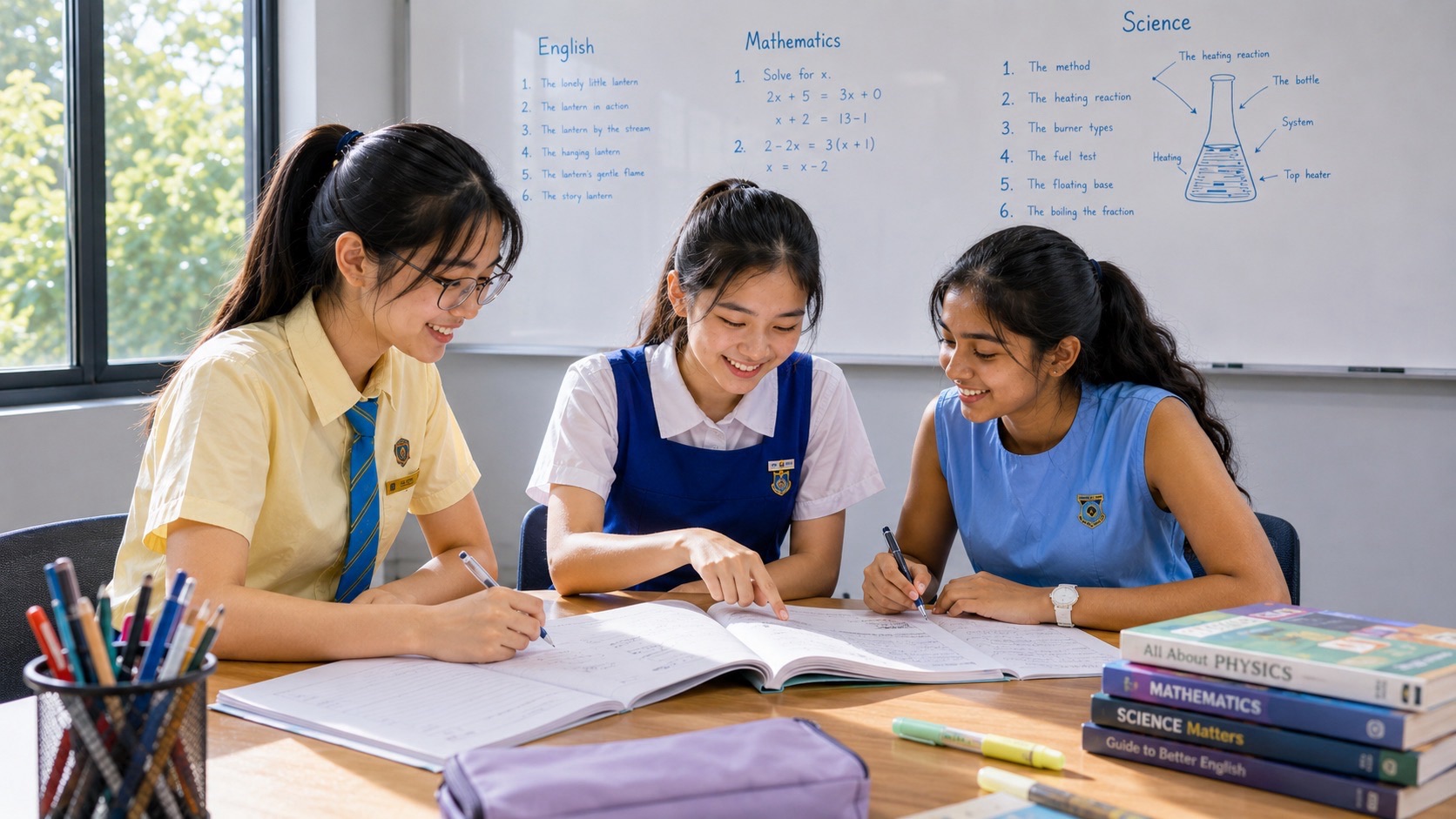
Secondary 2 Mathematics tuition in Punggol for students who can expand brackets or factorise expressions in isolation but still confuse the two movements when questions are mixed.
Expansion and factorisation are closely related.
One opens a product into a sum. The other recognises a common structure and compresses a sum back into a product.
When students see them as reverse operations, algebra becomes much easier to check and organise.
At eduKate Punggol, we teach these ideas inside premium 3-pax tutorials so every student’s symbolic working remains visible.
This article supports our main Punggol Secondary 2 Mathematics Tutor hub and narrows into one important algebra connection: expansion and factorisation as two directions through the same structure.
Class size is limited to three students. Lessons are about 1.5 hours weekly, with first-principles teaching, guided correction, mixed practice and support around school assessments.
Arrange a parent–student consultation with eduKate Singapore
Chat with eduKateSG on WhatsApp
Visit the eduKateSG Facebook page
Expansion and Factorisation Are Opposite Movements
Consider an expression written as a product.
Expansion removes the brackets by applying multiplication to every relevant term.
Factorisation works in reverse. It identifies a common factor or pattern and rewrites the expression as a product.
This reverse relationship is powerful because one method can check the other.
If an expression has been factorised correctly, expanding it should return the original expression.
Why Students Often Learn the Two Topics Separately
Worksheets usually group similar questions together.
That helps while a new procedure is forming, but it can hide an important decision:
Should this expression be expanded or factorised?
In a mixed school paper, the chapter title disappears. The student must identify the structure independently.
That is why method recognition matters as much as execution.
Expansion: One Multiplier Must Reach Every Term
The most common expansion mistake is incomplete distribution.
A student sees a multiplier outside a bracket and applies it to the first term but not the second.
A safer mental sentence is: the outside factor multiplies the entire bracket.
Clear spacing and one algebraic movement per line make this easier to protect.
Negative Signs Make Expansion More Demanding
A negative multiplier changes the sign of every affected term.
Students who rush may preserve the first sign and lose the second.
We therefore slow the sign decision down:
- identify the multiplier;
- identify every term in the bracket;
- multiply coefficient and sign together;
- write the result before combining anything else.
The student becomes faster later because the sign routine becomes automatic.
Factorisation Begins With Structure Recognition
Factorisation is not simply “take something outside”.
The learner must identify what every term has in common.
That common structure may involve:
- a numerical factor;
- a variable;
- a power of a variable;
- a sign choice;
- a repeated algebraic factor.
The factor taken outside must divide every term exactly in the intended algebraic setting.
The Greatest Common Factor Is a Decision Tool
Students often factorise partially because they remove a common factor but not the greatest useful one.
A strong routine checks both number and variable structure.
For example, coefficients may share a common numerical factor while variables share a lower power.
The student should ask what can be removed from every term without changing the expression.
Use Expansion to Check Factorisation
This is one of the most useful Secondary 2 algebra checks.
After factorising, expand the answer mentally or on paper.
If the original expression returns exactly, the factorisation is likely correct.
This reverse-operation check is more reliable than staring at the answer and hoping the signs look right.
Use Factorisation to Understand Expansion
The reverse direction also deepens expansion.
If students know where a product came from, they become less likely to treat brackets as decoration.
They begin to see algebraic expressions as structures that can be opened and closed while preserving value.
This structural view becomes increasingly important before upper-secondary Mathematics.
Six Common Secondary 2 Errors
1. Only the first term is multiplied
The student forgets that the multiplier applies to the entire bracket.
2. A negative sign is lost
The coefficient is multiplied but the sign is not carried correctly.
3. Unlike terms are combined after expansion
The learner simplifies expressions that do not have the same algebraic structure.
4. Only part of the common factor is removed
Factorisation is correct but incomplete.
5. A factor is removed from some terms but not all
The rewritten expression is no longer equivalent to the original.
6. The student does not know which direction to use
Execution is fine, but method recognition is weak in mixed questions.
Why a 3-Pax Class Helps
Expansion and factorisation errors are highly visible in line-by-line work.
- One student may understand distribution but lose signs.
- One may factorise correctly but stop too early.
- One may know both procedures but choose the wrong one when the question is mixed.
In a class of three, the tutor can correct the exact broken movement rather than assign the same generic algebra sheet to everyone.
A 1.5-Hour Expansion–Factorisation Lesson
- Retrieve signed numbers and like terms.
- Expand a clean positive bracket.
- Add negative multipliers.
- Factorise by identifying a common numerical factor.
- Add variable factors.
- Check factorisation by re-expanding.
- Mix expansion and factorisation questions without labels.
- Finish with an unfamiliar application where the student must choose the direction independently.
The goal is recognition plus reliable execution.
From Topical Practice to Mixed Algebra
Once the procedures are secure, students should stop receiving the method from the worksheet title.
Mixed algebra might ask the learner to:
- simplify an expression;
- expand a bracket;
- factorise a sum;
- solve an equation;
- substitute into a formula;
- recognise when factorisation makes a later step easier.
This connects directly to our Secondary 2 transfer guide.
What Progress Should Look Like
- Brackets are expanded completely.
- Negative signs survive distribution.
- Like and unlike terms are distinguished.
- Common factors are identified more systematically.
- Factorisation is checked by expansion.
- The student can explain why the two operations are related.
- Mixed algebra questions cause less hesitation.
- Working becomes shorter without becoming less clear.
Secondary 2 Mathematics Under Full Subject-Based Banding
Students may take Mathematics at G1, G2 or G3 subject levels.
The complexity of expansion and factorisation work should follow the student’s actual Mathematics course and school sequence, while the structural ideas remain valuable across levels.
When Should Parents Pay Attention?
- The child expands only the first term in a bracket.
- Negative signs repeatedly disappear.
- Factorisation is partial or inconsistent.
- The learner cannot explain what was taken outside the bracket.
- The student can do topical worksheets but cannot choose between expansion and factorisation in mixed work.
- Algebra becomes much slower when several steps are combined.
These are signs that the algebraic structure needs strengthening, not simply more speed.
Class Details
Format: Premium 3-pax small-group tutorials
Level: Secondary 2 Mathematics
Subject support: matched to the student’s current Mathematics subject level and school programme
Duration: 1.5 hours weekly
Location: 83 Punggol Central, Singapore 828761
Teaching approach:
- first-principles algebra;
- visible symbolic working;
- expansion–factorisation reversal;
- guided and independent practice;
- retrieval and interleaving;
- school-paper analysis; and
- variation for transfer.
What Parents Can Bring to the Consultation
- recent school papers;
- algebra worksheets;
- examples of sign or bracket errors;
- factorisation questions the student could not finish;
- teacher comments;
- the school’s current topic sequence.
A few real questions usually reveal whether the bottleneck is distribution, signs, factor recognition or method selection.
Frequently Asked Questions
Are expansion and factorisation really opposites?
Yes. Expansion rewrites a product as a sum, while factorisation rewrites a sum or expression structure as a product.
Why should factorisation be checked by expansion?
Because the reverse operation should reproduce the original expression exactly. It is a fast structural check.
Why does my child factorise only part of the expression?
Often because the student sees one common feature but has not learnt to inspect both numerical and variable factors systematically.
When should mixed algebra begin?
After the individual methods are reasonably stable. Mixed practice then trains the student to recognise which method is needed.
Does this matter before Secondary 3?
Yes. Strong symbolic control reduces cognitive load when upper-secondary algebra becomes denser.
Helpful Reading for Punggol Parents
- Punggol Secondary 2 Mathematics Tutor | 3-Student Small-Group Tutorials
- How to Improve Algebraic Expressions, Expansion and Factorisation
- Repair Algebra Before Secondary 3
- Linear Equations, Inequalities and the Balance Principle
- Train Transfer for Unfamiliar Questions
- Punggol Mathematics Article Index
Arrange a Parent–Student Consultation
Bring the algebra lines where the working changes direction. We can usually see whether the issue is distribution, negative signs, common factors or method recognition.
Properly taught kids shine a bright light into the future.


