
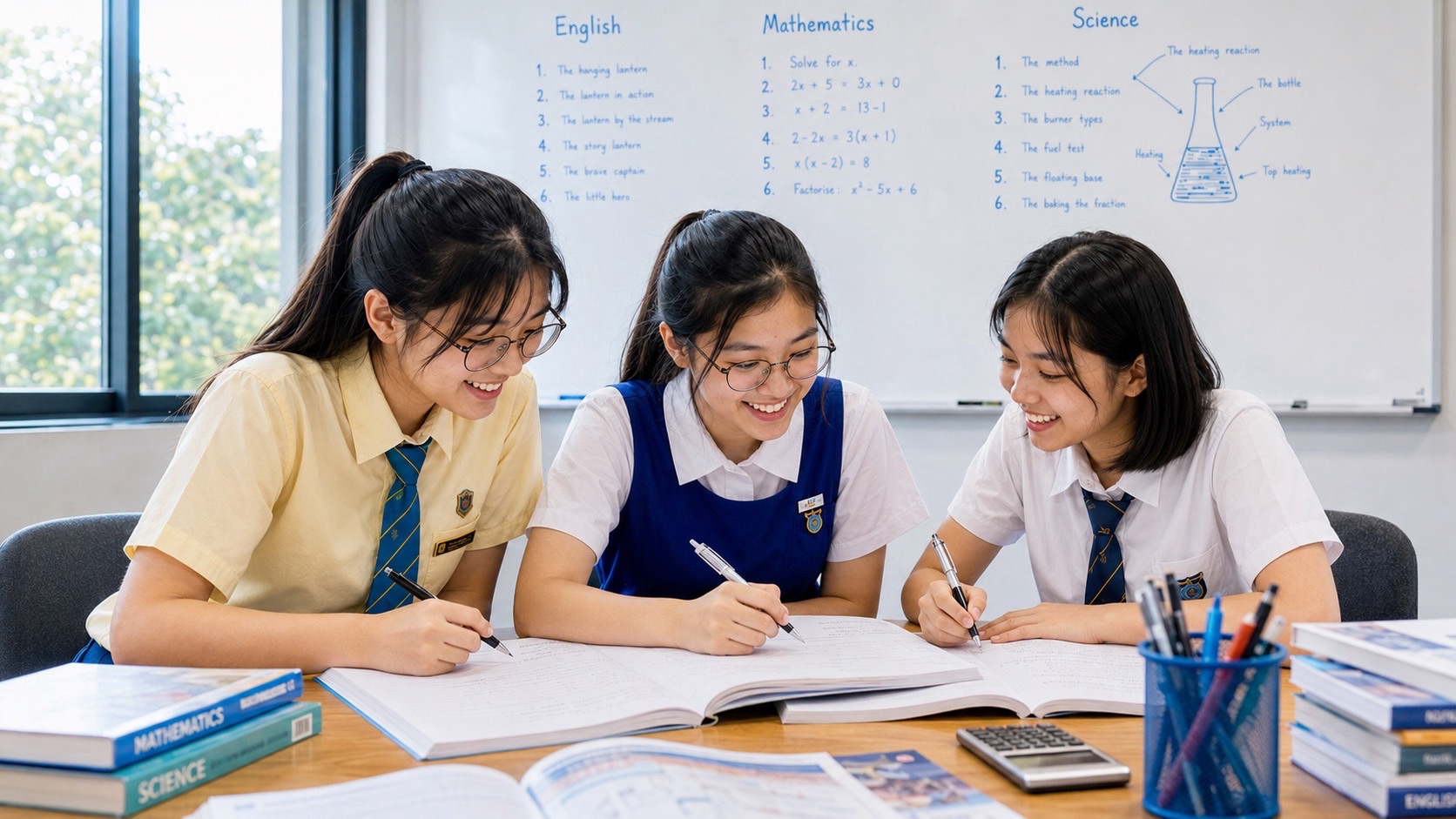
Secondary 2 Mathematics tuition in Punggol for students who have failed, scored poorly or are beginning to feel that Mathematics is moving faster than they can repair.
A low score is useful evidence.
It is not a permanent description of the student.
The important question is not “Why is my child bad at Math?” It is “Where did the mathematical chain first stop carrying the next skill?”
At eduKate Punggol, our premium 3-pax tutorials rebuild from the first weak link rather than blame the student or restart the entire syllabus unnecessarily.
This article supports our main Punggol Secondary 2 Mathematics Tutor hub and focuses on recovery after a weak test, repeated low marks or a growing loss of confidence.
Class size is limited to three students. Lessons are about 1.5 hours weekly, with diagnosis, targeted repair, guided practice and close school-paper alignment.
Arrange a parent–student consultation with eduKate Singapore
Chat with eduKateSG on WhatsApp
Visit the eduKateSG Facebook page
A Failing Score Can Come From One Bottleneck or Several
Two students can both score 45% and need completely different plans.
- One may understand most topics but lose marks through signs, units and time pressure.
- One may have a concentrated algebra weakness that damages several chapters.
- One may know procedures but freeze on mixed questions.
- One may have missed lessons and never rebuilt the sequence.
- One may have weak number foundations that reappear inside Secondary 2 algebra.
The percentage does not tell us which of these is happening.
That is why recovery begins with evidence, not assumptions.
Find the First Weak Link
A useful repair starts from the earliest movement that no longer works reliably.
If a student cannot solve a fraction equation, the problem may be equation balance, fraction control, negative signs or algebraic simplification.
Repairing only the final question type can leave the real weakness untouched.
We therefore trace the solution backward until we find the first unstable skill.
Do Not Restart Everything
A student who fails Secondary 2 Mathematics does not automatically need to relearn every Primary and Secondary 1 topic.
That can be demoralising and inefficient.
A stronger plan is selective:
- identify the current failure pattern;
- test the prerequisite beneath it;
- repair only the prerequisite that is actually weak;
- return to the current Secondary 2 question;
- prove that the repaired skill now carries the larger method.
This keeps recovery connected to what the student is actually learning now.
Separate Concept Problems From Execution Problems
A wrong answer can come from different layers.
Concept
The student does not understand the mathematical relationship.
Method selection
The learner knows several methods but cannot identify which one fits.
Execution
The method is correct but signs, arithmetic, units or calculator input fail.
Assessment control
The student understands but cannot finish, check or sustain accuracy under time pressure.
Recovery becomes much faster when these layers are not mixed together.
Start With One or Two High-Connectivity Repairs
Some Secondary 2 weaknesses affect many topics.
- negative numbers;
- fractions;
- algebraic manipulation;
- equation solving;
- ratio and proportional reasoning;
- graph interpretation;
- clear multi-step working.
Repairing one high-connectivity weakness can improve several chapters at once.
This is usually more useful than trying to raise every topic by the same amount.
Use the Returned Paper as a Map
A weak paper contains valuable information.
We look at:
- which questions were blank;
- where the last correct line appeared;
- which mistakes repeated older patterns;
- which errors were conceptual;
- which were execution;
- where time disappeared;
- whether corrections from earlier tests survived.
For a deeper process, read Turn School Test Papers Into a Repair Plan.
A Six-Week Recovery Cycle
Week 1: diagnose
Identify the main bottleneck and collect evidence from schoolwork.
Weeks 2–3: repair
Rebuild the weak concept with clean examples and close tutor feedback.
Weeks 4–5: reconnect
Put the repaired skill back into current school topics and mixed questions.
Week 6: retest
Use fresh questions to confirm that the repair survives without hints.
If the target is stable, move to the next bottleneck. If not, refine the diagnosis.
Confidence Should Come From Evidence
A student who has been failing does not need empty reassurance.
The learner needs small, visible wins that are mathematically real.
- a question that could not be started last month is now completed independently;
- the same sign error stops repeating;
- homework time becomes shorter;
- a school test contains fewer blanks;
- the student can explain a method that previously felt mysterious.
Confidence becomes stronger when the child can point to evidence of improved capability.
Why a 3-Pax Class Helps Recovery
Recovery requires close observation.
In a large class, a student can copy a method and appear to understand.
In a class of three, the tutor can ask the learner to explain the first step, show the working and attempt a changed question independently.
The class is small enough to repair an individual gap while still giving the student the useful momentum of learning with peers.
A 1.5-Hour Recovery Lesson
- Short retrieval of the prerequisite skill.
- One diagnostic question from the current school topic.
- Repair the first weak movement.
- Guided practice with immediate correction.
- Variation to test whether the student understands rather than copies.
- Mixed application to reconnect the skill to school.
- Independent exit question.
- One manageable continuation task for the week.
The lesson should leave the student with one clearer system, not a larger pile of unfinished work.
What Parents Should Not Do After a Low Score
- Do not label the child as weak in everything.
- Do not buy three new assessment books immediately.
- Do not force full papers before the core bottleneck is repaired.
- Do not treat every mistake as carelessness.
- Do not rush into harder content to escape the uncomfortable chapter.
- Do not compare the child’s recovery speed with another student’s.
Repair is usually faster when the problem is made smaller and more precise.
What Progress Should Look Like
- The student can name the main weakness more accurately.
- Old mistakes repeat less often.
- Homework begins with less resistance.
- Working becomes easier to audit.
- The learner starts mixed questions with less panic.
- Fewer questions are left blank.
- Corrections survive into later work.
- Marks become more stable before they become dramatically higher.
Secondary 2 Mathematics Under Full Subject-Based Banding
Students may take Mathematics at G1, G2 or G3 subject levels.
Recovery should therefore be matched to the learner’s actual Mathematics course and school programme rather than to an old stream label or a generic worksheet sequence.
The objective is to build capability at the correct level and prepare the next stage from a stable base.
When Should Parents Seek Help?
- The same weak pattern has survived several school tests.
- Homework takes very long even with help.
- The student avoids Mathematics or leaves many questions blank.
- Corrections do not change later work.
- The child cannot explain where a solution went wrong.
- School pace is moving ahead while the foundation remains unstable.
Early repair is usually quieter than waiting for several layers of weakness to accumulate.
Class Details
Format: Premium 3-pax small-group tutorials
Level: Secondary 2 Mathematics
Subject support: matched to the student’s current Mathematics subject level and school programme
Duration: 1.5 hours weekly
Location: 83 Punggol Central, Singapore 828761
Teaching approach:
- diagnosis from real school evidence;
- first-principles repair;
- guided and independent practice;
- retrieval and interleaving;
- error analysis;
- school-test alignment; and
- measured rebuilding without blame.
What Parents Can Bring to the Consultation
- recent school tests;
- marked worksheets;
- teacher comments;
- examples of repeated errors;
- questions the student left blank;
- the school’s current topic sequence.
We are looking for the first weak link, not simply the final percentage.
Frequently Asked Questions
Can a failing Secondary 2 student still catch up?
Yes. The key is to diagnose the actual bottleneck and give the repair enough time to stabilise. The size of the gap determines the pace.
Should we restart from Secondary 1?
Only where a Secondary 1 prerequisite is directly affecting current work. We do not repeat an entire year unnecessarily.
Should the student do full papers immediately?
Not if core methods are still unstable. Targeted repair usually comes first, followed by mixed and timed work later.
How quickly should marks improve?
Process improvements often appear first: fewer blanks, cleaner working, fewer repeated errors and better retrieval. Larger score changes may follow over several assessment cycles.
What is the goal before Secondary 3?
A student whose key Secondary 2 foundations are stable enough that upper-secondary learning can build forward instead of spending the first months repairing backward.
Helpful Reading for Punggol Parents
- Punggol Secondary 2 Mathematics Tutor | 3-Student Small-Group Tutorials
- Turn School Test Papers Into a Repair Plan
- Why Careless Mathematics Mistakes Keep Returning
- What to Do Between Weekly Math Lessons
- Secondary 2 to Secondary 3 Mathematics Transition
- Punggol Mathematics Article Index
Arrange a Parent–Student Consultation
Bring the real school evidence. A few papers and worksheets are often enough to show whether the first repair should be algebra, fractions, method selection, accuracy or assessment control.
Properly taught kids shine a bright light into the future.


