
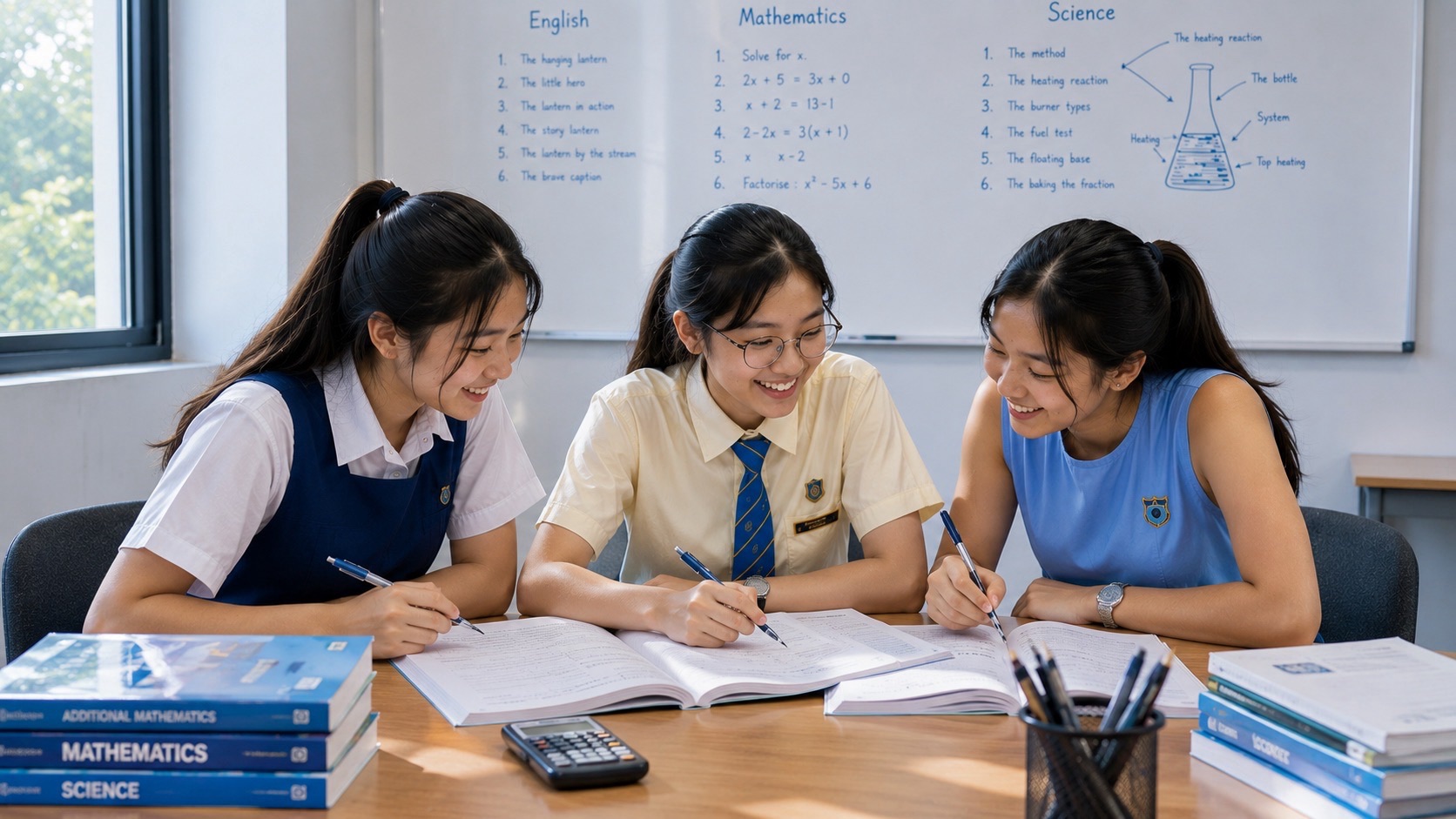
Secondary 2 Mathematics tuition in Punggol for students who can calculate percentages and ratios in familiar worksheets but become uncertain when the same ideas appear inside rates, comparisons, reverse problems and multi-step applications.
Ratio, proportion and percentage are not three separate islands.
They are different ways of describing relationships between quantities.
Once students see that connection, many Secondary 2 word problems become easier to organise.
At eduKate Punggol, we teach these relationships inside premium 3-pax tutorials so each student’s reasoning remains visible.
This article supports our main Punggol Secondary 2 Mathematics Tutor hub and narrows into one important Secondary 2 skill family: ratio, proportion, rate and percentage as connected reasoning.
Class size is limited to three students. Lessons are about 1.5 hours weekly, with clear explanation, guided practice, mixed application and support around school assessments.
Arrange a parent–student consultation with eduKate Singapore
Chat with eduKateSG on WhatsApp
Visit the eduKateSG Facebook page
The Hidden Connection: Ratio, Fraction and Percentage Describe the Same Relationship Differently
A ratio compares quantities.
A fraction expresses one quantity relative to another.
A percentage expresses a fraction out of one hundred.
These are not unrelated techniques. They are different representations of proportional structure.
For example, 1:4, 1/4 and 25% can describe the same underlying relationship in different forms.
Students become stronger when they can move between these forms rather than memorise separate procedures for each chapter.
Why Secondary 2 Students Still Lose Marks on “Easy” Percentage Questions
The arithmetic is often not the hard part.
The difficult part is identifying the reference quantity.
A percentage increase, discount, reverse percentage or comparison problem can all use the same numbers but require different reasoning.
We train the student to ask:
- What quantity is the percentage of?
- Is the question asking for the part, the whole or the percentage?
- Has the reference quantity changed after an increase or decrease?
- Is this a direct calculation or a reverse problem?
- Does the final answer make sense relative to the original amount?
Reverse Percentage Is Really a Relationship Problem
Students often learn forward percentage first: find 20% of a number, then increase or decrease.
Reverse percentage asks the learner to work backward from a changed value to the original.
This is where rote rules become fragile.
The student should understand that the new amount represents a known percentage of the original amount.
Once that relationship is clear, the equation becomes natural rather than mysterious.
Rate: Always Read the Units
Rate compares quantities measured in different units.
Speed, price per item and work rate are familiar examples.
The units tell the story.
If a student writes dollars per kilogram, kilometres per hour or litres per minute, the unit itself helps define what is being compared.
We therefore keep rate units visible instead of treating them as decoration at the final line.
Proportion: Find What Stays Constant
Proportional questions are easier when students ask what relationship remains unchanged.
If cost is directly proportional to quantity at a fixed price, doubling the quantity doubles the cost.
If a scale drawing uses a fixed ratio, every corresponding length follows the same scale factor.
The learner should identify the invariant relationship before choosing a calculation.
Five Common Secondary 2 Ratio and Percentage Errors
1. The wrong base quantity is used
The student calculates a percentage of the wrong whole.
2. Increase and final amount are confused
A 20% increase is not the same as the new amount being 20% of the original.
3. Ratio parts and actual quantities are mixed
The learner treats a ratio number as though it were already a real measurement.
4. Rate units are dropped
The calculation may be correct but the meaning of the answer becomes unclear.
5. Direct and inverse reasoning are confused
The student assumes all relationships scale in the same direction.
A Reliable Word-Problem Routine
- Identify the quantities.
- Write down the relationship between them.
- Mark the reference whole or constant rate.
- Choose the representation: ratio, fraction, percentage, table or equation.
- Calculate one step at a time.
- Check whether the answer is plausible in the original context.
This routine reduces the temptation to hunt for keywords and guess a formula.
Why a 3-Pax Class Helps
Three students may all struggle with the same percentage question for different reasons.
- One cannot identify the base quantity.
- One understands the relationship but makes a decimal conversion error.
- One solves correctly but interprets the final percentage incorrectly.
In a group of three, the tutor can hear each student’s explanation and correct the real cause rather than assign the same extra worksheet to everyone.
A 1.5-Hour Ratio–Percentage Lesson
- Retrieve fraction, decimal and percentage equivalence.
- Use one clean ratio comparison.
- Connect the ratio to a fraction and percentage.
- Introduce a rate with visible units.
- Solve a percentage change question.
- Reverse the same relationship.
- Mix the idea into an unfamiliar context.
- Finish with an independent transfer question.
The student is learning one connected proportional system.
From Routine Calculation to Transfer
Once the basic methods are secure, the chapter label should disappear.
The same proportional relationship may appear in:
- shopping and discounts;
- speed and travel;
- recipes and mixtures;
- scale drawings;
- currency-style comparison;
- population or data change;
- geometry dimensions;
- financial or everyday contexts.
Changing the surface teaches the student to recognise the structure.
For the wider method-selection system, read Train Transfer for Unfamiliar Questions.
What Progress Should Look Like
- The student identifies the reference quantity before calculating.
- Ratios are converted into actual quantities correctly.
- Percentage increase and final amount are kept distinct.
- Reverse percentage becomes a relationship rather than a trick.
- Rate units remain visible.
- Proportional questions are represented in more than one way.
- The learner can explain why the chosen method fits.
- Mixed word problems cause less hesitation.
Secondary 2 Mathematics Under Full Subject-Based Banding
Students may take Mathematics at G1, G2 or G3 subject levels.
The depth of proportional reasoning should follow the student’s actual course and school sequence, while the same core habits remain: identify quantities, identify the relationship, preserve units and check meaning.
When Should Parents Pay Attention?
- The child calculates percentages but cannot explain what the percentage refers to.
- Reverse percentage is memorised as a separate trick.
- Ratio questions work only when they look exactly like textbook examples.
- Rate units are often missing or incorrect.
- Word problems take much longer than routine calculations.
- The student cannot decide whether ratio, fraction or percentage is the best representation.
These are signs that the relationship needs strengthening, not simply more arithmetic drills.
Class Details
Format: Premium 3-pax small-group tutorials
Level: Secondary 2 Mathematics
Subject support: matched to the student’s current Mathematics subject level and school programme
Duration: 1.5 hours weekly
Location: 83 Punggol Central, Singapore 828761
Teaching approach:
- first-principles explanation;
- ratio–fraction–percentage connection;
- rate and unit discipline;
- guided and independent practice;
- retrieval and interleaving;
- school-paper analysis; and
- variation for transfer.
What Parents Can Bring to the Consultation
- recent school papers;
- marked worksheets on ratio, rate or percentage;
- examples of reverse-percentage difficulty;
- teacher comments;
- the school’s current topic sequence;
- word problems the student could not start independently.
We are looking for the relationship that is breaking, not simply the final mark.
Frequently Asked Questions
Why can my child calculate percentages but struggle with word problems?
Because calculation and interpretation are different skills. The learner must identify the reference quantity and relationship before the arithmetic becomes useful.
Is reverse percentage a special formula?
It can be expressed with formulas, but the safest understanding is relational: the known new amount represents a known percentage of the original.
Why are units so important in rate?
The units define what is being compared. They help the student choose, interpret and check the calculation.
How do ratio and fraction connect?
Both describe relative quantities. Moving between ratio, fraction and percentage helps students see the same proportional structure in different forms.
What should be stable before Secondary 3?
Students should identify proportional relationships independently and move between representations without relying on a single memorised worksheet pattern.
Helpful Reading for Punggol Parents
- Punggol Secondary 2 Mathematics Tutor | 3-Student Small-Group Tutorials
- How to Improve Ratio and Proportion
- Train Transfer for Unfamiliar Questions
- Turn School Test Papers Into a Repair Plan
- Secondary 2 to Secondary 3 Mathematics Transition
- Punggol Mathematics Article Index
Arrange a Parent–Student Consultation
Bring the ratio, rate and percentage questions where your child gets stuck. We can usually see whether the issue is arithmetic, reference quantity, units, representation or method selection.
Properly taught kids shine a bright light into the future.


