
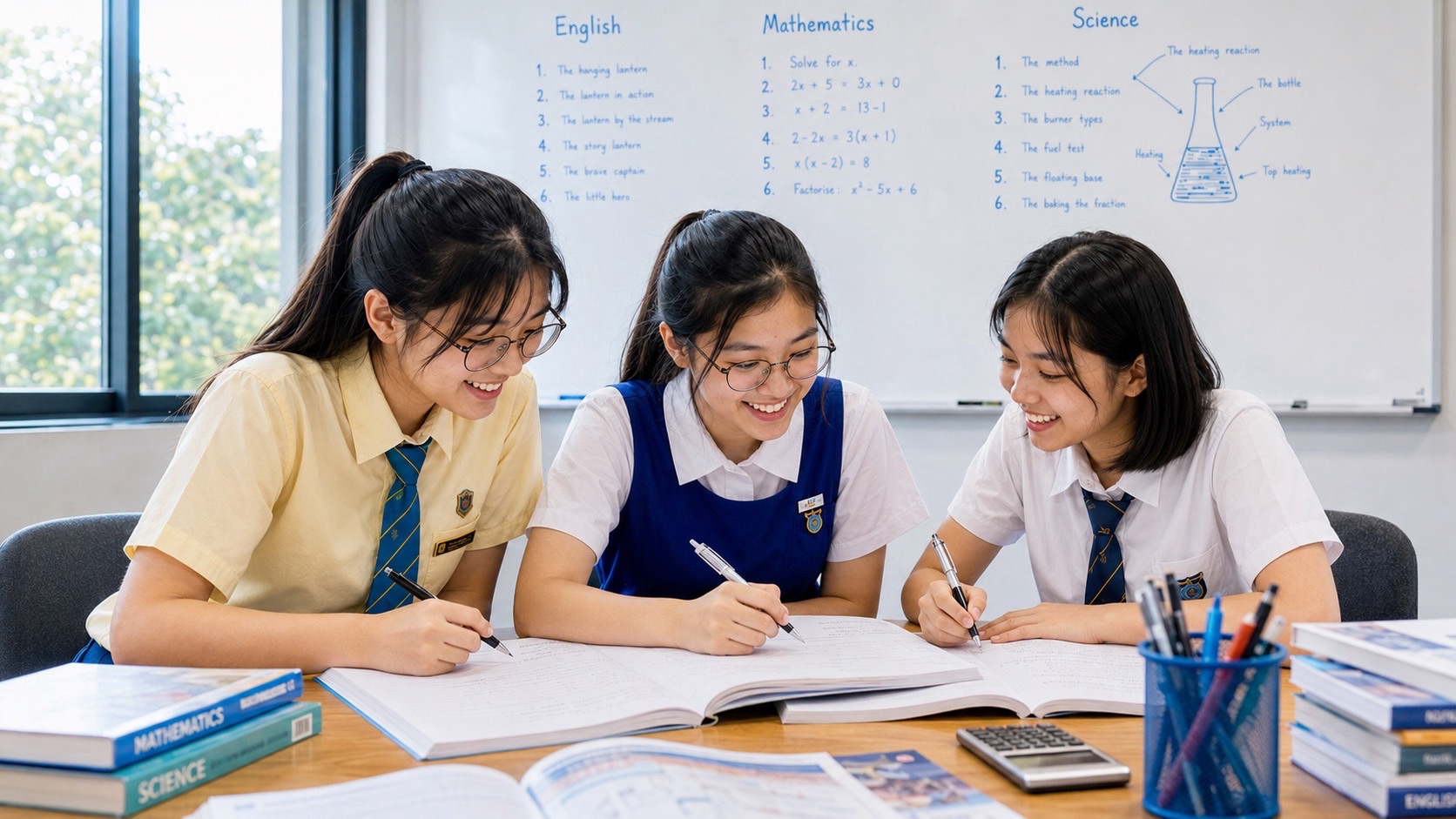
Secondary 2 Mathematics tuition in Punggol for students learning percentage applications such as discounts, profit and loss, percentage change and simple interest where these topics appear in their school Mathematics programme.
These questions are not difficult because the arithmetic is exotic. They are difficult because students must identify the correct base quantity.
A 20% discount is 20% of the original price. A 15% profit is usually measured against cost price unless the question defines another base. Simple interest uses the principal as the repeated annual base.
At eduKate Punggol, our premium 3-pax tutorials train students to name that base before calculating.
This guide supports our main Punggol Secondary 2 Mathematics Tutor hub and connects to ratio, rate, proportion and percentage.
Class size is limited to three students. Lessons are normally around 90 minutes weekly, with worked examples, reverse percentage, interpretation and school-paper alignment.
Arrange a parent–student consultation with eduKate Singapore
Chat with eduKateSG on WhatsApp
The Base Quantity Controls the Percentage
Before calculating, ask: percentage of what?
The same 20% can produce different numerical amounts depending on the base.
If a $160 item is discounted by 20%, the discount is 20% of $160, not 20% of the final price.
Worked Example 1: Discount
An item costs $160 before a 25% discount.
Discount = 25% of 160 = 0.25 × 160 = $40.
Sale price = 160 − 40 = $120.
A faster equivalent method is 75% of 160 = 0.75 × 160 = $120.
Both methods are valid because the final price is 75% of the original.
Worked Example 2: Profit Percentage
A shop buys an item for $80 and sells it for $92.
Profit = 92 − 80 = $12.
Profit percentage based on cost price = 12/80 × 100% = 15%.
The denominator matters. Using 92 as the base would answer a different question.
Worked Example 3: Percentage Loss
An item bought for $250 is sold for $225.
Loss = 250 − 225 = $25.
Loss percentage = 25/250 × 100% = 10%.
The loss is measured relative to the original cost in this standard setup.
Successive Percentage Changes Do Not Simply Add
Suppose a $200 item receives a 10% discount followed by another 20% discount.
After the first discount: 200 × 0.90 = $180.
After the second discount: 180 × 0.80 = $144.
The total reduction is $56, which is 28% of $200.
It is not a 30% discount because the second 20% is taken from a new base of $180.
Reverse Percentage Works Backward From the Final Amount
An item costs $96 after a 20% discount. Find the original price.
After a 20% discount, the final price is 80% of the original.
0.8 × original = 96.
original = 96 ÷ 0.8 = $120.
The student should understand the relationship rather than memorise a special “reverse percentage formula”.
Simple Interest Uses a Fixed Principal Base
Where simple interest is part of the student’s school programme, the common relationship is:
I = Prt
where I is interest, P is principal, r is the annual rate written as a decimal, and t is time in years.
The word simple means the interest is calculated from the original principal rather than from a growing balance.
Worked Example 4: Simple Interest
A principal of $1,200 earns simple interest at 3% per year for 2.5 years.
I = 1200 × 0.03 × 2.5 = $90.
Final amount = 1200 + 90 = $1,290.
The rate 3% must be written as 0.03 in the multiplication.
Do Not Confuse Simple and Compound Growth
Simple interest repeatedly uses the same principal base.
Compound growth changes the base as interest is added to the balance.
If a question asks for compound interest or repeated percentage growth, use the method specified by the school and question. Do not apply the simple-interest formula automatically.
Worked Example 5: Percentage Increase
A fee rises from $240 to $270.
Increase = 270 − 240 = $30.
Percentage increase = 30/240 × 100% = 12.5%.
The original amount is the base because the question asks how much the value increased relative to where it started.
Five Common Financial-Mathematics Errors
- using the final price as the base for a discount on the original price;
- confusing profit amount with profit percentage;
- adding successive percentage discounts directly;
- forgetting to convert a percentage rate into a decimal for multiplication;
- using simple interest when the question describes a different growth process.
Why a 3-Pax Class Helps
One student may calculate the percentage correctly but choose the wrong base. Another may know discount problems but fail reverse percentage. A third may understand both and confuse the time unit in a simple-interest question.
A three-student tutorial lets the tutor diagnose the relationship before assigning more arithmetic practice.
An Illustrative 90-Minute Lesson
- Retrieve percentage of a quantity.
- Identify the base in discount and profit questions.
- Solve direct discount and profit problems.
- Reverse a percentage relationship.
- Compare one successive-change example.
- Introduce simple interest where it is in scope.
- Finish with an independent mixed application.
Try Four Questions
- A $300 item is discounted by 20%. Find the sale price.
- An item costs $120 and is sold for $138. Find the profit percentage based on cost price.
- A price becomes $84 after a 30% discount. Find the original price.
- Find the simple interest on $2,000 at 2.5% per year for 3 years.
Answers: (1) $240. (2) Profit = $18, so 15%. (3) $120. (4) $150.
What Progress Should Look Like
- The student names the percentage base before calculating.
- Discount amount and final price are distinguished.
- Profit amount and profit percentage are kept separate.
- Successive percentage changes use the updated base.
- Reverse percentage is solved as an equation or proportional relationship.
- Simple-interest time and rate units are handled consistently.
Full Subject-Based Banding and School Scope
Students may take Mathematics at G1, G2 or G3 subject levels, and schools can sequence financial percentage applications differently.
Use the student’s actual programme to decide whether simple interest or particular applications are current. The durable skill is identifying the base and preserving the percentage relationship.
Class Details
Format: Premium 3-pax small-group tutorials
Level: Secondary 2 Mathematics
Duration: normally around 90 minutes weekly
Location: 83 Punggol Central, Singapore 828761
Teaching approach: percentage-base identification, proportional reasoning, worked examples, reverse percentage, guided and independent practice, school-paper analysis and carefully paced extension.
What Parents Can Bring to the Consultation
- recent percentage or financial-mathematics worksheets;
- a marked school paper;
- examples where the student chose the wrong base;
- reverse-percentage questions;
- the school’s current topic sequence.
Frequently Asked Questions
Why is profit percentage usually based on cost price in these examples?
Because the standard calculation compares the profit with the amount originally invested in the item. Always follow the question’s stated definition if it uses another base.
Why don’t two discounts of 10% and 20% make 30%?
The second percentage is applied to the already-reduced price, so the base has changed.
Is reverse percentage just dividing by the remaining percentage?
That is the calculation, but understanding why is important: the final amount represents a known fraction or percentage of the original.
When is tuition useful?
When the student can calculate percentages but repeatedly chooses the wrong base or cannot transfer the idea into unfamiliar contexts. A student already doing this independently may not need extra tuition.
Helpful Reading and Next Step
Continue with ratio, rate, proportion and percentage, multi-step word problems, and rounding and answer form.
The objective is not to memorise a shopping formula. It is to identify the base, translate the percentage relationship and check whether the result makes sense. Discuss your child’s current Mathematics work with eduKate Punggol.


