
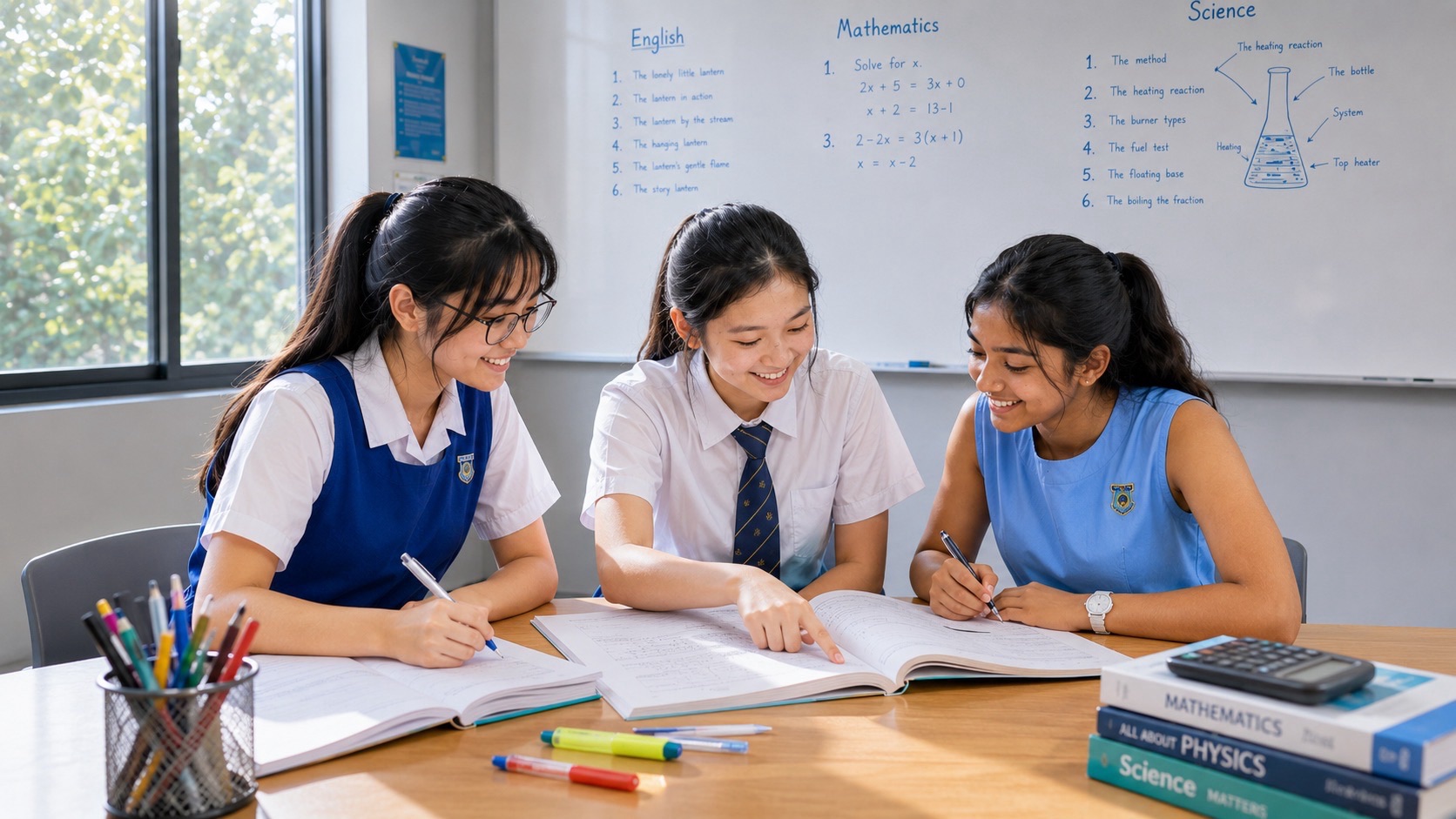
The syllabus is important because it gives students a structured route. But Science does not end at the edge of the syllabus.
Advanced learners eventually need to ask their own questions, read beyond the textbook, compare sources, test explanations and use new tools responsibly.
Today, one of those tools is artificial intelligence. AI can generate explanations, code, summaries, graphs, possible experiments and even hypotheses. That makes Science learning more powerful—but only if the student keeps control of evidence and judgement.
This article extends the long-horizon ideas in From SEC Science to JC, Polytechnic, University and the Future.
Research Begins With a Better Question
Weak research starts with “tell me everything about electricity.” Stronger research starts with a bounded question such as “how does wire length affect resistance when material and cross-sectional area are controlled?”
A good question narrows the field enough that evidence can answer it.
Search Is Not Understanding
Students can find information quickly. The harder skill is deciding what deserves trust.
- Who produced the source?
- What evidence is provided?
- Is the explanation consistent with established science?
- Are units, graphs and definitions correct?
- Does another reliable source agree?
- Is the claim stronger than the evidence?
These questions matter whether the source is a textbook, website, video, research article or AI response.
AI Should Be an Assistant, Not an Authority
AI is useful for generating examples, explaining vocabulary, proposing alternate representations, checking a calculation path or suggesting questions to investigate.
But students should not accept an AI answer merely because it sounds fluent. A confident sentence can still be scientifically wrong.
The scientific habit remains the same: verify against evidence, established relationships, reliable references and the actual conditions of the problem.
A Safe AI Science Workflow
- Ask a clear, bounded question.
- Request the reasoning or model behind the answer.
- Check units, definitions and equations.
- Compare with the textbook or reliable reference.
- Test the idea using an example or calculation.
- Identify what assumptions the answer made.
- Rewrite the explanation in your own words.
- Record what you now understand that you did not understand before.
The purpose is not to produce homework faster. It is to make thinking more visible.
Local Research in Punggol
Punggol gives students many project questions that can be explored safely and observationally.
- How do shaded and unshaded surfaces differ in temperature?
- How does sound intensity vary with distance in an open area?
- How do different surfaces affect water runoff after rain?
- What plant species appear in different local microhabitats?
- How does light intensity change across indoor and outdoor spaces?
- How do travel times vary by route or time of day?
The point is not to produce publishable research. It is to practise asking, measuring, recording, comparing and explaining.
Use Punggol Science Inquiry as a local starting point.
Projects Should Build Capability
A project is valuable when the student learns something transferable: how to define a variable, design a method, collect data, create a graph, interpret anomalies, write a conclusion or present a result.
A beautiful model with no understanding is less valuable than a modest investigation that the student can explain completely.
Research Connects Science to English and Mathematics
Reading sources uses English. Quantifying evidence uses Mathematics. Presenting a conclusion uses vocabulary, structure and logic. Science projects therefore naturally activate the wider eduKate ecosystem.
This is one reason project work can be powerful when it is designed carefully.
Beyond the Syllabus Does Not Mean Random
Extension should still have structure. The student can move one step beyond the current topic rather than jumping ten levels ahead.
| Current topic | Useful extension |
| Forces | friction, drag, centre of mass, stability |
| Cells | surface area-to-volume ratio, membranes, transport |
| Acids and bases | titration, indicators, concentration |
| Electricity | power, energy use, semiconductors |
| Waves | Doppler effect, polarisation, electromagnetic applications |
This keeps extension connected to the learner’s current knowledge.
The Future Is Interdisciplinary
The world students enter will mix Science with computing, engineering, health, environmental systems, design and AI.
That makes SIT and Punggol Digital District especially relevant as a local reminder that future capability often sits between traditional school subjects.
Students do not need to predict one career. They need the ability to learn across boundaries.
Robustness Matters
The best future-ready student is not one who needs a tutor, textbook or AI tool for every step. It is a learner who can continue when support is reduced.
That connects directly to Learning for Robustness Thinking: build capability that still works when conditions change.
A Strong Advanced Science Student Can
- ask a useful question,
- find trustworthy information,
- use AI carefully,
- build or select a model,
- measure and calculate,
- interpret evidence,
- challenge an explanation,
- write clearly,
- revise an idea,
- and continue learning independently.
The Journey So Far
- Curiosity → evidence → models → explanations.
- Lower Secondary Science → Physics, Chemistry and Biology.
- Experiments → data → graphs → practical reasoning.
- SEC → JC/polytechnic → university → future capability.
- Connections across Physics, Chemistry and Biology.
- Mathematics inside Science.
- Scientific reading and writing.
Return to the Punggol Science Tuition hub for the wider local Science pathway.
Closing
Advanced Science is not simply harder Science. It is better organised curiosity.
The learner asks more precise questions, uses stronger models, handles evidence more carefully and becomes more independent over time. AI can accelerate that journey, but it cannot replace the student’s responsibility to decide what is true, what is uncertain and what should be tested next.


