
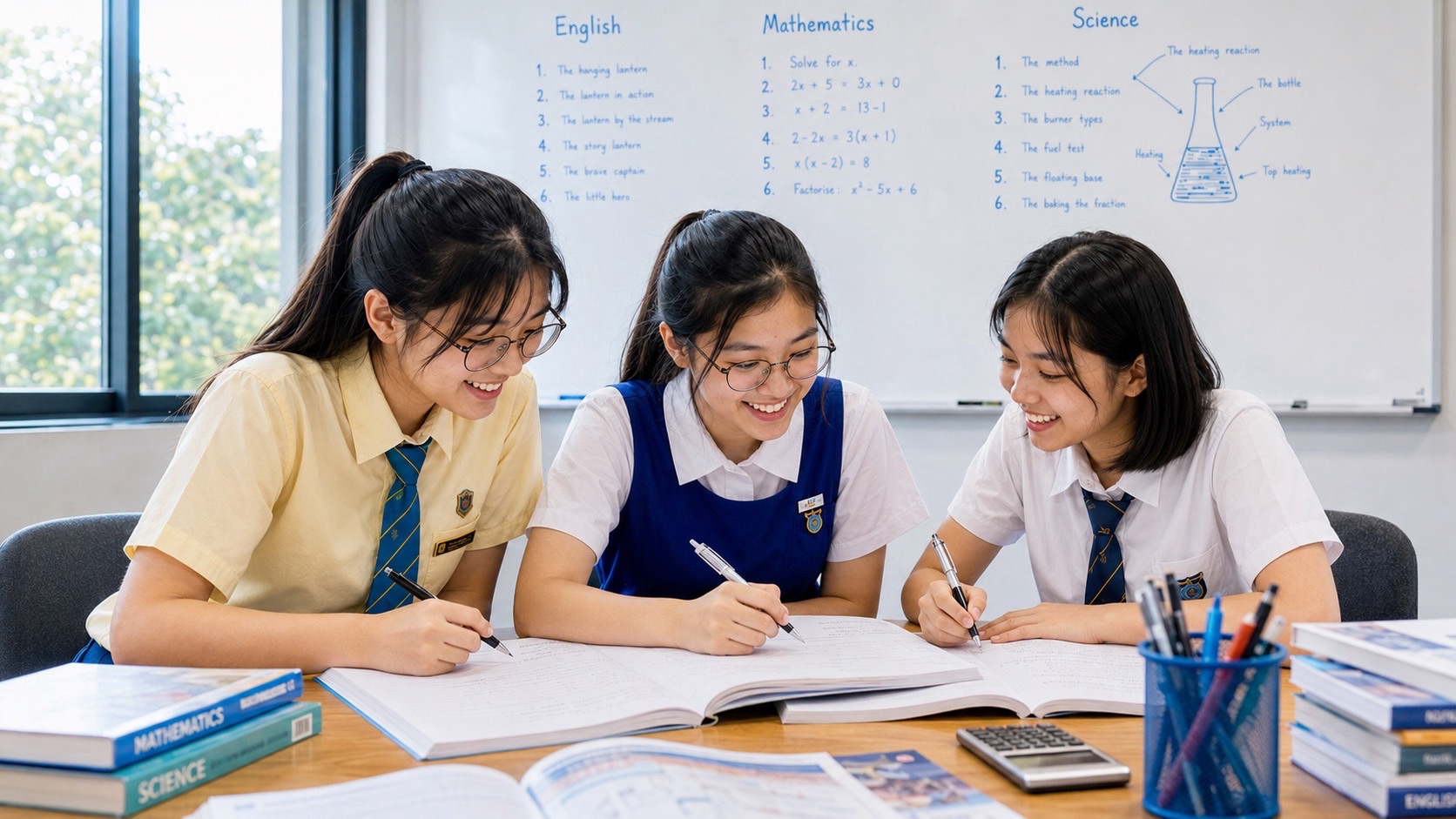
Why can Additional Mathematics feel easy in tuition but hard when studying alone? The explanation is often not that the student suddenly forgot everything. Tuition provides structure that independent work removes: the topic is known, a tutor is present, examples are recent, hints arrive quickly, and mistakes are corrected before they grow. When the student sits alone with a mixed question, all of those supports disappear at once.
For the 2027 SEC G3 Additional Mathematics route, this gap matters because the examination requires students to identify relevant concepts, connect topics and produce reasoning independently. A learner who can follow a strong explanation but cannot generate the first step still has an independence gap.
At eduKate Punggol, Mathematics tutorials are held at 83 Punggol Central, Singapore 828761, near Punggol MRT and Waterway Point, in small groups of up to three students. Small groups help because the tutor can fade support deliberately instead of allowing a student to remain permanently carried by the lesson.
Support can hide a retrieval problem
A student may recognise a method immediately after the tutor starts it and conclude, “I knew that.” Recognition is easier than retrieval. Independent study requires producing the method from memory without the cue.
The cure is not more explanation alone. It is closed-book retrieval after the explanation.
Support can hide a method-selection problem
In tuition, the class may already know the chapter. At home or in tests, the student must decide whether a question is about a discriminant, a function, a trigonometric identity, a tangent, an integral or something else.
That decision is part of the mathematics.
Support can hide a first-step problem
Some students can execute ten lines perfectly once the first line is supplied. The weak point is not the whole solution; it is starting.
Train the student to answer three questions before asking for help: What is the target? What do I know? What relationship could connect them?
Support can hide weak error recovery
In tuition, the tutor notices a wrong sign quickly. Alone, the student may continue for half a page before recognising the route has failed.
Independent Mathematics requires monitoring as well as solving.
The support-fading ladder
- Tutor models the method.
- Student completes a similar question with prompts.
- Student completes a fresh question with only a metacognitive prompt.
- Student completes a changed-surface question without help.
- Student completes a mixed question under time.
- Student retests the same mechanism after several days.
The goal is not to remove support instantly. It is to reduce it systematically.
Use the two-minute start rule
Before asking for help, the student spends two focused minutes writing the target, givens and one plausible relationship. This prevents automatic dependence without forcing unproductive struggle for too long.
Use delayed retests
Same-day independence can be misleading because the explanation is still fresh. Retest two or three days later.
If the route disappears, the method has not yet become independently retrievable.
Use changed-surface questions
Do not retest with an almost identical question. Change wording, diagram, parameter or context while preserving the same mathematical relationship.
This separates genuine understanding from memory of layout.
The tuition-to-solo bridge
- Lesson: understand the method.
- After lesson: retrieve the core condition without notes.
- Next day: solve one fresh question.
- Midweek: solve one changed-surface question.
- Before next lesson: solve one mixed question and record where help is still needed.
The student should arrive at tuition with evidence
Instead of “I don’t understand A-Math,” bring one or two questions showing the first point of failure. That lets tuition target the mechanism rather than repeat an entire chapter.
How to measure support dependence
- Number of hints needed per question.
- Whether the student can start without being told the topic.
- Performance with notes open versus closed.
- Performance same day versus several days later.
- Performance topical versus mixed.
- Performance untimed versus timed.
How to know the gap is closing
- The student begins more questions independently.
- Questions for the tutor become more specific.
- Hints can be less direct.
- Fresh home questions work after a delay.
- School-test performance moves closer to tuition performance.
- Wrong routes are abandoned earlier.
Continue the Mathematics Improvements in Punggol lane
- Stop Forgetting A-Math Between Lessons.
- Review A-Math Tests So Mistakes Do Not Return.
- What to Do Between Weekly A-Math Tuition Lessons.
- Become Independent in A-Math Without Waiting for Hints.
When A-Math feels easy in tuition but hard alone, the missing layer is usually not more explanation. It is the transfer from supported understanding to independent retrieval, method selection, self-monitoring and delayed performance. Tuition should deliberately build that bridge.
Official reference: SEAB 2027 SEC G3 Syllabuses.
Continue Through the Mathematics System
Explore the Punggol Mathematics reading library for related guides.


